Beginner's Guide: How Merkle Trees Verify Whether a CEX Has 100% Reserves
Everyone is likely aware of the incident where a leading exchange's liquidity dried up, triggering panic across the entire industry.
After the incident was exposed, exchanges纷纷 issued statements that they would publicly share auditable Merkle Tree reserve proofs to demonstrate the platform's asset status to users and ensure information transparency. Among them was OKX exchange, which was the first to step forward.
Some professional investors believe that this simultaneous move by CEXs can, to a certain extent, serve as a reserve proof system for the blockchain world.

So, what is the reserve proof system in the traditional world? Why is it important? What does it mean for users after the blockchain world adopts this system? We've covered this before—interested readers can click "Reserve Proofs Become Industry Standard, OKX Drives Change."
But what exactly is a Merkle Tree, and how does it help CEXs prove their innocence? What operational logic does this obscure computer science term actually correspond to?
While this topic is being widely discussed, OKX Academy will use the most accessible language and simplest logic to take you through it. Of course, to explain this major question well to new users, we need to break down a series of smaller questions layer by layer. Let's look at them one by one.
1. First, Key Point: User Principal Deposited on Exchanges Is Actually the Exchange's Liability
Many users have a habit of storing assets on centralized exchanges, after all, the vast majority of our asset buying and selling happens on exchanges, making the cost and time of switching back and forth much lower.
But what many users may overlook is that the assets we store on exchanges—the principal intended for investment—are actually the exchange's liability.
When we urgently need to withdraw, the exchange must fully honor the withdrawal, and the faster the better. This is also the most intuitive indicator for judging an exchange's operational status and credibility.

Therefore, the fundamental reason behind many exchange blowups in the past is that they couldn't honor users' principal—plainly speaking, they ran out of money and fell into insolvency. But users are often unaware of this because they can't know how much money the CEX has left or how much users have deposited on the platform in total. If total reserves > total liabilities, the platform is proven safe; otherwise, it's full of risks.
At this point, CEXs need to proactively disclose both amounts.
According to the Merkle Tree asset verification logic, exchanges first need to disclose their total reserves, and this must be the total amount of on-chain assets. Because of the special properties of being on-chain, the exchange cannot fake it, and the total reserve amount is completely authentic. However, how to prove the total liability amount becomes a difficult problem.
Large exchanges often have tens of millions of users, and each user's deposit amount varies widely with huge gaps. Any miscalculation or omission, even by a tiny amount, will cause deviations in the results, affecting the transparency of the CEX's asset security. For CEXs, they need to ensure that every user's assets are correctly counted in the total liabilities, and even be able to reconcile with users during the audit process, to ensure everyone's peace of mind and satisfaction.

So, the hardest problem is actually how to accurately calculate the exchange's liabilities. Only Merkle Trees can play a decisive role at this time.
2. Merkle Tree: A Data Verification Process That Looks Like an Upside-Down Tree
First, let's explain what a Merkle Tree is.
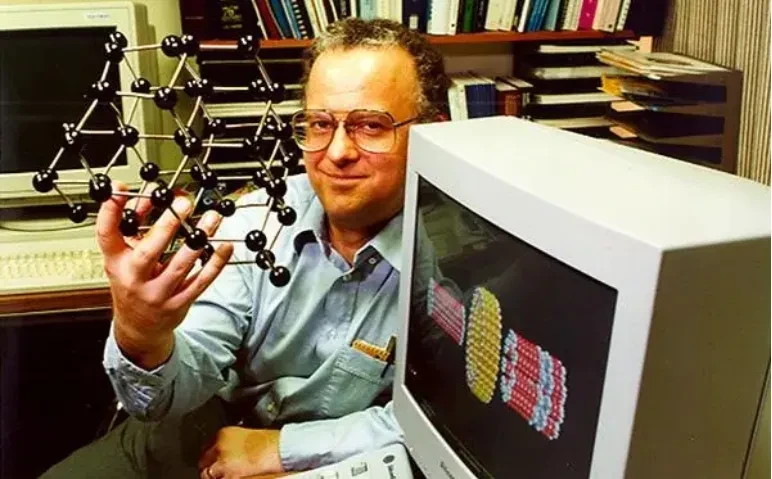
It's a tree-structured data processing system designed to verify data integrity and accuracy, and is considered an important form of blockchain technology. The name comes from its inventor, scientist Ralph Merkle (Stanford professor, one of the founders of public-key cryptography), and its shape resembles an upside-down tree.
We all know that blockchain is a network system where all nodes can participate in data processing. This is its fundamental difference from the traditional internet, where data calculation, transmission, and storage are all handled by centralized nodes. This determines that the former's efficiency is far lower than the latter.
Therefore, current blockchain technology applications mainly focus on recording transaction information. For example, the original Bitcoin system primarily handled peer-to-peer electronic transfer issues. Blockchain is thus called distributed ledger. The special nature of this ledger is that any slight data change can have a malignant impact on the system, because it's collectively maintained by all nodes—affecting one part affects the whole.
Thus, to ensure no errors occur, an extremely rigorous, highly precise data processing system like Merkle Tree is needed. Merkle Tree's processing approach is to hierarchicalize all data processing flows—that is, divide all nodes into layers, and in the process of transmitting results upward layer by layer, verification between preceding and succeeding nodes is required. If verification fails, it cannot continue to the next step, indicating data falsification.
We see that Merkle Tree is shaped like an upside-down tree because it's a top-down data verification process. If data grows explosively, it corresponds to the tree branching out, but the root remains only one and grows thicker. To understand it visually, the information covered by the root data becomes richer as system data accumulates.
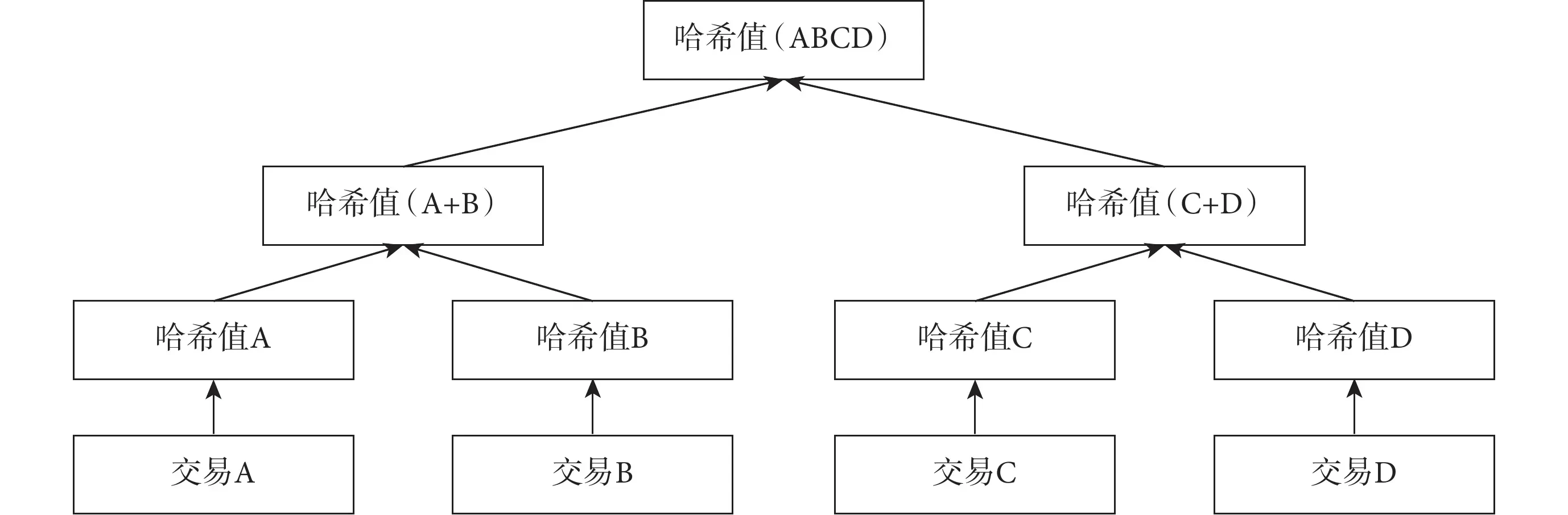
So, as node layers become more complex and systems larger, will data be missed and accuracy compromised? To address this, Merkle Tree uses hash algorithms.
A simple explanation: hash algorithm is the process of encoding all data files into unique characters. This character is called a hash value, composed of a mix of letters and numbers. The data file is what we commonly call a block. Whenever a block's data content changes, the hash value also changes accordingly. It can be said that the hash value is the block's identity proof.
In blockchain systems, hash algorithms link all blocks before and after, forming a chain-like network. For two major blocks to connect, they first need to verify hash values. If the hash value is wrong or missing, calculation stops and the network cannot update. In Merkle Tree systems, any anomaly in any link's hash value is like a misplaced branch and is quickly detected. It's worth noting that each node's hash value is made public for reverse-retrieving the data involved in the corresponding process, similar to a statement.
In such an extremely intricate, tightly interlocked data structure, every user's or node's data directly affects the overall data—that is, changes in the root data. However, if the calculation process starts, there will be no errors or omissions.
3. The Validator for Whether Exchanges Have Enough Money and Correct Accounts
After introducing the background and terminology, readers should more easily understand why CEXs using Merkle Trees can prove total liability data is authentic and credible. When Merkle Trees are introduced, each user's account is a node, and the funds amount in the account is the node's data. The total assets of all accounts calculated through Merkle Trees is the authentic total liability of the CEX.
Additionally, CEXs can provide users with their account's asset amount at the time of statistics, as well as all node hash values from their Merkle tree to the root node. This way, users can confirm their assets are included in this statistic, with no omitted calculations, though the process may be relatively cumbersome and complex for everyone.
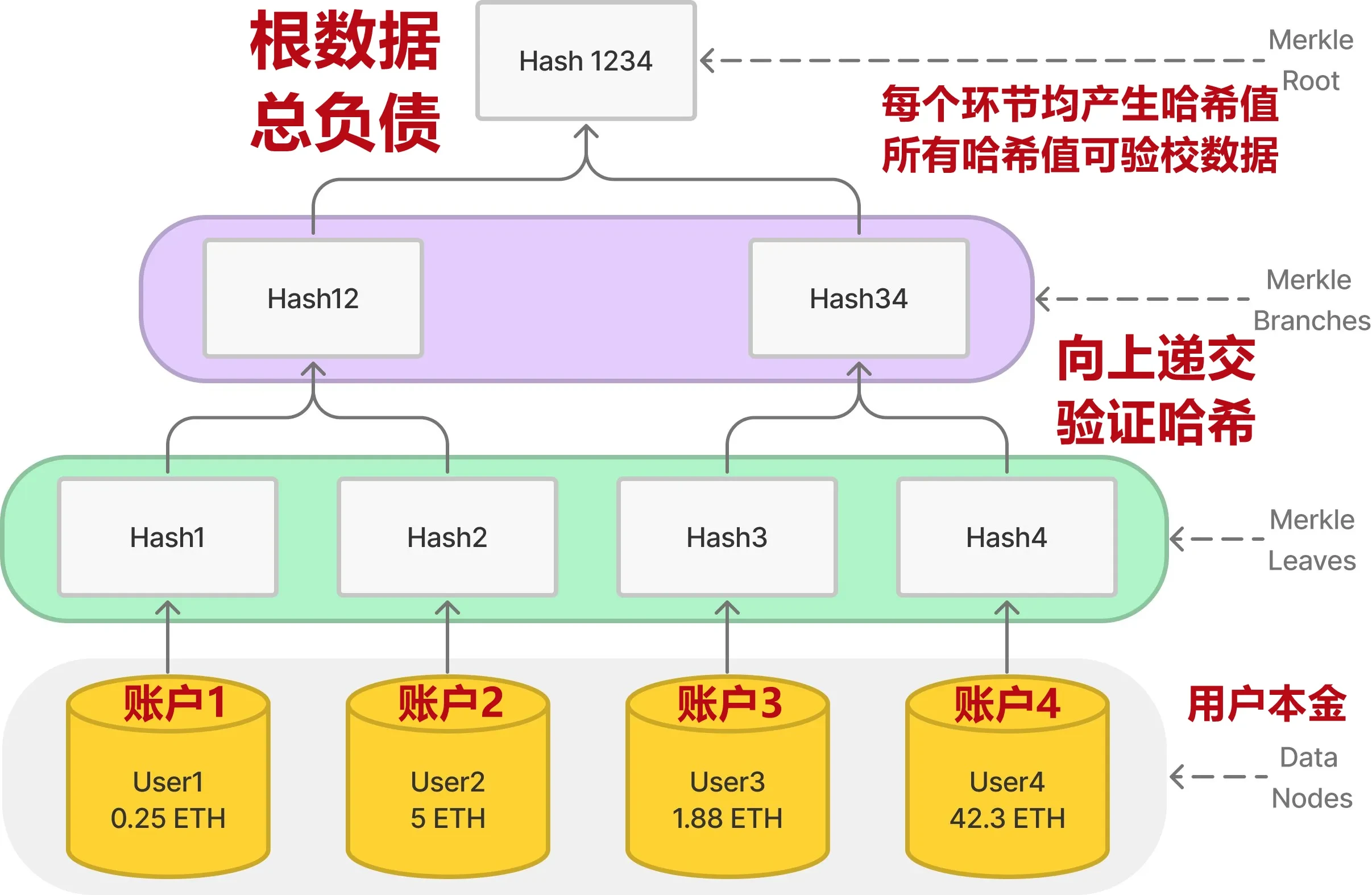
After solving the authenticity problem of total liabilities, we only need to compare this result with the platform's total on-chain funds to verify the platform's operating status. If the two amounts are 1:1, or total reserves > total liabilities, the platform is proven safe and reliable. If total reserves < total liabilities, caution is needed.
Summarizing, using Merkle Trees to verify the authenticity of total liabilities is a method to ensure information transparency. Its introduction is to assure everyone that CEXs haven't misappropriated users' assets, or that the platform's operational costs or even founders' extra expenses are completely isolated from clients' principal.
Of course, this method is not perfect, as it may to some extent leak some privacy of CEX officials and users, exposing them to hackers determined to steal assets. However, from the current CEX industry status, sharing auditable Merkle Tree total reserves becoming standard practice is already the best choice to improve user trust issues. As for how to do anti-hacker defense well,我相信 large platforms with strong financial and technical capabilities have their own good strategies.

For a platform like OKX with strong risk resistance and positive corporate values, this system will further enhance user trust and form a virtuous cycle. After all, in an open and transparent network, everyone will more recognize platforms that proactively accept supervision and prove their innocence authentically.
Disclaimer
This article may contain product-related content not applicable to your region. This article is intended only to provide general information and is not responsible for any factual errors or omissions therein. This article represents only the author's personal views and does not represent OKX's views. This article is not intended to provide any of the following advice, including but not limited to: (i) investment advice or investment recommendations; (ii) offers or solicitations to buy, sell or hold digital assets; or (iii) financial, accounting, legal or tax advice. Holding digital assets (including stablecoins) involves high risk, may fluctuate significantly, and may even become worthless. You should carefully consider whether trading or holding digital assets is suitable for you based on your financial situation. For questions about your specific situation, please consult your legal/tax/investment professional. The information appearing in this article (including market data and statistics, if any) is for general reference only. Although we have taken all reasonable precautions in preparing these data and charts, we accept no responsibility for any factual errors or omissions expressed herein. © 2025 OKX. This article may be reproduced or distributed in full, or excerpts of 100 words or less from this article may be used, provided such use is non-commercial. Any reproduction or distribution of the entire article must also prominently state: "Copyright © 2025 OKX, used with permission." Permitted excerpts must cite the article title and include attribution, for example "Article Title, [Author Name (if applicable)], �� 2025 OKX". Some content may be generated or assisted by artificial intelligence (AI) tools. Derivative works or other uses of this article are not permitted.
Show More
Recommended Reading
How to Unfreeze Your OKX Account: Documents and Steps Explained
# How to Unfreeze Your OKX Account: Documents and Steps Explained Being locked out of your OKX account can be stressful, but with the right documents and steps, recovery is possible. If you're facing the OKX account verification process, or looking for the documents needed to unfreeze your OKX account, you've come to the right place. This guide will explain the reasons for account freezing, what documents you need, and a step-by-step plan to regain access. We'll cover
March 10, 2026
How to Resolve OKX Withdrawal Freezes: Step-by-Step Troubleshooting
# How to Resolve OKX Withdrawal Freezes: Step-by-Step Troubleshooting You try to withdraw from OKX—but your funds are frozen or stuck. This can be stressful, especially when you need quick access to your crypto assets. Fortunately, there are clear steps that can help you resolve OKX withdrawal freeze issues. This guide will cover why withdrawals get frozen, how to troubleshoot, and how to prevent future problems. We'll cover the main reasons
March 10, 2026
How Long Does OKX Withdrawal Take? Processing Time, Fees, and Troubleshooting
# How Long Does OKX Withdrawal Take? Processing Time, Fees, and Troubleshooting Many crypto traders worry about how fast they can get their funds—withdrawal speed is crucial. If you're wondering about OKX withdrawal processing times, you're not alone. This guide will detail how long OKX withdrawals usually take, factors affecting the timeline, and how to avoid delays. You'll also learn about OKX withdrawal fees, common troubles
March 10, 2026
OKX Withdrawal Blocked Due to KYC Verification: Causes and Solutions
# OKX Withdrawal Blocked Due to KYC Verification: Causes and Solutions Many OKX users face sudden withdrawal blocks related to KYC verification—this article will explain why and how to resolve it. If you've encountered OKX withdrawals blocked due to KYC verification, you're not alone. This guide will explain why OKX enforces these restrictions, how their KYC process works, and how to resolve the issue
March 10, 2026
OKX Withdrawal Pending: Causes, Solutions, and Support Guide
# OKX Withdrawal Pending: Causes, Solutions, and Support Guide Still waiting for your OKX withdrawal to complete? You're not alone—withdrawal delays are a common concern for cryptocurrency users. If you see an "OKX withdrawal pending" status, it can be stressful, but most delays have simple explanations and solutions. This guide will detail why OKX withdrawals may be pending, the most common issues, and how long withdrawals usually take
March 10, 2026
How to Contact OKX Support for Withdrawal Issues: Step-by-Step Guide
# How to Contact OKX Support for Withdrawal Issues: Step-by-Step Guide Is your crypto withdrawal stuck? You're not alone. Many OKX users occasionally encounter withdrawal delays or issues, and knowing how to contact OKX support is crucial for quickly resolving withdrawal problems. In this guide, you'll learn how to contact OKX support, troubleshoot withdrawal issues, and get your funds moving again. We'll walk you through the most common problems, show you
March 10, 2026