Inflation Keeps Hitting New Highs! Can Bitcoin Continue to Beat Inflation Over the Next Decade?
On July 13, data released by the U.S. Department of Labor showed that both the June U.S. Consumer Price Index (CPI) and core CPI — on a year-over-year and month-over-month basis — came in above both expectations and prior readings, with multiple data points hitting new highs. June core CPI rose 4.5% year-over-year, surpassing the expected 4.0% and the prior reading of 3.8%, reaching a 30-year high.
On July 14, the freshly released Producer Price Index (PPI) added fuel to the inflation debate alongside CPI. June PPI rose 7.3% year-over-year, far exceeding the expected 6.7%, with core PPI up 5.6% year-over-year.
Federal Reserve Chairman Powell delivered testimony on the semiannual monetary policy report before the House of Representatives at 0:00 and before the Senate at 21:30 Hong Kong time on Thursday. Before U.S. market hours on Wednesday, Powell's testimony was released in advance, showing that the Federal Open Market Committee (FOMC) will continue debating asset purchases at its meeting, and that the Fed will provide notice before deciding to change its asset purchase program.
Powell stated that FOMC members expect economic progress to continue, but are still far from achieving "substantial further progress." On inflation, Powell reiterated his consistent stance, maintaining that the current loose monetary policy will remain unchanged, urging patience as inflation is expected to rise in the coming months before leveling off. That said, if inflation rises too quickly, the Fed is prepared to adjust its policies. The testimony makes clear that Powell remains optimistic about U.S. financial markets.
U.S. stocks closed mixed over the past two days, as investors weighed a new round of corporate earnings reports alongside the recently released CPI and PPI inflation data. Lower U.S. Treasury yields and a weaker dollar provided a lift to gold prices. For Bitcoin, daily charts showed a three-session losing streak, though it held firmly above the lower Bollinger Band.
Investors who view Bitcoin as a strong inflation hedge believe that high inflation is a buy signal for Bitcoin. However, many take a more cautious view, arguing that recent price action clearly demonstrates Bitcoin's close relationship with interest rate hikes — Bitcoin's decline from its all-time high began precisely when rate hike expectations started to emerge, and has since fallen to varying degrees as those expectations intensified. There is currently no indication that Bitcoin has fully bottomed, so caution remains warranted in trading.
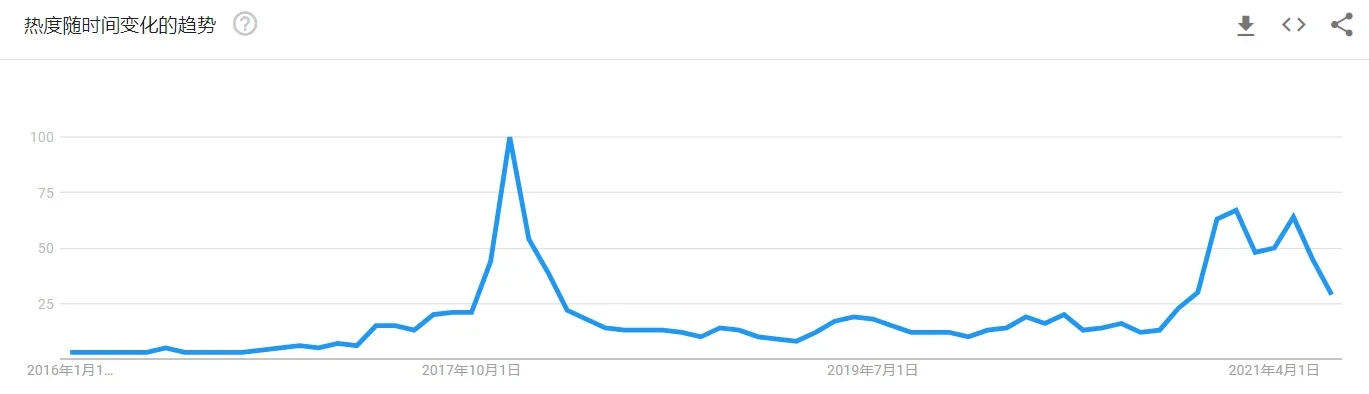
According to Google Trends, Bitcoin's recent search热度 has retreated to levels on par with December 2020. Glassnode's Week 28 report shows that as volatility continues to decline, the Bitcoin market has entered a narrow trading range — the calm in the market is striking, and investors are starting to view it as the quiet before a storm.
CPI Beats Expectations for Four Straight Months; Markets Focus on Powell's Speech
Since March this year, CPI has missed analyst forecasts for four consecutive months. The June CPI data not only came in above expectations and prior readings but also set new highs across multiple indicators. On an annualized basis, June CPI rose 5.4% year-over-year, marking the largest increase since 2008. After excluding the more volatile food and energy prices, core CPI still climbed 4.5% year-over-year — the highest year-over-year increase since November 1991, far exceeding market expectations of 3.8%. Reports indicate that industries hit particularly hard by pandemic-related shutdowns, such as used cars, airlines, and transportation, were the primary drivers of price increases.
Looking at the details, U.S. used car and truck prices rose 10.5% month-over-month and 45.2% year-over-year in June — this single category accounted for more than a third of the seasonally adjusted increase across all items. Food and energy prices continued to climb, with food up 0.8% month-over-month and 2.4% year-over-year, while energy rose 1.5% month-over-month and 24.5% year-over-year.
Analysts believe that the sharp year-over-year surge in CPI in recent months is partly attributable to the "base effect" — meaning that from March to June 2020, CPI fell sharply during the COVID-19 pandemic, leaving comparable data at relatively low levels, which made year-over-year gains appear especially pronounced. Fed Governor Daly stated, "The rise in inflation is expected. Only by getting through the current period of volatility can we see the true state of the economy. Short-term inflation expectations have risen, but long-term inflation expectations remain very stable, with inflation on track to return to the 2% target."
In addition, the June PPI data released on July 14 rose 1.0% month-over-month and 7.3% year-over-year — the largest increase since the index was first calculated in November 2010, exceeding expectations and signaling that inflation may continue to run hot, as strong demand from the post-pandemic economic recovery strains supply chains. Higher wages for low-income workers have pushed labor costs into inflation.
Meanwhile, the U.S. Congress held hearings on the Fed's semiannual monetary policy report. Fed Chairman Powell continued to reiterate that the sharp rise in inflation is temporary and that U.S. monetary policy will provide strong support for the economy until the recovery is complete. He remains far from being ready to begin scaling back the $120 billion in monthly asset purchases — the first step toward withdrawing economic support measures.
Facing the societal concern over inflation risks, Powell acknowledged that inflation is higher and more persistent than expected, but predicted that price pressures should ease later this year. This makes it clear that Powell sees no need to rush a change in monetary policy and that patience is still required.
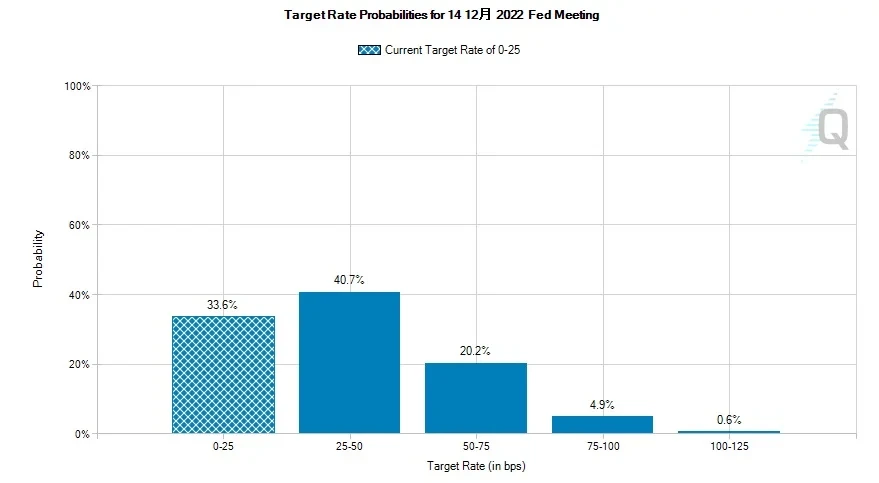
According to the CME Fed Watch tool, the probability of a Fed rate hike by December 2022 stands at approximately 66.4%, rising to 68.9% by February 2023. Fed Watch is a tool that uses the 30-day federal funds rate futures contracts published by CME to predict the likelihood of future Fed rate hikes or cuts.
Bitcoin Tracks Rate Hike Trends Closely — Can It Continue Outperforming Inflation Over the Next Decade?
After hitting an all-time high, Bitcoin has remained sluggish for three months — perhaps a re-entry into a test of conviction territory. Since falling below $40,000 on May 19, it has lingered in the $30,000–$40,000 range for several weeks. Google Trends shows Bitcoin search热度 has dropped to a new yearly low, on par with December 2020. Nevertheless, the search surge that followed Bitcoin's new highs in 2021 still fails to match the peak reached when Bitcoin touched $20,000 in December 2017.
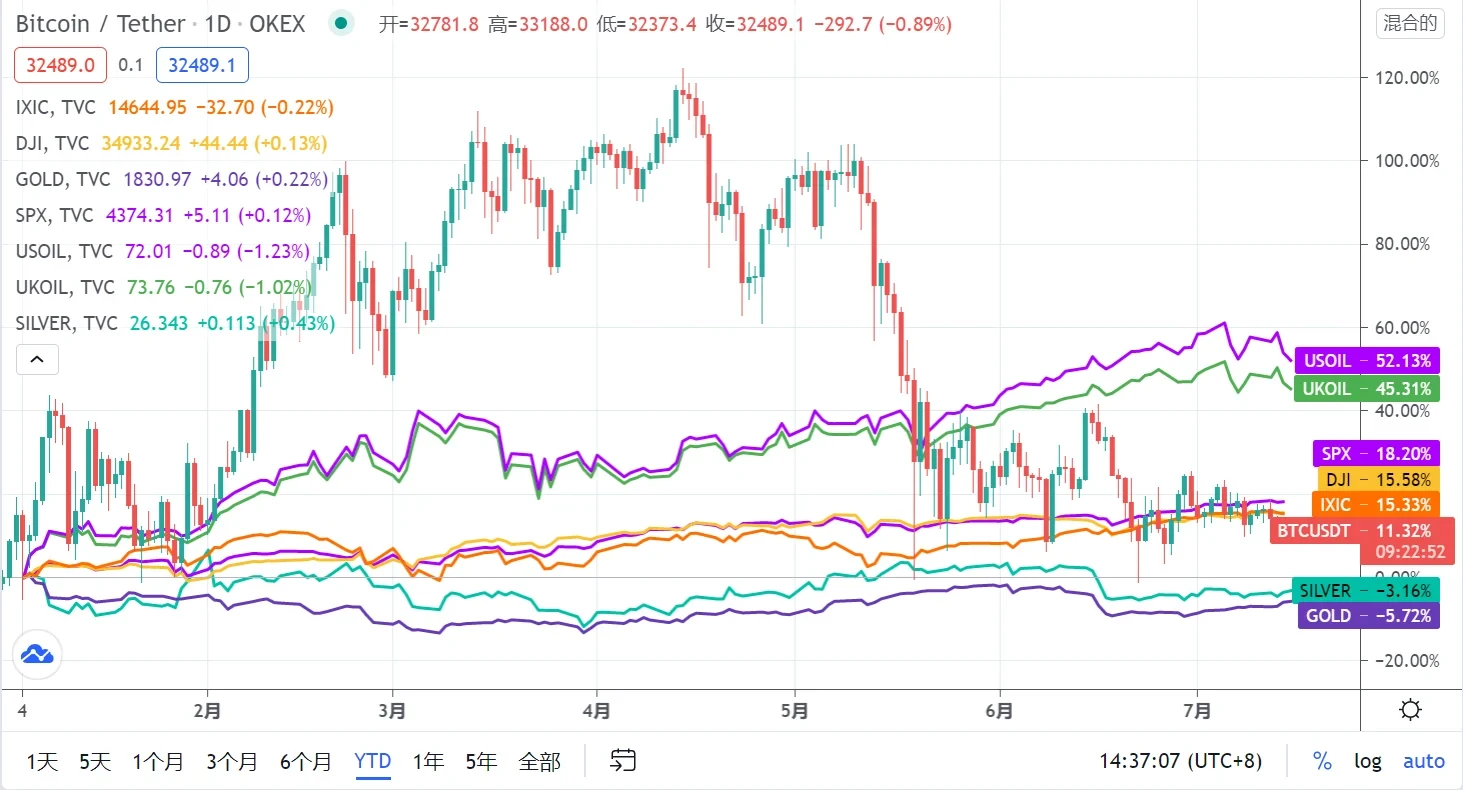
According to OKX real-time market data, Bitcoin's year-to-date gains as of now have narrowed to 11.32%. By comparison, WTI crude oil (52.13%), Brent crude oil (45.31%), the S&P 500 (18.20%), the Dow Jones (15.58%), and the Nasdaq (15.33%) have all outperformed Bitcoin, while gold (-5.72%) and silver (-3.16%) have underperformed Bitcoin.
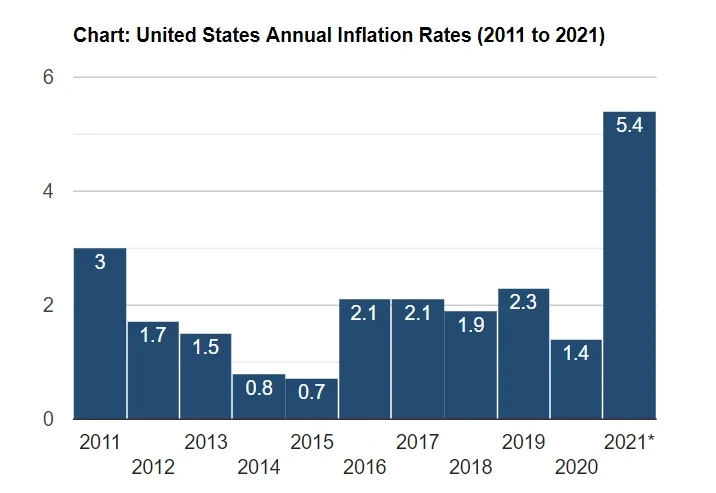
CoinDesk columnist David Z. Morris published an article yesterday stating that based on the newly released U.S. CPI data — with year-over-year inflation at 5.4%, a 13-year high, far above the Fed's 2% long-term target for a healthy economy — some Bitcoin investors may view it as a buy signal, as they believe Bitcoin has potential as an inflation hedge against any single currency.
What does a 5.4% annual CPI rate mean? Financial blogger Beatle News did the math: assuming prices maintain this average annual increase over the next decade, $1 million in 10 years would have the purchasing power of just $574,000 today — a 42.6% loss in purchasing power. The blogger's advice: "If you believe your salary or personal income can grow faster than 5.4%, then first invest in yourself. Otherwise, consider hitching a ride: 1) Invest in scarce real estate locations or companies with industry moats; 2) Invest in and hold assets with strong long-term consensus and deflationary characteristics."
Over the past decade (not including 2021), the U.S. annual average inflation rate was 1.75%.
Meanwhile, based on Brave New Coin data, Bitcoin opened at $0.292 in January 2011 and closed at $28,957.794 in December 2020, yielding an annualized growth rate of 991,695.27% — dramatically outperforming inflation.
However, Goldman Sachs noted in a previous research report that gold is better suited than crypto assets as an inflation-fighting tool, arguing that crypto assets are far inferior to gold and cannot serve as a reliable store of value. Goldman Sachs listed five criteria, stating that at least three must be met to determine whether an asset is a sound commodity: 1) Provides stable, reliable cash flows based on contracts, like bonds; 2) Generates returns aligned with economic fundamentals, like equities; 3) Offers sustainable and reliable diversified returns for an investment portfolio; 4) Avoids excessive and significant volatility; 5) Preserves value during periods of inflation or deflation. Goldman Sachs argued that Bitcoin meets none of the above conditions and is not a sound investment asset.
It is worth noting that Bitcoin does indeed suffer from high volatility — drawdowns from peak to trough are typically around 70%–80% in each cycle. And because this asset class has not yet reached full maturity, we believe it will exhibit characteristics of both a safe-haven asset and a risk asset. For example, during the 2019 trade war tensions, the S&P 500 fell 3% and the Russell 2000 dropped 3%, while gold — a traditional safe-haven asset — gained 1.4%, yet Bitcoin surged nearly 10% on August 5 alone, meaning that as panic spread, investors voted with their feet, driving crypto assets higher as a store of value. But on August 14, the market reversed sharply: when U.S. Treasuries exhibited a yield curve inversion, Bitcoin's behavior shifted closer to that of a risk asset — the S&P 500 fell 1%, gold slipped 0.1%, and Bitcoin dropped 7%.
Therefore, Bitcoin's true role is more accurately described as an emerging store of value, with price action resembling gold during the 1970s and early 1980s — also a period of extreme gold volatility. At that time, gold had already decoupled from the U.S. dollar, and investor sentiment seesawed, but the market eventually reached a consensus: the role we now know well — gold as a "safe-haven asset" and "store of value."
From the above, it is clear that Bitcoin has dramatically outperformed inflation over the past decade, but its high volatility — with drawdowns of 70%–80% being quite startling — means investors may consider Bitcoin as a long-term allocation asset. However, for short-term trading, it tests investors' skill levels. For long-term holding at a reasonable average cost basis, dollar-cost averaging (DCA) is the most commonly recommended approach in the community.
The AHR999 index is considered a useful tool to assist with DCA strategies. According to backtesting, when the indicator falls below 0.45, it is deemed a suitable buying opportunity. When the indicator is between 0.45 and 1.2, it is considered appropriate for DCA, while above this range suggests it is not a favorable time for DCA. Current data shows that on July 15, the AHR999 indicator placed the DCA line at $34,700 and the buying opportunity line at $21,200. Of course, no indicator is foolproof — each has its own pros and cons. This is merely a commonly used data tool in the community and does not constitute any investment advice.
As we all know, the most basic goal of investment and wealth management is to beat inflation. If you fail to keep pace, your wealth effectively depreciates. The only way to beat inflation is to make your capital appreciate, and the key to appreciation is choosing the right investment approach. Bitcoin has delivered stellar returns over the past decade. If we accept the premise that as its market cap grows, its volatility will gradually decline — and with Bitcoin going mainstream and more investors entering the space — continuing to outperform inflation over the next decade remains the most likely outcome.
Disclaimer
This article may contain product-related content not applicable to your region. This article is intended solely to provide general information and makes no representation as to the accuracy or completeness of any facts. The views expressed herein are those of the author alone and do not necessarily reflect the opinions of OKX. This article is not intended to provide, and should not be relied upon as, (i) investment advice or investment recommendations; (ii) offers or solicitations to buy, sell, or hold digital assets; or (iii) financial, accounting, legal, or tax advice. Holding digital assets (including stablecoins) involves a high degree of risk and their value may fluctuate significantly or even become worthless. You should carefully consider whether trading or holding digital assets is appropriate for you based on your financial situation. For questions specific to your circumstances, please consult your legal/tax/investment professional. The information in this article (including market data and statistics, where applicable) is provided for general reference purposes only. Although all reasonable steps have been taken in preparing this data and these charts, we accept no responsibility for any factual errors or omissions expressed herein. © 2025 OKX. This article may be reproduced or distributed in its entirety, or excerpts of 100 words or fewer may be used, provided that such use is non-commercial in nature. Any reproduction or distribution of the full article must prominently state: "This article is copyrighted © 2025 OKX, used with permission." Permitted excerpts must cite the article title and include attribution, for example, "Article Title, [Author Name (if applicable)], © 2025 OKX". Some content may have been generated or assisted by artificial intelligence (AI). Derivative works and other uses of this article are not permitted.
Show More
Recommended Reading
OKX Pay: Ushering in the Next Generation of Crypto Payments
The choice of tens of millions of users. Register with OKX to enjoy an exceptional trading experience and a wide range of wealth management products. A letter from OKX CEO Star: Today, we are officially launching the first version of OKX Pay to over 100 million global users. As the industry's first truly non-custodial and compliant payments application, OKX Pay will be embedded directly in the OKX App and is currently available in select markets, with full rollout expected in the coming months.
2026年3月22日

A New Chapter: Building the Next Generation of Financial Infrastructure Together
The partnership between OKX and the Intercontinental Exchange (ICE) marks a significant milestone for OKX — and carries profound implications for the evolution of the entire digital assets market. ICE builds and operates the world's most critical financial infrastructure, including the New York Stock Exchange and global derivatives and clearing platforms. ICE's strategic investment in OKX and its joining of our board reflects our shared conviction that digital assets technology will transform financial markets.
2026年3月10日

Celebrating Another Year of Relentless Progress
As OKX's CEO and a builder who stays true to the original mission, I take great pride in reflecting on the remarkable growth and progress OKX achieved this year. Despite a year filled with challenges, 2024 was a year defined by focus, innovation, and resilience. We not only expanded and optimized our product suite, but also made significant strides in launching transparent and regulation-aligned localized businesses, while further strengthening our global management team. It is worth noting that after going through...
2026年1月29日

2025: Steady Progress Toward Financial Freedom
— Year-End Letter to Global Users from OKX Founder & CEO Star "Financial freedom" is often misunderstood. It doesn't mean an absence of rules — rather, it means having the right to choose even when rules exist — and that the system remains reliable and effective when truly put to the test. That has been our unwavering focus throughout 2025. First and foremost, I would like to express my sincere gratitude to our global customers, partners, and regulators.
2026年1月16日

OKX Officially Launches in Germany and Poland
By Erald Ghoos, CEO of OKX Europe Today is a momentous day for OKX — and for crypto users across Europe. We have officially launched our fully compliant centralized cryptocurrency exchange in Germany and Poland! For us, this is more than geographic expansion — it is a commitment to building the future of cryptocurrency the right way: secure, transparent, and tailored to local needs. If you are in Germany...
2025年10月21日

Partnership Upgrade! OKX Joins Forces with Standard Chartered to Expand into Europe
On October 15, Erald Ghoos, CEO of OKX Europe, said that OKX is expanding its strategic partnership with Standard Chartered into the European Economic Area (EEA). Earlier this year, OKX and Standard Chartered first teamed up in the UAE, launching a collateral mirroring initiative — this...
2025年10月15日