Overviewing Bitcoin's 12 Years: What Insights Can We Get from History?
Since Bitcoin hit its all-time high of $64,846 on April 14, it has oscillated downward over the following two months, touching as low as $29,000. According to OKX market data, as of this writing, Bitcoin is trading at $38,769, still down over 40% from its April 14 high.
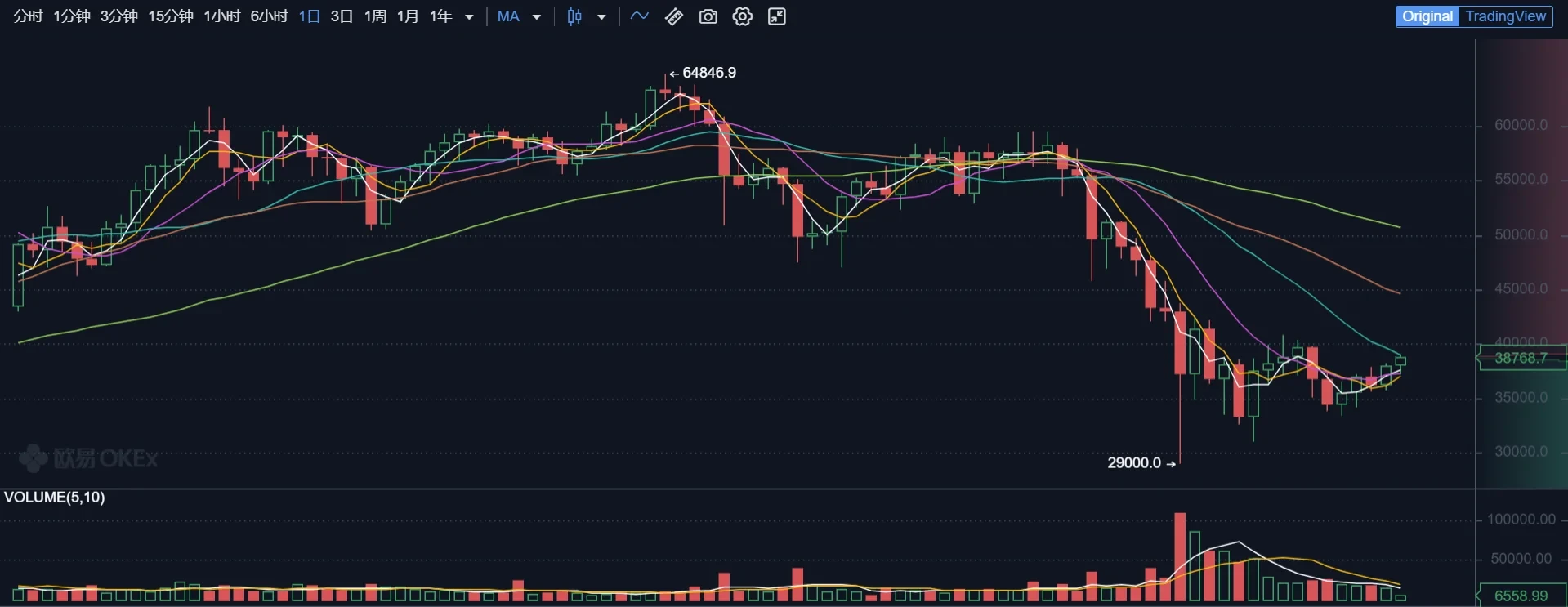
Bitcoin recent price trend, source OKX
Bitcoin's weak rebound, divergence in investor sentiment toward market outlook
Accompanying Bitcoin's price decline, the total crypto market capitalization has also seen a significant drop, falling from $2.56 trillion to a recent $1.68 trillion, a decline of nearly 35%.
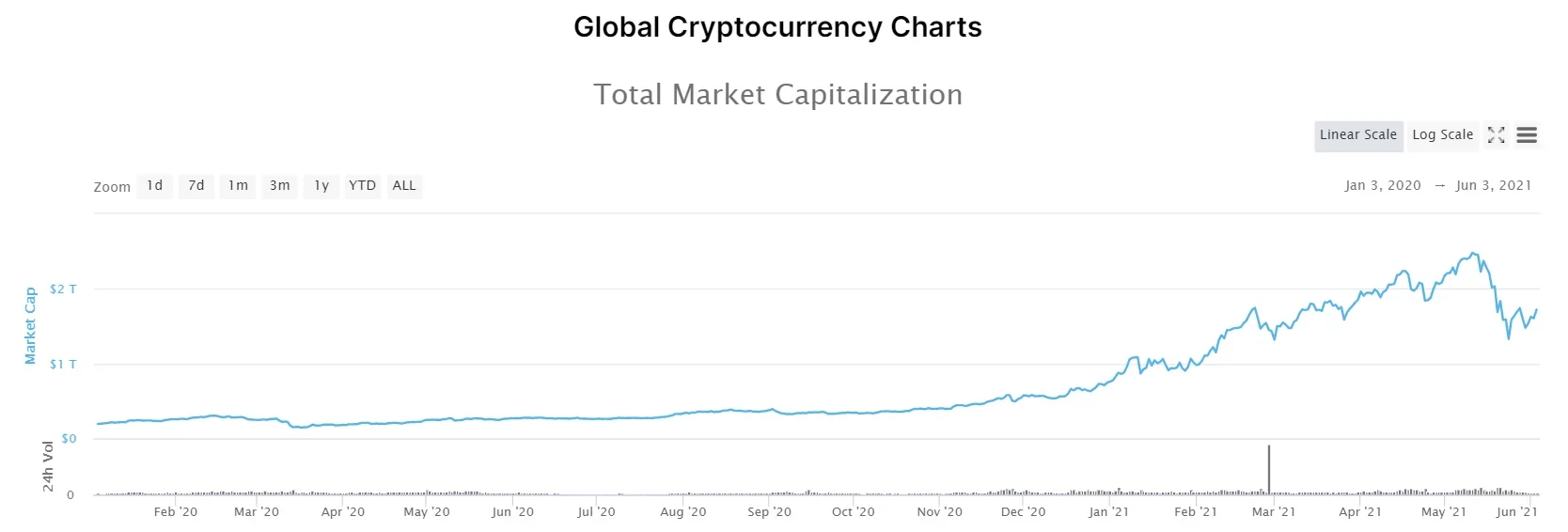
Total crypto market cap changes, source coinmarketcap
Meanwhile, another piece of information widely followed by the market is that in the two weeks since Bitcoin touched its recent low of $29,000, there has been no relatively strong rebound, remaining suppressed below the 200-day moving average (current MA200 price is approximately $41,435). OKX Research believes that from a technical analysis perspective, the MA200 is viewed as an important bull-bear dividing line in the market, so judging from Bitcoin's current trajectory, BTC has undoubtedly fallen into a technical bear market in the short term.
However, for many investors who focus more on macro market dynamics, while the signals from technical analysis are not optimistic, from a macro perspective, crypto market fundamentals have not deteriorated, and there are still promising developments.
Of course, the macro positives here mainly refer to the "money printing" plans of the United States and other major world economies. Judging by the results of the $1.9 trillion economic stimulus plan proposed by Biden at the beginning of this year, the impact on the crypto market in the short to medium term has been positive.
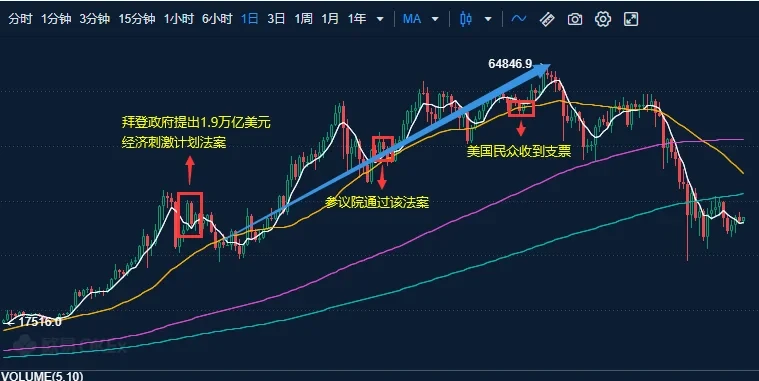
January 2021 Biden administration $1.9 trillion economic stimulus plan implementation milestones and Bitcoin market
Following this, the Biden administration proposed in March and April of this year the $2.3 trillion American Jobs Plan Act and the approximately $1.8 trillion American Families Plan stimulus act, respectively. In the early hours of May 29 Beijing time, the White House released Biden's first budget proposal, planning to increase government spending to $6 trillion in fiscal year 2022 (October 2021 ~ September 2022). The U.S. government's successive "money printing" plans will undoubtedly exacerbate inflation, and with high probability will push up global major asset prices like U.S. stocks, just as last year. As an emerging investment market with huge potential, Bitcoin is bound to benefit from this.
Can we find clues from historical trends?
Objectively speaking, looking at Bitcoin's current trajectory, whether investors who believe the bull market has ended and a bear market is coming, or those who remain bullish and believe it will reverse and continue the bull market, can find ample reasons to support their views. For any investment target analysis and judgment, this is inherently a matter of opinion. So we might as well break free from the constraints of technical and fundamental analysis, focus on Bitcoin's 12-year development history and the historical performance of 2 complete bull-bear cycles, to explore the similarities and find valuable reference information for the second half of this market cycle.
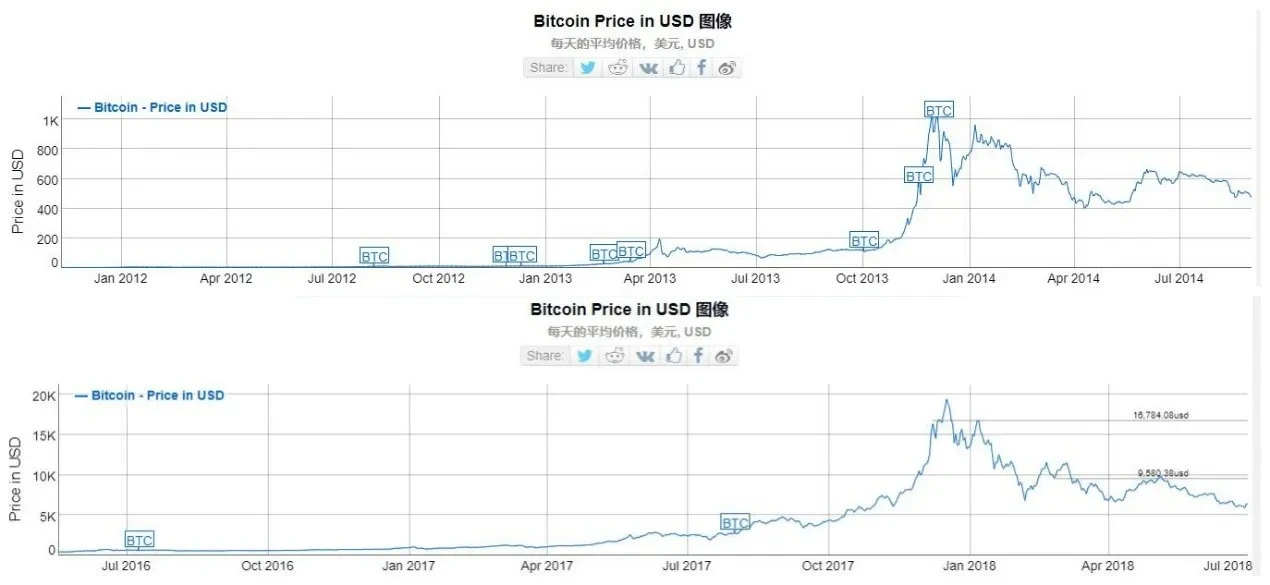
If we compare and analyze the 2013 bull market and the 2017 bull market, we can discover that both candlestick patterns followed very standard trajectories, highly consistent with Bitcoin's four-year halving cycle — the first halving occurred on November 28, 2012, then reached that bull market's price peak on November 30, 2013, an interval of 367 days; the second halving occurred on July 10, 2016, then reached that bull market's price peak on December 17, 2017, an interval of 525 days.
In addition, we can also see that in the previous two halving bull markets, not only did the upward trend last a long time, but there were also obvious characteristics of high upward slope + multiple large pullbacks of over 30%, for example on April 10-12, 2013, Bitcoin price fell 70% in two days, and additionally on April 25-May 2 and November 20 of the same year, there were pullbacks exceeding 30%. In the second halving bull market, this situation occurred even more frequently, for instance on May 25-27, June 12-July 15, and September 2-15, 2017, there were declines approaching or exceeding 40%.
Looking at this bull market, what are the similarities and differences with the previous two? Recently, Jiang Zhuoer, CEO of BTC.TOP, proposed a "atypical bull market" view on his Weibo, summarizing the differences between this bull market and previous ones while following the general tone of the "halving bull market":
1) In 2019, when it "should have" been consolidating at the bottom, it experienced a small bull market rising 340% over 3 months;
2) Due to multiple factors in 2020, global capital markets collectively experienced liquidity depletion, and Bitcoin saw an unprecedented "flash crash" on March 12-13;
3) Starting from October 2020, during Bitcoin's rise from $10,000 to $60,000, there was no major pullback exceeding 30%;
4) After Bitcoin reached the high of $64,846, extreme market conditions occurred successively on April 18 and May 19 over the following month.
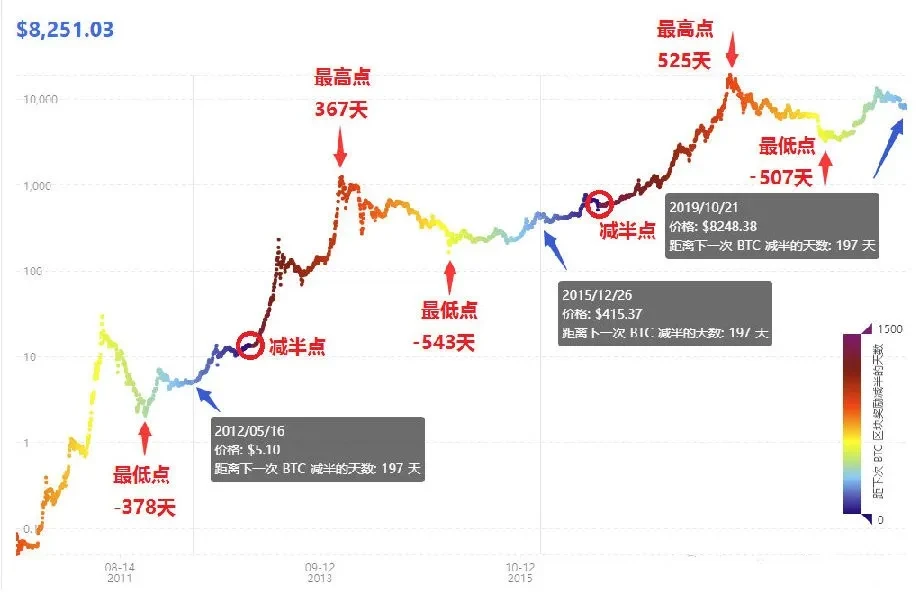
Historical Bitcoin "halving bull markets", source Jiang Zhuoer Weibo
Although from Bitcoin's performance in this bull market so far, there are indeed many "atypical" features, what cannot be ignored is that so far it still follows the laws of the "halving bull market" in its development. So even if we can no longer simply apply past historical experience, we can still understand the principles behind the candlestick chart from simple economic principles.
In other words, we need to return to the universally recognized "halving bull market." The important theoretical basis of the "halving bull market" is the most basic supply-demand relationship principle in economics — when demand does not suddenly change, an instantaneous halving of supply inevitably leads to price increases. If we analogize Bitcoin to commodities in traditional financial markets, Bitcoin miners play the role of producers, while various investors in the secondary market play the role of consumers.
Then according to the Kitchin cycle theory proposed by American economist Joseph Kitchin — demand shocks for goods are passive and external, while supply adjustments are active and internal, therefore different changes in demand and supply (inventory) form four cyclical phases: passive inventory destocking, active inventory replenishment, passive inventory replenishment, and active inventory destocking. We surprisingly discovered that Bitcoin's bull-bear transition process also conforms to these four cyclical phases.
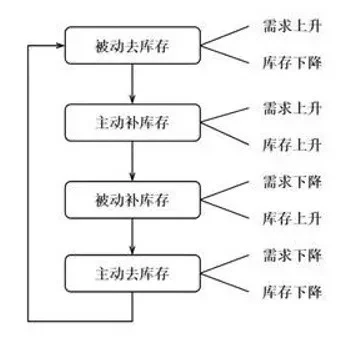
Kitchin cycle diagram, source internet
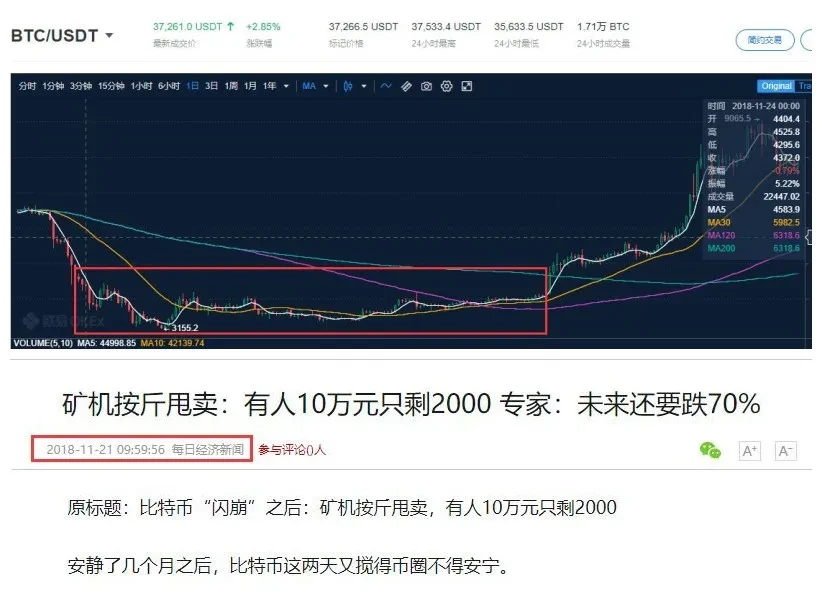
If judging Bitcoin's bull-bear cycle according to Kitchin cycle theory, it's much simpler — just need to focus on the producers, that is, miners' dynamics. When miners dump mining machines in the market, it actually means with high probability that the bear market has basically bottomed; when mining machine manufacturers produce at full capacity and there's still great demand for mining machines in the market, and mainstream mining machine payback periods significantly shorten, we're probably very close to the top. This point seems relatively easy to verify, for example at the end of November 2018.
Conclusion
In this Bitcoin uptrend, whether "typical" or "atypical," one reality we need to face is that after 12 years of refinement, Bitcoin has developed from a niche product for tech geeks into a global investment target with a market capitalization of $700 billion, gaining recognition from multiple sovereign country regulatory agencies, many large multinational companies including traditional financial giants, and small and medium investors worldwide. Its liquidity and risk resistance have already been significantly enhanced.
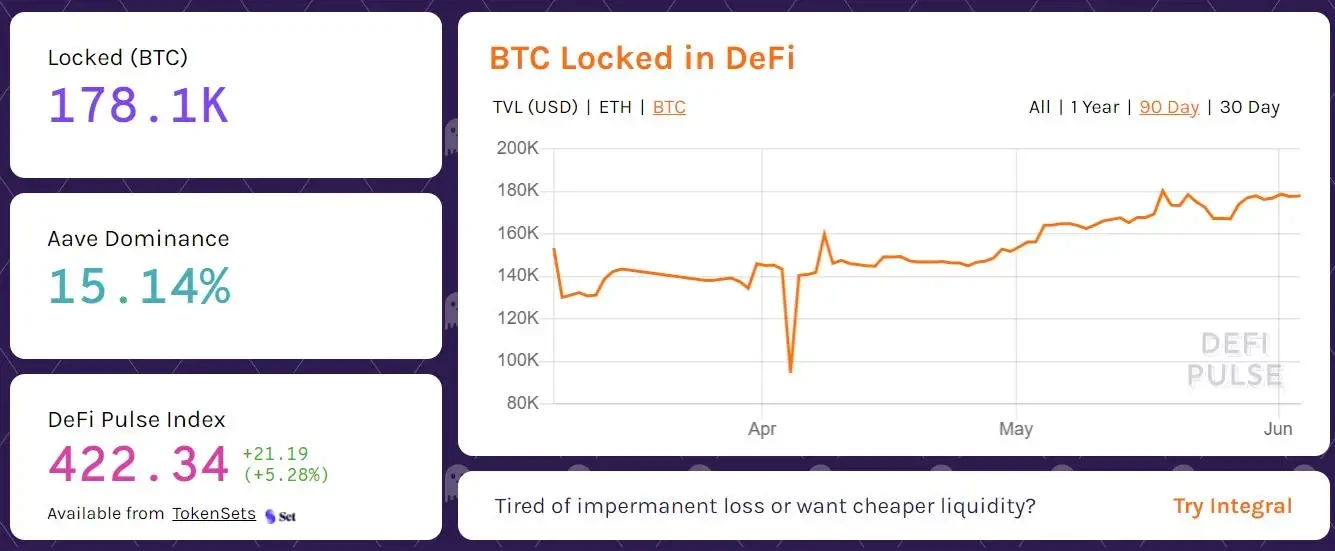
Amount of Bitcoin locked in DeFi, source defipulse
On the other hand, amid the DeFi boom, the total amount of Bitcoin locked on Ethereum currently reaches 178,000, developing extremely rapidly. Bitcoin is continuously being endowed with new value in more DeFi applications — its essence is a technology-driven financial innovation, financial innovation creates market demand, and demand drives up prices in a great wealth migration. With the gradual construction and improvement of blockchain infrastructure in the future, more blockchain applications will begin to explode, and Bitcoin's demand will also achieve greater growth.
Disclaimer
This article may contain product-related content not applicable to your region. This article is intended to provide general information only and does not take responsibility for any factual errors or omissions contained herein. This article represents only the author's personal views and does not represent the views of OKX. This article is not intended to provide any of the following advice, including but not limited to: (i) investment advice or investment recommendations; (ii) offers or solicitations to buy, sell, or hold digital assets; or (iii) financial, accounting, legal, or tax advice. Holding digital assets (including stablecoins) involves high risk, may fluctuate significantly, and even become worthless. You should carefully consider whether trading or holding digital assets is suitable for you based on your financial situation. For questions about your specific situation, please consult your legal/tax/investment professional. The information appearing in this article (including market data and statistics, if any) is for general reference only. While we have taken all reasonable care in preparing these data and charts, we assume no responsibility for any factual errors or omissions expressed herein. © 2025 OKX. This article may be reproduced or distributed in its entirety, or excerpts of 100 words or less from this article may be used, provided such use is non-commercial. Any reproduction or distribution of the entire article must also prominently state: "Copyright © 2025 OKX, used with permission." Permitted excerpts must cite the article title and include attribution, for example "Article Name, [Author Name (if applicable)], © 2025 OKX". Some content may be generated or assisted by artificial intelligence (AI) tools. Derivative works or other uses of this article are not permitted.
Show More
Recommended Reading

OKX Pay: Opening a New Era of Next-Gen Crypto Payments
Choice of tens of millions of users, register on OKX, enjoy ultimate trading experience and diverse wealth management products. A letter from OKX CEO Star: Today, we officially launch the first version of OKX Pay to over 100 million global users. As the industry's first payment application to truly achieve non-custodial and compliant integration, OKX Pay will be embedded in the OKX App, currently open to select markets, expected to fully launch within months
March 22, 2026

New Chapter: Building Next-Gen Financial Infrastructure Together
OKX's partnership with Intercontinental Exchange (ICE) is an important moment for OKX and equally significant for the evolution of the entire digital assets market. ICE establishes and operates the world's most important financial infrastructure, including the New York Stock Exchange and global derivatives and clearing platforms. ICE's strategic investment in OKX and joining our board reflects both parties' shared belief — digital assets technology will play a crucial role in financial markets
March 10, 2026

Tribute to Another Year of Forging Ahead
As OKX's CEO, and also a builder who stays true to our original mission, I proudly review OKX's extraordinary growth and progress this year. Despite numerous challenges, 2024 has been a year of focus, innovation, and resilience. We not only expanded and optimized our products, but also made important progress in launching transparent and compliant localized operations, while further strengthening our global management team. Notably, after experiencing
January 29, 2026

2025: Steady Progress Toward Financial Freedom Together
—— A year-end letter from OKX Founder and CEO Star to global users "Financial freedom" is often misunderstood. It doesn't mean no rules, but rather having the right to choose when rules exist — and, when the system is truly tested, it remains reliable and effective. This is exactly the direction we've remained focused on throughout 2025. First, I want to extend my sincere gratitude to our global clients, partners, and regulatory authorities
January 16, 2026

OKX Officially Launches in Germany and Poland
Author: Erald Ghoos, CEO of OKX Europe Today is significant for OKX — and for crypto users across Europe. We have officially launched fully compliant centralized cryptocurrency trading platforms in Germany and Poland! For us, this is not just a geographic expansion, but a commitment to building the cryptocurrency future the right way: secure, transparent, and meeting local needs. If you're in Germany
October 21, 2025

Partnership Expanded! OKX Partners with Standard Chartered to Expand European Market
On October 15, OKX Europe CEO Erald Ghoos stated that OKX is expanding its strategic partnership with Standard Chartered to the European Economic Area (EEA). Earlier this year, OKX first partnered with Standard Chartered in the UAE to launch the collateral mirroring program — a
October 15, 2025