Opportunities and Risks Coexist in 2021 — How Did the Crypto Market Perform That Year?
As December enters its second half, the 2021 digital assets market is entering its year-end closing phase. Over the course of 2021, we witnessed not only a spectacular bull run in the digital assets market but also endured grim行情 of sharp, short-term downturns. However, through all these twists and turns, we continue to see the entire market maintaining a vibrant development momentum.
Therefore, in this article, we will take a broad look at the key information worth noting in the 2021 digital assets market from various perspectives: the overall overview of the digital assets market, the development trajectories of Bitcoin and Ethereum — the two leading cryptocurrencies — as well as dark horses of the market this year such as NFT and GameFi.
Overall Overview of the Digital Assets Market in 2021
First, let's look at changes in the total market capitalization of the digital assets market. According to data from the third-party data site CoinGecko, on January 1, 2021, the total market cap of the digital assets market was approximately $787.1 billion, coming within just 7.2% of the previous cycle's peak of $848.6 billion from 2017.
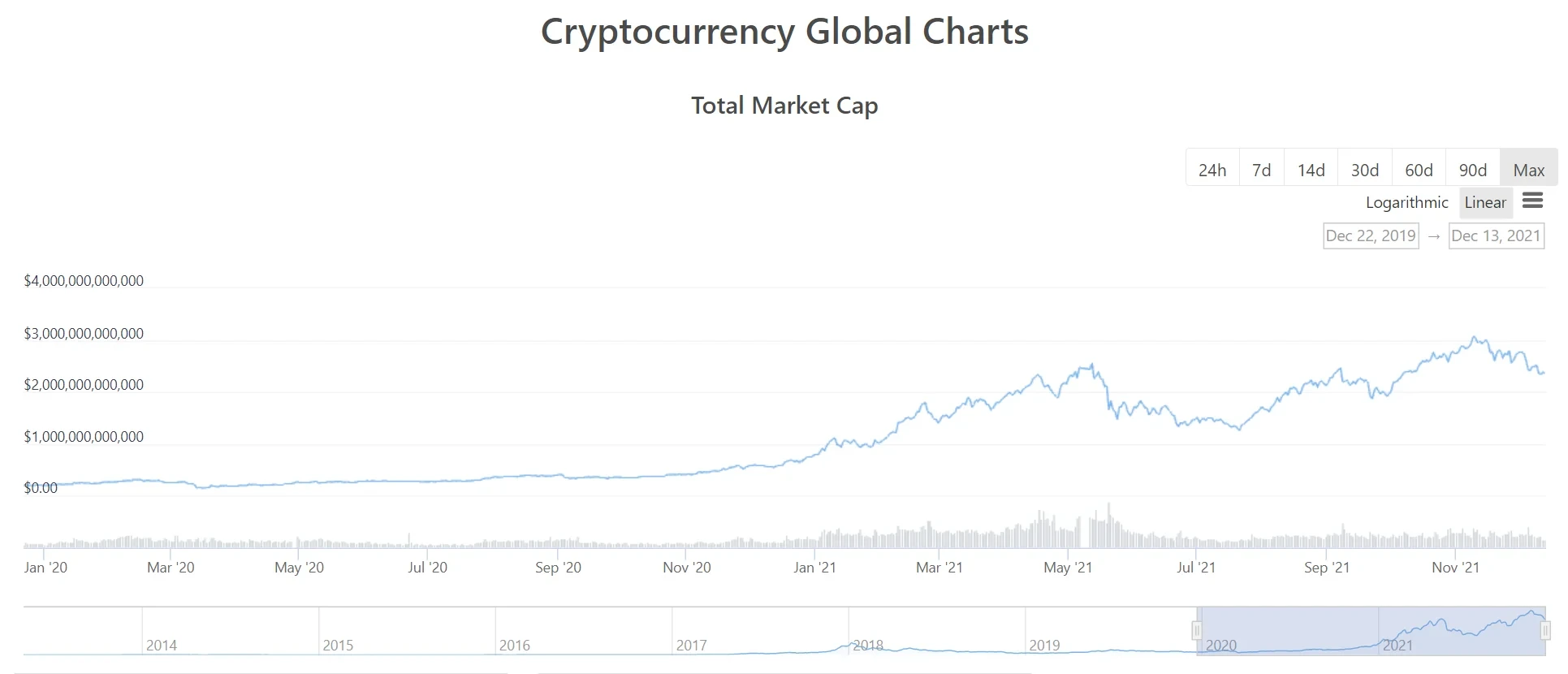
Changes in total digital assets market capitalization in 2021, data source: CoinGecko
However, the digital assets market soon pressed the accelerator. Just four days later, on January 5, 2021, the total market cap of the digital assets market successfully broke through its all-time high, setting a new record of $864.1 billion. From there, it began a four-month period of oscillating upward trends, breaking through the $1 trillion mark on January 7, reaching the $2 trillion milestone on April 6, and ultimately peaking at $2.56 trillion on May 12 — the first half of the year's high. It then entered a downward trend lasting over two months, with the total market cap dropping as low as $1.25 trillion, a decline exceeding 50%, and pessimism pervading the market.
However, as internal and external market conditions stabilized and improved in the third quarter, following the bottoming out, the total market cap began climbing again from late July, successfully breaking through the $3 trillion mark on November 10 to set a new all-time high. As of December 14 data, while the total digital assets market cap has pulled back somewhat, it remains at approximately $2.38 trillion, slightly below the first-half peak (all digital assets market cap data above is sourced from CoinGecko).
Bitcoin and Ethereum Begin to Diverge
According to OKX platform data, on January 1, 2021, Bitcoin's price closed at $29,185.7; by April 14, it reached $64,864.9, setting a new all-time high for the first half of the year with a maximum interim gain of 122.3%; in the subsequent decline, it pulled back to as low as $28,808, slightly below the ~$29,000 price at the beginning of the year. Then, in the second-half recovery rally, it surged again to $69,040 on November 10, approaching the $70,000 psychological level, with a maximum annual gain of 136.6%. Corresponding to its price fluctuations was the change in its market cap.
According to QKL123 data, at the beginning of the year, Bitcoin's minimum market cap was $566.6 billion, dipping to $561.7 billion in July, and then rebounding to $1.28 trillion (November 10) during the Q3–Q4 rally, with a maximum cumulative gain of 127.9% for the year — nearly matching its price appreciation.
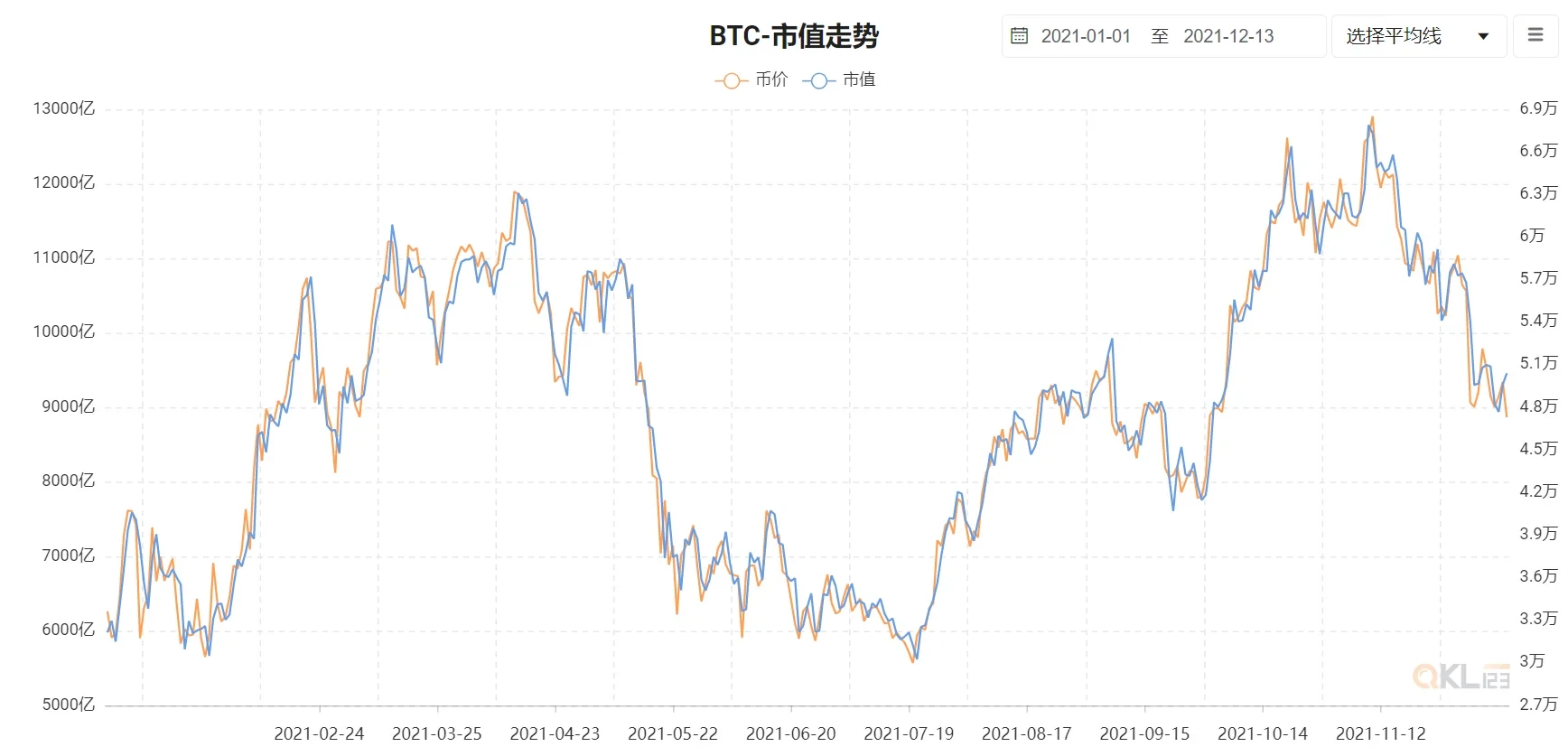
Bitcoin market cap trend in 2021, data source: QKL123
From another angle, let's compare the changes in Bitcoin's share of the total digital assets market cap. On January 1, 2021, Bitcoin's market share was approximately 70%; by the 11th of that month, it rose to 77.11% — the highest Bitcoin market share recorded through December 14. By May 16, this figure had fallen to 38.13%, a decline exceeding 50%. From that point onward, it fluctuated within a 40%–50% range, and as of December 14, Bitcoin's market share was approximately 42.1%.
For comparison, on the price front, Ethereum rose from $735.42 in early January to $4,371.96 on May 12, a maximum interim gain of approximately 495%; during the third-quarter decline, the price also pulled back but only dropped to around $1,700, still representing a 131% gain compared to the beginning-of-year price; as the broader market recovered, it hit a new all-time high of $4,871.42 on November 10, recording a maximum annual gain of 562.7% — higher than Bitcoin's 127.9%.
In terms of market cap movements, also according to QKL123 data, at the beginning of the year, Ethereum's total market cap was only $84.032 billion, which represented just 14.82% of Bitcoin's market cap on the same day.
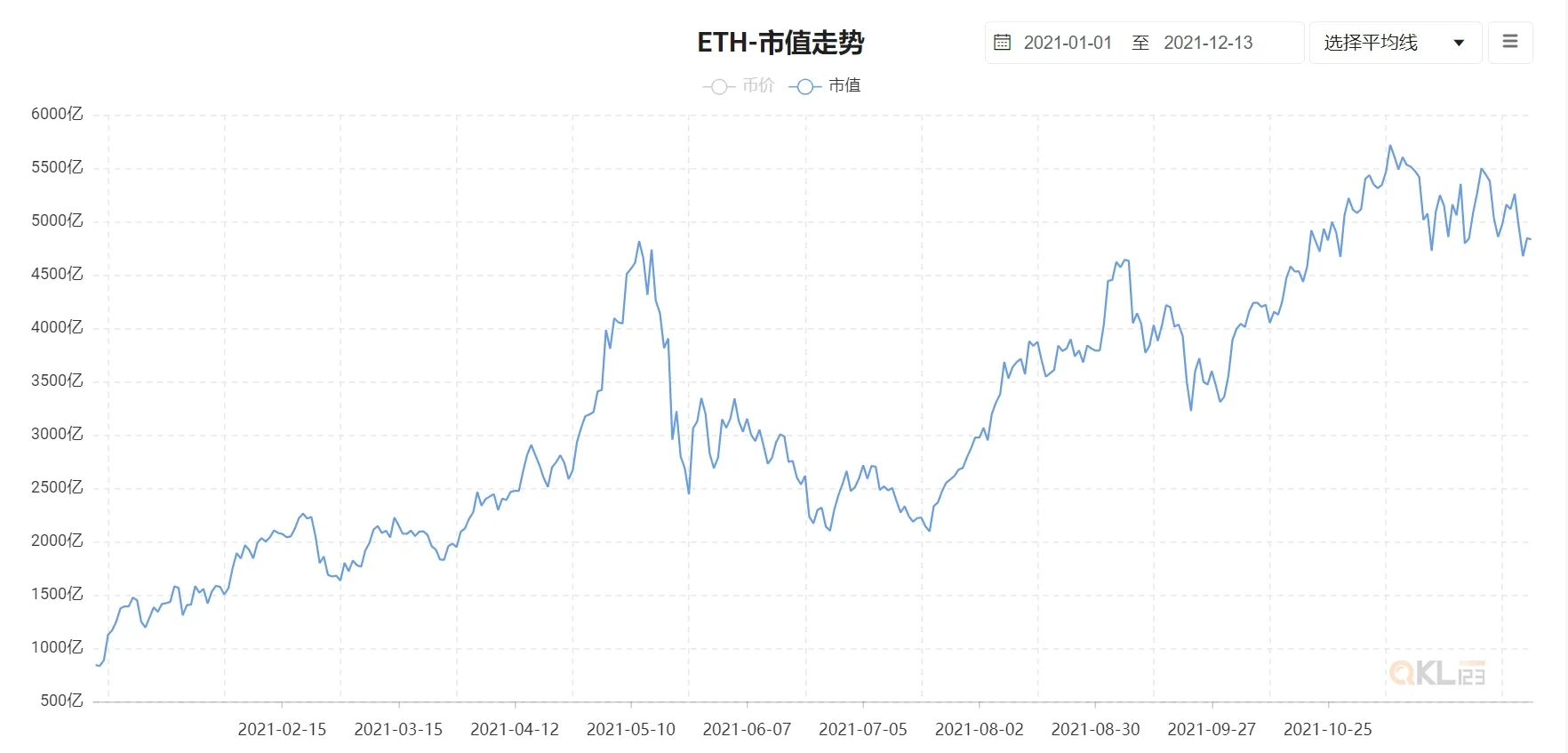
Ethereum market cap trend in 2021, data source: QKL123
As of December 14, Ethereum's highest market cap for the year reached $571.666 billion (November 10), a gain of 780.6% compared to the beginning of the year. Compared to Bitcoin's market cap over the same period, Ethereum's market cap represented 44.66% of Bitcoin's — simply looking at the change in share, a gain of more than threefold.
From another dimension, we can more intuitively observe this divergent trend between Ethereum and Bitcoin in the secondary market.
Looking at the ETH/BTC exchange rate changes, we can clearly see that at the beginning of the year, the exchange rate between the two was approximately 0.025, but over the course of the following year, it rapidly oscillated upward, first touching 0.08 in mid-May; then from late October, it entered another accelerated phase, reaching 0.08836 on October 8 — a new three-year high for the ETH/BTC exchange rate.
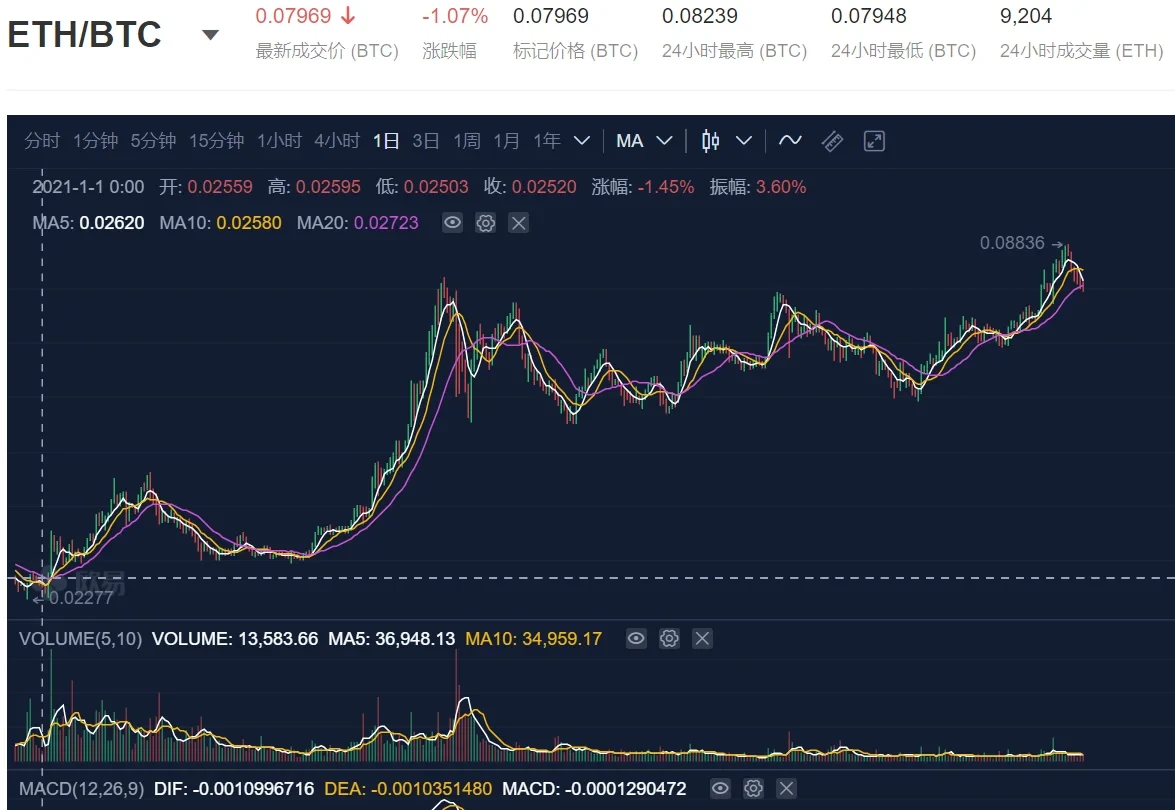
ETH/BTC exchange rate changes in 2021, data source: OKX
As for the aforementioned divergence between Bitcoin and Ethereum in the secondary market, the deeper underlying cause is the分歧 among the broad base of investors in the digital assets market regarding Bitcoin and Ethereum's two different development paths. This divergence is currently intensifying alongside the growth of emerging concepts such as DeFi, NFT, GameFi, DAO, and Web3.0.
The Blazing Hot NFT and GameFi Sectors
If DeFi was the standout dark horse in last year's digital assets market, then this year's market has been far more bustling — one might even say it's a garden of competing flowers, with players taking turns in the spotlight. In the first half of this year, boosted by the Olympics, numerous regional sporting events, and the加持 of many well-known art circles, sports industry companies and figures, the NFT trading market experienced a brief but notable surge.
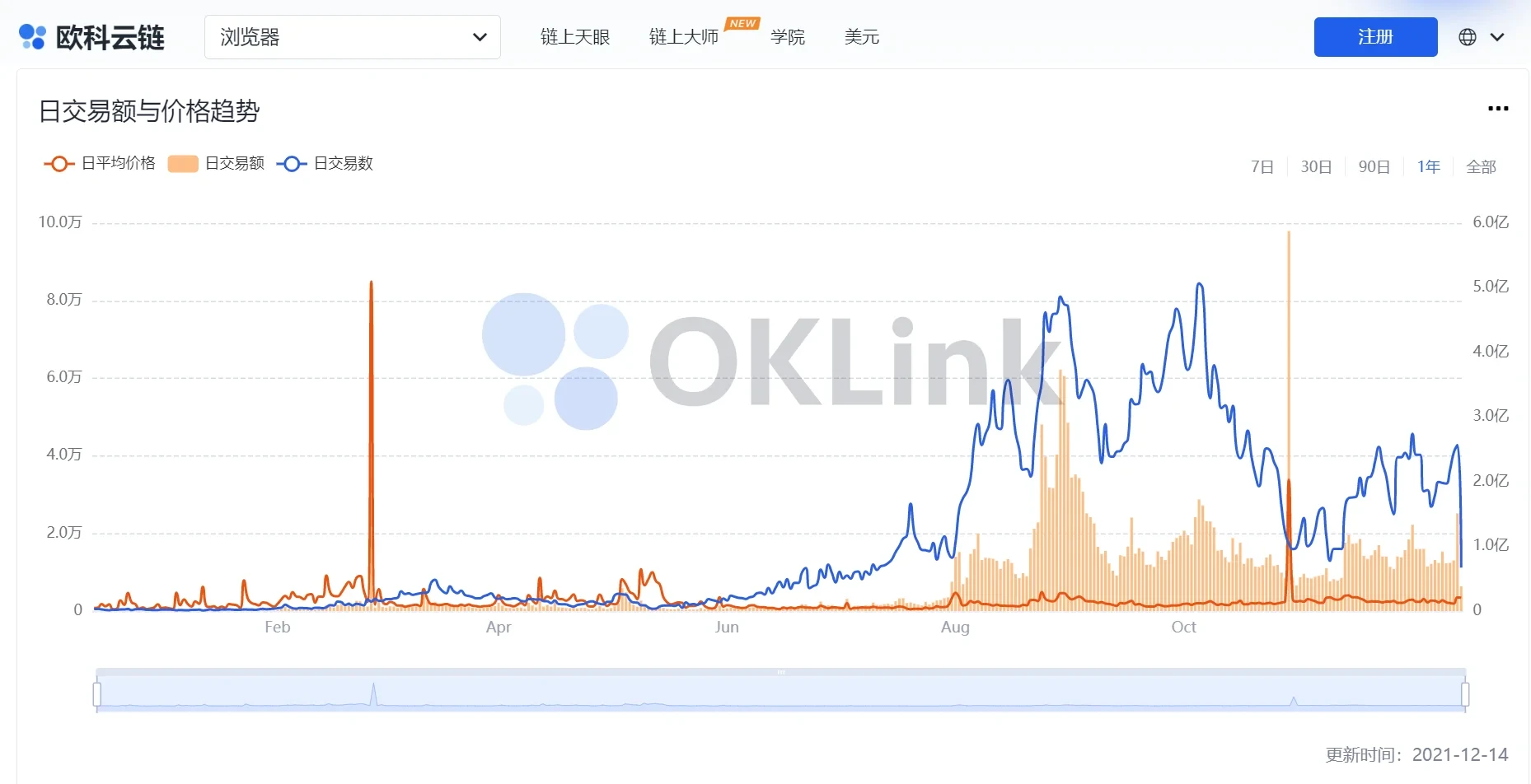
2021 NFT market daily trading volume and price trend changes, data source: OKC Chainspace
As shown in the statistics from OKC Chainspace above, on February 26, the NFT market's daily trading volume once reached $205 million, with an average transaction price exceeding $80,000 and approximately 2,400 daily trades. After several months of accumulation, the NFT market ultimately experienced a full-scale爆发 from August to October, with multiple key indicators — trading volume, average transaction price, and trade count — mostly setting new records. To put it in numbers: during this period, the NFT market's maximum daily trading volume exceeded $580 million, and the highest single-day trade count surpassed 80,000 trades. Such trading规模 is, for an NFT market with generally limited liquidity, an achievement certainly worth acknowledging.
Finally, turning to GameFi — the P2E model popularized by GameFi not only brought fresh gameplay to the digital assets market but also delivered an unprecedented shock to the traditional gaming market, while also bringing limitless imagination to the metaverse. According to statistics from OKC Chainspace, GameFi saw rapid development as early as April of this year, recording a peak monthly trading volume of $3.365 billion, with over 200,000 traders, and more than 5 million trades.
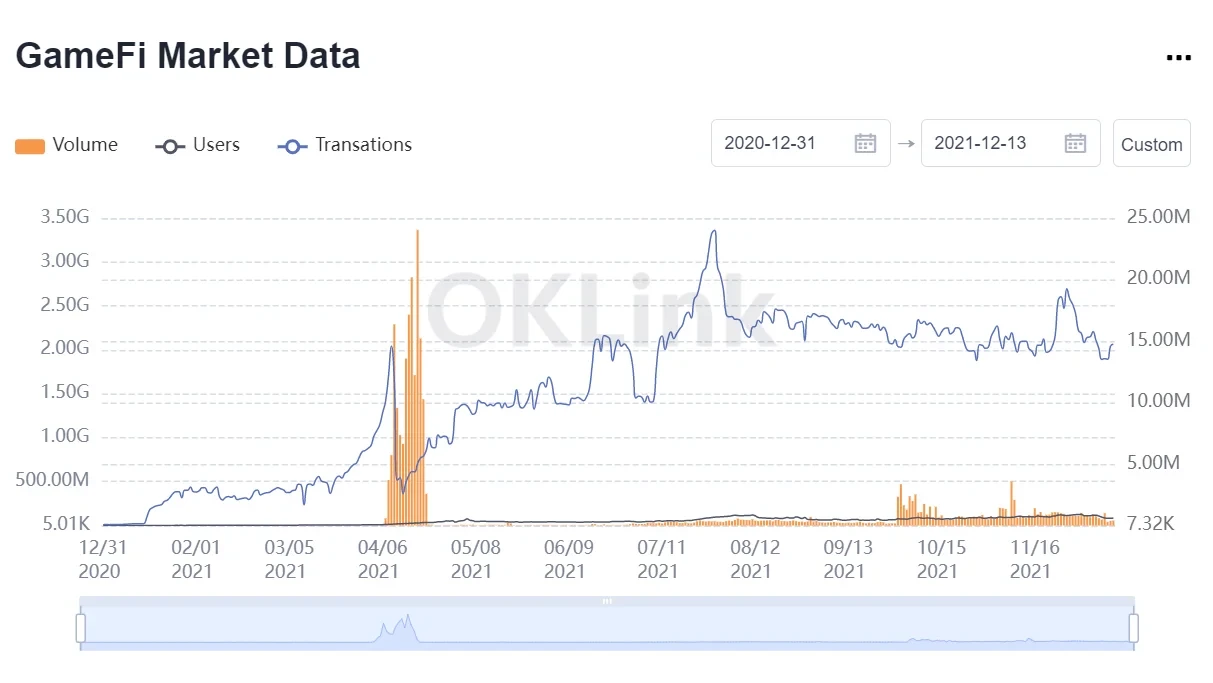
2021 GameFi market overview, data source: OKC Chainspace
Thereafter, while trading volume declined somewhat, the number of traders and daily trade count showed a steady upward trend. As of December 14, the maximum number of users participating in GameFi in a single day exceeded 680,000, with over 24 million trades — beginning to exhibit the characteristics of an expanding user base, increasing frequency, and decreasing average trade size.
Conclusion
There are only about ten days left until the end of 2021. Although the performance of most digital assets, Bitcoin included, currently remains somewhat subdued, as things stand, concepts such as the metaverse and GameFi continue to hold considerable influence in the market. In particular, since Facebook's rebranding to Meta, investment and financing in related tracks have become even more active. In closing, let us jointly look forward to the digital assets market delivering a strong performance in 2022.
Disclaimer
This article may contain product-related content not applicable to your region. This article is intended solely to provide general information and does not accept responsibility for any factual errors or omissions herein. This article represents the author's personal views only and does not constitute the views of OKX. This article is not intended to provide any recommendations, including but not limited to: (i) investment advice or investment recommendations; (ii) offers or solicitations to buy, sell, or hold digital assets; or (iii) financial, accounting, legal, or tax advice. Holdings in digital assets (including stablecoins) involve a high degree of risk and may fluctuate significantly, or even become worthless. You should carefully consider whether trading or holding digital assets is appropriate for you based on your financial situation. For questions about your specific circumstances, please consult your legal/tax/investment professional. The information contained in this article (including market data and statistics, if any) is for general reference purposes only. Although all reasonable precautions have been taken in the preparation of such data and charts, we assume no liability for any factual errors or omissions expressed herein. © 2025 OKX. This article may be reproduced or distributed in its entirety, or brief excerpts of 100 words or less from this article may be used, provided that such use is for non-commercial purposes. Any reproduction or distribution of the full article must prominently state: "This article is copyrighted © 2025 OKX, used with permission." Permitted excerpts must cite the article name and include attribution, for example: "Article name, [author name (if applicable)], © 2025 OKX." Some content may have been generated or assisted by artificial intelligence (AI) tools. Derivative works and other uses of this article are not permitted.
Show More
Recommended Reading
OKX Pay: Ushering in the Next Generation of Crypto Payment
The preferred choice of tens of millions of users — Register with OKX and enjoy an exceptional trading experience and a diverse range of wealth management products. A letter from OKX CEO Star: Today, we are officially launching the first version of OKX Pay to over 100 million global users. As the industry's first truly non-custodial and compliant payment application, OKX Pay will be embedded within the OKX App and is currently available in select markets, with a full rollout expected in the coming months.
March 22, 2026

A New Chapter: Building the Next Generation of Financial Infrastructure Together
The partnership between OKX and Intercontinental Exchange (ICE) marks a significant milestone for OKX and is equally profound for the evolution of the entire digital assets market. ICE builds and operates the world's most critical financial infrastructure, including the New York Stock Exchange and global derivatives and clearing platforms. This investment by ICE Select in OKX and its joining of our board reflects our shared belief — that digital assets technology will transform financial markets.
March 10, 2026
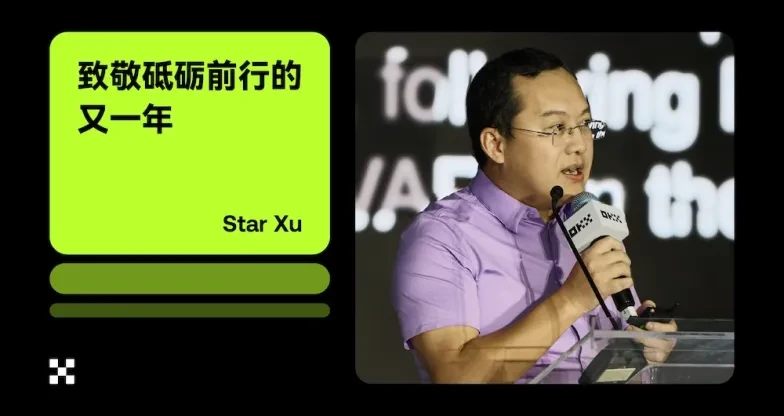
Paying Tribute to Another Year of Perseverance and Progress
As OKX's CEO and a builder who stays true to the original mission, I take great pride in reflecting on the extraordinary growth and progress OKX has achieved this year. Despite formidable challenges, 2024 was a year defined by focus, innovation, and resilience. We not only expanded and refined our products, but also made significant strides in launching transparent and regulation-compliant localized businesses, while further strengthening our global management team. It is worth noting that following
January 29, 2026

2025: Steady Progress Toward Financial Freedom
— An End-of-Year Letter to Global Users from Star, OKX Founder & CEO "Financial freedom" is often misunderstood. It does not mean the absence of rules, but rather having the freedom to choose even when rules exist — and, when the system is truly put to the test, that it remains reliable and effective. This has been our unwavering focus throughout 2025. First and foremost, I would like to extend my heartfelt gratitude to our global customers, partners, and regulators.
January 16, 2026
OKX Officially Launches in Germany and Poland
By Erald Ghoos, CEO of OKX Europe — Today is a momentous day for OKX — and for crypto users across Europe. We have officially launched a fully compliant centralized cryptocurrency exchange in Germany and Poland! For us, this is more than just a geographic expansion; it is a commitment to building the future of cryptocurrency the right way: secure, transparent, and tailored to local needs. If you are in Germany
October 21, 2025
Partnership Upgrade! OKX Joins Forces with Standard Chartered to Expand into Europe
On October 15, Erald Ghoos, CEO of OKX Europe, stated that OKX is expanding its strategic partnership with Standard Chartered into the European Economic Area (EEA). Earlier this year, OKX first partnered with Standard Chartered in the UAE, launching a collateral mirroring program — a
October 15, 2025