Trading Bitcoin: 2024 Technical and Sentiment Analysis of BTC
2024 has seen Bitcoin driving the cryptocurrency market upward. Investors looking to trade Bitcoin need to understand core metrics of trading tools and tokens before getting started. Whether you are just beginning to explore cryptocurrency trading or already have some experience, you may be interested in trading and investing in Bitcoin. As a cornerstone of the cryptocurrency world, Bitcoin is known as "digital gold" — it has stood the test of time and remains one of the earliest cryptocurrencies to challenge the traditional financial world. Although different from traditional stock and commodity markets, Bitcoin, as a relatively new asset class, frequently piques traders' curiosity.
Exploring Bitcoin trading involves multiple dimensions — from dynamic market factors to the uniqueness of token economics. If you are interested in how to trade Bitcoin, understanding relevant trading tools and strategies can be highly beneficial. This article covers fundamental technical analysis techniques as well as the Bitcoin trading landscape.
What Is Bitcoin (BTC)?
In response to the 2008 financial crisis, Bitcoin emerged as the world's first decentralized peer-to-peer payment network running without traditional intermediaries such as central banks or governments. Built on blockchain technology, Bitcoin provides all users with a public and accessible ledger to view secure and transparent trades. Since its inception by Satoshi Nakamoto in 2009, Bitcoin has grown in accessibility and scalability thanks to the widespread availability of various network upgrades (such as Taproot), and it now holds the position of the largest cryptocurrency by market cap.
BTC Token Economics
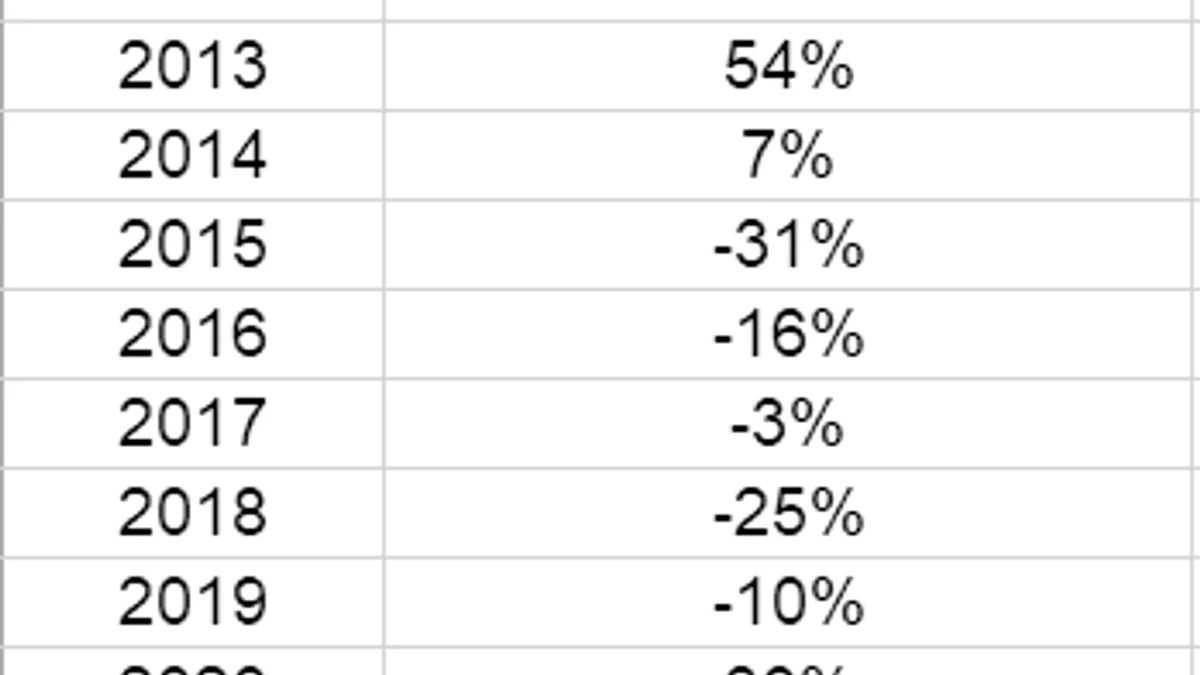
Bitcoin's token economics differ from other cryptocurrencies — it has no backing from risk investors and no concept of a community treasury. Instead, all newly minted Bitcoin is rewarded to individuals or organizations that mine new blocks. Bitcoin's maximum supply is capped at 21 million coins. Mining began with the genesis block in 2009 and will continue until all Bitcoin has been mined. A halving event occurs every 210,000 blocks, and the final batch of Bitcoin is expected to be distributed in 2142. Although miners will no longer be able to mint new Bitcoin after that point, they will still serve as network validators, earning returns through collecting transaction fees. Want to learn more about Bitcoin's supply schedule? Refer to the chart below for more details.
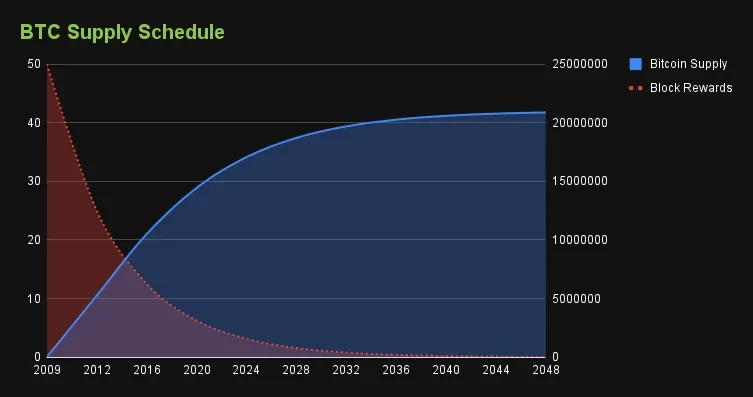
Source: coingecko.com
Source: coingecko.com
Why Is Bitcoin So Popular?
In the cryptocurrency market, Bitcoin is one of the most traded non-stablecoin assets. Many traders favor Bitcoin due to its high liquidity and extensive product suite, including derivatives such as futures and options. This has sparked curiosity among cryptocurrency beginners and new traders wanting to understand why Bitcoin has gained such widespread popularity among enthusiastic crypto traders.
A key reason for Bitcoin's widespread popularity is its first-mover advantage. Launched in 2009 as a pioneer in the digital assets space, Bitcoin inaugurated a new era in finance, striving to create a market independent of the traditional financial system.
After over a decade of development and proving its resilience, Bitcoin has earned the reputation of "digital gold" and a store of value, serving as a safe haven for wealth particularly during periods of economic instability. This status has been reinforced over time, especially during episodes of inflation or recession, when traders closely monitor Bitcoin's price movements to gauge overall market trends and sentiment.
Key Events Impacting Bitcoin's Price
While Bitcoin's price is influenced by multiple factors, BlackRock's announcement to file for a spot Bitcoin ETF was undoubtedly one of the most significant. BlackRock planned to launch an exchange-traded fund (ETF) tradable on traditional securities exchanges — a physically-backed spot Bitcoin ETF. Through this method, retail and institutional investors would be able to purchase shares in BlackRock's spot Bitcoin ETF, thereby indirectly holding a portion of BlackRock's Bitcoin reserves. Beyond attracting traders interested in cryptocurrency, Bitcoin may also benefit from the tax advantages of retirement accounts such as pensions and 401(k)s, as account holders in these vehicles now have greater access to invest in Bitcoin.
Beyond the excitement surrounding the spot Bitcoin ETF, other factors have kept Bitcoin's price in the mainstream media spotlight:
-
Argentina's new President Javier Milei pledged to abolish the central bank and has been a vocal supporter of cryptocurrency, sparking widespread speculation that Argentina might follow El Salvador's lead in making Bitcoin legal tender.
-
U.S. Senator Elizabeth Warren introduced a bill aimed at strengthening regulation and oversight of the crypto sector.
-
During the market volatility of 2023, Bitcoin advocate Michael Saylor continued to invest in Bitcoin through a dollar-cost averaging strategy, increasing MicroStrategy's total Bitcoin holdings to 193,000 BTC.
-
Interest rate cuts have been a hot topic among macroeconomists and those assessing economic health. If the U.S. Federal Reserve continues to implement significant rate cuts in 2024, borrowing costs will drop substantially and liquidity will increase. This could channel funds previously allocated to debt servicing into Bitcoin and other digital assets.
Bitcoin Sentiment Analysis
Regarding upcoming Bitcoin catalysts, the Bitcoin halving is something many crypto traders watch closely. Because Bitcoin halving reduces Bitcoin mining rewards by half every four years, it serves as a key catalyst for Bitcoin's price, as it marks another slowdown in the rate at which new Bitcoin enters the crypto market as it approaches its limited supply of 21 million. With each of the previous three Bitcoin halvings kickstarting crypto bull markets, traders will closely monitor price levels in April 2024 as we approach another Bitcoin halving. This halving will reduce Bitcoin mining rewards to 3.125 BTC per block.
Bitcoin Price Movements
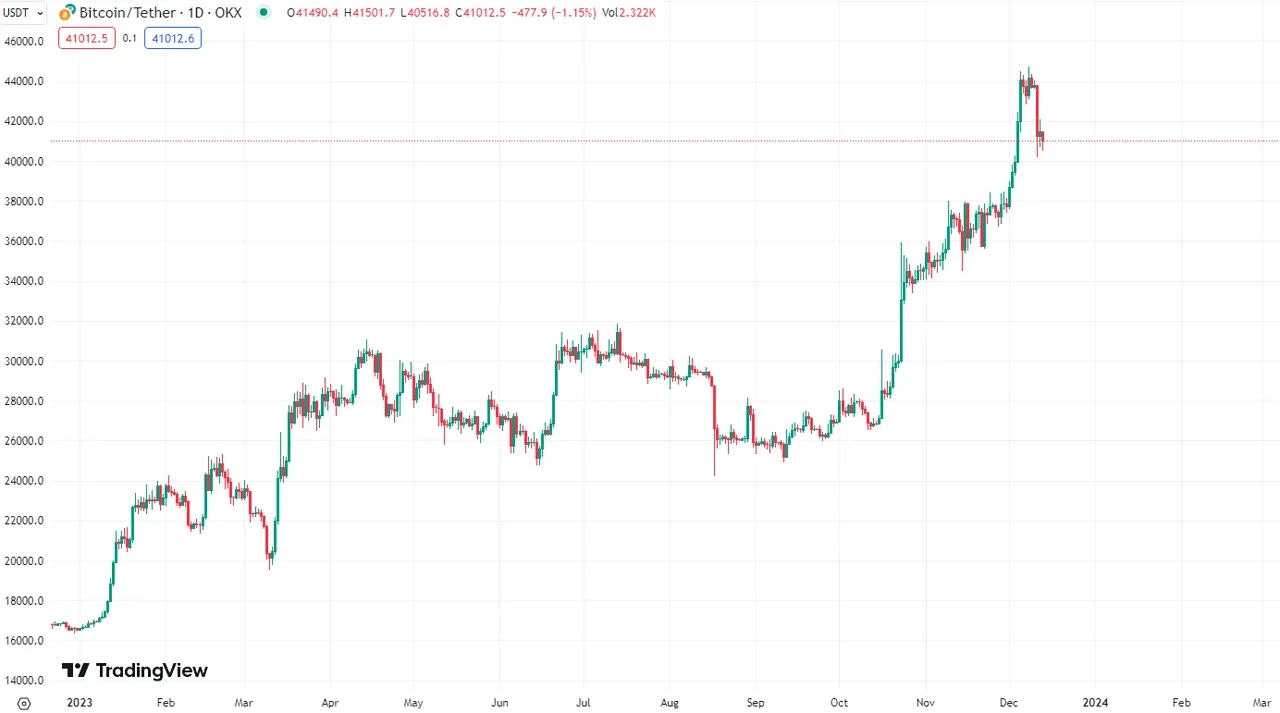
2023-2024 BTC price movements (source: TradingView)
2023 was referred to by many as the year of recovery for the crypto market, as Bitcoin led the market's resurgence with 155.57% annual performance. Since hitting its 2023 low on January 1, 2023, Bitcoin's price has recovered, driven by all the positive news around spot ETFs and a bullish macroeconomic sentiment, which resulted in BTC trading in a range of $16,502 to $44,726.80 throughout 2023.
While some crypto traders may have recently seen bearish news, market sentiment remains elevated based on market data, as BTC has hit new all-time highs.
Any cryptocurrency that is not a stablecoin is more prone to high levels of volatility. While accurately predicting BTC's price in the near term is difficult, some analysts have already shared their perspectives on where Bitcoin may be headed.
$29,564 – $101,528
$60,024 – $177,384
$139,026 – $266,977
$57,027 – $120,000
$61,357 – $140,449
$277,751 – $347,783
$45,615 – $68,422
$51,891 – $77,837
$98,862 – $148,293
$72,000 – $75,000
$78,000 – $78,500
$98,000 – $105,000
$100,000
–
–
$21,324 – $35,584
$95,388 – $116,344
$623,939 – $744,564
From the BTC forecast and price predictions, we can observe that analysts are indeed optimistic about Bitcoin's future.
Bitcoin Technical Analysis
To further validate Bitcoin price predictions and market sentiment, experienced cryptocurrency traders employ fundamental technical analysis to develop trading strategies and make inferences about Bitcoin's future movements. This typically involves a combination of using various trading indicators and identifying chart patterns. In the following examples, we will apply popular technical analysis tools such as the Simple Moving Average (SMA) and Relative Strength Index (RSI), while observing Bitcoin's price behavior on December 13, 2023.
Simple Moving Average (SMA)
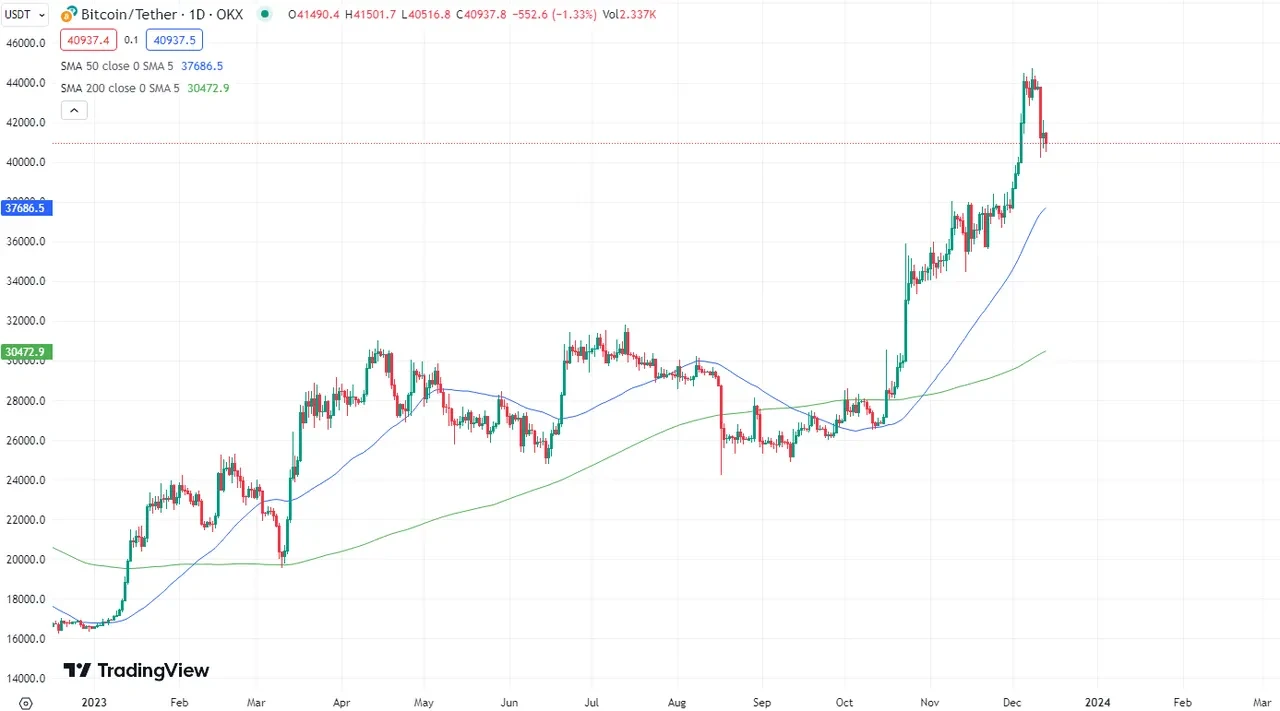
Bitcoin's Simple Moving Average (SMA) in 2023-2024 (source: TradingView)
Terms such as "golden cross" and "death cross" are frequently mentioned in technical analysis, with traders using the Simple Moving Average (SMA) indicator to identify these patterns. SMA lines serve as a visual representation of an asset's average closing price over a specific period, typically reflecting the asset's trend and serving as a convenient tool to determine whether an asset is in an uptrend or downtrend.
For Bitcoin, throughout 2023, we observed a golden cross forming in mid-October, as the 50-day Simple Moving Average crossed above the 200-day Simple Moving Average, signaling strong bullish momentum behind Bitcoin's price. This timing coincided with Bitcoin's price rising to the $36,000 range, amid heightened market excitement over the approval of spot Bitcoin ETFs. As these two moving averages continue to diverge, there is reason to believe the likelihood of a death cross forming in the near term remains low.
Entering 2024, Bitcoin's trajectory remained bullish, with the 50-day SMA and 200-day SMA widening further, showing no signs of slowing to date. With a target set at $69,000, we may witness a retest of previous all-time highs. Both bullish and bearish cryptocurrency traders will be watching this level to see whether there will be a breakout or another rejection at the $69,000 resistance level.
Relative Strength Index (RSI)
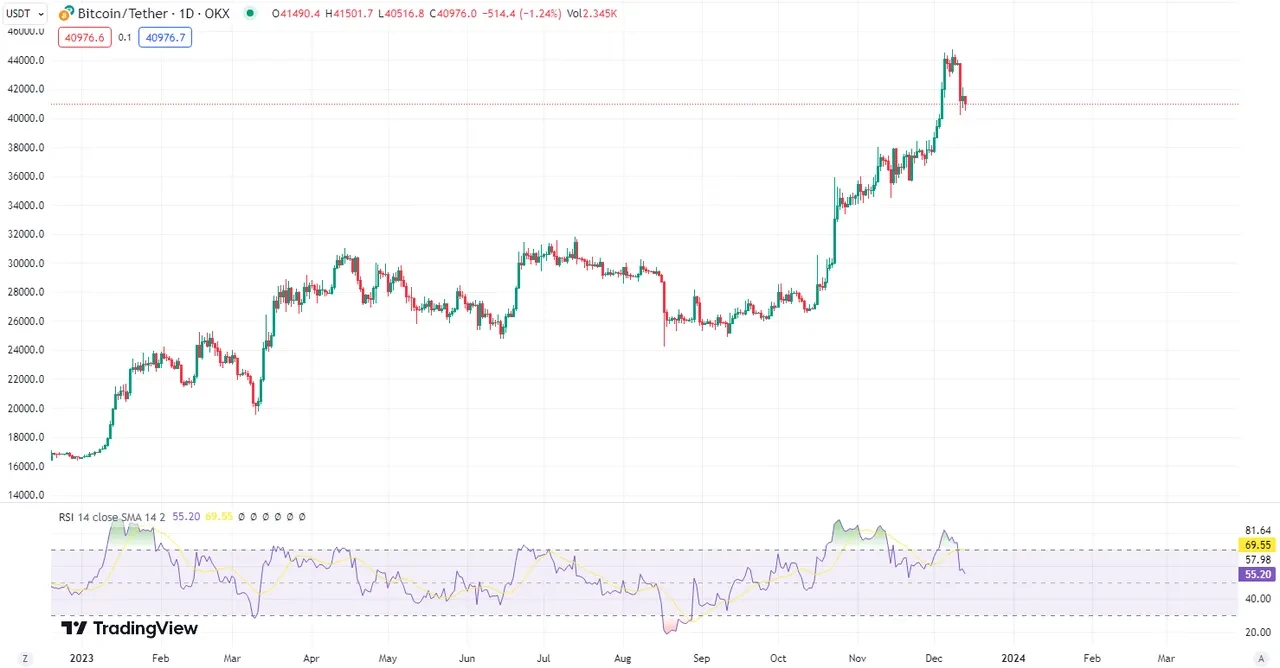
Bitcoin's Relative Strength Index (RSI) in 2023-2024 (source: TradingView)
RSI, as a lagging momentum indicator, is used to evaluate recent price changes and determine whether an asset is currently overbought or oversold. On a scale of 0 to 100, an RSI reading above 70 typically indicates that an asset is overbought and may require a short-term correction. Conversely, an RSI reading below 30 generally signals an oversold condition, with the asset potentially rebounding in the short term due to being undervalued.
Observing Bitcoin's RSI on the daily timeframe, we find its current value is 73.85, displaying overbought sentiment. This is somewhat understandable, as Bitcoin's price rise has been accompanied by bullish sentiment among cryptocurrency traders ahead of the upcoming Bitcoin halving event. Notably, during previous cryptocurrency bull markets, Bitcoin's RSI reached overbought highs of 83.46. This may also be one of the reasons Bitcoin's price has consolidated within this range, as traders who favor technical analysis may choose to sell to lock in profits after assessing Bitcoin's overbought condition.
Bitcoin Trading Strategy Examples
Completely new to the world of Bitcoin trading? Don't worry — here are some trading strategy examples you can reference when developing your trading plan.
Day Trading
Day trading is relatively lower risk in the cryptocurrency space, largely due to the typical volatility associated with cryptocurrency trading. This volatility carries a dual effect, providing day traders with numerous opportunities to lock in profits and limit losses, while avoiding overnight risk of holding Bitcoin.
When day trading Bitcoin, you need to set short-term trading strategies. This allows you to enter and exit the market quickly based on feedback from technical indicators and trading volume, which will signal whether you should make a buy or sell move. Additionally, implementing strict risk management measures and knowing when to exit a trade are critical, as excessive holding and wishful thinking often lead to unnecessary losses.
Swing Trading
Bitcoin swing trading is a more forgiving active trading approach, allowing cryptocurrency traders to focus on short-term price patterns and execute trades only after confirming such patterns or trends. While this method may be less effective in markets with sustained directional trends, swing trading can prove effective when Bitcoin's price oscillates within a range. As such, swing traders need to remain objective and capitalize on both market upswings and downswings.
Because Bitcoin swing trading involves a longer holding period than day trading, traders have the opportunity to set more flexible stop-loss and take-profit levels, allowing for higher risk tolerance. Additionally, the less frequent nature of swing trading enables traders to observe overall price trends from a broader perspective, avoiding the excessive focus on short-term price fluctuations that comes with frequent trading. This strategy reduces emotion-driven trading decisions, promoting more objective trading behavior that may yield steadier returns over time.
How to Trade Bitcoin?
Before considering how to trade Bitcoin, it is crucial to recognize the risks of reckless trading and succumbing to the fear of missing out (FOMO). It is also essential to understand the challenges you will face as a cryptocurrency trader. Due to potential flash crashes and rebounds, Bitcoin trading can experience dramatic price fluctuations, which can be challenging for inexperienced or greedy traders. Despite the risks involved, Bitcoin as an investment vehicle still offers certain advantages:
-
High Liquidity: As one of the most accessible cryptocurrencies currently available, Bitcoin has high liquidity and can be easily traded across platforms and exchanges. The launch of Bitcoin ETFs may further enhance its accessibility, typically meaning less slippage during trades and allowing for quick buying and selling without significant price differences.
-
High Volatility: Assets with stable, low volatility are often difficult to trade. Although Bitcoin's sharp price swings may deter risk-averse traders, they also represent opportunities for profit for those with proven trading strategies.
-
Trading Fees: Traders who trade frequently will find that trading fees accumulate over time, especially when trading over-the-counter stocks, where trading penny stocks may involve high trading fees. In contrast, Bitcoin's widespread adoption across major exchanges results in lower spreads and trading fees. By utilizing volume-based tiered fee structures, Bitcoin's trading fees can be adjusted based on individual trading volumes, making it more cost-effective.
Conclusion
Trading Bitcoin and other cryptocurrencies requires comprehensive knowledge and well-thought-out investment strategies, along with proper risk management. Looking to better understand market trading? Consider reading our Spot Trading Guide. Additionally, if you are interested in learning more about Bitcoin and the broader crypto space, feel free to continue exploring more articles — after understanding why Bitcoin and other cryptocurrencies are favored by investors, your crypto market investments will be better protected, and you will also gain insight into the volatility of the crypto market and the necessity of risk management.
Disclaimer
This article may contain product-related content not applicable to your region. This article is intended solely to provide general information and does not accept responsibility for any factual errors or omissions. The views expressed herein are solely those of the author and do not represent the views of OKX. This article is not intended to provide any advice, including but not limited to: (i) investment advice or investment recommendations; (ii) offers or solicitations to buy, sell, or hold digital assets; or (iii) financial, accounting, legal, or tax advice. Holding digital assets (including stablecoins) involves a high degree of risk and may be subject to significant price fluctuations, and may even become worthless. You should carefully consider whether trading or holding digital assets is appropriate for you based on your financial situation. Please consult your legal/tax/investment professional regarding questions specific to your circumstances. Information contained in this article (including market data and statistics, where applicable) is for general reference purposes only. Although all reasonable precautions have been taken in preparing such data and charts, we accept no responsibility for any factual errors or omissions expressed herein. © 2025 OKX. This article may be reproduced or distributed in its entirety, or excerpts of 100 words or fewer may be used, provided such use is non-commercial in nature. Any reproduction or distribution of the full article must also include prominent attribution: "This article is copyrighted © 2025 OKX, used under permission." Permitted excerpts must cite the article title and include the source, for example: "Article title, [author name (if applicable)], © 2025 OKX". Some content may have been generated or assisted by artificial intelligence (AI) tools. Derivative works and other uses of this article are not permitted.
Show More
What Is Bitcoin (BTC)?
Why Is Bitcoin So Popular?
Key Events Impacting Bitcoin's Price
Bitcoin Sentiment Analysis
Bitcoin Price Movements
Bitcoin Technical Analysis
Bitcoin Trading Strategy Examples
How to Trade Bitcoin?
Conclusion