As Bitcoin Price Falls Below $30,000 Again, Look to These Data Points for Clues
Since Bitcoin's brief dip to $28,808 on the 22nd of last month — followed by a quick recovery above the $30,000 mark — the price has traded in a $30,000–$37,000 range over the past month, with the fluctuations steadily narrowing. From the charts alone, the downward momentum has been unmistakable.
At 11:00 AM Beijing time on July 20th, Bitcoin's price fell below $30,000 once again. According to OKX market data, as of the time of writing, Bitcoin was trading at $29,590 and has yet to reclaim the $30,000 level.
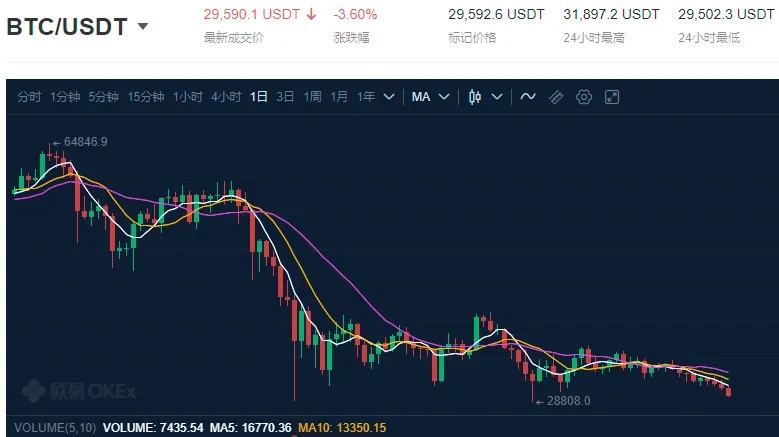
Bitcoin price chart, source: OKX
In the ever-changing crypto assets market, beyond the straightforward price action on the charts, there is a wealth of deeper-layer data worth paying attention to. Often, even before market volatility strikes, these indicators have already sent out signals in one form or another. With Bitcoin now trading below $30,000 once again, let us step into the role of the "Monday morning quarterback" and examine which "anomalous data points" had actually signaled valuable clues for market investors.
Bitcoin Exchange Net Inflow Volume
This indicator has been covered in prior articles. Bitcoin exchange net inflow volume essentially tracks the net difference between the number of Bitcoin flowing into exchange addresses from individual wallets and the number flowing out of exchange addresses over a given period. A positive value indicates that investors are transferring more Bitcoin to exchanges; a negative value means investors are moving Bitcoin from exchange addresses back to their own wallets. As a general market rule, when Bitcoin exchange net inflows surge in a short period, investors should be on high alert for the risk of whales dumping their positions.
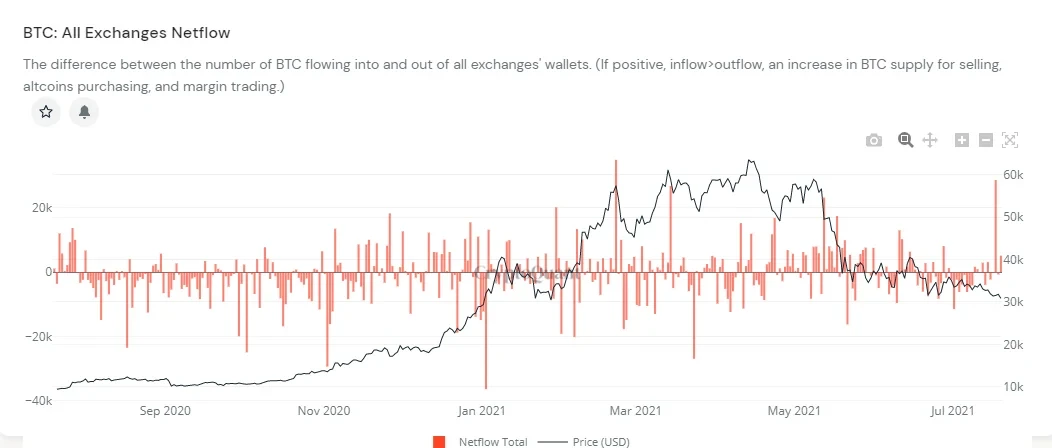
Bitcoin exchange net inflow data over the past year, source: CryptoQuant
Just yesterday (July 19th), crypto analytics firm CryptoQuant posted on its social media that Bitcoin exchange net inflows have been climbing sharply, with over 28,700 Bitcoin flowing into exchanges on July 17th alone. Since the start of 2021, there have been three instances of comparable-scale Bitcoin inflows to exchanges: on May 12th, March 14th, and February 21st — with February 21st recording the largest inflow at over 35,000 Bitcoin. In all three prior cases logged by CryptoQuant, Bitcoin's price dropped more than 10% within a week of the heavy inflows.
This brings us to the next logical question: who exactly is transferring Bitcoin to exchange addresses?
Bitcoin Miners' Selling Activity
If we categorize participants in the crypto market by asset size, among the largest investors — aside from well-known institutional players like Grayscale and MicroStrategy — Bitcoin miners certainly hold a prominent place.
When it comes to Bitcoin exchange net inflow volumes, miner addresses have historically been a key focus. In this latest episode, CryptoQuant also detected a significant transfer of Bitcoin from miner addresses to exchanges.
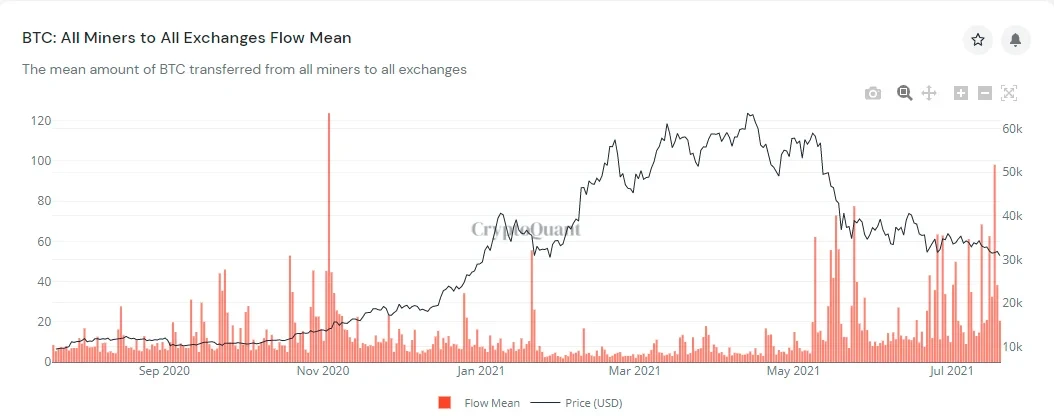
Average daily Bitcoin transferred from miners to exchanges over the past year, source: CryptoQuant
According to CryptoQuant data, over the past month the average number of Bitcoin transferred daily from all miners to exchanges saw several minor peaks, with six instances averaging over 60 Bitcoin. On July 17th, the average amount of Bitcoin transferred from all miners to exchanges reached 98.6171 Bitcoin — the highest since November 3, 2020. For context, during January to early May 2021 — as Bitcoin climbed from $30,000 to $60,000 — the daily volume of Bitcoin flowing from miners to exchanges was at its lowest point in nearly a year.
From an absolute volume perspective, recent Bitcoin transfers from miners to exchanges also show an upward trend, forming another small peak since May, with six single-day inflows close to or exceeding 10,000 Bitcoin. Looking specifically at July 17th's data, miners transferred a total of 14,000 Bitcoin to exchanges that day, accounting for approximately 50% of the total inflow of 28,700 Bitcoin — a formidable force on the sell side.
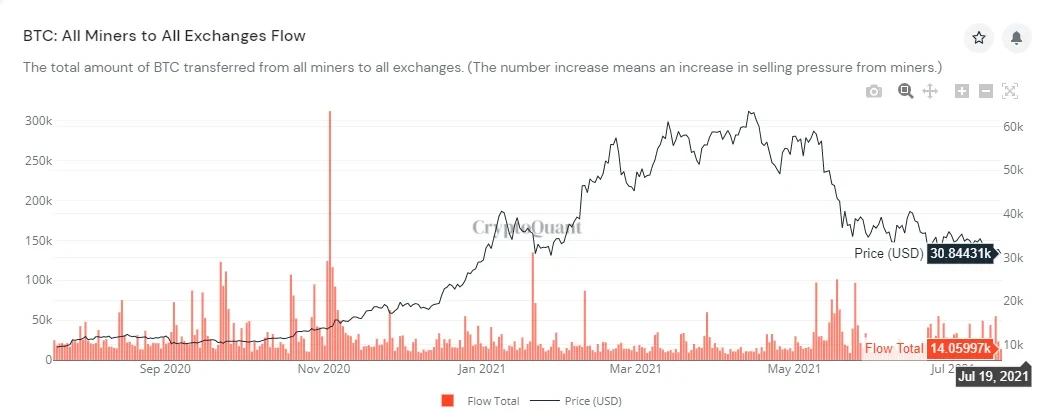
Bitcoin transferred from miners to exchanges over the past year, source: CryptoQuant
So why focus on miners during a downturn? Or rather, why categorize miners as part of the sell-side market? The key reason lies in the different profit mechanisms of miners compared to other market participants. For other investors — whether institutional or retail — profits primarily come from buying low and selling high in the secondary market (in the spot market, at least), capturing the spread. With this strategy, position-holding time carries a high degree of tolerance; their cost basis is incurred in a single upfront payment at the time of purchase, after which they simply wait patiently for the market price to reach their target before selling. This process can take a week, a month, or even several months. Miners, however, operate more like investors in a primary market. Their trading costs are ongoing, and their Bitcoin production costs are relatively fixed. For miners, selecting a higher price point to sell their Bitcoin in the short term is the most optimal strategy, as it maximizes returns while covering operational costs.
Bitcoin Market Dominance
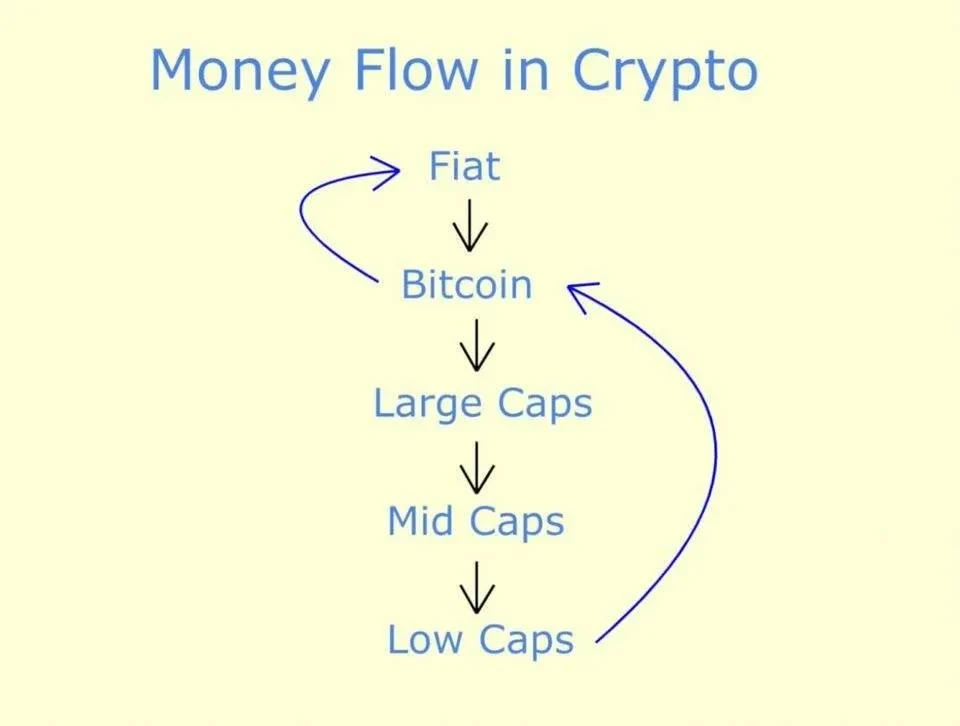
As the leader of the crypto market, Bitcoin's dominance has never been challenged since its inception — even after the rise of Ethereum and various altcoins, Bitcoin has maintained its absolute dominance. In our article "Bitcoin Market Dominance Falls Below 50% — How to Interpret This Key Signal," we outlined the basic patterns of cyclical sector rotation in the crypto market, which generally follow four stages: Bitcoin price surges → Ethereum leads the rally → mainstream coins climb → altcoins explode across the board. After the festivities end, profit-takers either cash out to fiat and exit, bringing the bull market to a close and ushering in a bear market; or after a period of consolidation, capital flows back into Bitcoin, kickstarting a new bull cycle.
Throughout this cycle, changes in Bitcoin market dominance offer a direct window into the market's rhythm. For instance, according to data from BYBT, Bitcoin's current market dominance stands at approximately 46.66%, roughly in line with the figure from April 2018 (47.08%). The chart further reveals that during that period, Bitcoin was in the process of falling from its previous bull market peak, with market dominance declining from 91% in February 2017 to 30.4% by mid-January 2018 — a pattern highly similar to the current cycle's trajectory: from 68.48% to 38.39% and back up to 46.66%.
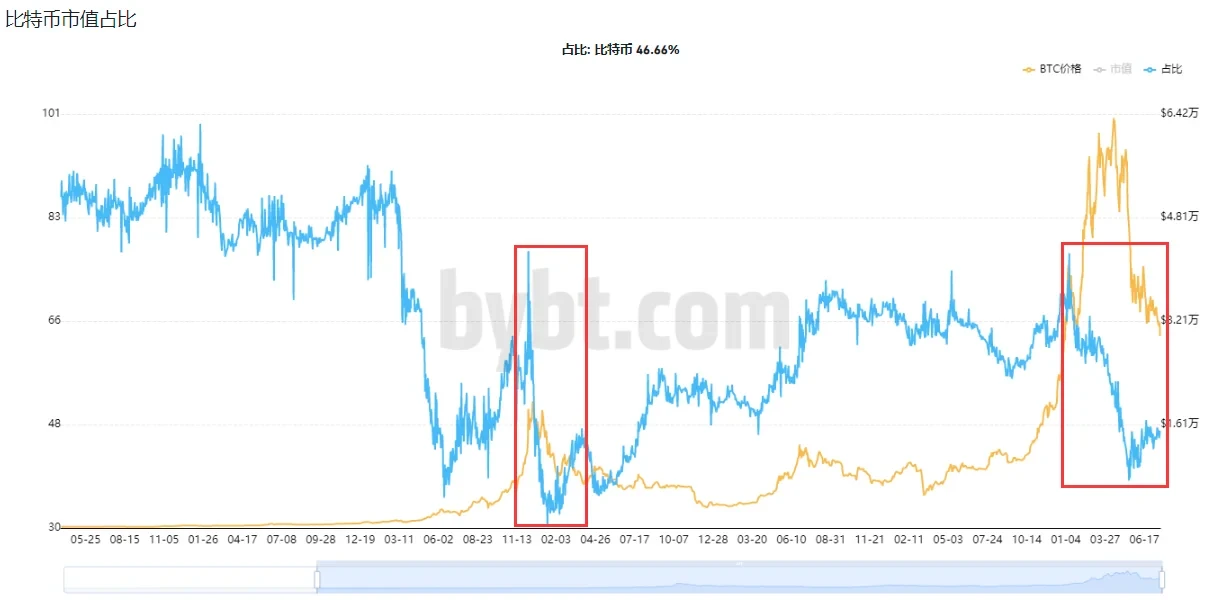
Bitcoin market dominance changes, source: BYBT
Bitcoin Contract Basis
Bitcoin contract basis refers to the difference between the futures contract price and the spot price. In essence, it reflects market investors' psychological expectations for Bitcoin's future price. When investors are broadly bullish on future prices, the contract premium will be positive, and the stronger the conviction, the higher the premium.
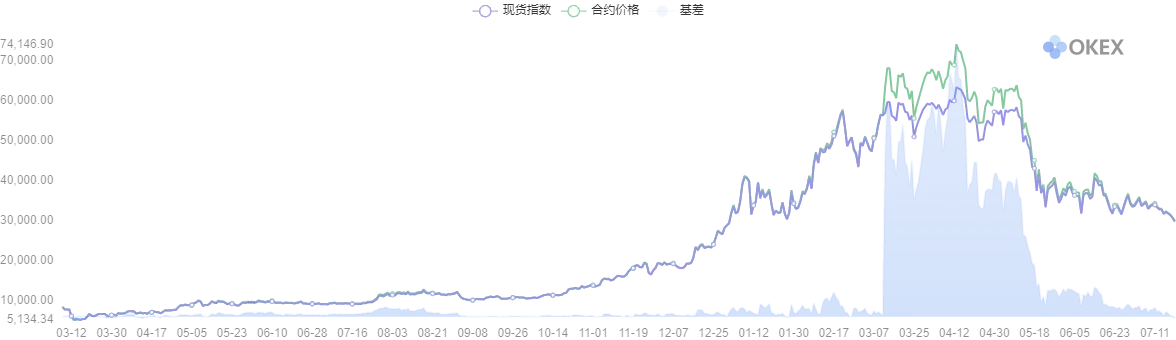
BTCQuanto式当季合约基差近4个月走势,来源OKX
Examining the BTCUSD quarterly contract basis from the chart above, it is evident that since April 13th, the BTCUSD quarterly contract basis has been steadily narrowing — meaning the gap between the quarterly contract price and the spot price has been compressing. As of 15:00 Beijing time on July 20th, 2021, the basis stood at -$83.7, representing a basis rate of -0.29%, indicating that the BTC quarterly contract was already trading below the BTC spot price. For comparison, on April 13th — when the basis on OKX's BTCUSD quarterly contract was at its peak — the basis had reached $10,798.85, with a basis rate of 17.04%. This comparison reveals that over the past three months, futures market investors' medium- to long-term psychological expectations for Bitcoin have been gradually declining.
Conclusion
The crypto market has evolved significantly since its early days. Investment targets have expanded from a single Bitcoin to thousands of different crypto assets, and the factors driving market movements have become increasingly complex and varied. Whether you are a crypto enthusiast or an investor, keeping a close eye on developments beyond the price charts is essential. Only by taking a holistic view can you minimize risk to the fullest extent possible.
Disclaimer
This article may contain product information not applicable to your region. This article is provided for general informational purposes only and we make no representation as to the accuracy or completeness of any information contained herein. The views expressed in this article are solely those of the author and do not represent the views of OKX. This article is not intended to provide, and should not be relied upon as, legal, tax, investment, financial, or other advice, including but not limited to: (i) any investment advice or investment recommendations; (ii) any offer or solicitation to buy, sell, or hold digital assets; or (iii) any financial, accounting, legal, or tax advice. Digital assets (including stablecoins) are subject to high risk and their prices may fluctuate significantly, and could even become worthless. You should carefully consider whether trading or holding digital assets is appropriate for you given your financial situation. Please consult your legal/tax/investment professionals for questions regarding your specific circumstances. Any market data or statistics appearing in this article are provided for general reference only. While reasonable precautions have been taken in preparing this data and these charts, we assume no liability for any factual errors or omissions expressed herein. © 2025 OKX. This article may be reproduced or distributed in its entirety, or in excerpts of 100 words or fewer, provided such use is for non-commercial purposes only. Any reproduction or distribution of the full article must prominently state: "This article is copyrighted © 2025 OKX, used with permission." Permitted excerpts must cite the article title and include the source, for example: "Article title, [author name (if applicable)], © 2025 OKX." Some content may have been generated or assisted by artificial intelligence (AI) tools. Derivative works and other uses of this article are not permitted.
Show More
Recommended Reading
OKX Pay: Ushering in a New Era of Next-Gen Crypto Payments
The choice of tens of millions of users. Register with OKX and enjoy an exceptional trading experience alongside a full suite of wealth management products. A message from OKX CEO Star: Today, we are officially launching the first version of OKX Pay to over 100 million global users. As the industry's first truly non-custodial and compliant payment application, OKX Pay will be embedded directly within the OKX App and is currently available in select markets, with a full global rollout expected in the coming months.
March 22, 2026

A New Chapter: Building the Next Generation of Financial Infrastructure Together
The partnership between OKX and Intercontinental Exchange (ICE) marks a significant milestone for OKX — and carries equally profound implications for the evolution of the entire digital assets market. ICE builds and operates some of the world's most critical financial infrastructure, including the New York Stock Exchange and global derivatives and clearing platforms. ICE's strategic investment in OKX and its seat on our Board of Directors reflect a shared conviction: that digital assets technology will transform financial markets.
March 10, 2026

To Another Year of Building
As CEO of OKX and a builder who has never forgotten the original mission, I am proud to look back on the extraordinary growth and progress OKX has achieved this year. Despite significant challenges, 2024 was a year defined by focus, innovation, and resilience. We not only expanded and refined our product suite, but also made major strides in launching transparent and regulation-compliant localized businesses, while further strengthening our global management team. It is worth noting that after going through
January 29, 2026

2025: A Steady Progression Toward Financial Freedom
— An End-of-Year Letter to Global Users from Star, Founder & CEO of OKX "Financial freedom" is often misunderstood. It does not mean the absence of rules, but rather the freedom to choose — even in the presence of rules — and the assurance that the system remains reliable and effective when it is truly put to the test. This has been our unwavering focus throughout 2025. First and foremost, I want to extend my sincere gratitude to our global customers, partners, and regulators.
January 16, 2026

OKX Officially Launches in Germany and Poland
By Erald Ghoos, CEO of OKX Europe Today is a milestone for OKX — and for crypto users across Europe. We have officially launched our fully compliant centralized cryptocurrency exchange in Germany and Poland! For us, this is more than a geographic expansion; it is a commitment to building the future of cryptocurrency the right way: secure, transparent, and tailored to local needs. If you are in Germany
October 21, 2025

Partnership Upgrade! OKX and Standard Chartered Join Forces to Expand Across Europe
On October 15th, Erald Ghoos, CEO of OKX Europe, announced that OKX is expanding its strategic partnership with Standard Chartered to the European Economic Area (EEA). Earlier this year, OKX and Standard Chartered first joined forces in the UAE, launching the Collateral Mirroring program — a
October 15, 2025