Exploring the Correlation Between Bitcoin and S&P 500 Charts and Stocks
When building a long-term investment portfolio, traders often focus on established blue-chip stocks and exchange-traded funds that track the S&P 500. Given their proven track record and popularity among institutions, it's no surprise they've become a go-to choice for those new to traditional finance (Trad Fi).
However, given that some hedge funds and institutions are championing the inclusion of cryptocurrency in investment portfolios, we're seeing this norm gradually shift. With Bitcoin rising from $16,000 to over $40,000 in a single year and outperforming traditional financial assets, cryptocurrency has once again become a hot topic in the traditional finance industry.
Curious about how Bitcoin stacks up against established companies like the S&P 500? This article will take a deep dive into comparing Bitcoin and the S&P 500—from viewing Bitcoin vs. S&P 500 charts, measuring their year-to-date (YTD) performance, to understanding the correlation between Bitcoin and the stock market, giving you the essential knowledge you need when comparing Bitcoin and the S&P 500.
If you're a seasoned cryptocurrency user or an interested observer, you already know what Bitcoin is. Before we dive into the comparison, let's first understand what the S&P 500 is and why it's so popular in traditional finance.
What Is the S&P 500?
The S&P 500 index is a stock market index compiled in 1957 to track the performance of the top 500 companies listed on US stock exchanges. The S&P 500's constituents include companies you interact with daily as well as high-growth tech companies—most notably Tesla, Microsoft, Visa, Coca-Cola, and McDonald's.
Why Is the S&P 500 So Popular?
As a barometer of the US economy, the S&P 500 has long been the preferred choice for risk-averse traders looking to hold long-term positions. This is largely due to its proven track record over time and history, as well as its diversification advantage across many popular sectors. By holding the S&P 500 long-term, traders have historically earned nearly 10% in annual returns. Beyond its depth and diversity, the S&P 500 is also favored for its regular rebalancing. By culling underperforming companies and ensuring reasonable sector weightings, this ongoing rebalancing keeps the S&P 500 diversified and prevents it from being overly tilted toward hot sectors like technology.
How Do Analysts View Bitcoin Now? The Shifting Bitcoin Narrative
The biggest reason Bitcoin and other cryptocurrencies are being discussed so frequently today is that traditional finance has finally shifted its stance on the legitimacy of cryptocurrency. Research analysts have publicly stated that including some cryptocurrency in your investment portfolio may be a good idea—a stark contrast to the sentiment in 2022, when Bitcoin's reputation was damaged by the collapse of Terra Luna and FTX. Today, this has evolved into a bullish narrative, with even traditional finance giants like BlackRock participating in the crypto market through Bitcoin spot ETFs.
Beyond this shifting narrative, Bitcoin is also gaining popularity because it's becoming less correlated with today's macroeconomic conditions. Given Bitcoin's decentralized nature, it's now more likely than ever to be viewed as a hedge against traditional financial market volatility. Echoing what BlackRock CEO Larry Fink has said, traders are treating Bitcoin as a safe-haven asset amid regional bank failures and countries like Sri Lanka declaring national bankruptcy.
Similarities Between Bitcoin and the S&P 500
Strong Performance During Loose Monetary Policy
One key commonality between Bitcoin and the S&P 500 is that both tend to perform well during periods of loose monetary policy—when central banks stimulate the economy by lowering interest rates, for example. Such periods often direct more funds toward asset markets, and understanding why this occurs is essential.
During the quantitative easing phase, central banks tend to purchase government bonds to inject liquidity into the economy. This creates a low-interest-rate environment, allowing businesses and individuals to obtain loans and minimize borrowing costs. This was the case during the COVID-19 pandemic, when companies took on significant debt to take advantage of near-zero interest rates, which fueled growth across tech companies and drove pandemic stocks like Peloton, Zoom, and DocuSign to all-time highs, with projected demand and revenue growth multiplying several times over. Ultimately, because companies quickly responded to favorable rates and took advantage of low borrowing costs, the S&P 500 recovered swiftly from its February 2020 lows.
The same holds true for Bitcoin, as traders also began injecting more funds into the crypto market and speculating aggressively due to government-distributed funds and stimulus checks. This ultimately drove Bitcoin to an all-time high before the federal government began raising interest rates.
Easy Access, Anytime, Anywhere
Stock trading today is widely considered convenient and efficient. This is a far cry from the past, when you had to call a broker and wait for an operator to assist with trade execution and get the best price. From accessing different markets to the commission fees involved, traditional finance traders must be familiar with trading the S&P 500 index and its related stocks.
While Bitcoin wasn't quite as accessible a decade ago, cryptocurrency traders can now hold Bitcoin anytime, anywhere. Thanks to the proliferation of centralized exchanges, crypto traders can easily deposit funds and access a variety of Bitcoin-related trading pairs and derivatives such as futures and options. And when spot ETFs were approved, traders gained even more methods to invest in Bitcoin.
Differences Between Bitcoin and the S&P 500
Degree of Diversification
The most apparent difference between Bitcoin and the S&P 500 is that the former is a single digital asset, while the latter is a collection of the top 500 US-listed companies. While trading Bitcoin gives you 100% exposure to the asset itself, trading the S&P 500 index gives you a market-cap-weighted combination of various stocks, with the top holdings being Apple, Microsoft, and Amazon. This ultimately makes trading the S&P 500 index more suitable for risk-averse traders, as it's relatively more stable and diversified compared to Bitcoin.
Volatility
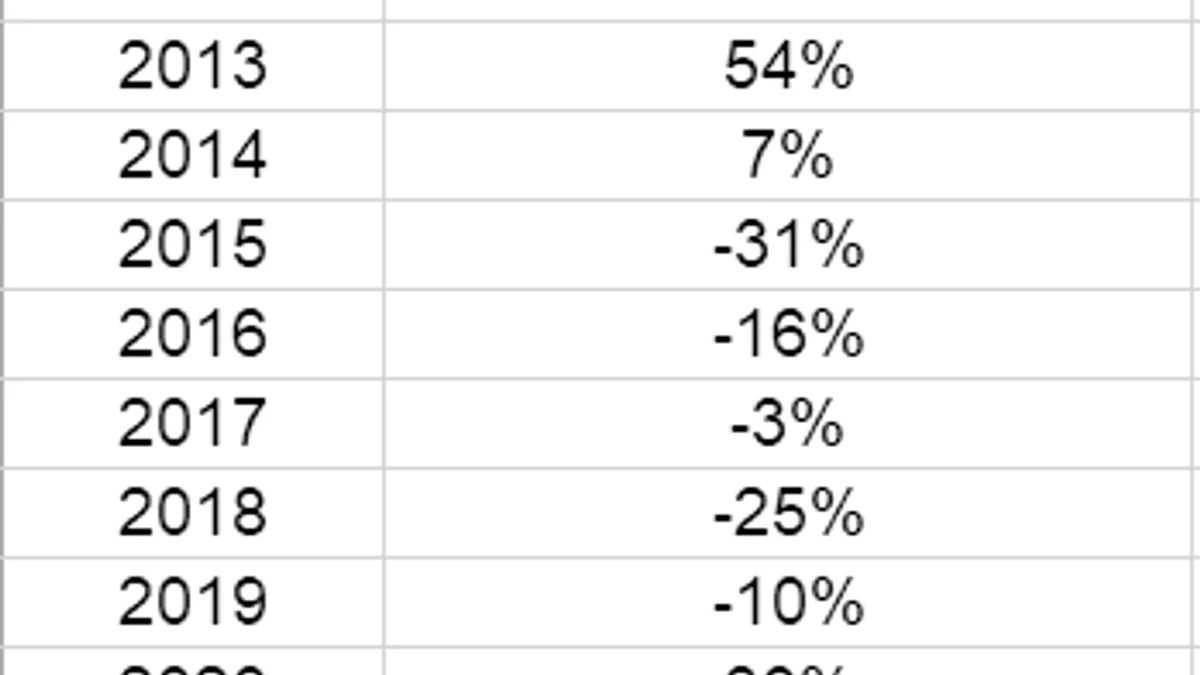
When comparing Bitcoin and the S&P 500, an important topic is their differing volatility. To measure this, we can look at Bitcoin and the S&P 500's historical performance. Bitcoin's performance is akin to a rollercoaster, with its 2022 performance contrasting sharply with 2023. From plummeting over 64% in 2022 to surging 160% year-to-date in 2023, cryptocurrency traders need to adapt to Bitcoin's volatility when trading it. By contrast, the S&P 500 steadily averages around 9% to 10% annual gains, and because it's a benchmark for overall US economic performance, it's much less volatile. Although the S&P 500 had lower overall returns over the same comparison period, its year-to-date performance and long-term track record make it a more stable performer over time.
Different Levels of Regulation
For those unfamiliar with cryptocurrency, the regulatory differences compared to traditional finance make Bitcoin and the crypto market appear to be the Wild West. Traditional finance traders have established regulatory frameworks, whereas in the cryptocurrency space, such frameworks and regulatory bodies are still gradually taking shape. Fortunately, centralized exchanges have complied with anti-money laundering standards by implementing Know Your Customer (KYC) verification requirements.
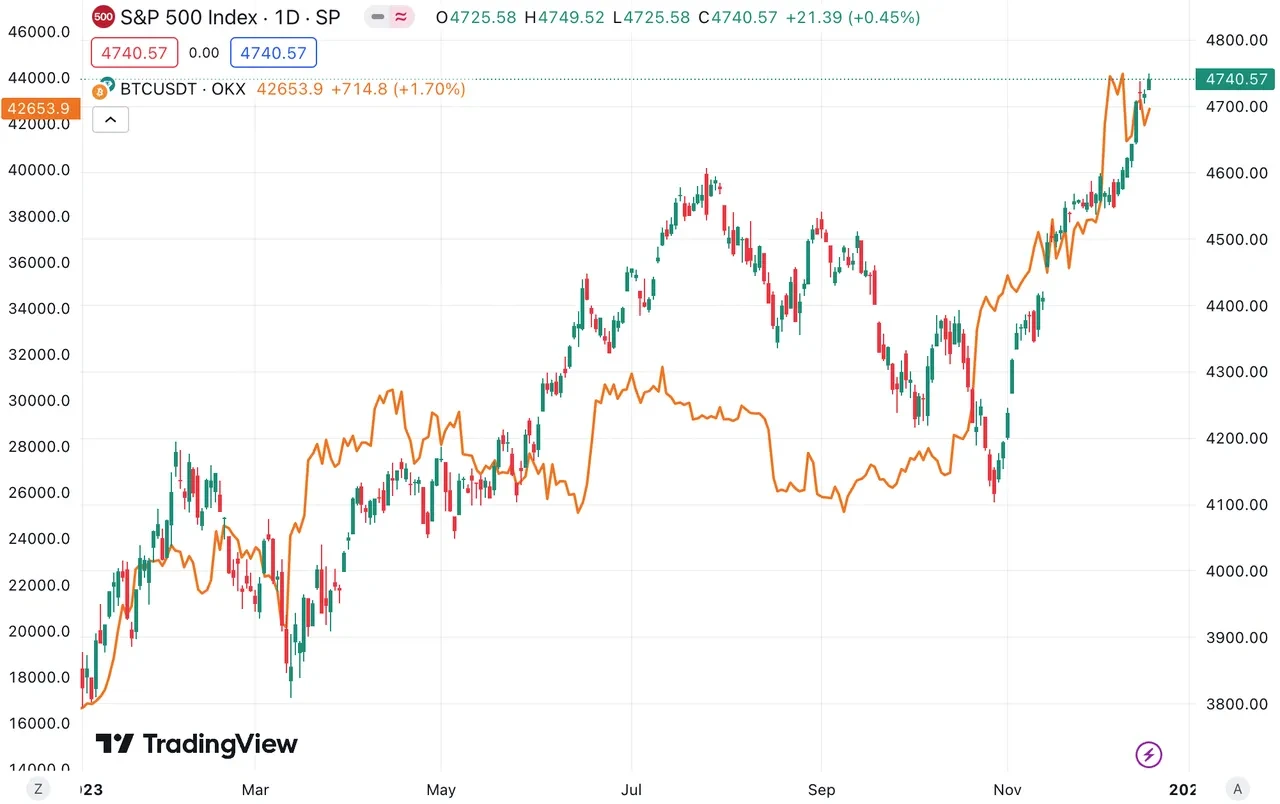
From the chart above, we can observe that as of December 19, 2023, both Bitcoin and the S&P 500 are clearly in an uptrend. Curious about why Bitcoin correlates with the S&P 500? One reason could be the decline in inflation rates and the halt in interest rate hikes by the US Federal Reserve.
In doing so, the Fed created a favorable environment for risk trading, as both Bitcoin and the S&P 500 index experienced bull market rallies, breaking the bearish sentiment caused by the 2022 correction. Year-to-date, Bitcoin has surged 160%, while the S&P 500 gained 23%. While some may hail Bitcoin as the clear winner by comparison, when looking back at 2022, Bitcoin plummeted 64% while the S&P 500 fell only 19%. These annual performances ultimately make the comparison between Bitcoin and the S&P 500 more nuanced, as Bitcoin's outsized gains typically come after significant Bitcoin price pullbacks.
Bitcoin and Stock Market Correlation: Bitcoin vs. S&P 500 Correlation
Is Bitcoin correlated with the stock market? A quick glance at the chart above shows they appear correlated, but it's not that simple. As mentioned, a key reason they both rose is the improvement in macroeconomic conditions. Removing this from the equation, we can note that the narratives driving Bitcoin and the S&P 500 higher differ significantly. Here are some reasons why the correlation between Bitcoin and the S&P 500 may be called into question.
Bitcoin's Inherent Volatility
One of the biggest reasons Bitcoin isn't correlated with the stock market is that price shocks driven by news around Bitcoin ownership cause more significant volatility than anticipated. From Tesla selling its Bitcoin holdings to MicroStrategy's aggressive Bitcoin accumulation strategy, these are major catalysts that have led to substantial Bitcoin price swings. As a result, this causes a decoupling from stock market indices like the S&P 500, as the stock market may rise or fall in the opposite direction of Bitcoin's price in response to such announcements.
S&P 500 vs. Bank Runs
In early March 2023, as rising interest rates shook the foundations of many US banks, the S&P 500 faced a startling decline. Due to panicked withdrawals by wealthy individuals and institutions, the now-defunct Silvergate Bank, Signature Bank, and Silicon Valley Bank all fell victim to bank runs. This led to a distrust of the current banking system, prompting a migration of funds toward the cryptocurrency market. For many traders, this was viewed as a hedge against the fiat currency system given cryptocurrency's decentralization, reducing the risk of fund losses. As a result, Bitcoin became even more popular while the S&P 500 declined, further highlighting the lack of correlation between Bitcoin and the stock market.
Incorporating Both Bitcoin and the S&P 500 Into a Comprehensive Investment Portfolio
In an in-depth study conducted by Fidelity, the effects of adding a small allocation of Bitcoin to a traditional investment portfolio composed of stocks and bonds were examined. It found that traders who added just 1% Bitcoin to their portfolio experienced approximately 3% more volatility. Due to the limited data available on Bitcoin, the team concluded that given its volatility correlation with traditional assets, Bitcoin has the potential to enhance overall diversification. Therefore, given that Bitcoin and cryptocurrency as an asset class carry potential hedging capabilities and have delivered impressive returns so far, including it as part of a comprehensive investment portfolio makes sense.
However, given Bitcoin's high volatility, traders must ultimately maintain strict risk management, as increased portfolio holdings require higher returns to justify them. Therefore, traditional finance traders planning to add Bitcoin to their portfolio must account for the risks involved and how Bitcoin may alter the overall dynamics of the investment portfolio.
Conclusion
When comparing Bitcoin to the S&P 500, it's important to first understand that both are popular among many people due to their high liquidity and broad accessibility. However, when it comes to planning and executing trades, which one you choose depends more on your personal risk tolerance and investment time horizon.
For seasoned traditional finance traders, if you prioritize security measures to prevent fraud and scams, the S&P 500 index may be more favored. Conversely, if you're a cryptocurrency trader who understands the cycles cryptocurrency goes through and has strict risk management and successful trading strategies, taking on Bitcoin's risk and capitalizing on its volatility may be more appealing to you.
Eager to explore more about Bitcoin? Through our in-depth research, discover why we believe Bitcoin has intrinsic value. If you're interested in upcoming influencing factors, you may want to read about the Bitcoin halving—which could be the key event that sparks the next crypto market bull run.
Disclaimer
This article may contain product content not applicable to your region. This article is committed to providing general information only and accepts no responsibility for any factual errors or omissions. This article represents the author's personal views only and does not represent the views of OKX. This article is not intended to provide any advice, including but not limited to: (i) investment advice or investment recommendations; (ii) offers or solicitations to buy, sell, or hold digital assets; or (iii) financial, accounting, legal, or tax advice. Holdings in digital assets (including stablecoins) carry a high degree of risk and may fluctuate significantly, or even become worthless. You should carefully consider whether trading or holding digital assets is suitable for you based on your financial situation. For questions about your specific circumstances, please consult your legal/tax/investment professional. The information contained in this article (including market data and statistics, if any) is for general reference purposes only. While all reasonable precautions have been taken in preparing such data and charts, we accept no responsibility for any factual errors or omissions expressed herein. © 2025 OKX. This article may be reproduced or distributed in its entirety, or excerpts of 100 words or less may be used, provided that such use is non-commercial. Any reproduction or distribution of the full article must also prominently state: "This article is copyrighted © 2025 OKX, used under permission." Permitted excerpts must cite the article title and include attribution, e.g., "Article Title, [Author Name (if applicable)], © 2025 OKX." Some content may have been generated or assisted by artificial intelligence (AI) tools. Derivative works and other uses of this article are not permitted.
Show More
What Is the S&P 500?
How Do Analysts View Bitcoin Now? The Shifting Bitcoin Narrative
Similarities Between Bitcoin and the S&P 500
Differences Between Bitcoin and the S&P 500
Bitcoin and Stock Market Correlation: Bitcoin vs. S&P 500 Correlation
Incorporating Both Bitcoin and the S&P 500 Into a Comprehensive Investment Portfolio
Conclusion
Recommended Reading
Everything You Need to Know About Cryptocurrency Scams
While the cryptocurrency industry offers groundbreaking opportunities for growth and innovation, it has also attracted its fair share of fraudulent activities. Cryptocurrency trading scams are often disguised as attractive opportunities promising high returns with minimal risk. These scams take many forms, from sophisticated Ponzi schemes to deceptive Initial Coin Offerings (ICOs), luring traders into traps set by cunning fraudsters. On the other hand, withdrawal scams add another layer of complexity, leaving traders trapped in
2026年3月11日
Beginner
Martingale Strategy (DCA) - How to Strategically Average Costs
DCA, short for Dollar Cost Averaging, is a strategy commonly used in traditional finance forex markets. If you always worry about missing the bottom, or if the asset continues to fall after buying at a low point, understanding and using the Martingale strategy can help you invest more effectively in the crypto market. What Is the Martingale Strategy (DCA)? The Martingale
2026年2月27日
Intermediate
Virtual Currency Technical Analysis Guide: Complete Introduction to 5 Common Analysis Tools!
2026年2月27日
Beginner
Trading Bitcoin: Technical and Sentiment Analysis for BTC in 2024
In 2024, Bitcoin has been driving the cryptocurrency market upward, and investors looking to trade Bitcoin need to understand the core metrics of trading tools and tokens before doing so. Whether you're just starting to explore cryptocurrency trading or have already accumulated some experience, you may want to trade and invest in Bitcoin. As one of the pillars of the cryptocurrency world, Bitcoin is hailed as "digital gold"—it has not only stood the test of time but was also the first to challenge the traditional financial world
2026年2月26日
Beginner
How to Conduct Block Trades on the OKX Liquidity Market?
Block trading is one of the cutting-edge products and services offered by OKX, and users can access this feature on our liquidity market. Block trading enables users to enter or exit significant cryptocurrency positions without worrying about the risk of price slippage. The OKX liquidity market supports trading across a variety of instruments, where users can execute block trades and deploy more complex multi-leg trading strategies. This article will cover how to use block
2026年2月26日
Intermediate
What Is the "Pig Butchering" Scam and How to Avoid It?
"Pig butchering" scams are a relatively new form of fraud in the cryptocurrency space, where scammers financially defraud victims through fake romantic or friendship relationships. These scams are typically meticulously planned over long periods, with scammers winning victims' trust and encouraging them to invest funds in seemingly legitimate opportunities, only to disappear suddenly. As cryptocurrency has gradually entered the mainstream, "pig butchering" scams have been on the rise. This article will explain what "pig butchering" scams are and
2026年2月21日
Beginner