Twitter and Other Giants Support BTC Payment — How Long Until Bitcoin Is Widely Adopted?
BCH+0. 68%
In our previous article "Bitcoin Whitepaper Published 12 Years Ago: Looking Back at Its Journey from Three Perspectives", we reviewed Bitcoin's development history. Today, Bitcoin is no longer a niche hobby within the geek community. It has not only become one of the best-performing financial assets, but is also increasingly gaining mainstream recognition and adoption.
On September 23, Twitter announced support for users to receive tips via Bitcoin, and Robinhood plans to begin testing a digital wallet feature on its app in October, enabling sending and receiving of digital assets. In this article, we will盘点一些Bitcoin and other digital assets being adopted by mainstream companies or projects, why Bitcoin has become the preferred choice for mainstream payments, and explore future payment trends for Bitcoin.
Part 1: Giants Accepting Bitcoin Payment
In recent years, as Bitcoin has grown and become more widely adopted, many globally recognized companies have begun to use Bitcoin as a payment option for business transactions and payments. According to incomplete statistics, companies accepting Bitcoin payment are currently distributed across more than a dozen countries and regions, with well-known U.S. companies accounting for the highest proportion.
1. Twitter
On September 23, social media giant Twitter announced that it would support users receiving tips via Bitcoin. The tipping feature is powered by Strike, a wallet application based on the Bitcoin Lightning Network protocol. Using Strike's API platform, users can add a Tip URL, which will display a tipping icon on their profile homepage. Currently, iOS users can already use this feature on the app, and it will be rolled out to Android users in the following weeks.
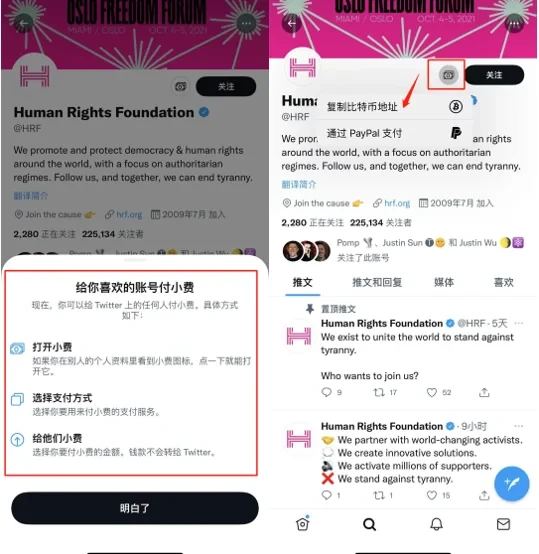
However, it should be noted that the Strike app currently only supports users in the United States and El Salvador, which recently adopted Bitcoin as legal tender. In addition to using Strike, users can also choose to directly add their Bitcoin wallet address to their account information, making it easy for other users to copy the address for transfers.
2. PayPal
In September 2014, U.S. mobile payment giant PayPal announced it would accept Bitcoin payment, but only allowed some specific merchants using PayPal to receive Bitcoin payment through BitPay, Coinbase, and GoCoin's PayPal Payment Centers. This feature was later restricted due to violations of its official policies.
By October 2020, PayPal announced that users would be able to directly purchase, hold, and sell digital assets within their PayPal accounts, including Bitcoin, Ethereum, Bitcoin Cash, and Litecoin, officially opening the door to digital assets payments to tens of millions of merchants and hundreds of millions of users worldwide. In August of this year, PayPal launched its digital assets services to UK customers, gradually expanding to international markets.
3. Microsoft
Like PayPal, tech giant Microsoft was also among the first major companies to accept Bitcoin payment. It began offering Bitcoin as a payment option for its Windows, Windows Phone, and Xbox platforms back in 2014, allowing users to purchase digital content on these platforms. However, it was limited to U.S. users only, and users could only deposit Bitcoin into their Microsoft accounts—they could not use Bitcoin to directly purchase Microsoft products and services. After briefly suspending Bitcoin payments in 2018, Microsoft resumed Bitcoin as a payment option.
4. Tesla
In March 2021, Tesla announced it would accept Bitcoin for car purchases, causing Bitcoin prices to surge. Then, in May, Musk announced the cessation of Bitcoin as a payment tool. However, at The B Word conference held in July this year, Musk changed his stance again, stating that Tesla might resume accepting Bitcoin in the future as Bitcoin shifts toward renewable energy.
Part 2: Trends in Bitcoin's Mainstream Adoption
In addition to the major companies mentioned above, many other food service, hospitality, and retail payment providers—such as Starbucks, McDonald's, Shopify, and Overstock.com—have already accepted Bitcoin payment, so we won't list them all here. You can join OKX's official community to discuss and learn about industry trends.
According to data collected by coinmap.it, there are currently 7,600 stores and businesses worldwide that accept Bitcoin payment, including Bitcoin ATMs, tourist attractions, coffee shops, restaurants, grocery stores, hotels, and more.
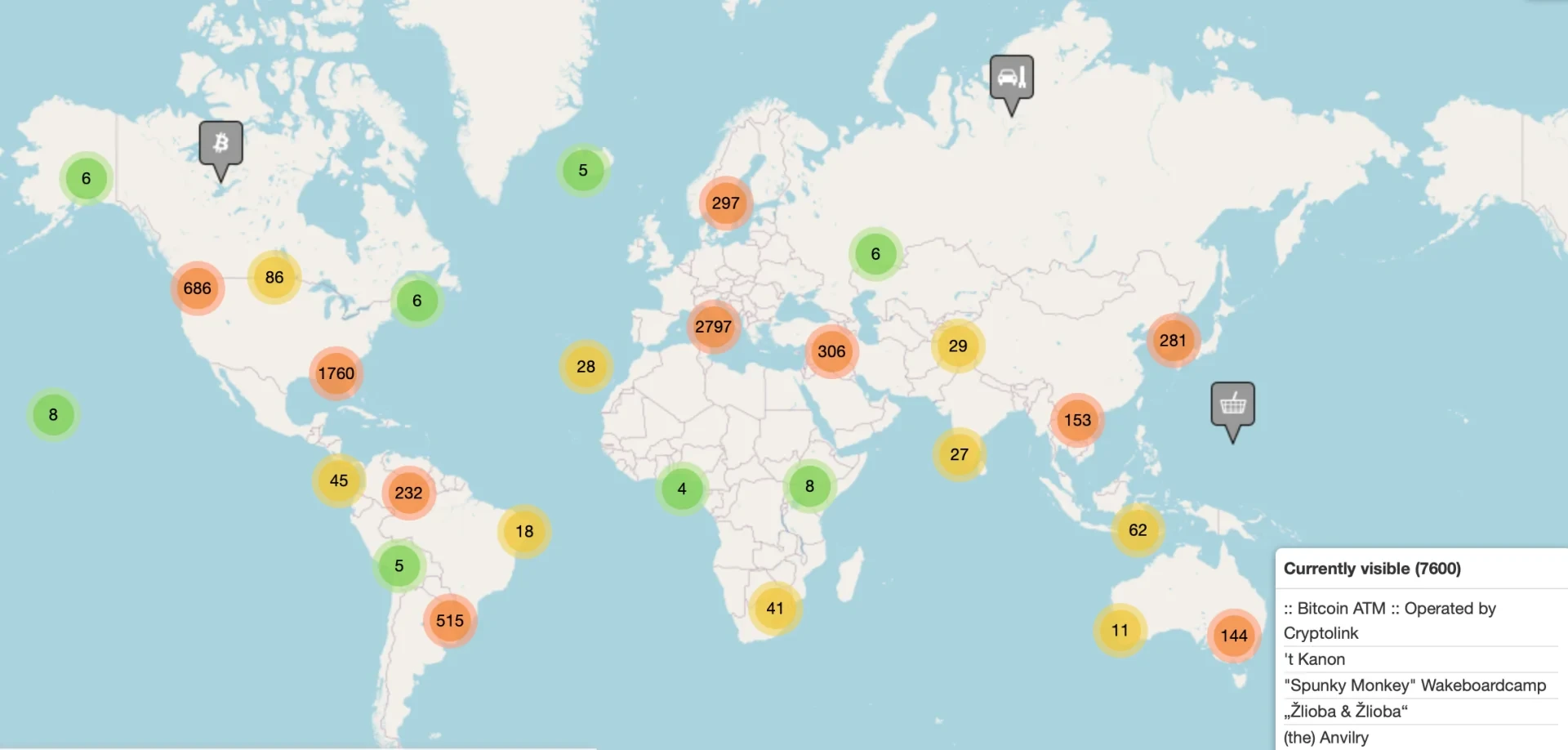
Global distribution of merchants accepting Bitcoin payments Source: coinmap
In fact, tracing Bitcoin's history, the use of Bitcoin for payment has a long tradition. The earliest and most well-known example was in May 2010, when American programmer Laszlo Hanyecz purchased two pizzas with 10,000 Bitcoin—hence the origin of Bitcoin Pizza Day. In recent years, as Bitcoin has grown, more and more large enterprises have chosen to accept Bitcoin as a payment option for their users. Some countries, like El Salvador, have even adopted Bitcoin as legal tender. Why is this? This is directly related to Bitcoin's inherent advantages and its growing adoption, and it also reflects the trend of digitalization globally.
First, Bitcoin is a decentralized, highly anonymous digital asset with fast transfer speeds and real-time trade processing. Compared to centralized third-party financial services, the cost of using Bitcoin for payment and transactions is lower, giving it a natural advantage in the payment field, especially for cross-border payments. For example, regarding Twitter's adoption of Bitcoin payment, Tip Jar product lead Esther Crawford stated that Bitcoin is "one of the best solutions to enable people to trade in underbanked regions of the world."
Second, the digital age is here, and digital assets are already a current development trend. Especially since 2020, under the backdrop of COVID-19, digital assets have received unprecedented attention. Bitcoin's anti-inflationary and decentralized characteristics have sparked surging interest from ordinary investors to institutions and companies. As a globally circulating asset, Bitcoin has successfully proven that the economic value attributes of physical assets like gold can be represented through digital assets. In the digital assets era, even physical forms of gold may seem somewhat "outdated" (referencing Grayscale's "Drop Gold" advertisement), and Bitcoin represents the future trend of digital assets.
Finally, from the perspective of these major companies, beyond following the digital era trend, many of them accept digital assets payments also to demonstrate the company's forward-thinking and open innovative mindset, while attracting more potential new users and digital assets enthusiasts. As PayPal President and CEO Dan Schulman stated, the shift toward digital forms of currency is inevitable, which can provide significant advantages in financial inclusivity and access, while payment systems will improve in efficiency, speed, and resilience.
Part 3: Challenges Facing Bitcoin's Wide Adoption
Accordingly, it is expected that more companies and enterprises will join the ranks supporting Bitcoin payment in the future, and mainstream adoption of Bitcoin will become an inevitable development trend. However, Bitcoin also faces some core issues in terms of wide adoption.
Over the past few years, while new companies have embraced Bitcoin, some projects that briefly accepted it have stopped supporting Bitcoin payment services. Major companies and platforms such as cross-border payment service provider Stripe, gaming distribution platform Steam, and travel industry giant Expedia have discontinued support. The core reasons for their withdrawal are primarily the high transaction fees and excessive price volatility of Bitcoin, which have led to fewer users paying with Bitcoin. When considering the maintenance costs of payment channels, if the revenue generated by those channels is insufficient to cover costs, shutting them down is the more rational choice.
Setting aside Bitcoin's characteristic of high price volatility, the issue of excessive transaction fees mainly relates to Bitcoin network's scalability. For a Bitcoin network that can only process 7 transactions per second, high-frequency micro-payments indeed lack advantages—this has long been a constraint on Bitcoin's development and application in retail payments. In response to this issue, a relatively mature solution has already been introduced—the Lightning Network. Consistent with Ethereum Layer 2's positioning and intent, the Lightning Network is an off-chain Layer 2 scaling solution for Bitcoin. By processing micro-transactions off the Bitcoin main chain, it enables users to conduct faster, lower-fee Bitcoin trading.
As mentioned earlier, Twitter's tipping feature was launched through partnership with Strike wallet based on the Lightning Network, enabling users to make micro Bitcoin payments denominated in "satoshis" (sats) via the Lightning Network.
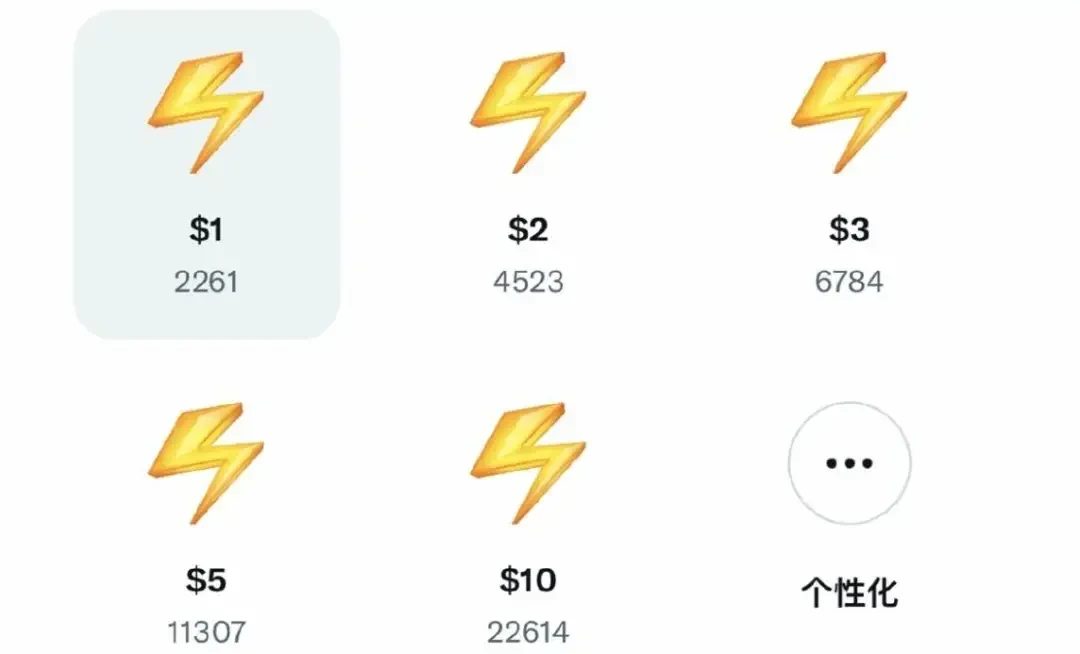
Twitter user's tipping page
However, in our previous article "Ethereum Layer 2 Is Thriving—How Is Bitcoin's Lightning Network Doing?", we briefly introduced the Lightning Network's current development status. Although the number of Lightning Network channels and the amount of Bitcoin locked in the Lightning Network have been rising over the past year, its development speed and scale still lag behind Ethereum's Layer 2.
Therefore, although Bitcoin's Lightning Network can currently address and handle certain transfer and payment demands, for Bitcoin's future wide adoption, relying solely on the Lightning Network as a solution is far from sufficient. For Bitcoin, which inherently lacks strong payment and consumption attributes, there is still a long way to go in the payment domain. In the short term, Bitcoin's Taproot upgrade may become the next anticipated milestone to improve Bitcoin network performance.
Disclaimer
This article may contain product-related content not applicable to your region. This article is solely committed to providing general information and accepts no responsibility for any factual errors or omissions. This article represents the author's personal views only and does not represent OKX's views. This article is not intended to provide any advice, including but not limited to: (i) investment advice or investment recommendations; (ii) offers or solicitations to purchase, sell, or hold digital assets; or (iii) financial, accounting, legal, or tax advice. Holdings of digital assets (including stablecoins) involve high risk and may fluctuate significantly, or even become worthless. You should carefully consider whether trading or holding digital assets is suitable for you based on your financial situation. For questions regarding your specific circumstances, please consult your legal/tax/investment professional. Any information appearing in this article (including market data and statistics, if any) is provided for general reference purposes only. Although we have taken all reasonable precautions in preparing such data and charts, we accept no responsibility for any factual errors or omissions expressed herein. © 2025 OKX. This article may be reproduced or distributed in its entirety, and excerpts of 100 words or less may be used, provided that such use is non-commercial. Any reproduction or distribution of the full article must prominently state: "This article is copyrighted © 2025 OKX, used with permission." Permitted excerpts must cite the article title and include attribution, for example, "Article Title, [Author Name (if applicable)], © 2025 OKX". Some content may have been generated or assisted by artificial intelligence (AI) tools. Derivative works and other uses of this article are not permitted.
Show More
Recommended Reading
OKX Pay: Ushering in a New Era of Next-Gen Crypto Payments
The choice of tens of millions of users. Register on OKX to enjoy an exceptional trading experience and diverse wealth management products. A letter from OKX CEO Star: Today, we officially launch the first version of OKX Pay to over 100 million global users. As the industry's first truly integrated non-custodial and compliant payment application, OKX Pay is embedded within the OKX App, currently available in select markets and expected to fully
2026年3月22日

A New Chapter: Building the Next Generation of Financial Infrastructure Together
The collaboration between OKX and the Intercontinental Exchange (ICE) represents a significant milestone for OKX and holds equally profound meaning for the evolution of the entire digital assets market. ICE establishes and operates the world's most critical financial infrastructure, including the New York Stock Exchange and global derivatives and clearing platforms. ICE's decision to invest in OKX and join our board reflects our shared belief—that digital assets technology will reshape financial markets
2026年3月10日

Paying Tribute to Another Year of Relentless Progress
As OKX's CEO and a builder who stays true to the original mission, I take great pride in looking back at the extraordinary growth and progress OKX has achieved this year. Despite formidable challenges, 2024 was a year marked by focus, innovation, and resilience. We not only expanded and optimized our products, but also made significant strides in launching transparent and regulatorily compliant localized businesses, while further strengthening our global management team. It is worth noting that after
2026年1月29日

2025: Steady Progress Toward Financial Freedom
— A Year-End Letter to Global Users from OKX Founder & CEO Star "Financial freedom" is often misunderstood. It doesn't mean the absence of rules, but rather having the right to choose even when rules exist—and when the system is truly put to the test, it remains reliable and effective. This is precisely what we focused on throughout 2025. First, I want to express my sincere gratitude to our global customers, partners, and regulators for their continued
2026年1月16日

OKX Officially Launches in Germany and Poland
By Erald Ghoos, CEO of OKX Europe Today is significant for OKX—and for crypto users across Europe. We have officially launched a fully compliant centralized cryptocurrency trading platform in Germany and Poland! For us, this is not just a geographic expansion, but a commitment to building the future of cryptocurrency the right way: secure, transparent, and tailored to local needs. If you are in Germany
2025年10月21日

Partnership Upgrade! OKX Joins Forces with Standard Chartered to Expand into Europe
On October 15, OKX Europe CEO Erald Ghoos stated that OKX is expanding its strategic partnership with Standard Chartered into the European Economic Area (EEA). Earlier this year, OKX first partnered with Standard Chartered in the UAE, launching the Collateral Mirroring initiative—a
2025年10月15日