US Treasury Yield Hits Multi-Month Low, GBTC Large-Scale Unlock Approaching - Will It Cause Bitcoin Price to Decline?
This Thursday, the US 10-year Treasury yield briefly touched 1.25%, marking a new low since February 16. Reports indicate this may be due to US investors' concerns about whether economic recovery can be sustained, as well as the spread of the COVID-19 Delta variant, which has driven safe-haven funds back to the US, putting downward pressure on Treasury yields.
The three major US stock indices all closed lower yesterday. Christopher Harvey, head of equity strategy at Wells Fargo, stated, "There is no indication that the (US 10-year Treasury) yield's near-collapse trend has ended. If it breaks significantly below 1.25%, investors may think something is wrong. Therefore, we believe the likelihood of a 5% stock market pullback before earnings season is growing."
OKX real-time quotes show that Bitcoin closed at $32,898.1 on Thursday, with a daily decline of 4.73%. Recently, Bitcoin's price movement has become increasingly similar to the US 10-year Treasury yield, meaning that if Treasury yields continue to fall, Bitcoin's price may also face further downward pressure.
Additionally, OK Link data shows that Grayscale will unlock 424,000 Bitcoin equivalent of GBTC in mid-to-late July, with the largest single-day unlock occurring on July 17 at 16,200 Bitcoin. As a result, there has been renewed discussion in the community about whether the large-scale GBTC unlock will cause Bitcoin's price to decline further.
US Treasury Yields Plummet, Investor Risk Aversion Rises
At 2 PM Eastern Time on Wednesday, July 7, the Federal Reserve released the much-anticipated full minutes of the June FOMC meeting. The minutes reiterated the Fed's long-standing view that despite inflation rising faster than expected, they still believe the current inflation uptick is temporary and overall has not yet reached the point where the Fed needs to change policy. The meeting's main tone remained patient regarding tightening monetary policy. However, some officials believe the economic recovery is faster than expected, accompanied by a significant rise in inflation, providing justification for the Fed to begin tapering its balance sheet.
Overall, the meeting minutes were less hawkish than expected, ruling out the possibility of short-term rate hikes. Last Friday's non-farm payrolls data showed strong employment growth, but the unemployment rate and average hourly earnings fell short of expectations. On Tuesday, the June ISM services index was released, falling from the historic high of 64 in May to 60.1, not only below market expectations of 63.5 but also marking a new low since April, indicating that US services sector growth is slowing.
At 10 AM Eastern Time on July 7, the Bureau of Labor Statistics under the US Department of Labor released the Job Openings and Labor Turnover Survey (JOLTS) results for May. This indicator is also US Treasury Secretary Janet Yellen's favorite labor market metric. The data showed that US job openings rose slightly from a downwardly revised 91.93 million in April to 92.09 million in May, a record high. Job vacancies reflect accelerating demand following US economic recovery, but hiring faces challenges due to fear of COVID-19, family care needs, and generous unemployment benefits. It's worth noting that JOLTS data lags non-farm payrolls by one month.
US Treasury yields climbed continuously in Q1 2021 but have recently started to decline as investors have renewed concerns about economic recovery prospects, making Treasuries more attractive. Kathy Jones, chief fixed income strategist at Charles Schwab, stated that multiple data points seem to suggest not only that inflation may be temporary, but that some economic growth may also be temporary.
Of course, besides investors reassessing their optimism about the economic outlook, Dongwu Macro's Tao Chuan team believes there are two other special reasons for the decline in Treasury yields: First, due to failure to reach a debt ceiling agreement early, the US Treasury must reduce the cash balance in its account at the Federal Reserve by $400 billion to achieve its target level by the end of July. Injecting such large liquidity into financial markets in the short term will inevitably increase financial institutions' demand for Treasuries, thereby pulling down long-term Treasury yields. Second, the recent spread of the COVID-19 Delta variant has exacerbated the divergence between US and European pandemic responses. Considering Europe's economic restart is weaker than the US, safe-haven funds flowing back will also put downward pressure on Treasury yields. Since mid-June, overseas funds' net inflows into Treasuries have been increasing.
It's worth noting that Bitcoin's trend is becoming increasingly similar to the US 10-year Treasury yield.
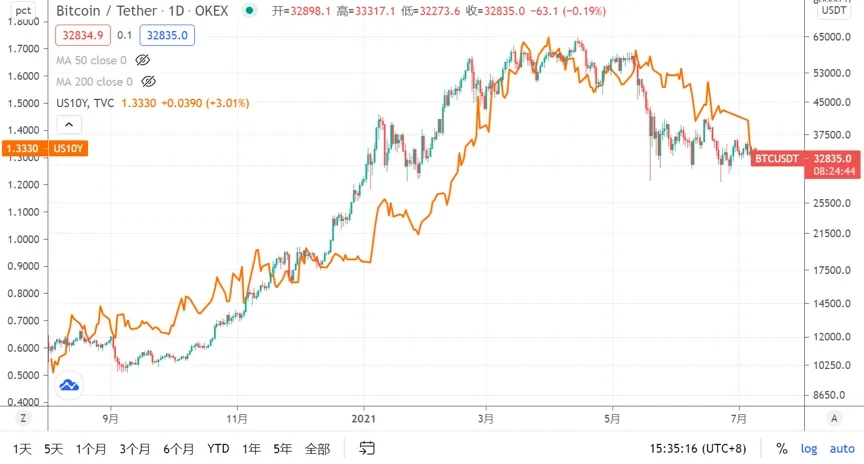
As is well known, Treasury yields move inversely to Treasury prices. From October 2020 to Q1 2021, due to the Fed's massive money printing, various asset prices rose significantly, reducing the attractiveness of low-yield instruments like Treasuries, causing funds to flow to risk assets and Treasury yields to rise continuously. Now, however, risk assets are at high levels, expectations of liquidity tightening are increasing, and investor concerns about economic prospects are intensifying, increasing demand for safe havens. More funds are buying Treasuries, Treasury prices rise, and yields naturally fall. This Bitcoin bull market was caused by massive money printing, and from last October to this year, large-scale gains accumulated significant bubbles, so immunity to negative news has significantly declined. This is also one of the main factors in Bitcoin's decline over the past two months. Macroeconomic analysts generally believe the Fed is increasingly likely to discuss policy adjustments at the Jackson Hole Global Central Bank Symposium in August and may announce more details about tapering asset purchases.
As of this writing, Bitcoin's price is $32,835.0, having remained in the $35,000 (±5,000) price range for quite some time.
GBTC Large-Scale Unlock Approaching - Will It Cause Bitcoin Price to Decline?
Besides macro market news, the market has been paying close attention to GBTC recently. OK Link data shows that over 40,000 Bitcoin worth of GBTC will be unlocked in mid-to-late July, with July 17 seeing the largest single-day unlock at 16,200 Bitcoin.
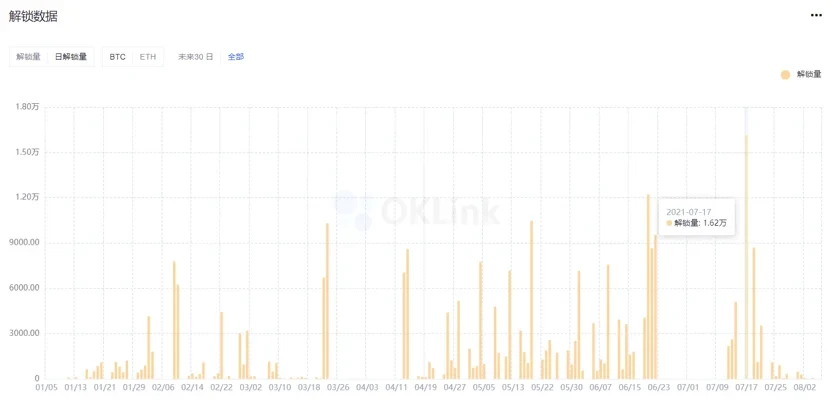
We all know that if 2017 was a retail-driven bull market, then 2020's driving force shifted to institutions, with Grayscale considered the largest engine among them, demonstrating its significant influence. In our article "GBTC Negative Premium Recovery Suggests Institutional Accumulation - Grayscale ETF Conversion Approaching?" we mentioned that from November 1 to February 18 this year, Grayscale added 180,200 Bitcoin, corresponding to the unlock peak period from mid-to-late April to July.
Facing the upcoming large-scale unlock, market views are divided. In a widely cited report, JPMorgan Chase stated that GBTC unlocks could put downward pressure on GBTC's price and the broader Bitcoin market. Meanwhile, Amber Group and Arca Funds stated that GBTC unlocks could actually be beneficial for Bitcoin's price. Messari researcher Mira Christanto also tweeted that GBTC unlocks won't crush the market, giving two reasons: 1) Grayscale has no mechanism to sell BTC, so (GBTC) will maintain a premium or discount to net asset value, and 2) Grayscale founder Barry Silbert doesn't want to do so either, as he can collect a 2% management fee on the growing Grayscale Bitcoin Trust.
So, will Grayscale's GBTC large-scale unlock affect the market? We believe that while historical data shows some correlation between Bitcoin price and Grayscale unlock dates, since the Bitcoin Grayscale currently holds is non-redeemable (GBTC cannot be exchanged back for Bitcoin), and GBTC can only be sold on the US OTC market, even if there is significant selling after unlock, it would have a clear impact on GBTC's secondary market price but is unlikely to cause direct, significant impact on the Bitcoin market.
To understand this, we need to return to the Grayscale Bitcoin Trust mechanism. There are two methods for investing in GBTC: cash investment and in-kind investment (Bitcoin), with a 6-month lock-up period. Additionally, Grayscale charges a 2% management fee, deducted directly from the Bitcoin holdings (in Bitcoin denomination), which is Grayscale's main profit method.
The reason Grayscale could continuously accumulate before was the high premium on GBTC. On December 21, 2020, GBTC's premium even rose to a record 40.2%, leading to a surge in the trust's popularity. According to JPMorgan data, the Grayscale Bitcoin Trust saw record inflows of $2 billion in December.
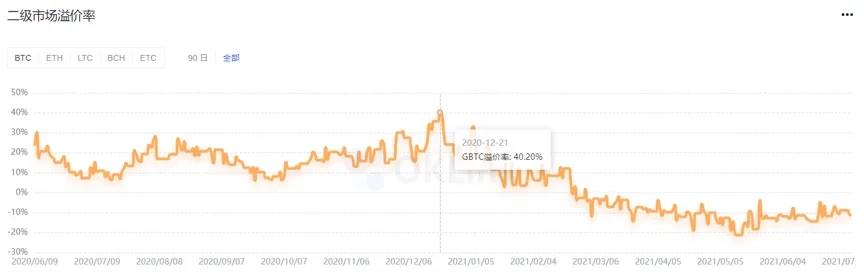
There are two reasons for such high premiums: first, the arbitrage mechanism is not smooth; second, market speculation. We know that ETF funds don't show very high premiums or discounts because when market price is less than net asset value, arbitrageurs buy ETF shares on the secondary market, then redeem the underlying assets (like a basket of stocks) on the primary market to earn the spread. If market price exceeds net asset value, arbitrageurs subscribe for ETF shares on the primary market, then sell on the secondary market for profit. It's precisely because of the subscription and redemption mechanism that when a spread appears between fund NAV and market price, arbitrage can level it out. However, since Grayscale cannot be redeemed, there's no mechanism to level out the price difference between primary and secondary markets.
In the past, due to high premiums, many institutional investors were willing to invest in cash or Bitcoin to obtain GBTC shares from Grayscale. But now, because the negative premium persisting since March 2 has eliminated arbitrage opportunities, and the launch of Bitcoin ETFs means GBTC is no longer the only path for institutional entry, this is evident from the significant reduction in funds flowing into Grayscale since mid-to-late February. Considering Grayscale closed GBTC trust fundraising in March, if it doesn't reopen soon, there will be no new GBTC unlocks after September.
However, we need to consider one more point: markets are mostly driven by sentiment. When Bitcoin shows a downward trend, bullish factors are often overlooked while bearish factors are amplified. Grayscale's existence and its influence are seen as market confidence indicators, similar to "ancient Bitcoin addresses being activated, MicroStrategy selling Bitcoin, Musk stating no longer accepting Bitcoin payments," etc. If it continues to show negative premium, it will affect the Bitcoin market, though more likely on a psychological level. Fortunately, since hitting a negative premium of 21.23% on May 14, GBTC's negative premium has been gradually narrowing, now fluctuating in the -4% to -11% range.
Disclaimer
This article may contain product-related content not applicable to your region. This article is intended to provide general information only and does not take responsibility for any factual errors or omissions contained herein. This article represents the author's personal views only and does not represent OKX's views. This article is not intended to provide any recommendations, including but not limited to: (i) investment advice or investment recommendations; (ii) offers or solicitations to buy, sell, or hold digital assets; or (iii) financial, accounting, legal, or tax advice. Holding digital assets (including stablecoins) involves high risk, may fluctuate significantly, and may even become worthless. You should carefully consider whether trading or holding digital assets is suitable for you based on your financial situation. For questions about your specific situation, please consult your legal/tax/investment professional. The information appearing in this article (including market data and statistics, if any) is for general reference only. While we have taken all reasonable precautions in preparing these data and charts, we accept no responsibility for any factual errors or omissions expressed herein. © 2025 OKX. This article may be reproduced or distributed in full, or excerpts of 100 words or less may be used, provided such use is non-commercial. Any reproduction or distribution of the entire article must prominently state: "Copyright © 2025 OKX, used with permission." Permitted excerpts must cite the article title and include attribution, such as "Article Name, [Author Name (if applicable)], © 2025 OKX". Some content may be generated or assisted by artificial intelligence (AI) tools. Derivative works or other uses of this article are not permitted.
Show More
Recommended Reading
OKX Pay: Opening a New Era of Next-Generation Crypto Payments
Join tens of millions of users, register on OKX, and enjoy ultimate trading experience and diverse wealth management products. A letter from OKX CEO Star: Today, we officially launch the first version of OKX Pay to over 100 million global users. As the industry's first payment application to truly achieve non-custodial and compliant integration, OKX Pay will be embedded in the OKX App, currently available in select markets, expected to fully
March 22, 2026

New Chapter: Building Next-Generation Financial Infrastructure Together
The partnership between OKX and Intercontinental Exchange (ICE) is an important moment for OKX and equally significant for the evolution of the entire digital assets market. ICE establishes and operates the world's most important financial infrastructure, including the New York Stock Exchange and global derivatives and clearing platforms. ICE's strategic investment in OKX and joining our board demonstrates both parties' shared belief that digital assets technology will transform financial markets
March 10, 2026

Tribute to Another Year of Forging Ahead
As OKX's CEO and a builder who stays true to our mission, I am proud to look back on OKX's extraordinary growth and progress this year. Despite many challenges, 2024 was a year of focus, innovation, and resilience. We not only expanded and optimized our products but also made significant progress in launching transparent and compliant localized businesses, while further strengthening our global management team. Notably, after experiencing
January 29, 2026

2025: Steady Progress Toward Financial Freedom Together
— A Year-End Letter from OKX Founder and CEO Star to Global Users "Financial freedom" is often misunderstood. It doesn't mean no rules, but rather having the right to choose within the framework of rules—and when the system is truly tested, it remains reliable and effective. This is exactly what we focused on throughout 2025. First, I want to extend my sincere gratitude to our global clients, partners, and regulatory authorities
January 16, 2026

OKX Officially Launches in Germany and Poland
Author: Erald Ghoos, CEO of OKX Europe Today is significant for OKX—and for crypto users across Europe. We have officially launched our fully compliant centralized cryptocurrency trading platform in Germany and Poland! For us, this is not just geographic expansion, but a commitment to building the cryptocurrency future the right way: secure, transparent, and meeting local needs. If you're in Germany
October 21, 2025

Partnership Upgrade! OKX Partners with Standard Chartered to Expand European Market
On October 15, OKX Europe CEO Erald Ghoos stated that OKX is expanding its strategic partnership with Standard Chartered to the European Economic Area (EEA). Earlier this year, OKX first partnered with Standard Chartered in the UAE to launch the collateral mirroring program—a
October 15, 2025