From GBTC's Return to Over 20% Negative Premium: Reassessing the Crypto Market's Expectations for Bitcoin ETFs
History doesn't repeat itself, but it often rhymes. This oft-cited saying seems particularly fitting for the cryptocurrency market. Looking at the crypto market's development over the past decade or so, we can see that many major events influencing the industry's trajectory have occurred in the second half of the year, with the fourth quarter being particularly concentrated. For example, at the end of October 2008, the Bitcoin whitepaper was released; on November 28, 2013, Bitcoin price first broke through $1,000; on November 28, 2017, Bitcoin trading price first broke through $10,000; on December 18 of the same year, the Chicago Mercantile Exchange (CME) officially launched Bitcoin futurescontracts, while a week earlier the Chicago Board Options Exchange (CBOE) had抢先 introduced Bitcoin futures. Whether intentional or coincidental, attributed to chance or some unseen force, the fourth quarter in the crypto market seems destined never to be uneventful.
Now as we enter the fourth quarter of 2021, we see signs of dramatic shifts in the crypto market. In today's article, we'll take Grayscale Investments—the crypto asset management company representing the major institutional investors driving this bull market—and the currently hot Bitcoin (futures) ETF as our main themes, to review and examine what major events have been worth noting since entering the fourth quarter, and what valuable insights we can interpret from these clues.
Five Months Later: GBTC Shows Negative Premium Exceeding 20% Again
As Grayscale Investments' largest single asset trust fund by market capitalization, GBTC firmly holds the top position with a total value of $38.683 billion (accounting for approximately 75% of the total value of all digital asset trust funds under Grayscale). It has also become a key focus for analysts in the crypto market—after all, given GBTC's status and scale, it still carries significant benchmark significance in today's crypto market.
Last Tuesday, October 12th Hong Kong time, according to statistics from OK Link On-Chain Master, GBTC's premium rate on the secondary market once again fell to -20.06%. The last time GBTC's premium rate touched -20% was during May 12-15 in the first half of this year, when it briefly fell to -21.23%.
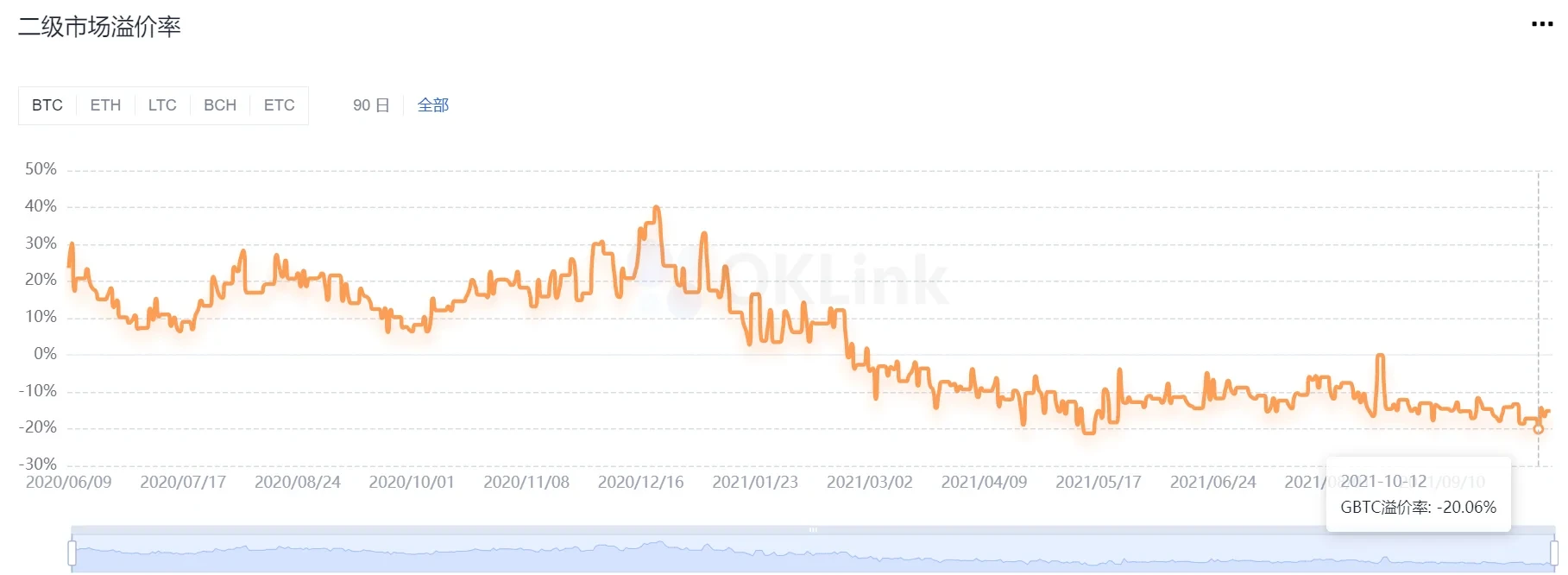
GBTC premium rate trend on the secondary market, data source OK Link On-Chain Master
Generally speaking, when GBTC's premium rate on the secondary market is negative, it means GBTC's market price has fallen below its net asset value per share. Simply put, if one were to subscribe and hold GBTC from the primary market at this point, the trading cost would be higher than buying directly from the secondary market. A rough analysis suggests that the fundamental cause of this situation can be traced to decreased attractiveness of GBTC to investors on the secondary market, ultimately leading to oversupply.
However, looking at the details and comparing with the overall environment of the crypto market at that time, we can discover that the reasons for GBTC's premium rate falling below -20% on these two occasions are quite different. The significant negative premium that appeared in GBTC in mid-May was mainly due to the sharp short-term decline in the crypto market represented by Bitcoin, which caused panic to spread among market investors and serious selling behavior. Under strong selling pressure, GBTC's price on the secondary market continued to fall, widening the negative premium rate. In contrast, last week's GBTC showing a negative premium exceeding 20%, viewed from a retrospective perspective, was largely due to market investors being stimulated by the potential positive news of the upcoming approval and launch of Bitcoin (futures) ETFs. Therefore, in terms of duration, the negative premium rate situation in mid-May lasted longer, and the degree of negative premium was also somewhat greater.
Bitcoin Futures ETF Approved, Grayscale to Apply to Convert GBTC to Bitcoin Spot ETF
Shortly after GBTC's premium rate touched -20.06% on October 12th, news came one after another within just a few days about the approval of Bitcoin futures ETFs and Grayscale's plan to apply to convert GBTC to a Bitcoin spot ETF, which also confirms our speculation above in terms of timing. On October 15th, following a meeting with the U.S. Securities and Exchange Commission (SEC), it was announced that they had approved the Bitcoin futures ETF issued by fund management company ProShares. According to public documents, this trading product's trading symbol is BITO, and it is planned to trade on the NYSE Arca exchange. Additionally, its management fee is only 0.95%, far lower than GBTC's current 2% management fee. However, it should be pointed out that this trading product will use Bitcoin futures contracts rather than Bitcoin spot as its underlying asset, which is still quite different from the Bitcoin ETF we've long been focused on.
Also on October 15th, according to overseas media citing informed sources, Grayscale Investments plans to apply soon to convert GBTC into a spot exchange-traded fund (ETF). In fact, as early as early April this year, there were already rumors in the market that Grayscale would apply to the SEC to convert GBTC to a Bitcoin ETF, though at that time Grayscale Investments' CEO stated that "the timing of the conversion depends on the regulatory environment." From this perspective, perhaps Grayscale believes the regulatory environment has now reached "the right time." It can be speculated that in the months between April and now, Grayscale has likely been making various preparations to convert GBTC to a Bitcoin ETF, such as formulating trading rules, communicating with the SEC and investors, and so on. However, even after Grayscale officially submits the conversion application, according to SEC rules, it will still face a review period of up to 240 days, the same as the Bitcoin ETF applications currently under review from institutions such as Van Eck, Wisdom Tree, Kryptoin, Valkyrie, and others. As for whether they can ultimately be successfully approved, only time will tell. From a slightly subjective perspective, the news of Bitcoin futures ETF approval has already stimulated moderately optimistic market sentiment to some extent, and more investors currently tend to believe that the SEC will ultimately approve Bitcoin spot ETFs for listing and trading. Here, a special reminder is needed: from December 2017, when the Chicago Board Options Exchange and Chicago Mercantile Exchange launched Bitcoin futures, Bitcoin price quickly reached the peak of the previous bull market within half a month, then fell rapidly. As we mentioned at the beginning—history doesn't repeat itself, but it often rhymes. Once a Bitcoin spot ETF is approved for listing, the vast majority of investors will need to be even more prepared with risk control measures.
Grayscale's Self-Rescue and the Crypto Market's Expectations for Bitcoin ETFs
In previous content introducing Grayscale GBTC, we've explained that Grayscale's GBTC is an ETF-like trust fund product that can be subscribed to on the primary market and traded on the secondary market. This mechanism creates two prices: real-time net asset value and real-time market price. Grayscale's GBTC allows qualified investors to subscribe for GBTC shares with cash or Bitcoin, but they can only sell on the secondary market after a six-month lock-up period.
When Grayscale first showed negative premium, some in the market thought this situation would also occur with ETFs, that everyone was still in the same boat, so no need to worry too much. But in fact, Grayscale Trust and traditional ETFs are completely different. In traditional financial markets, ETFs typically can be sold on the same day or the day after subscribing for shares on the first day. Therefore, when net asset value is greater than market price, investors buy ETFs on the secondary market and redeem at net asset value at any subsequent time, thereby arbitraging.
When market price is greater than net asset value, investors first subscribe, then arbitrage on the secondary market. GBTC's lock-up period is as long as six months, which means if after buying, Bitcoin price crashes, investors cannot sell and can only watch their assets drain away.
Therefore, from this we can further understand why GBTC has had a negative premium for 7 months since March, and why Grayscale urgently wants to convert GBTC to a Bitcoin ETF. We can also better understand the mood of investors in the crypto market looking forward to Bitcoin spot ETF listings. To summarize, mainly the following points:
1. ETFs allow market makers to create and redeem shares at will; GBTC does not allow redemption, and realization of fund shares must be through secondary market trading.
2. GBTC has a 6-month lock-up period, usually with high premium; ETFs have better liquidity and typically don't show premiums or discounts.
3. GBTC trading fees are high, involving broker fees, annual management fees, and needing to bear the premium. Bitcoin ETFs have lower fees—for example, the BITO mentioned above has a management fee of only 0.95%, while the first Bitcoin ETF in North America listed in Canada—BTCC—has an even lower management fee, down to 0.75%.
4. GBTC investment threshold is high, starting at $50,000, open only to qualified investors. Bitcoin ETFs have fewer restrictions on investor qualifications and investment amounts.
Considering the recent series of developments in the crypto market, it's not hard to see that after more than a decade of wild growth, the crypto market represented by Bitcoin has attracted widespread attention from traditional financial markets and is gradually moving toward standardization and compliance.
Disclaimer
This article may contain product-related content not applicable to your region. This article is intended to provide general information only and assumes no responsibility for any factual errors or omissions contained herein. This article represents only the author's personal views and does not represent the views of OKX. This article is not intended to provide any recommendations, including but not limited to: (i) investment advice or investment recommendations; (ii) offers or solicitations to buy, sell or hold digital assets; or (iii) financial, accounting, legal or tax advice. Holding digital assets (including stablecoins) involves high risk, may fluctuate significantly, and may even become worthless. You should carefully consider whether trading or holding digital assets is suitable for you based on your financial situation. For questions about your specific situation, please consult your legal/tax/investment professional. The information appearing in this article (including market data and statistics, if any) is for general reference only. While we have taken all reasonable precautions in preparing these data and charts, we assume no responsibility for any factual errors or omissions expressed herein. © 2025 OKX. This article may be reproduced or distributed in full, or excerpts of 100 words or less from this article may be used, provided such use is non-commercial. Any reproduction or distribution of the entire article must also prominently state: "Copyright © 2025 OKX, used with permission." Permitted excerpts must cite the article name and include attribution, for example "Article Name, [Author Name (if applicable)], © 2025 OKX". Some content may be generated or assisted by artificial intelligence (AI) tools. Derivative works or other uses of this article are not permitted.
Show More
Recommended Reading
OKX Pay: Opening a New Era of Next-Generation Crypto Payments
The choice of tens of millions of users, register with OKX to enjoy the ultimate trading experience and diverse wealth management products. A letter from OKX CEO Star: Today, we are officially launching the first version of OKX Pay to over 100 million global users. As the industry's first payment app to truly achieve non-custodial and compliant integration, OKX Pay will be embedded within the OKX App, currently available to select markets, expected to fully roll out within months
March 22, 2026

New Chapter: Building Next-Generation Financial Infrastructure Together
The partnership between OKX and Intercontinental Exchange (ICE) is an important moment for OKX and equally significant for the evolution of the entire digital assets market. ICE establishes and operates the world's most important financial infrastructure, including the New York Stock Exchange and global derivatives and clearing platforms. ICE choosing to invest in OKX and join our board reflects both parties' shared belief—that digital assets technology will transform financial markets
March 10, 2026
Tribute to Another Year of Forging Ahead
As OKX's CEO and also a builder who never forgets the original intention, I'm proud to look back on the remarkable growth and progress OKX has achieved this year. Despite numerous challenges, 2024 has been a year of focus, innovation, and resilience. We've not only expanded and optimized our products, but also made significant progress in launching transparent and regulatory-compliant localized businesses, while further strengthening our global management team. Notably, after experiencing
January 29, 2026

2025: Steady Progress Toward Financial Freedom Together
—— Year-end letter from OKX Founder and CEO Star to global users. "Financial freedom" is often misunderstood. It doesn't mean no rules, but rather having the right to choose within the framework of existing rules—and when the system is truly tested, it remains reliable and effective. This is exactly the direction we've remained focused on throughout 2025. First, I want to extend my sincere gratitude to our global clients, partners, and regulatory authorities
January 16, 2026

OKX Officially Launches in Germany and Poland
Author: Erald Ghoos, CEO of OKX Europe. Today is significant for OKX—and for crypto users across Europe as well. We have officially launched our fully compliant centralized cryptocurrency trading platform in Germany and Poland! For us, this is not just a geographic expansion, but a commitment to building the cryptocurrency future the right way: securely, transparently, and meeting local needs. If you're in Germany
October 21, 2025
Partnership Expanded! OKX Partners with Standard Chartered to Expand into European Markets
On October 15th, OKX Europe CEO Erald Ghoos stated that OKX is expanding its strategic partnership with Standard Chartered into the European Economic Area (EEA). Earlier this year, OKX first partnered with Standard Chartered in the UAE to launch the collateral mirroring program—a
October 15, 2025