GBTC Negative Premium Day 24: Is the "Grayscale Bull" Bowing Out?
According to Grayscale's official website data, on March 25, GBTC's secondary market closing price was temporarily reported at $44.50 per share, while the underlying BTC value per share was $49.30, resulting in a GBTC negative premium of 9.74% relative to BTC. Just one day prior, the negative premium rate reached 14.34%, setting a record for the largest negative premium in GBTC history.
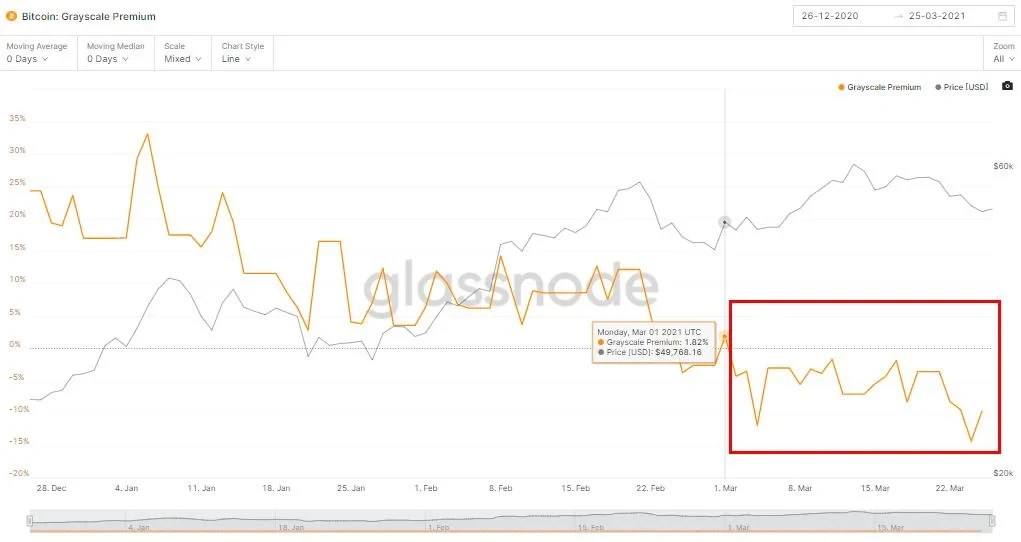
From Glassnode's charts, we can see that since March 2, GBTC has experienced negative premiums for 24 consecutive days. Despite Grayscale's parent company DCG announcing on March 10 its plan to purchase $250 million worth of GBTC, the market response has not been particularly positive.
Although there is a prevailing belief in the industry that public companies are competing to buy BTC, as of press time, the 26 publicly listed companies including MicroStrategy hold approximately 171,700 BTC combined. Compared to Grayscale's holdings of approximately 654,900 BTC, this represents only 26.22% of Grayscale's holdings.
As the undisputed "BTC whale," Grayscale is considered one of the main drivers of this BTC rally, with the current bull market even being dubbed the "Grayscale Bull" at one point—demonstrating Grayscale's significant influence. Now, with GBTC experiencing negative premiums for 24 consecutive days, this has naturally attracted attention within the industry. This article attempts to analyze the causes of Grayscale GBTC's negative premium and its potential impact on the cryptocurrency market.
24 Consecutive Days of Negative Premium: Has Grayscale Lost Its Appeal?
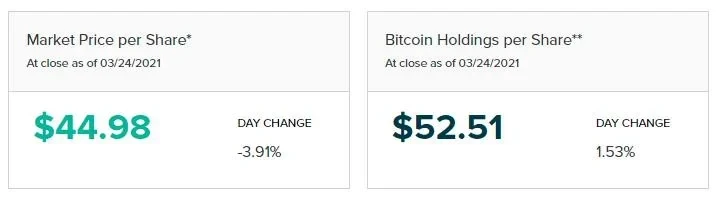
Regarding GBTC, we can see two prices on Grayscale's official website: Market Price per Share and Bitcoin Holdings per Share. As the names suggest, the former is the price of one GBTC share, while the latter is the value of Bitcoin contained in one share. Dividing the former by the latter and subtracting 1 yields the so-called "premium rate." If the result is positive, GBTC is trading at a positive premium relative to BTC; if negative, GBTC is at a negative premium relative to BTC. Using the data below as an example, on March 24, GBTC had a negative premium of 14.34% relative to BTC.
The reason for the negative premium is simple: GBTC supply in the secondary market exceeds demand. Historically, investors purchased GBTC for three reasons: first, compliance—Grayscale's trust products comply with U.S. securities and IRA regulatory frameworks; second, security and convenience—clients purchasing trust shares indirectly invest in cryptocurrency without worrying about custody issues; third, yield enhancement—expecting BTC to continue rising, believing that buying GBTC could increase returns.
Currently, against the backdrop of global quantitative easing, institutional investors have frequently announced purchases or continued accumulation of Bitcoin. Additionally, payment giants like Square and PayPal have built cryptocurrency trading channels friendly to retail investors, increasing BTC's "mainstream" adoption and attracting more participants. Therefore, BTC still maintains strong upward expectations, meaning the third reason is not the cause of Grayscale's negative premium. Thus, the problem lies in the first and second points.
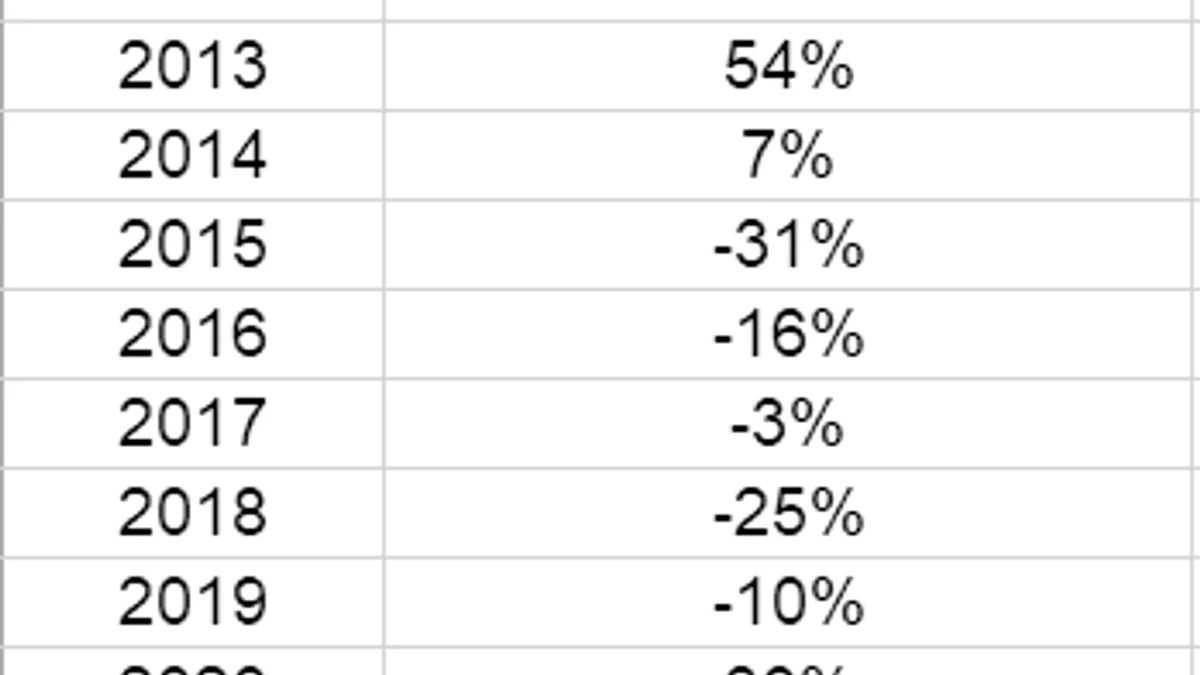
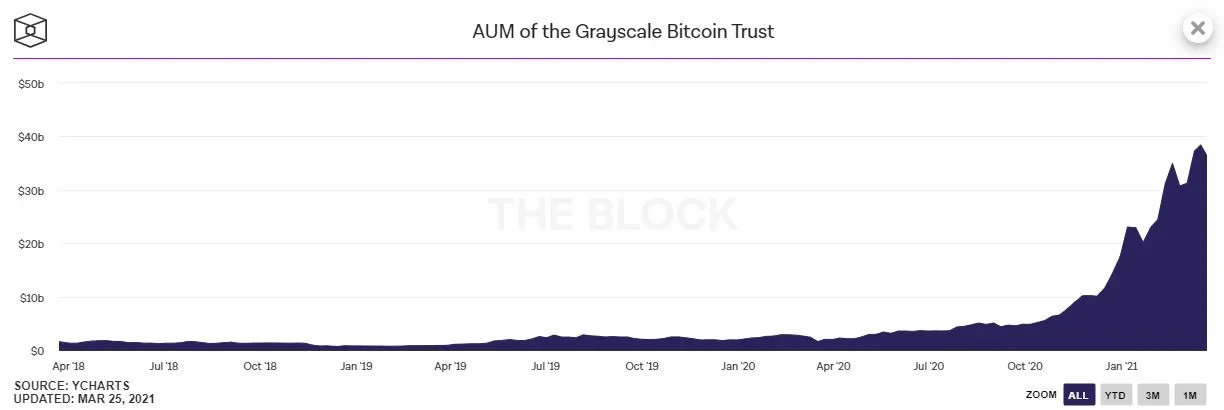
Reviewing GBTC's history, the trust was established in 2013. After determining the non-redemption clause in 2014, it successfully listed on OTCQX, the highest tier of the U.S. over-the-counter trading market, in 2015. From 2015 to the end of 2019, Grayscale GBTC's development remained lukewarm. According to The Block data, as of December 31, 2019, its assets under management were only $1.88 billion.
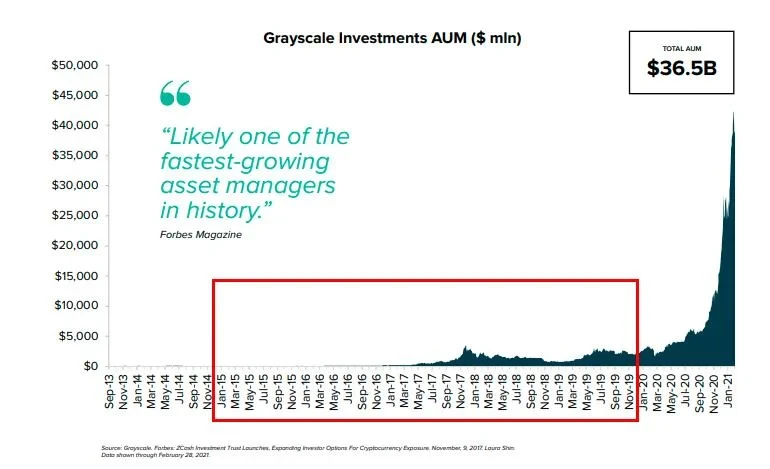
It wasn't until January 21, 2020, when GBTC successfully registered with the U.S. SEC, becoming the first cryptocurrency investment tool to report to the SEC, that Grayscale entered a period of rapid development. GBTC's successful registration significantly increased its liquidity, and GBTC's lock-up period was reduced from 12 months to 6 months.
For a long time, Grayscale was one of the few compliant channels for institutions to participate in cryptocurrency investment. OKX market data shows that since BTC began its upward trend on October 17 at $11,326.20, it rose to a high of $61,829.00 in less than six months, an increase of over 445%.
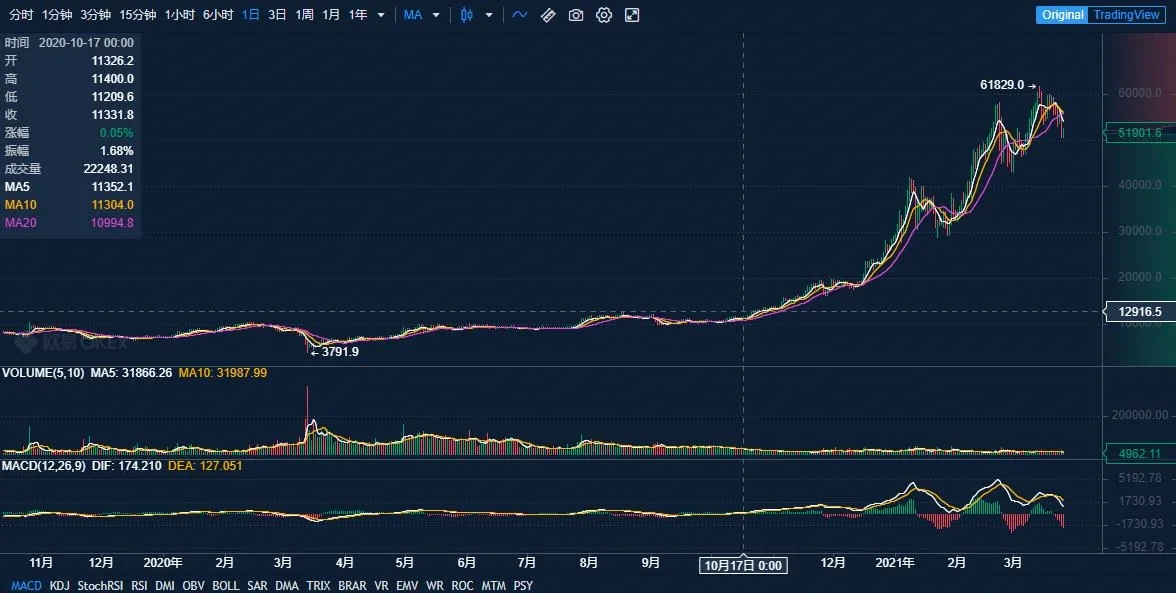
During this period, Grayscale's BTC holdings grew from 450,500 to 654,900, an increase of 204,400 BTC. That is, over 159 days, Grayscale added an average of approximately 1,286 BTC per day, while BTC's daily production was about 900. Grayscale's accumulation rate exceeded daily BTC production, with a total supply gap of 61,300 BTC over the 159 days. It was also during this period that Grayscale GBTC's assets under management soared from $5.52 billion to $36.36 billion, an increase of over 5.5 times.
However, according to Glassnode data, we can clearly see that this accumulation rate experienced a cliff-like decline after mid-to-late February. It was also on February 23 that Glassnode recorded GBTC's first negative premium, at -0.67%. Entering March, the negative premium further expanded, reaching a historical record of -14.34% on March 24.
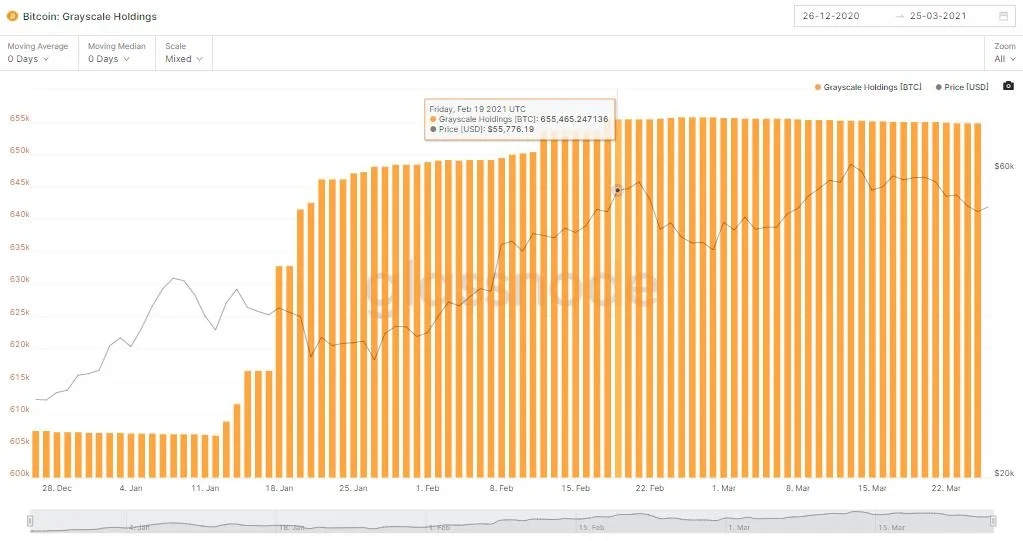
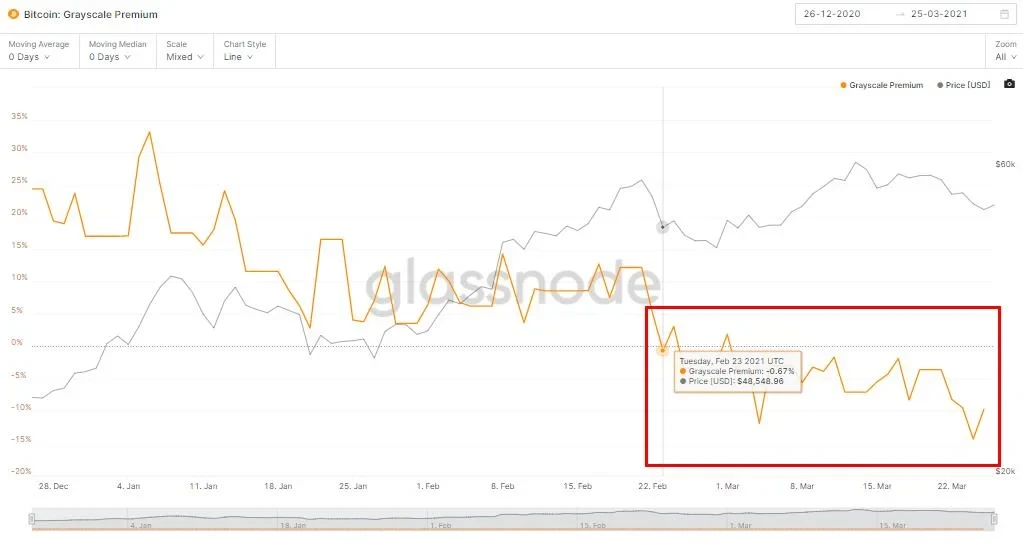
At this time, news headlines were still featuring "Square Buys $170 Million Worth of BTC," "Meitu Spends $40 Million on Bitcoin, Becoming First in Hong Kong Stocks," "Morgan Stanley to Offer Bitcoin Fund Investments to High-Net-Worth Clients," and "Visa Working to Enable Bitcoin Purchases and Allow Seamless Conversion to Fiat." Yet Grayscale GBTC, as the primary channel for compliant investors to enter the market, showed significantly slowed growth and an oversupply of GBTC in the secondary market—requiring serious consideration. This stems from several factors.
First, this may be related to the large amount of GBTC unlocking and entering the market. Grayscale GBTC has a 6-month lock-up period; investors can only trade on the over-the-counter market after six months. During this six-month period, Grayscale purchased nearly 220,000 BTC, and with BTC prices surging, investors who entered six months ago enjoyed substantial returns. Therefore, there is significant selling pressure in the over-the-counter market.
Second, Grayscale's previously monopolistic market environment has been increasingly divided as new compliant competitors enter. Purpose Investments' world's first Bitcoin ETF began trading on February 18. According to Bitcoin Treasuries data, as of March 25, the fund holds 14,700 BTC with assets under management of $773 million, ranking sixth on the Bitcoin fund leaderboard with notable growth.
Considering that Grayscale GBTC suspended accepting new investments from March 10, comparing new additions between February 18 and March 10: Purpose Bitcoin ETF added 12,468 BTC, while Grayscale only added 2,200 BTC—Grayscale's appeal has visibly declined.
Another development: REX Shares' digital assets subsidiary Osprey Funds' Bitcoin trust fund OBTC has surpassed $81.56 million in assets under management as of March 26. It is custodied by Fidelity Digital Assets with a management fee of only 0.49%, compared to Grayscale's 2% management fee. This means that with Grayscale's current holdings of over 650,000 BTC, daily management fees collected amount to approximately 35 BTC—indeed shockingly high.
From this perspective, Purpose Bitcoin ETF has no lock-up period and trades like stocks, allowing for immediate buying and selling, while OBTC offers lower management fees. Whether in terms of exit mechanisms or management fees, Grayscale holds no advantage. Therefore, the narrowing of Grayscale GBTC's moat is evident. Bitcoin Treasuries data shows Grayscale currently has at least 16 competitors.
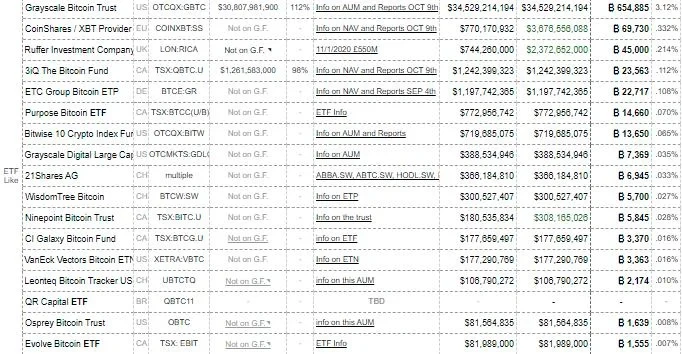
Additionally, according to a March 25 report, Fidelity has filed an S-1 with the SEC to apply for a BTC ETF. Besides the newly filed Fidelity application, six other companies have proposed BTC ETFs: Wisdom Tree Investments, Van Eck Associates Corp., NYDIG Asset Management, First Advisors/Sky Bridge, and Valkyrie Digital Assets. The influx of increasingly more competitors will also compete with Grayscale for market share.
Negative Premium Has Limited Short-Term Impact on Cryptocurrency Market, But Grayscale's Model Urgently Needs Transformation
After Grayscale's negative premium emerged, the first to be affected were holders of its trust products. In the past, due to the limited availability of compliant investment channels, GBTC enjoyed significant market demand, often trading at a premium in the secondary market. Where there is premium, there is arbitrage opportunity—investment institutions could "borrow" GBTC from GBTC holders, sell it in the secondary market, use the proceeds to subscribe to newly issued Grayscale GBTC shares, return the shares plus interest to the lender, completing the arbitrage for the borrower while the lender earns interest.
When the premium is negative, since Grayscale does not support redemptions, arbitrage opportunities cease to exist. Consequently, fund inflows slow down, and with the visible future selling pressure of GBTC, in a buyer's market, the discount cannot be prevented from further expanding. Naturally, holders will quickly sell their GBTC holdings once the lock-up period ends.
Currently, Grayscale's negative premium is not due to institutional investors withdrawing from the cryptocurrency industry, but rather because more competitive alternatives have emerged, dividing Grayscale's market share. As an investment tool more readily accepted by mutual funds and pension funds, ETFs may also force investors to shift funds originally intended for GBTC to BTC ETFs in the future. This is a problem arising from Grayscale's disadvantages in redemption mechanisms and management fees, not a market problem, so its impact on the cryptocurrency market is limited.
However, some still worry: after all, Grayscale holds over 650,000 BTC—what if they "dump" in the future? Previously, Grayscale announced it would spend $250 million to repurchase GBTC in the secondary market. BTC critic Peter Schiff tweeted that this means Grayscale will sell Bitcoin to raise funds for the repurchase. This was immediately "refuted" by Grayscale CEO Michael Sonnenshein: "Get your facts straight—Grayscale is not selling BTC to fund the share buyback."
Indeed, this is not just the CEO's statement but a regulatory requirement that Grayscale "cannot sell coins." Due to the non-redemption mechanism mandated by the SEC, Grayscale can essentially only buy BTC, not sell it. The only circumstance under which it can sell BTC is to pay trust fees and related expenses. To understand: regulations stipulate that Grayscale's issued shares (unless redeemed) cannot change in total quantity. This means that even if Grayscale repurchases GBTC in the secondary market, it merely reduces the circulating shares in the secondary market without affecting the total issued shares. The BTC corresponding to the total shares must remain fully held by Grayscale, and these exited shares can only re-enter the market when sold again.
Therefore, unless the SEC allows Grayscale to "redeem," Grayscale will likely hold these coins indefinitely—hence its nickname "BTC Pixiu" (a mythical creature that only takes in, never gives out). However, it is worth noting that Byte Tree co-founder Charlie Morris previously pointed out that in today's BTC trading market, 81% of institutional trading volume is completed through GBTC. Grayscale's position is pivotal, and as an investor confidence barometer, Grayscale faces aggressive "latecomers." Although it can still collect high management fees daily, it has reached a crossroads where transformation is urgently needed.
Disclaimer: Digital asset trading involves significant risk. This material should not be used as a basis for investment decisions, nor should it be interpreted as advice to engage in investment trading. Please ensure you fully understand the risks involved and invest cautiously. The OKX tutorial team provides information for reference only and does not constitute any investment advice. All investment actions by users are unrelated to this platform.
Disclaimer
This article may contain product-related content not applicable to your region. This article is dedicated to providing general information only and is not responsible for any factual errors or omissions. This article represents the author's personal views and does not reflect OKX's opinions. This article is not intended to provide any of the following advice, including but not limited to: (i) investment advice or investment recommendations; (ii) offers or solicitations to buy, sell, or hold digital assets; or (iii) financial, accounting, legal, or tax advice. Holding digital assets (including stablecoins) involves high risk, may fluctuate significantly, or even become worthless. You should carefully consider whether trading or holding digital assets is suitable for you based on your financial situation. For questions regarding your specific circumstances, please consult your legal/tax/investment professionals. Information appearing in this article (including market data and statistics, if any) is for general reference only. Although we have exercised all reasonable care in preparing this data and these charts, we assume no responsibility for any factual errors or omissions expressed herein. © 2025 OKX. This article may be reproduced or distributed in its entirety, or excerpts of 100 words or less may be used, provided such use is non-commercial. Any reproduction or distribution of the entire article must also prominently state: "This article is copyrighted © 2025 OKX, used with permission." Permitted excerpts must cite the article title and include attribution, such as "Article Title, [Author Name (if applicable)], © 2025 OKX." Some content may be generated or assisted by artificial intelligence (AI) tools. Derivative works or other uses of this article are not permitted.
Show More
Recommended Reading
OKX Pay: Ushering in a New Era of Next-Generation Crypto Payments
The choice of tens of millions of users. Register with OKX to enjoy an exceptional trading experience and diverse wealth management products. A letter from OKX CEO Star: Today, we officially launch the first version of OKX Pay to over 100 million global users. As the industry's first payment application to truly achieve the integration of non-custodial and compliance, OKX Pay will be embedded within the OKX App, currently available in select markets with full rollout expected within months.
March 22, 2026

A New Chapter: Building Next-Generation Financial Infrastructure Together
The partnership between OKX and Intercontinental Exchange (ICE) is a significant moment for OKX and equally meaningful for the evolution of the entire digital asset market. ICE builds and operates the world's most important financial infrastructure, including the New York Stock Exchange and global derivatives and clearing platforms. ICE's decision to invest in OKX and join our board reflects our shared belief that digital asset technology will play a significant role in financial markets.
March 10, 2026
To Another Year of Building
As CEO of OKX and a builder who never forgets his original aspirations, I am proud to look back on the extraordinary growth and progress OKX achieved this year. Despite numerous challenges, 2024 was a year of focus, innovation, and resilience. We not only expanded and optimized our products but also made important progress in launching transparent, regulatory-compliant localized operations, while further strengthening our global management team. Notably, after experiencing...
January 29, 2026

2025: Steady Progress Toward Financial Freedom
— Year-End Letter from OKX Founder and CEO Star to Global Users. "Financial freedom" is often misunderstood. It does not mean the absence of rules, but rather having the right to choose even when rules exist—and when the system is truly tested, it remains reliable and effective. This is what we have focused on throughout 2025. First, I would like to extend sincere gratitude to our global customers, partners, and regulators.
January 16, 2026

OKX Officially Launches in Germany and Poland
Author: Erald Ghoos, CEO of OKX Europe. Today is a significant day for OKX—and for crypto users across Europe. We have officially launched a fully compliant centralized cryptocurrency trading platform in Germany and Poland! For us, this is not just a geographic expansion, but a commitment to building the future of cryptocurrency the right way: secure, transparent, and meeting local needs. If you are in Germany...
October 21, 2025
Partnership Upgrade! OKX Collaborates with Standard Chartered to Expand European Market
On October 15, Erald Ghoos, CEO of OKX Europe, announced that OKX is extending its strategic partnership with Standard Chartered to the European Economic Area (EEA). Earlier this year, OKX first partnered with Standard Chartered in the UAE to launch a collateral mirroring program—a...
October 15, 2025