MicroStrategy Plans Another Debt Issuance to Add Bitcoin Positions—Will Investors Still Buy After $285 Million Impairment?
MicroStrategy's aggressive buying spree has made both the company and its CEO, Michael Saylor, household names in the crypto world. Unlike other publicly traded companies that cautiously dip their toes into Bitcoin with only a portion of their funds, MicroStrategy is an "outlier." It has not only deployed significant amounts of its own cash but also raised $1.7 billion through debt issuance to bet on Bitcoin.
Through its strategy of buying more as prices rise, MicroStrategy holds 92,079 Bitcoin—the largest holdings among publicly traded companies—2.38 times more than second-place Tesla. At the time of writing, OKX shows Bitcoin trading at $36,821.7, meaning MicroStrategy's Bitcoin assets are worth $3.391 billion. Compared to its cost basis of $2.251 billion ($24,446.4 per Bitcoin), this represents an unrealized gain of 51%. However, this safety margin is somewhat precarious given the severe bullish-bearish divergence in the crypto market, especially with Bitcoin technically entering a bear market.
On June 7, after reporting to the U.S. Securities and Exchange Commission (SEC) that it expected to record at least $284.5 million in impairment losses on its Bitcoin investment for Q2, MicroStrategy announced plans to issue $400 million (later increased to $500 million) in senior secured notes to purchase more Bitcoin. The notes carry a 6.125% annual interest rate and mature in 2028.
Notably, the high interest rate of 6.125%-6.25% falls into the junk bond category, typically issued by companies with low credit ratings. As soon as MicroStrategy announced its debt financing plans, it received $1.6 billion in orders—four times its initial target.
Market reactions to this news have been polarized. Bitcoin supporters view it as evidence of crypto's growing appeal, while critics argue that MicroStrategy's Bitcoin position has grown too large—arguably becoming its core business. If prices continue to fall, this "gambler-like" aggressive accumulation strategy could leave MicroStrategy insolvent. Should that happen, its celebrated holdings of over 90,000 Bitcoin could become a bomb waiting to be dumped on the market.
Public Company "Neglects Core Business," Aggressive Bitcoin Buying Creates Shadow Stock
Founded in 1989, MicroStrategy is a provider of business intelligence, mobile software, and cloud-based services. For the first 31 years of its existence, the company had nothing to do with crypto assets. In fact, CEO Michael Saylor criticized Bitcoin on social media in 2013, claiming its days were numbered.

Yet on August 11, 2020, this very company suddenly announced it had purchased $250 million worth of Bitcoin, becoming the first publicly traded company to publicly adopt Bitcoin as a treasury reserve asset. MicroStrategy cited dollar depreciation, declining cash returns, and macroeconomic conditions such as the COVID-19 pandemic as reasons. At that time, Bitcoin was trading around $11,000.
Shortly thereafter, Bitcoin embarked on a significant rally, rising from approximately $11,000 in August 2020 to a peak of $64,846.9 on April 14, 2021, before beginning its decline. During this period, MicroStrategy continued to add to its Bitcoin position.
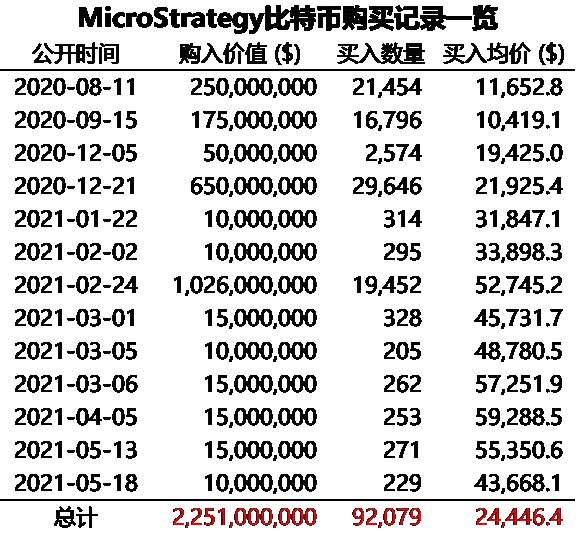
As of June 10, based on 13 publicly disclosed purchases, MicroStrategy has invested a total of $2.251 billion to acquire 92,079 Bitcoin at an average cost of $24,446.4 per Bitcoin. Of this, $551 million came from company funds, while $1.7 billion was raised through convertible note offerings—placing it at the top of the list for Bitcoin holdings among public companies.
After reviewing MicroStrategy's Q1 2021 financial report, we compiled the following summary. As of March 31, 2021, MicroStrategy's total assets were $2.443 billion, with crypto assets accounting for approximately $1.947 billion—an astonishing 79.70% of total assets.
Under U.S. GAAP, companies purchasing Bitcoin and other crypto assets may record them on the balance sheet at the lower of cost or net realizable value (MicroStrategy uses cost). Therefore, although MicroStrategy held 91,326 Bitcoin as of March 31, and OKX showed Bitcoin closing at $59,286.3 (implying a total value of $5.414 billion), its financial statements still reflected the $1.947 billion figure.
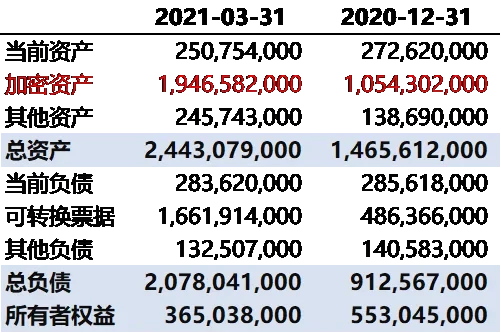
As of June 10, before market close, MicroStrategy's market capitalization was $4.725 billion, while its Bitcoin holdings were worth $3.391 billion—meaning its Bitcoin represented 71.76% of the company's total market value. This high concentration means Bitcoin price movements directly impact MicroStrategy's stock price, earning it the nickname "Bitcoin shadow stock." Its performance is closely tied to the crypto market's ups and downs.
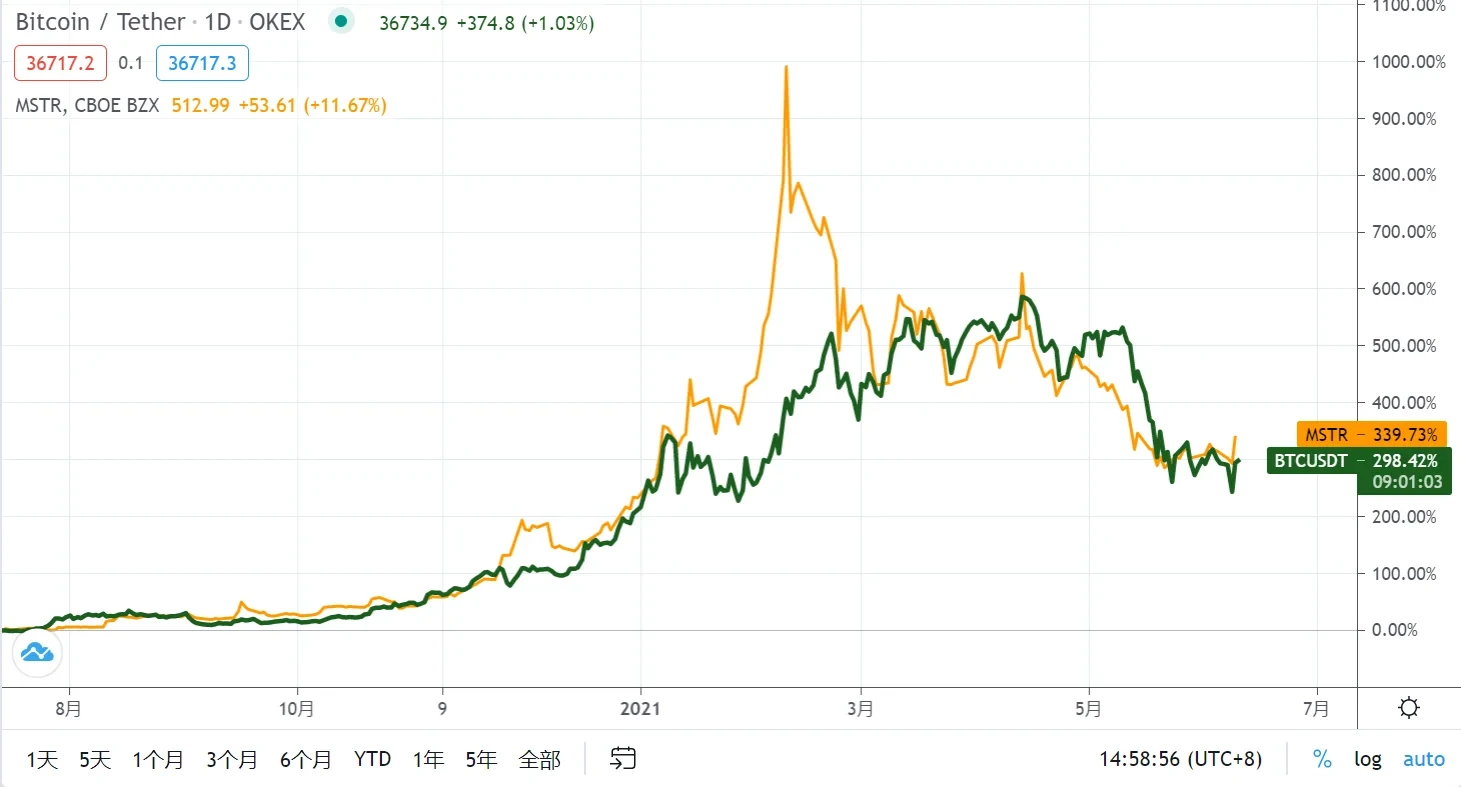
Since announcing its Bitcoin purchase on August 11, 2020, MicroStrategy's stock price has climbed alongside crypto asset growth. On August 11, its stock was at $134.89, but seven months later—fueled by the company's aggressive accumulation and strong marketing—its stock reached $1,272.94 on February 9, an increase of nearly 850%. However, as the crypto market began to decline, MicroStrategy's stock followed suit. At the time of writing, it trades at $512.99, down 61% from its peak.
$1.7 Billion in Debt Not Enough—Plans to Issue Another $500 Million in Junk Bonds to Continue Accumulating
On December 11, 2020, and February 19, 2021, MicroStrategy issued two rounds of notes, raising a total of $1.7 billion. This is perhaps the most ingenious aspect of MicroStrategy's strategy. Its cleverness lies in using "convertible notes" as a financial instrument to access virtually cost-free capital from traditional markets, then deploying it to bet on highly volatile Bitcoin.
On December 11, 2020, MicroStrategy announced the completion of a $650 million senior unsecured convertible note offering. According to Business Wire, these convertible notes carried a 0.750% annual interest rate, with semi-annual interest payments beginning June 15, 2021—meaning interest is paid every June 15 and December 15. The offering was initially planned for $400 million but was ultimately oversubscribed to $650 million.
The maturity date is December 15, 2025, at which point investors may elect to convert the notes to cash, MicroStrategy Class A common stock, or a combination thereof. The initial conversion ratio was set at 2.5126 shares of MicroStrategy Class A stock per $1,000 principal amount, implying a conversion price of $397.99 per share. Based on MicroStrategy's closing price of $289.45 on December 8, 2020, this represented a premium of approximately 37.50%.
Then on February 19, 2021, MicroStrategy completed another $1.05 billion senior unsecured convertible note offering, maturing on February 15, 2027. These convertible notes also allow investors to convert to cash, MicroStrategy Class A stock, or a combination at maturity.
The initial conversion rate for these notes was 0.6981 shares of MicroStrategy Class A stock per $1,000 principal amount, equivalent to an initial conversion price of $1,432.46 per share. Compared to the February 16, 2021 closing price of $955.00, this represented a premium of approximately 50.00%.
Beyond the premium rates indicating strong investor appetite, the interest MicroStrategy pays on its convertible notes tells the story. The previous round was 0.750%; this round was zero-coupon (0% annual interest), requiring only principal repayment at maturity. Strictly speaking, this isn't even a conventional zero-coupon note—those are typically issued at a discount, whereas MicroStrategy issued these at par.
For these two debt issances totaling $1.7 billion, MicroStrategy's interest obligation is only $24.375 million.
To provide a more intuitive comparison, we looked at OKX's professional user margin rates. VIP 1 has a daily rate of 0.0145% (approximately 5.2925% annualized) with a maximum borrowing limit of 1.8 million USDT. VIP 7 has a daily rate of 0.0021% (approximately 0.7665% annualized) with a maximum borrowing limit of 3.6 million USDT.
Whether in terms of capital scale or interest rates, MicroStrategy's financing costs are exceptionally low. Therefore, using convertible notes to raise capital from traditional markets to purchase Bitcoin is indeed a commendable strategy.
We all know that issuing debt means taking on leverage. If we use Bitcoin's current market price multiplied by MicroStrategy's current holdings instead of the cost method, and assuming other values remain constant, we arrive at a hypothetical balance sheet for MicroStrategy as of June 10, 2021, as shown below:
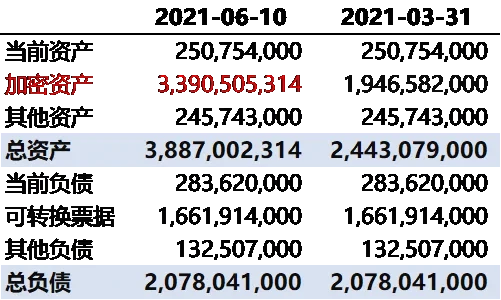
At this point, MicroStrategy's total assets would be $3.887 billion, with liabilities of $2.078 billion, yielding a debt-to-asset ratio of 53.46%. If Bitcoin falls to $17,176, MicroStrategy would become insolvent. Considering Bitcoin's historical 80% drawdown during bear markets, and with Bitcoin already down 43.22% from its peak, sustained underperformance going forward—combined with potential Federal Reserve rate hikes—could make a return to $17,000 a real possibility.
And at this very moment, MicroStrategy announced another debt issuance to institutional investors, raising $400 million (now adjusted to $500 million) in senior secured notes, maturing in 2028 with a 6.125% annual interest rate.
Such a high interest rate classifies these senior secured notes as junk bonds. Junk bonds are issued by companies with low credit ratings; due to higher investment risk, they offer elevated yields to attract investors.

Although MicroStrategy's debt announcement immediately attracted $1.6 billion in orders, the shift from low or even zero interest to high interest reflects both internal and external factors. External factors include Bitcoin's uncertain future trajectory and rising expectations of Federal Reserve rate hikes. Internally, Bitcoin investments now constitute the majority of the company's assets, leading the market to downgrade expectations of MicroStrategy's debt repayment capacity.
Behind the glamorous facade of a publicly traded company lies a reality of debt-funded speculation on Bitcoin that sent its stock soaring, only to fall as the crypto market declined. With mediocre core business revenue and a dual decline in both crypto and stock prices, the market lowers its expectations of the company's solvency, triggering a vicious cycle of fundraising difficulties. In severe cases, this could even lead to bankruptcy or restructuring. This is why Citigroup downgraded the stock to "sell" after MicroStrategy first announced plans to issue convertible notes to buy Bitcoin, and why HSBC prohibited clients from purchasing MicroStrategy shares.
MicroStrategy once cleverly used its aggressive push into the crypto industry to rescue its stock price after a crash and reinvent itself. But if it fails to control position risk and continues to accumulate blindly, the risks are considerable—after all, the company nearly went bankrupt during the 2001 dot-com bubble. Of course, the crypto world is ever-changing, and MicroStrategy's story will continue to be written by the market.
Disclaimer
This article may contain content related to products not available in your region. It is intended solely to provide general information, and we assume no responsibility for any factual errors or omissions. The views expressed are those of the author alone and do not represent the views of OKX. This article is not intended to provide any of the following, including but not limited to: (i) investment advice or recommendations; (ii) an offer or solicitation to buy, sell, or hold digital assets; or (iii) financial, accounting, legal, or tax advice. Holding digital assets (including stablecoins) involves high risk and may fluctuate significantly or even become worthless. You should carefully consider whether trading or holding digital assets is suitable for you based on your financial situation. For questions regarding your specific circumstances, please consult your legal/tax/investment professionals. Information appearing in this article (including market data and statistics, if any) is provided for general reference only. Although we have exercised all reasonable care in preparing this data and these charts, we assume no responsibility for any factual errors or omissions expressed herein. © 2025 OKX. This article may be reproduced or distributed in its entirety, or excerpts of 100 words or less may be used, provided such use is non-commercial. Any reproduction or distribution of the entire article must also prominently state: "Copyright © 2025 OKX, used with permission." Permitted excerpts must cite the article title and include attribution, such as "Article Title, [Author Name if applicable], © 2025 OKX." Some content may be generated or assisted by artificial intelligence (AI) tools. Derivative works or other uses of this article are not permitted.
Show More
Recommended Reading
OKX Pay: Ushering in a New Era of Next-Generation Crypto Payments
The choice of tens of millions of users. Register with OKX to enjoy an exceptional trading experience and diverse wealth management products. A letter from OKX CEO Star: Today, we officially launch the first version of OKX Pay to over 100 million global users. As the industry's first payment application to truly achieve the integration of non-custodial and compliance, OKX Pay will be embedded within the OKX App. It is currently available in select markets and is expected to roll out fully within months.
March 22, 2026

A New Chapter: Building Next-Generation Financial Infrastructure Together
The partnership between OKX and Intercontinental Exchange (ICE) is a significant moment for OKX and equally meaningful for the evolution of the digital assets market. ICE builds and operates the world's most important financial infrastructure, including the New York Stock Exchange and global derivatives and clearing platforms. ICE's decision to invest in OKX and join our board reflects our shared belief that digital assets technology will play a vital role in financial markets.
March 10, 2026

To Another Year of Building
As CEO of OKX and a builder who remains true to my original vision, I look back with pride on the extraordinary growth and progress OKX achieved this year. Despite numerous challenges, 2024 was a year of focus, innovation, and resilience. We not only expanded and optimized our products but also made important strides in launching transparent, regulatory-compliant localized businesses, while further strengthening our global management team. Notably, after experiencing...
January 29, 2026

2025: Steady Progress Toward Financial Freedom
— Year-End Letter from OKX Founder and CEO Star to Global Users. "Financial freedom" is often misunderstood. It doesn't mean the absence of rules, but rather having the right to choose even when rules exist—and when the system is truly tested, it remains reliable and effective. This is what we have focused on throughout 2025. First, I would like to extend my sincere gratitude to customers, partners, and regulators around the world.
January 16, 2026

OKX Officially Launches in Germany and Poland
By: Erald Ghoos, CEO of OKX Europe. Today is a significant day for OKX—and for crypto users across Europe. We have officially launched a fully compliant centralized cryptocurrency trading platform in Germany and Poland! For us, this is more than just geographic expansion; it is a commitment to building the future of cryptocurrency the right way: secure, transparent, and tailored to local needs. If you are in Germany...
October 21, 2025

Partnership Upgrade! OKX Collaborates with Standard Chartered to Expand in Europe
On October 15, Erald Ghoos, CEO of OKX Europe, announced that OKX is extending its strategic partnership with Standard Chartered to the European Economic Area (EEA). Earlier this year, OKX first partnered with Standard Chartered in the UAE to launch a collateral mirroring program—this is...
October 15, 2025