OKX Research | A Deep Dive into 10-Year Performance of Major Assets, The Truth Behind Bitcoin, Gold, US Stocks, US Treasuries and More


During 2015-2025, global financial markets experienced a magnificent cycle. From quantitative easing in the post-financial crisis era to historic zero interest rate environments, then to aggressive tightening cycles triggered by high inflation, macroeconomic waves continuously impacted various assets. In this context, crypto assets represented by BTC and ETH far exceeded returns of gold and US Treasuries, completing an astonishing transition from geek circle experiments to entering Wall Street institutional balance sheets. But behind excess returns also comes extreme risk—crypto assets once experienced deep drawdowns exceeding 75%, with recovery periods often measured in years, while traditional assets demonstrated stronger resilience.
Therefore, OKX Research focuses on "10-Year Performance of Five Major Assets" to answer a key question: Over a 10-year timeframe, placing BTC and ETH alongside mainstream assets like gold, S&P 500 index, and US Treasuries, what are the true portraits of their respective returns and risks? Have we paid equivalent, or even excess risk prices for the astonishing returns of crypto assets? To this end, we will go beyond single return rate comparisons, striving to paint a complete, objective, cycle-crossing asset performance map. (Statistics as of August 31, 2025)

Data source: 8Market Cap; Global major asset market cap ranking as of end of August 2025, Bitcoin has risen to the forefront
Returns Showdown: Who is the King of Assets?
The most intuitive method to evaluate an asset is to observe its long-term value growth trajectory. We assume investing $10,000 in these 5 assets on August 1, 2015, and track their cumulative value changes to August 1, 2025. This comparison clearly reveals the huge differences in wealth creation capabilities across different asset classes.
(I) Annual Price Snapshot: Value Benchmarks at Key Nodes (2015-2025, August 1 each year)
The table below records closing prices of five core assets on August 1 (or first trading day thereafter) each year from 2015 to 2025.

Data source: Based on Yahoo Finance and CoinGecko, closing price on that day or first trading day thereafter, ETF prices are adjusted closing prices
From price snapshots we can clearly see that Bitcoin and Ethereum experienced exponential growth, with their price orders of magnitude fundamentally changing within a decade. In comparison, S&P 500 demonstrated steady bull market upward trajectory, gold presented volatility related to macroeconomic cycles, while US Treasury prices clearly reflected interest rate environment changes, under significant pressure during the 2022-2023 rate hike cycle.
(II) Annual Peak Moments: Capturing Each Cycle's Highest Point
Merely observing price snapshots on specific dates is far from sufficient to depict the full picture of assets. In-year price fluctuations, especially the appearance of highest points, reveal assets' potential explosive power and "fear of missing out" (FOMO) traders may face. The table below statistics the highest prices each asset reached within each annual cycle (from August 1 of current year to July 31 of following year).

Data source: Ethereum launched on July 30, 2015, early data had lower liquidity and may contain certain errors, other data calculated based on Yahoo Finance daily historical data
By observing annual price peaks, we can clearly see the magnitude differences in asset growth. Bitcoin and Ethereum's price highs in bull markets present astonishing jumps, while S&P 500 and gold show much smaller gaps between annual highs and snapshot prices, reflecting their more mature and stable market characteristics.
(III) Wealth Growth Simulation: A 10-Year Fantasy Journey of $10,000
To more intuitively feel the wealth creation capabilities of different assets, we simulated a simple experiment: On August 1, 2015, buying $10,000 of each of the five assets and holding until August 1, 2025. The chart below uses logarithmic coordinates to display cumulative value changes of this investment—this coordinate system better handles data with huge order of magnitude differences, avoiding overly steep curves for high-growth assets
and obscure details of other assets.

Data sources: Yahoo Finance, FRED, Macrotrends, etc.
The table shows that over the decade from 2015 to 2025, different assets grew by the following multiples: BTC 402.17x, with 10-year cumulative returns of approximately $4.02 million; ETH 1,195.55x, with 10-year cumulative returns reaching as high as $11.95 million; Gold 3.08x, with 10-year cumulative returns of approximately $30,000; S&P 500 2.97x, with 10-year cumulative returns of approximately $29,600; US Treasury bonds 1.26x, with 10-year cumulative returns of only approximately $12,600.

Among these, Bitcoin and Ethereum have demonstrated astonishing wealth growth effects, with returns far exceeding those of traditional assets, reaching levels of a hundredfold or even a thousandfold. This reflects the asymmetric return potential of emerging technology assets under high risk, which would be unimaginable in the traditional financial world. In contrast, the S&P 500 tripled an investment through stable compound growth; gold primarily served a value-preservation function; and US Treasury bonds, after fully experiencing both low and high interest rate cycles, remained virtually stagnant over 10 years, highlighting how interest rate risk constrains the long-term performance of bond assets.
Maximum Drawdown — How High Is the Risk Behind Those Returns?
No single asset can always lead the way; returns are merely the beginning of the story. A seasoned trader is more concerned with the quality of returns — that is, how much risk was assumed to earn those returns. Therefore, understanding the risk characteristics of different assets is just as important as understanding their return potential. Through three core metrics — volatility, maximum drawdown, and the Sharpe ratio — we can more comprehensively evaluate the true "value for money" of various assets. Volatility, typically measured by standard deviation, reflects the magnitude of price fluctuations in an asset. Maximum drawdown measures the largest peak-to-trough decline from an asset's historical high to its subsequent low, serving as an intuitive indicator of downside risk and directly relating to traders' psychological tolerance and the survivability of an asset portfolio.
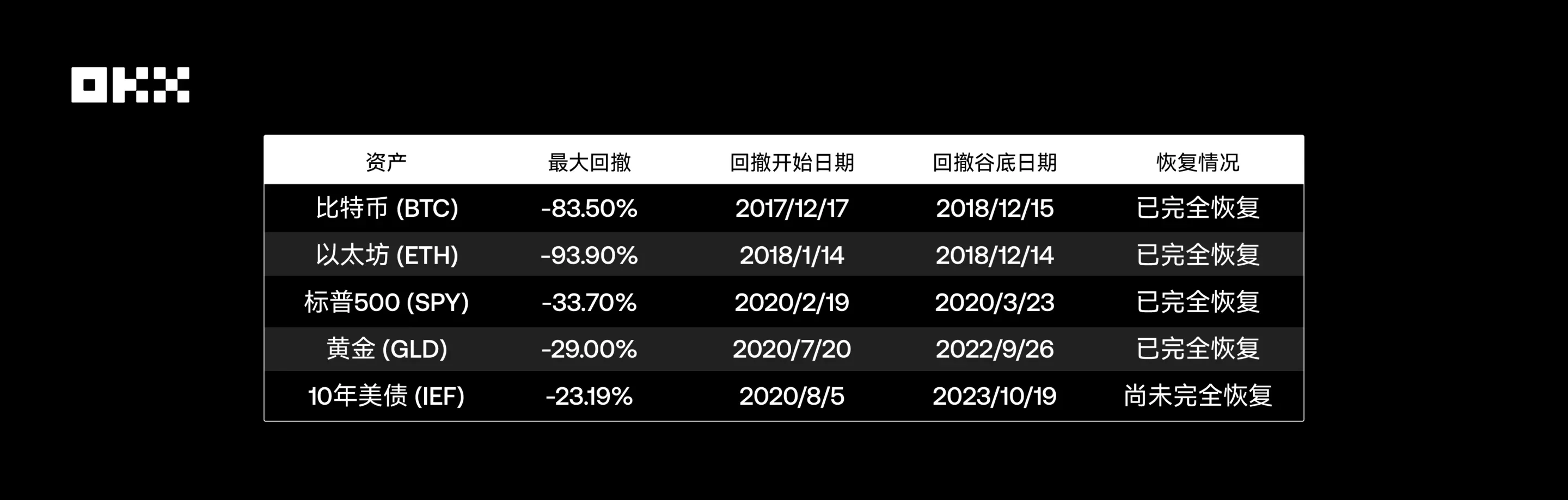
Data sources: Bloomberg, S&P Global, Yahoo Finance, etc.
Crypto assets exhibit far greater volatility than traditional assets. According to Digital One Agency data, Bitcoin's annualized standard deviation is approximately 70%–90%, while the S&P 500 index is only 15%–20%. This enormous volatility directly leads to staggering maximum drawdowns: over the past 10 years, Bitcoin and Ethereum have experienced multiple drawdowns exceeding 70%. For example, during the 2018 bear market, BTC's price plummeted from nearly $20,000 to approximately $3,000, a drawdown exceeding 80%. The S&P 500's largest drawdown occurred during the early stages of the COVID-19 pandemic in 2020, at approximately -34%. During the 2008 financial crisis, its drawdown exceeded -50%. Gold has performed relatively steadily, with a maximum drawdown of approximately -29% over the past 15 years. As a safe-haven asset, US Treasury bonds experienced the smallest drawdown, but influenced by interest rate cycles, they also suffered a maximum drawdown of approximately -23% during the rate-hike cycle after 2020, shattering the myth of their being "risk-free."

This data is sobering. Bitcoin and Ethereum investors must be capable of withstanding asset contractions of 80% or even 90%, and may need to wait more than two to three years to break even.
Additionally, to comprehensively evaluate risk and returns, we introduce the Sharpe ratio and the Calmar ratio. The Sharpe ratio, proposed by Nobel laureate William Sharpe, is the most classic risk-adjusted return metric internationally. It measures how much excess return over the risk-free rate an investor can earn per unit of total risk (measured by volatility). A higher Sharpe ratio indicates that the asset delivers better returns for the same level of risk assumed, meaning higher trading efficiency.
The Calmar ratio is another important risk-adjusted return metric, but it focuses more on measuring the downside risk of an asset. It is calculated as the annualized return rate divided by the historical maximum drawdown. A higher Calmar ratio means the asset has stronger "recovery capability" or "value for money" when enduring its worst historical drawdown. This metric is especially favored by risk-conscious investors.

Bitcoin and Ethereum's radar charts show the most "aggressive" shape. They demonstrate unparalleled advantages in the two dimensions of annualized return rate and Calmar ratio, forming two outward-pointing spikes. This reflects their astonishing wealth growth effect over the past decade and their strong post-drawdown recovery capabilities.
Resilience. However, this high return comes at a cost. On the two dimensions of maximum drawdown and annualized volatility, they score the lowest among all assets, meaning their radar charts significantly contract in both these directions, forming a clear "short board." This vividly reveals the high-risk, high-volatility nature of crypto assets. Notably, Bitcoin's Sharpe ratio outperforms Ethereum, indicating that after risk adjustment, Bitcoin's investment efficiency has a slight edge.
The radar chart for U.S. stocks (S&P 500) presents a relatively balanced pentagon with considerable coverage area. It shows no obvious weak points across all five dimensions, nor does it have extreme strengths. Its Sharpe ratio performance stands out, second only to Bitcoin, demonstrating excellent risk-adjusted returns. At the same time, its annualized return rate is robust, while volatility and maximum drawdown are well controlled—far superior to crypto assets. This paints the typical image of a "core strength": capable of delivering substantial long-term returns while keeping risk within a relatively reasonable range, serving as the cornerstone for building an asset portfolio.
Gold's radar chart shape leans toward the risk-control dimension. It scores high on annualized volatility and maximum drawdown, indicating relatively stable prices and strong downside resistance. However, on the three return-related dimensions—annualized return rate, Sharpe ratio, and Calmar ratio—gold's performance is relatively mediocre. This aligns perfectly with gold's positioning as a traditional safe-haven asset: it is not a tool for pursuing high growth, but rather provides value preservation and risk-hedging functions during market turmoil. Its smaller chart area also reflects its lower overall return efficiency.
The radar chart for U.S. Treasury bonds is the smallest coverage area among all assets, with its shape compressed toward the center. It scores highest on the two risk dimensions—annualized volatility and maximum drawdown—demonstrating exceptional stability. However, its scores on all return-related dimensions rank at the bottom. This clearly indicates that, against the macroeconomic backdrop of declining interest rates over the past decade, U.S. Treasury bonds have primarily served the role of capital preservation and providing liquidity, acting as the "ballast" in an asset portfolio rather than a return engine. Its extremely low risk contrasts sharply with its extremely low returns.
Inter-Asset Correlations: How to Optimize Asset Portfolios?
The core of portfolio diversification lies in including assets with low correlation. When one asset declines, another may rise or remain stable, thereby smoothing the volatility of the entire portfolio. When Bitcoin was first created, it had almost no correlation with traditional financial markets, earning it the reputation of a perfect "diversification tool." However, this characteristic has changed significantly over the past decade, especially as institutionalization accelerated.
The correlation coefficient measures the degree to which two assets' prices move in the same direction, ranging from -1 (perfect negative correlation) to +1 (perfect positive correlation). An effective diversified portfolio typically consists of assets with low or negative correlation. The following table synthesizes data from multiple research institutions, showing the approximate correlations between various assets over this decade.

Data sources: Crypto Research Report, LSEG, Newhedge
**Bitcoin vs S&P 500:** From Independence to Synchronization. This is one of the most significant changes over the decade. Before 2020: Crypto assets' correlation with traditional assets was generally low and unstable, often fluctuating between positive and negative, demonstrating strong independence. 2020–2021: During the pandemic and monetary easing period, as global central banks adopted large-scale liquidity injections, the "rising tides lift all boats" effect on all risk assets was significant. During this period, the correlation between Bitcoin and the S&P 500 (especially tech stocks) surged sharply, once exceeding 0.6, presenting a strong "coupling" phenomenon. This indicates that in a macro liquidity-driven market, Bitcoin behaves more like a high-beta risk asset than a safe-haven tool.
2022–2023: During the rate-hike and tightening cycle, as the Federal Reserve initiated an aggressive rate-hike cycle, risk assets generally came under pressure. The correlation between Bitcoin and the S&P 500 remained elevated, with both declining together. However, its negative correlation with the U.S. Dollar Index (DXY) strengthened significantly—Bitcoin prices tended to come under pressure when the dollar strengthened. 2024–2025: The ETF Era. The approval of U.S. spot Bitcoin ETFs was viewed as a structural inflection point. On one hand, it strengthened the connection between the crypto market and the traditional financial system; on the other hand, the sustained fund inflows from ETFs could also become a pricing factor independent of macro sentiment, causing correlations to shift once again. Data shows that after ETF approval, Bitcoin's correlation with the S&P 500 declined, showing signs of a certain "decoupling."
Bitcoin vs Gold: Challenges to the "Digital Gold" Narrative. Although Bitcoin has been dubbed "digital gold" due to its fixed supply, data shows that its safe-haven properties and correlation with physical gold are unstable. Research from the European Securities and Markets Authority (ESMA) indicates that there is no clear stable relationship between the two, especially during market panics, Bitcoin tends to fall alongside risk assets rather than providing shelter like gold.
Internal Relationships Among Traditional Assets: The classic negative or low correlations between gold, U.S. Treasury bonds, and the S&P 500 remain the foundation of traditional asset allocation, providing important stability to asset portfolios.
Major Event Shocks: How Did the Five Major Assets Perform?
Long-cycle averages may mask extreme performances at critical moments. By conducting a "cross-section" analysis of several major events, we can gain a deeper understanding of each asset class's true "stress response."
(1) March 2020: The COVID-19 Black Swan Event—Indiscriminate Selling Across Global Markets
In March 2020, the COVID-19 pandemic sparked panic across global financial markets, historically referred to as "Black March." In this extreme liquidity crisis, nearly all assets faced indiscriminate selling. The S&P 500 entered bear market territory in just 16 trading days—the fastest in history—with a maximum drawdown of -34%. Bitcoin was not spared either; its price plummeted nearly 50% in a single day on March 12, falling from approximately $8,000 to below $4,000. Gold (GLD) also failed to escape entirely, declining in the short term as investors sold assets for dollar liquidity. Only U.S. Treasury bonds, as the ultimate safe haven, held firm in price. This event profoundly revealed that during extreme "risk-off" phases, correlations converge toward 1, and Bitcoin's "digital safe-haven" narrative crumbled in the face of liquidity exhaustion.
(2) May & November 2022: Crypto-Native Crises—LUNA & FTX Collapses Brought Devastating Blows
2022 was a "year of disaster" for the crypto industry. In May, the collapse of algorithmic stablecoin Terra USD (UST) and its sister token LUNA wiped out nearly $500 billion in market cap within days. In November of the same year, the sudden bankruptcy of FTX, the world's second-largest crypto exchange, further intensified market panic. These two events were classic crypto "endogenous" crises. Research shows that following FTX's collapse, both Bitcoin and Ethereum prices dropped by more than 20%, with assets closely tied to the FTX ecosystem suffering even greater losses. However, during these events, traditional financial market assets such as gold, the S&P 500, and U.S. Treasuries were barely affected, clearly demonstrating the risk isolation that exists between the crypto market and traditional finance. This indicates that crypto assets not only face macroeconomic risks, but also unique—and potentially more devastating—internal protocol, platform, and trust risks.
(3) 2020–2025: A Cycle of Macro Policy Reversal, the Tides of Liquidity
The Federal Reserve's monetary policy serves as the "master valve" for global liquidity. Under the massive quantitative easing and zero-interest-rate policies of 2020–2021, abundant liquidity flooded into risk assets, and both Bitcoin and the S&P 500 experienced a major bull market. However, after the Federal Reserve initiated an aggressive rate-hiking cycle in March 2022 to combat inflation, global liquidity tightened and risk asset prices fell sharply. Academic research shows that Bitcoin's sensitivity to Federal Reserve rate decisions and Monetary Policy Uncertainty (MPU) increased significantly after 2020. This once again confirms that Bitcoin has become deeply integrated into the macro-financial framework, with its price movements closely tied to Federal Reserve policy expectations.
Furthermore, research has found that the Bitcoin market exhibits a notable "anticipatory trading" characteristic. Before rate-hike announcements, the market had often already priced in the hiking expectations, causing Bitcoin to come under pressure in advance; when rate-cut expectations were strong, prices would rise ahead of time. On the day a decision was announced, if the outcome met expectations, market reactions were typically muted. The real violent volatility comes from "rate surprises"—where FOMC decisions deviate from the expectations priced in by the market through tools like interest rate futures.
The chart below shows Bitcoin's average cumulative abnormal returns (CAR) relative to the S&P 500 during rate-hike and rate-cut event windows (T-5 to T+5 days). As can be seen, during rate-cut cycles, Bitcoin showed significant positive abnormal returns before the announcement, whereas during rate-hike cycles the effect was not significant, or even negative. This indicates that the market responds to rate cuts more positively and more proactively.

(4) January 2024: Bitcoin Spot ETF Approval, A Milestone on the Path to the Mainstream
On January 10, 2024, the U.S. Securities and Exchange Commission (SEC) officially approved the first batch of Bitcoin spot ETFs for listing. This was viewed as a landmark event for the legalization and mainstream adoption of crypto assets. The launch of ETFs greatly lowered the barriers for traditional users to access Bitcoin. Data shows that after ETF approval, Bitcoin trading volume surged with strong fund inflows. Charts from Chainalysis show that following the ETF launch, its daily trading volume approached $10 billion at one point in March, with cumulative fund inflows growing far faster than the performance of the first gold ETF when it launched in 2005. This event not only drove Bitcoin to new price highs, but more importantly, it is structurally changing Bitcoin's user base and market dynamics, making its ties to the traditional financial system closer than ever before.
No Asset Is Perfect—Building a Portfolio That Withstands Market Cycles
BTC/ETH have been the undisputed "kings of growth" over the past decade, delivering returns no traditional asset can match. However, the price of those returns is extreme volatility and significant drawdowns. Their correlation with traditional markets is increasing, eroding their value as a pure diversification tool. They are suited for investors with very high risk tolerance and a long-term holding conviction.
The S&P 500 is the "anchor" of a long-term portfolio. It provides excellent, sustainable compound growth, and on a risk-adjusted basis, it shows the best balance in both the Sharpe ratio and the Calmar ratio. Although it experiences cyclical pullbacks, its strong recovery ability and support from the real economy make it the absolute core of any portfolio construction.
As a time-honored store of value, gold offers limited absolute returns, but remains an indispensable "insurance policy" during periods of macro uncertainty, geopolitical risk, and when confidence in the fiat currency system is questioned. Its value in a portfolio lies not in offense, but in defense.
U.S. Treasuries' traditional "safe haven" status has faced a severe test during the unprecedented rate-hiking cycle, reminding investors that "risk-free" is merely a relative concept. Nevertheless, they remain one of the most liquid assets with the highest credit rating globally, and their fundamental role of providing stability and liquidity in a portfolio cannot be easily replaced in the short term.
So, the answer to this classic question is also clear: Dollar-cost averaging (DCA) or lump-sum investing?
In the long run, for high-volatility assets (BTC/ETH), DCA has shown tremendous advantages. By buying more shares at price troughs, DCA effectively smooths costs, reduces timing risk, and ultimately delivers very substantial returns—all while imposing far less psychological stress than lump-sum investing.
For steadily growing assets (SPY), since the stock market trends upward over the long term, lump-sum investing has historically outperformed DCA for most of the time, as it allows capital to benefit from market compounding earlier and more fully.
For low-growth assets (GLD/IEF), the final difference between the two strategies is negligible, as neither delivers explosive returns. The conclusion is that DCA is an effective strategy for navigating highly volatile assets like Bitcoin, while for long-term steadily growing equity markets, investing a lump sum as early as possible is typically the better choice. Whether you prefer the basic DCA strategy, smart arbitrage strategy, grid strategy suitable for short-term trading, or advanced signal or iceberg strategies, OKX Strategy Trading can meet all your needs in one stop.
The "holy grail" of asset allocation is not about finding a single best asset, but about deeply understanding and cleverly combining the unique characteristics of different assets. A robust portfolio should leverage the sharpness of crypto assets to pursue excess returns, rely on the depth of equity assets to drive long-term growth, and configure the stability of gold and bonds to guard against unknown risks. Ten years of data tells us: the market is always evolving, and there are no eternal winners. The true "king of assets" may not reside in any single specific asset, but rather within a rational trading framework capable of deeply understanding and驾驭 different asset characteristics.
Disclaimer
This article may contain product-related content that does not apply to your region. This article is only committed to providing general information and does not responsible for any factual errors or omissions contained herein. This article represents only the author's personal views and does not represent the views of OKX. This article does not intend to provide any of the following advice, including but not limited to: (i) investment advice or investment recommendations; (ii) offers or solicitations to buy, sell, or hold digital assets; or (iii) financial, accounting, legal, or tax advice. Holding digital assets (including stablecoins) involves high risk and may fluctuate significantly or even become worthless. You should carefully consider whether trading or holding digital assets is suitable for you based on your financial situation. For questions about your specific circumstances, please consult your legal/tax/investment professionals. The information contained in this article (including market data and statistical information, if any) is for general reference purposes only. Although we have taken all reasonable precautions in preparing this data and these charts, we do not accept any responsibility for any factual errors or omissions expressed herein. © 2025 OKX. This article may be reproduced or distributed in its entirety, and excerpts of 100 words or less from this article may be used, provided that such use is non-commercial. Any reproduction or distribution of the full article must also prominently state: "This article is copyrighted © 2025 OKX, used with permission." Permitted excerpts must cite the article title and include the source, for example "Article Title, [Author Name (if applicable)], © 2025 OKX". Some content may have been generated or assisted by artificial intelligence (AI) tools. Derivative works and other uses of this article are not permitted.
Show More
Returns Battle: Who Is the King of Assets?
Maximum Drawdown: How High Is the Risk Behind Returns?
Asset Correlation: How to Optimize Your Asset Portfolio?
Major Event Shocks: How Did the Top Five Assets Perform?
No Perfect Asset — Build a Cycle-Resistant Asset Portfolio
Recommended Reading

2025 KOL Most Used OKX Products Ranking
In the cryptocurrency industry, professional players' choices are always direct and pure. In 2025, KOLs cast the most authentic votes for industry tools and ecosystem development with a full year of capital investment and time commitment. We focused on four core questions: "What was your biggest achievement this year?", "With that achievement in mind, what is your most frequently used and favorite OKX product in 2025?", "Why do you love it?", "How does this
January 5, 2026

2026 Investment Outlook: Assets On-Chain, Intelligence & Privacy | OKX Annual Review
The three major trends of Crypto's future: asset transformation, subject transformation, and rule transformation. As we are about to enter 2026, bidding farewell to four years of focusing on "building roads" infrastructure, the crypto industry is ushering in a profound paradigm shift. OKX Ventures defines it as the dawn of the "Kinetic Finance" era, whose core is no longer how fast the network is, but the liquidity and earning of on-chain assets
December 31, 2025

Vote with Data — A Deep Dive into 2025's Hot Trading Products | OKX Annual Review
If you only look at price movements, it is difficult to explain the returns differences among exchange users in 2025. What truly determines returns also depends on account-level operation methods, not just market volatility itself. OKX's annual report shows that mainstream coins remain the core of capital turnover and returns bearing, supporting trading and strategy execution; emerging coins are more used to amplify volatility and provide阶段性 opportunities, but are not a stable, long-term source of returns. What truly continuously contributes to returns is
December 30, 2025

Fusaka in Practice: What Does Ethereum's Latest Upgrade Mean for L2s, Nodes, and Users?
The Ethereum mainnet has completed the Fusaka fork. At the protocol level, this upgrade mainly covers four areas. Full text follows Q&A Show More Core viewpoints and front-line experience from three guests: A
hmad (@smartprogrammer) – Nethermind Execution Client / Ethereum Core Developer Manu (@manunalepa) – Prysm / OfDecember 16, 2025

OKX Research | RWA Why Became a Key Narrative in 2025?
RWA (Real World Assets) is becoming the "new favorite" of global capital. Simply put, RWA is about taking valuable, ownership-backed assets from the real world—such as houses, bonds, stocks, and other traditional financial assets, or even art, private lending, and carbon credits that are usually hard to trade directly—and moving them onto the blockchain, turning them into tradable, programmable crypto assets. This way,
November 20, 2025
Claude Takes the Championship, 6 Major AI Grid Strategies Showdown Revealed | OKX & Ai Coin Live Test
Short-term trading champion , is it also the king of grid strategies? The first season of NOF1's "AI Crypto Trading Live Arena" finally concluded at 6 AM on November 4, 2025, whetting the appetite of the crypto, tech, and finance communities. But the outcome of this "AI IQ public test" was somewhat unexpected—the combined $60,000 principal from six models had shrunk to just $4.
November 6, 2025