Strengthening Fed Rate Hike Expectations: Can Ethereum 2.0 Still Meet Our Expectations?
Just half a month into 2022, ETH has already experienced significant volatility. After reaching a high of $3,900.01 on January 4, it dropped to around $2,933 on January 10, and is currently hovering near $3,300. In just two weeks, Ethereum's maximum decline was nearly 25%.
Looking back, Ethereum's market performance set an all-time high record in early November 2021, reaching $4,871.42. In just three months, ETH has lost 39% of its value from its peak. Since late last year through January this year, not only Ethereum but the entire crypto market has been sluggish, shrouded in bearish sentiment. This is primarily related to the recent strengthening expectations of Federal Reserve rate hikes. So as Ethereum officially transitions to the PoS mechanism this year, what will Ethereum face? Under the macroeconomic environment, can Ethereum still surprise the market this year?
Rate Hike Expectations Impact Crypto Market
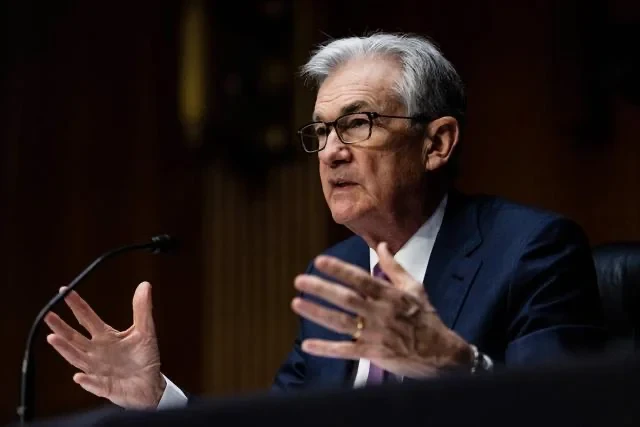
On January 11, Federal Reserve Chairman Powell testified at a nomination hearing held by the U.S. Senate Banking Committee, stating that inflationary pressures may persist until mid-2022. If U.S. high inflation lasts longer than expected, the Fed may raise rates more times and reduce its balance sheet earlier and faster to address persistent high inflation. Powell outlined the roadmap for U.S. monetary policy normalization this year: ending net asset purchases in March, raising rates during the year, and possibly beginning balance sheet reduction later this year. If the recovery progresses as expected, the Fed is prepared to act quickly.
During Powell's speech, European and U.S. Treasury yields rose together, with 10-year U.S. Treasury yields hitting daily highs, but after the hearing, all gains were reversed and yields turned lower. Conversely, due to Powell's moderate stance and reassurance to U.S. stocks, the S&P 500 reversed a five-day losing streak, with tech stocks continuing to support the broader market rebound. Crypto assets represented by Bitcoin and Ethereum also experienced a brief rapid rebound after the hearing, reflecting the strengthened correlation between crypto assets and major stock indices in the post-pandemic era.
Last week, the Fed's minutes from its December meeting showed that Fed officials were considering starting rate hikes earlier and at a larger magnitude. Most Fed officials expect three rate hikes in 2022 to control inflation. Additionally, the Fed announced it would reduce monthly purchases of U.S. Treasuries and mortgage-backed securities by $30 billion (originally planned at $15 billion monthly), double the previous pace. Data shows the Fed's balance sheet currently exceeds $8.7 trillion.
This news triggered a broad decline in tech stocks, with the three major U.S. stock indices also falling sharply. Meanwhile, employment data released by the U.S. Department of Labor further fueled market expectations that the Fed would soon begin raising rates. Affected by this, the crypto market responded, with most mainstream coins declining and remaining sluggish during this period, with numerous "bear market is here" voices emerging in the crypto community.
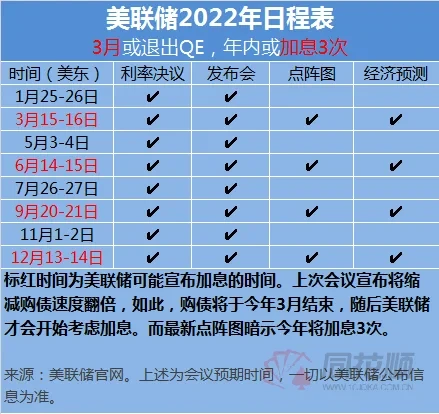
The macroeconomic environment's impact on the entire investment market is comprehensive. Since the pandemic, downward economic pressure has led central banks to continuously inject liquidity, bringing huge opportunities to investment markets. This is one reason the crypto market has enjoyed bull market prosperity from 2020 to now. However, as one of the world's major central banks, the Federal Reserve's monetary policy has always affected investors' nerves. When rates will rise, how many times, and whether policy will tighten will profoundly influence investor sentiment and risk appetite. If Fed tightening expectations intensify and U.S. Treasury yields rise rapidly, risk assets like gold and crypto will face pressure. Powell also emphasized in this hearing that policy would attempt to remain neutral and may tighten. Considering the Fed also frequently "turns dovish," there's no need to be overly anxious about rate hikes for now. Of course, undeniably, whether Ethereum or other mainstream assets, price trends will inevitably be affected by changes in the macroeconomic environment and Fed policy going forward. Investors need to pay close attention. Below is the 2022 Fed meeting schedule for readers' reference.
Ethereum (ETH) Current Status
The just-passed 2021 was an extraordinary year for Ethereum. On one hand, ETH price set a historical record, reaching a high of $4,871.42. Ethereum's development also made certain progress, most notably the Ethereum London hard fork upgrade, which introduced a burning mechanism, transitioning ETH toward a deflationary model with major implications for Ethereum's value.
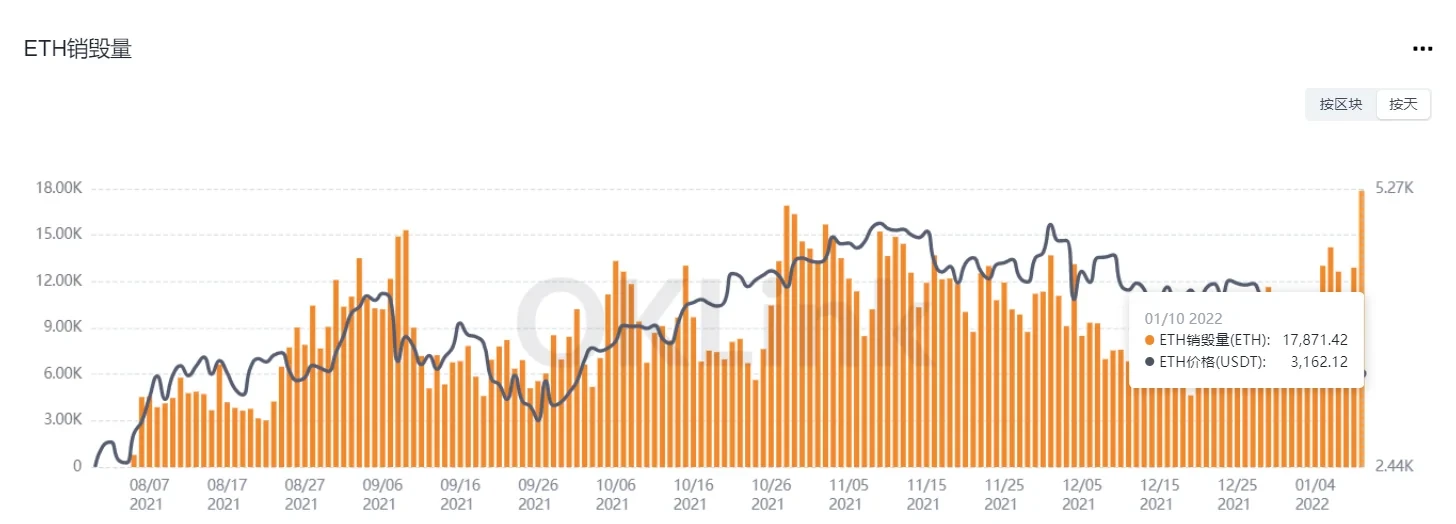
According to OKLink on-chain data, current Ethereum burn amount is 1.449 million ETH, with a 24-hour Base Fee average of 187 Gwei. In the most recent day (January 10), Ethereum burned 17,871.42 ETH, setting a new single-day burn record. The top three protocols by 24-hour burn amount are OpenSea, Uniswap V3, and LooksRare.
Currently, TradingView data shows Ethereum's market cap ratio is 19.33%, down 3% from its high on December 8 last year, directly related to the recent market downturn.
From an on-chain perspective, Ethereum still dominates the crypto ecosystem. According to Messari's blockchain development activity analysis report released on January 4, Polkadot ecosystem development activity growth reached 147% over the past year, higher than Cosmos (56%), Ethereum (21%), and Solana (2%). However, Ethereum remains the most active L1 platform among mainstream protocols. Ethereum has the most active developers, with monthly active developers reaching 250 as of November last year, nearly 5 times that of Polkadot, Cosmos, and Solana.
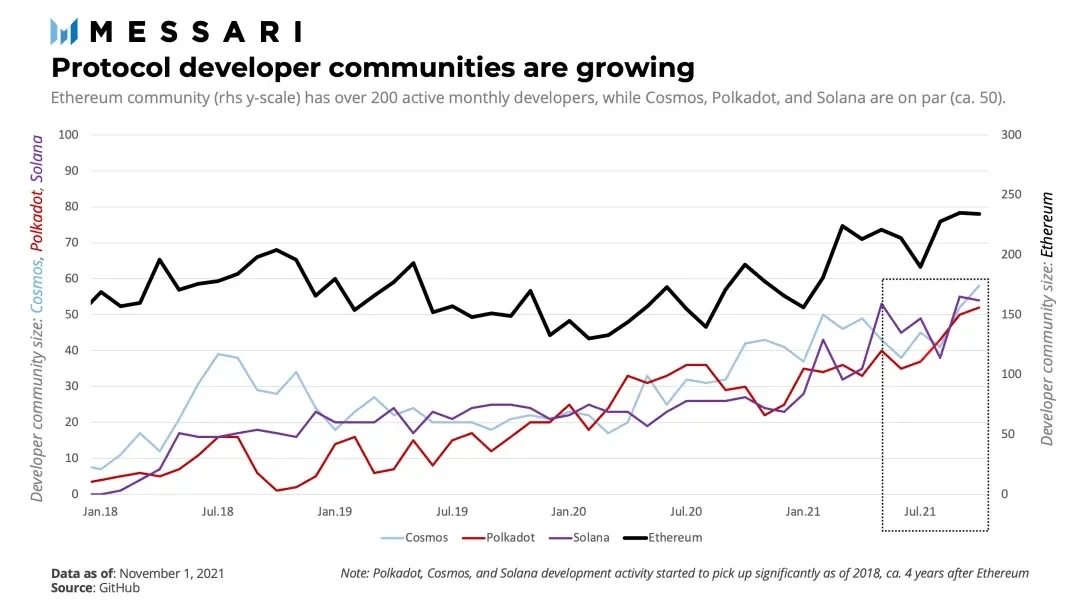
Growth of Ethereum, Cosmos, Polkadot, and Solana protocol developer communities
However, it must be noted that Ethereum also faces "threats" from other public chains and L2 platforms. Data shows Ethereum's share in the decentralized finance market has been steadily shrinking over the past year. According to DefiLlama data, in January last year, Ethereum protocols accounted for over 97% of total value locked in DeFi protocols, but due to rapid growth from competitors like Terra, Avalanche, and Solana, Ethereum's share has now shrunk to 62.19%.
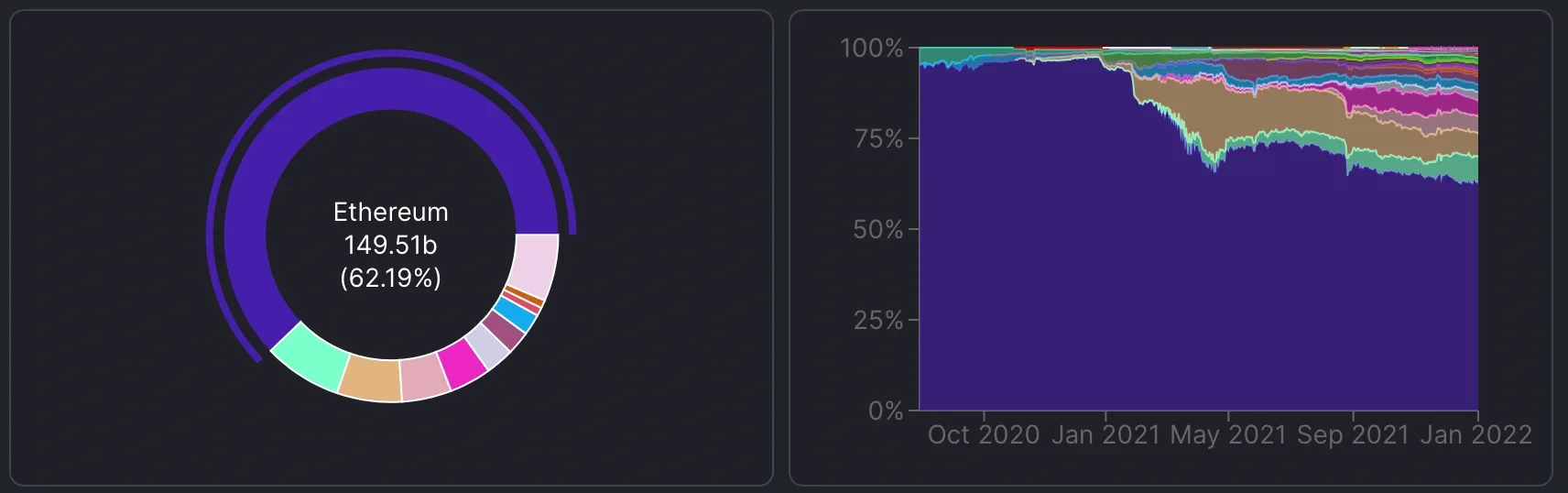
DeFi protocol TVL share by public chain Source: defillama
This is mainly due to Ethereum's congestion and high gas fees limiting its rapid market expansion. Since sharding chains are not expected to be implemented until 2023, the short-term scaling "burden" falls on L2. So, as Ethereum 2.0 progresses this year, can this situation improve?
What Will ETH 2.0 Look Like?
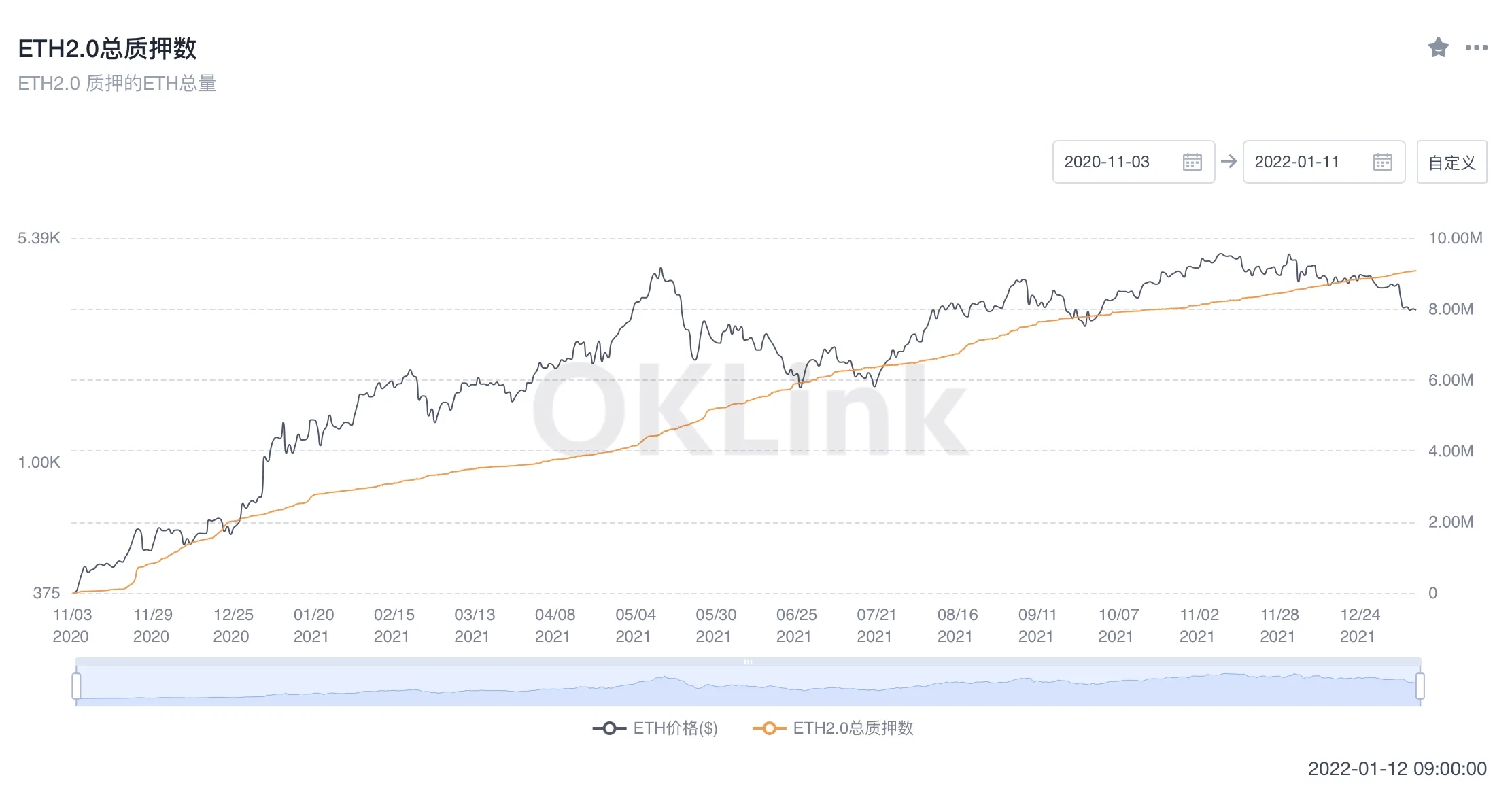
Ethereum 2.0 has indeed made certain progress over the past year. Since the Beacon Chain went live, staking volume has exceeded the original target by about 17 times. OKLink data shows the current Ethereum 2.0 deposit address balance has exceeded 9.07 million ETH, accounting for 7.71% of Ethereum's supply, with over 280,000 validator nodes on the Beacon Chain.
When will Ethereum 2.0 be realized? According to the roadmap, this year we'll first see the merge of Eth1 and Eth2, followed by post-merge cleanup work to address unnecessary legacy features from the PoW and PoS hybrid model, while this phase will enable the function to redeem staked ETH. Recently, Ethereum Beacon Chain community security advisor Superphiz stated on social media that the Ethereum fork Bellatrix (formerly named Merge) will activate the merge of the current PoW chain with the PoS Beacon Chain, but will not immediately enable withdrawals of staked ETH on the Beacon Chain. Withdrawals of staked ETH are expected to open approximately six months after the merge (around December).
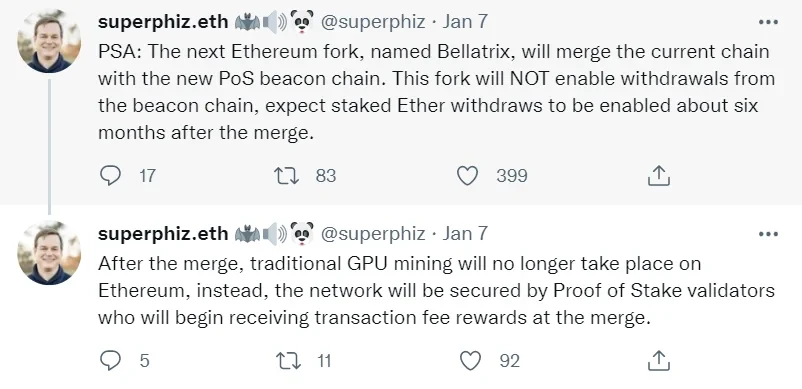
After implementing the merge, Ethereum will officially transition from PoW to PoS (Proof of Stake) mechanism. This means traditional GPU mining will no longer occur on Ethereum, and the network will be maintained by PoS validator nodes that receive corresponding transaction fee rewards.
What impact will this have on Ethereum? First, from a monetary policy and token value perspective, transitioning to PoS may mean more ETH being staked, and miners becoming validators means less ETH being created, thereby reducing ETH's circulating supply. From a supply-demand perspective, this could theoretically drive prices upward. Therefore, Ethereum in the first half of this year may be primarily influenced by its monetary policy. However, considering the Federal Reserve factors mentioned in the first section, whether Ethereum can meet our previous expectations and imagination remains to be seen.
Balancer Labs co-founder and CEO Fernando Martinelli believes that Ethereum's merge in 2022 will be a wake-up call for the market, making people realize ETH's solidity as a store of value, which will make "the flippening" still happen in 2022.
On the other hand, the chain merge actually has minimal impact on Ethereum's performance improvements. True comprehensive improvements to network transaction processing speed, transaction throughput, gas fees, and other metrics may depend on one of Ethereum 2.0 upgrade's main features—sharding. However, sharding chains are not expected to be implemented until 2023. At that time, Ethereum will be divided into 64 shards to process transactions and data in parallel, and with Rollup cooperation, is expected to solve high gas fees and network congestion problems.
Although the arrival of sharding chains requires a long wait, transitioning to PoS may lead more projects to choose to rely on Ethereum again. Facing numerous competitors eyeing it hungrily, Ethereum may be able to turn the situation around. Joey Krug, co-chief investment officer of U.S. crypto investment firm Pantera Capital, believes that within 10-20 years, over 50% of global financial transactions will connect to the Ethereum network in some way. Even if so-called 'Ethereum killers' experience explosive growth, they won't threaten Ethereum blockchain's market dominance.
Conclusion
Regardless, the entire roadmap for Ethereum 2.0 upgrade remains very ambitious, requiring many small phases and upgrade improvements for support. Perhaps it will take another three to five years. Therefore, transitioning to the PoS mechanism is not the endpoint of Ethereum's upgrade, but a new starting point.
What surprises Ethereum's upgrade can bring us, we'll wait and see. Once it can deliver lower fees and better network performance, it will have the potential to disrupt L1 competitors and continue to dominate. Looking at this year, with growth in areas like DAO, DeFi, and NFT, L2 networks are expected to continue playing a major role, with Ethereum continuing to function as the blockchain for interaction between these L2 networks.
Disclaimer
This article may contain content related to products that are not available in your region. This article is provided for general informational purposes only and is not responsible for any factual errors or omissions contained herein. This article represents the author's personal views only and does not represent OKX's views. This article is not intended to provide any advice, including but not limited to: (i) investment advice or investment recommendations; (ii) an offer or solicitation to buy, sell or hold digital assets; or (iii) financial, accounting, legal or tax advice. Holdings of digital assets (including stablecoins) involve high risk, can fluctuate significantly, and may even become worthless. You should carefully consider whether trading or holding digital assets is suitable for you based on your financial situation. Please consult your legal/tax/investment professional regarding your specific circumstances. Information appearing in this article (including market data and statistical information, if any) is for general reference purposes only. While all reasonable care has been taken in preparing this data and charts, no responsibility is accepted for any factual errors or omissions expressed herein. © 2025 OKX. This article may be reproduced or distributed in its entirety, or excerpts of 100 words or less from this article may be used, provided such use is non-commercial. Any reproduction or distribution of the entire article must also prominently state: "This article is © 2025 OKX and used with permission." Permitted excerpts must cite the article name and include attribution, for example "Article Name, [Author Name (if applicable)], © 2025 OKX". Some content may be generated or assisted by artificial intelligence (AI) tools. No derivative works or other uses of this article are permitted.
Show more
Related Articles
OKX Pay: Ushering in the Next Generation of Crypto Payments
Chosen by tens of millions of users, register with OKX to enjoy the ultimate trading experience and diverse wealth management products. A letter from OKX CEO Star: Today, we officially launch the first version of OKX Pay to our over 100 million global users. As the industry's first payment application that truly integrates non-custodial and compliant features, OKX Pay will be embedded in the OKX App, currently available in select markets, with full
March 22, 2026

A New Chapter: Building Next-Generation Financial Infrastructure Together
OKX's partnership with Intercontinental Exchange (ICE) is a significant moment for OKX and equally meaningful for the evolution of the entire digital asset market. ICE builds and operates the world's most important financial infrastructure, including the New York Stock Exchange and global derivatives and clearing platforms. ICE's decision to invest in OKX and join our board reflects a shared belief—that digital asset technology will play a fundamental role in financial
March 10, 2026
To Another Year of Building
As CEO of OKX and a Builder who never forgets the original mission, I'm proud to reflect on OKX's extraordinary growth and progress this year. Despite numerous challenges, 2024 was a year full of focus, innovation, and resilience. We not only expanded and optimized our products but also made significant progress in launching transparent and regulatory-compliant localized businesses while further strengthening our global management team. Notably, after experiencing
January 29, 2026

2025: A Steady Progression Toward Financial Freedom
—— Year-end letter from OKX Founder and CEO Star to global users "Financial freedom" is often misunderstood. It doesn't mean the absence of rules, but rather having the right to choose even when rules exist—and when the system is truly tested, it remains reliable and effective. This is exactly what we've focused on throughout 2025. First, I want to extend sincere gratitude to our global customers, partners, and regulators
January 16, 2026

OKX Now Officially Live in Germany and Poland
Author: Erald Ghoos, OKX Europe CEO Today is significant for OKX—and for crypto users across Europe. We've officially launched fully compliant centralized cryptocurrency trading platforms in Germany and Poland! For us, this isn't just geographic expansion, but a commitment to building crypto's future the right way: secure, transparent, and meeting local needs. If you're in Germany
October 21, 2025
Partnership Upgrade! OKX Teams Up with Standard Chartered to Expand European Market
On October 15, Erald Ghoos, CEO of OKX Europe, stated that OKX is expanding its strategic partnership with Standard Chartered to the European Economic Area (EEA). Earlier this year, OKX first partnered with Standard Chartered in the UAE, launching a collateral mirroring program—this is
October 15, 2025