TVL Drops Nearly 40% in Two Weeks, What Happened to DeFi on Ethereum?
Recently, crypto assets represented by Bitcoin have experienced significant volatility in secondary markets. Compared to monthly highs, maximum declines are generally over 50%. Meanwhile, the DeFi market has also been far from calm. According to data from OKLink, as of the time of writing, the total DeFi TVL based on Ethereum stands at $67.78 billion, a decline of 38.9% compared to the high of $110.86 billion set on the 11th of this month.
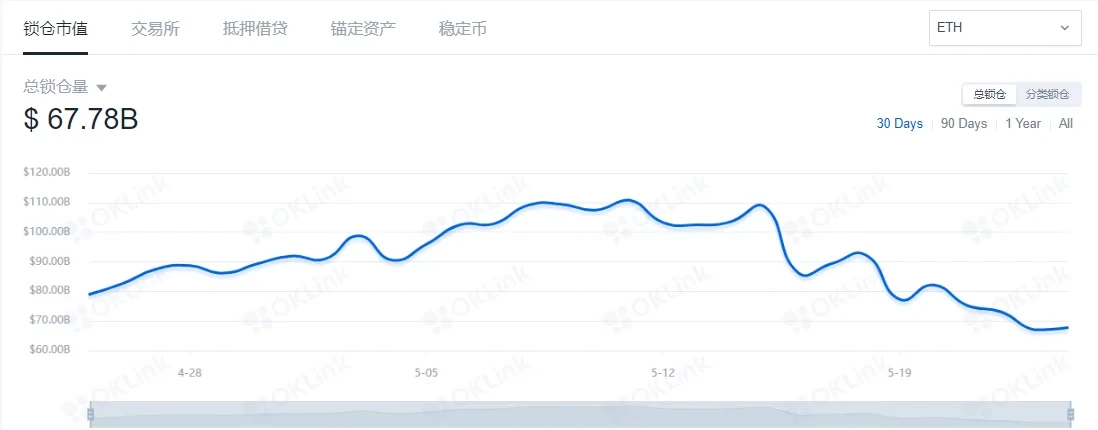
Total DeFi TVL on Ethereum over the past 30 days, Source: OKLink
At the same time, the total market capitalization of Ethereum-based DeFi has also declined in tandem, falling from $92.82 billion to $43.18 billion, a drop of over 53%.
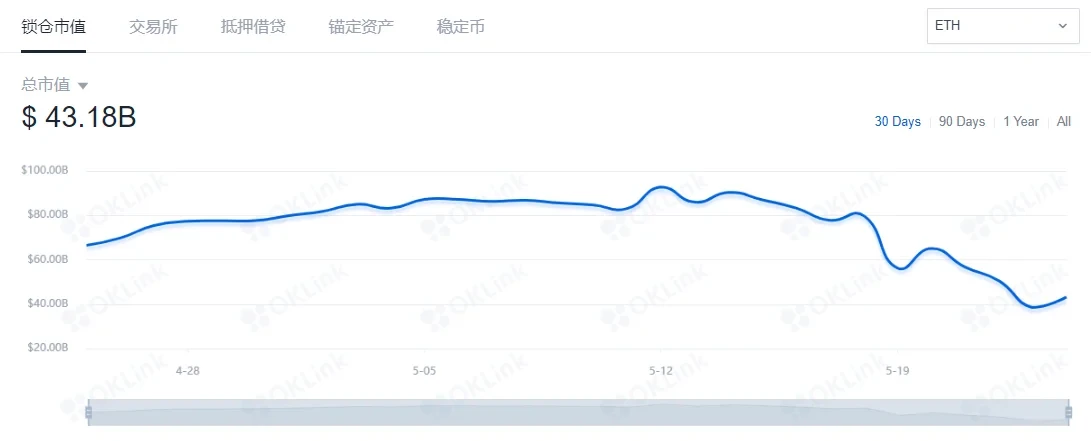
Total DeFi market capitalization on Ethereum over the past 30 days, Source: OKLink
If we further break down the data above by the main application directions in the current DeFi market—decentralized Trading (DEX), decentralized lending, pegged Assets, wealth management, etc.—we can additionally discover that among the top five categories by TVL, the decline rates for stablecoins, wealth management, and decentralized Trading exceeded the average decline. In terms of the absolute value of TVL reduction, decentralized lending and decentralized Trading together accounted for over half of the funds outflow in this round, with decentralized lending protocols experiencing the highest asset outflow, reaching $15.53 billion.
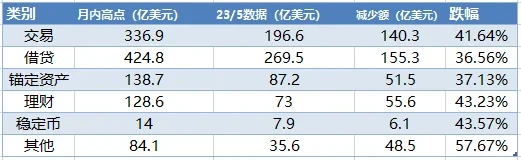
Details of DeFi market TVL changes, Chart: OKX, Data Source: OKLink
We shouldn't actually be surprised by this data. In our summary article "Under the Plunge, Over $3.85 Billion in Assets Were Liquidated on Ethereum DeFi Lending Protocols" published the day after the market crash, we already observed that within 24 hours of ETH's rapid decline, liquidations on Ethereum-based lending protocols exceeded $385 million, reaching a historic high.
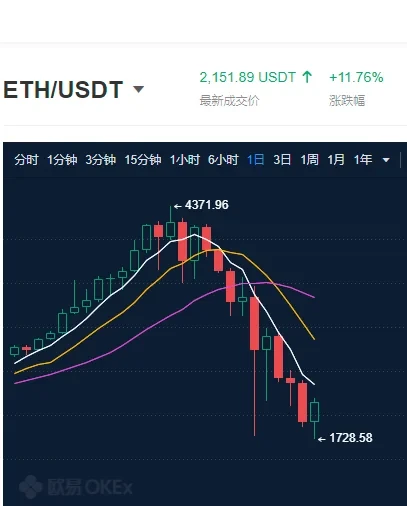
ETH price trend this week, Source: OKX
During the continued ETH decline from May 20-23, the amount of assets liquidated in DeFi lending protocols saw another small peak, exceeding $100 million.
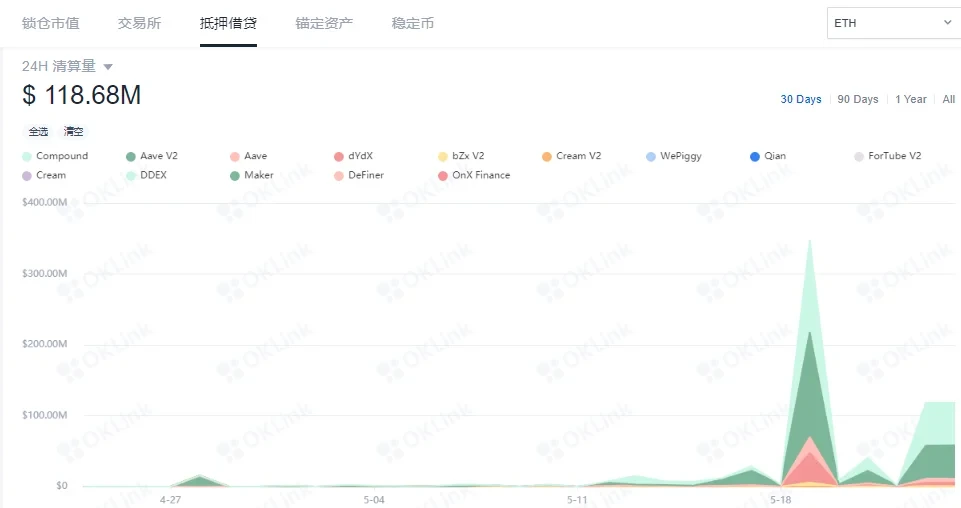
Asset liquidations in DeFi lending protocols since May 19, Source: OKLink
Why single out DeFi lending protocols for special focus? Let's take Tron founder Justin Sun's 600,000 ETH position on Liquity on the 19th as an example to understand how collateral assets in DeFi lending protocols get liquidated when ETH prices fall rapidly, and what impact liquidations might have on secondary markets. The core issue is that if a cascade of liquidations occurs, the resulting stampede of selling will not only bring enormous selling pressure to secondary markets, but also lead to massive outflows of locked assets from DeFi protocols.
Before this, it's necessary to understand the liquidation mechanism in DeFi lending protocols. As introduced in the article "Under the Plunge, Over $3.85 Billion in Assets Were Liquidated on Ethereum DeFi Lending Protocols", here is a summary:
Essentially, liquidation in DeFi lending protocols is a mechanism that sells a portion of collateral assets below market price to repay the principal and interest that borrowers owe to the funding pool, thereby enabling the funding pool to continue operating in a healthy manner.
Why introduce a liquidation mechanism? In DeFi collateral lending protocols, when the value of collateral assets exceeds the borrowed value and is below the optimal utilization rate, it represents a healthy operating state. At this point, borrowers can obtain liquidity without needing to sell the assets they've deposited in the protocol. However, when the value of collateral assets drops significantly, or when borrowed value rises, borrowers have incentive to avoid repayment, which could trap both lenders and borrowers in difficulty, leading to bad debt.
Returning to the aforementioned 600,000 ETH position by Tron founder Justin Sun, BTC.TOP founder Jiang Zhuoer and F2Pool co-founder Shenyu provided professional analysis of this event. The key point of their discussion was: "If Justin Sun's 600,000 ETH position were ultimately liquidated, would it push ETH (from $1,764) below $1,000?"
According to data provided by Shenyu, Justin Sun's 600,000 ETH position at the time accounted for over 60% of the Liquity system, and the collateralization ratio had fallen below 145%, entering the liquidation queue according to protocol rules, but at the tail end of the queue awaiting liquidation. According to the liquidation rules mentioned earlier, if liquidators were to completely liquidate Justin Sun's position at that time, the estimated profit would be around 40%. Meanwhile, following principles of return maximization and optimal capital utilization, liquidators would continue selling on DEXs after taking over the 600,000 ETH, causing ETH on DEXs to show a negative premium. This negative-priced ETH would then be moved by arbitrage teams to CEXs for secondary selling, further triggering a chain reaction—in other words, ETH would most likely continue downward, leading to larger-scale liquidations in DeFi lending protocols.
In fact, when DeFi lending protocols experienced large-scale liquidations, DEX trading volumes simultaneously showed significant growth. According to OKLink data, on May 19, DEX trading volume reached $146.6 billion, a historic high. Meanwhile, during May 21-23, when DeFi lending protocols experienced a liquidation peak, DEX trading volumes also showed corresponding growth.
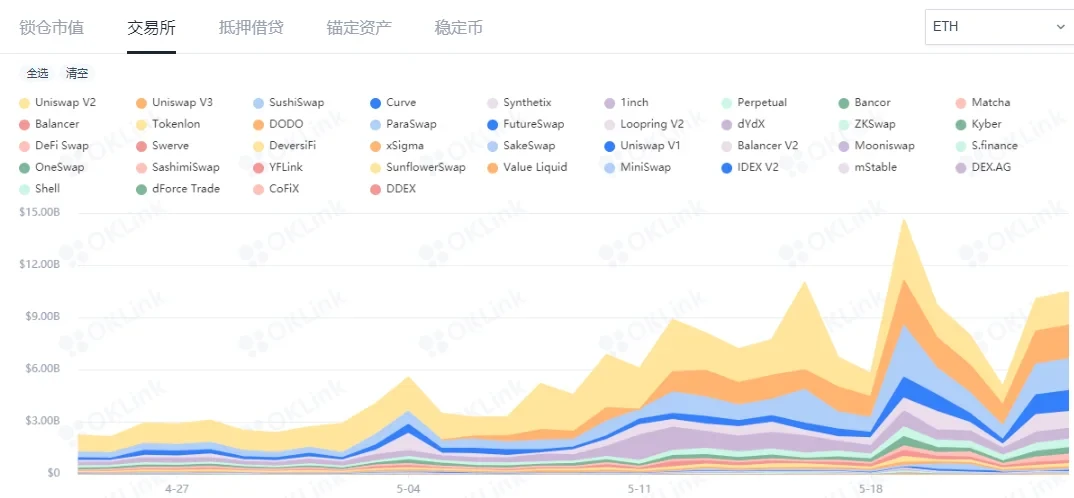
DEX trading volume changes over the past 30 days, Source: OKLink
Additionally, we noticed that while DeFi locked assets experienced significant outflows, DeFi financing costs showed a downward trend. This is clearly good news for DeFi protocol developers, and for investors it seems to be an investment window worth considering. According to data from Tonghuangke, on May 23, the DeFi decentralized finance benchmark rate was 3.81%, while on May 21 this figure stood at 4.73%, showing a continuous downward trend over several days.
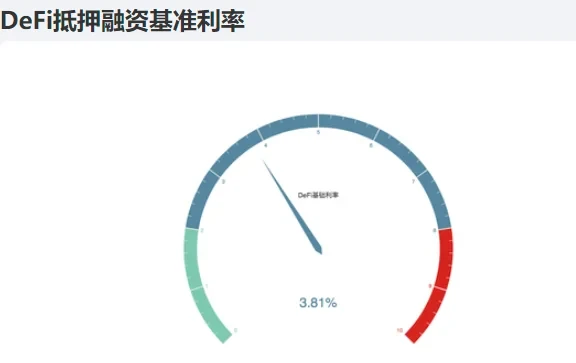
DeFi collateral financing benchmark rate on May 23, Source: Tonghuangke
For comparison, the U.S. Treasury collateral repo rate during the same period was 0.01%, a rate difference of 3.8 percentage points. It's worth noting that the DeFi benchmark rate represents the difficulty of DeFi financing—higher rates indicate higher financing costs, lower rates indicate lower costs. The rate differential with U.S. Treasury repo rates facilitates comparison between DeFi and traditional markets. From this perspective, we can at least derive two valuable pieces of information: although after several years of development, particularly the explosive growth since last summer, DeFi has made significant progress, it still lags behind traditional markets in attracting large capital, and still has a long way to go in the future.
Disclaimer
This article may contain product-related content not applicable to your region. This article is intended only to provide general information and does not take responsibility for any factual errors or omissions therein. This article represents only the author's personal views and does not represent the views of OKX. This article is not intended to provide any advice, including but not limited to: (i) investment advice or investment recommendations; (ii) offers or solicitations to buy, sell, or hold digital assets; or (iii) financial, accounting, legal, or tax advice. Holding digital assets (including stablecoins) involves high risk, may fluctuate significantly, and may even become worthless. You should carefully consider whether trading or holding digital assets is suitable for you based on your financial situation. For questions about your specific situation, please consult your legal/tax/investment professional. The information appearing in this article (including market data and statistics, if any) is for general reference only. While we have taken all reasonable precautions in preparing these data and charts, we assume no responsibility for any factual errors or omissions expressed herein. © 2025 OKX. This article may be reproduced or distributed in its entirety, or excerpts of 100 words or less from this article may be used, provided such use is non-commercial. Any reproduction or distribution of the entire article must also prominently state: "Copyright © 2025 OKX. Used with permission." Permitted excerpts must cite the article name and include the source, for example "Article Name, [Author Name (if applicable)], © 2025 OKX". Some content may be generated or assisted by artificial intelligence (AI) tools. Derivative works or other uses of this article are not permitted.
Show More
Recommended Reading
OKX Pay: Opening a New Era of Next-Gen Crypto Payments
The choice of tens of millions of users. Register with OKX to enjoy the ultimate trading experience and diverse wealth management products. A letter from OKX CEO Star: Today, we officially launch the first version of OKX Pay to over 100 million global users. As the industry's first payment application to truly achieve non-custodial and compliant integration, OKX Pay will be embedded in the OKX App, currently open to select markets, expected to fully
March 22, 2026

New Chapter: Building Next-Generation Financial Infrastructure Together
The partnership between OKX and Intercontinental Exchange (ICE) marks an important moment for OKX and holds equally profound significance for the evolution of the entire digital assets market. ICE establishes and operates the world's most important financial infrastructure, including the New York Stock Exchange and global derivatives and clearing platforms. This investment by ICE in OKX and joining our board reflects our shared belief that digital assets technology will transform financial markets
March 10, 2026
Tribute to Another Year of Forging Ahead
As CEO of OKX and a builder who remains true to our original mission, I look back on this year with pride at the remarkable growth and progress OKX has achieved. Despite numerous challenges, 2024 has been a year of focus, innovation, and resilience. We not only expanded and optimized our products, but also made significant progress in launching transparent and regulatory-compliant localized operations, while further strengthening our global management team. Notably, after experiencing
January 29, 2026

2025: Steady Progress Toward Financial Freedom Together
— Annual letter from OKX Founder and CEO Star to global users. "Financial freedom" is often misunderstood. It doesn't mean an absence of rules, but rather having the right to choose within a framework of rules—and when the system is truly tested, it remains reliable and effective. This has been our consistent focus throughout 2025. First, I want to extend my sincere gratitude to our global clients, partners, and regulatory authorities
January 16, 2026

OKX Officially Launches in Germany and Poland
Author: Erald Ghoos, CEO of OKX Europe. Today is significant for OKX—and for crypto users across Europe. We have officially launched our fully compliant centralized cryptocurrency trading platform in Germany and Poland! For us, this is more than just geographic expansion; it's a commitment to building the cryptocurrency future the right way: securely, transparently, and meeting local needs. If you're in Germany
October 21, 2025

Partnership Expanded! OKX Partners with Standard Chartered to Expand in European Markets
On October 15, Erald Ghoos, CEO of OKX Europe, stated that OKX is expanding its strategic partnership with Standard Chartered to the European Economic Area (EEA). Earlier this year, OKX first partnered with Standard Chartered in the UAE to launch the collateral mirroring program—a
October 15, 2025