Ethereum London Upgrade Confirmed with These 5 EIPs — Which One Are You Most Excited About?
Following the completion of the Berlin upgrade in April, Ethereum is set to experience its next upgrade — the London upgrade. While the exact timing has not yet been finalized, barring any unforeseen circumstances it is expected to launch by the end of July. However, this does not prevent us from keeping a close eye on the developments of this upgrade. According to public information released by Ethereum developer Tim Beiko, the EIPs (Ethereum Improvement Proposals) included in the London upgrade have been confirmed. The London upgrade encompasses the following 5 main EIPs:
1) EIP-1559: Ethereum transaction fee mechanism improvement proposal, with the core being a change to the method of paying Gas fees to miners.
2) EIP-3198: Adds the Base Fee opcode.
3) EIP-3554: Delays the difficulty bomb to December 2021.
4) EIP-3541: Rejects new contracts starting with the 0xEF bytecode.
5) EIP-3529: The core focus is reducing Gas refunds. By removing the Gas refund for SELFDESTRUCT and reducing the Gas refund for SSTORE to a lower level.
Now let's look at the specific details of these 5 EIPs:
First is EIP-1559, which is the most impactful and also the most controversial reform proposal in this London upgrade. This proposal was introduced by Vitalik in 2019, suggesting to reduce transaction fee volatility by burning the fees paid in ETH rather than distributing them to miners. As we all know, in the current Ethereum network, if a user wishes to secure priority packaging rights with miners, they can do so by manually increasing the transaction fee. When the network experiences congestion, more and more users want their transactions packaged as soon as possible, inevitably leading to fee "bidding wars," similar to what happened during the DeFi boom. Regarding the specific fee calculation process, we provided a detailed analysis in our previous article "Examining the Battle of Interests on the Ethereum Chain from the Perspective of Short-Term Fee Drops", so we will not dwell on it here. Continuing with Vitalik's EIP-1559, the core problem this proposal aims to solve is reducing users' transaction fees by changing the method of paying Gas fees to miners, thereby alleviating network congestion during peak periods. The specific solution introduces a variable "base fee" concept. The base fee tracks Ethereum's network Gas price, meaning users will be able to more accurately estimate transaction fees, avoiding "bidding wars" as much as possible. The base fee will ultimately be burned or destroyed, with only an optional tip paid to miners as a reward.
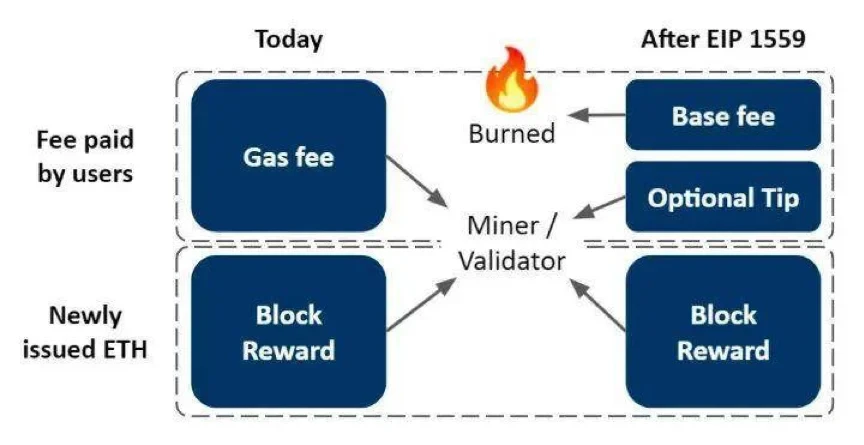
Summary diagram of EIP-1559 proposal, source: internet
Of course, the brief analysis above is from the perspective of the fee-paying party — the user. As for the receiving party — the miners, they are not so readily accepting of this proposal, because once the EIP-1559 proposal is implemented, it is evident that their overall revenue will be significantly reduced in the short term. This is precisely one of the most controversial aspects of this proposal. In fact, over the past few months, Ethereum miners and mining pools have been strongly opposed, even going so far as to threaten striking in opposition to the upgrade.
Second is EIP-3198, which can be considered a complementary solution to EIP-1559. This EIP only adds the BASEFEE opcode, which is a variable that can be dynamically adjusted based on the sum of Gas Limit consumed by all transactions in the previous block. When the total Gas Limit exceeds the Gas Limit target for a given block, it will increase, and when it falls below this value, it will decrease. After adding this opcode, it returns the base fee value of the block in which it is located, allowing smart contracts to access this value on-chain, which helps in submitting fraud proofs and creating trustless Gas price derivatives.
As for EIP-3554's delay of the difficulty bomb to December 2021, this is primarily a technical postponement due to the Ethereum network not being ready to transition from PoW to PoS. Ethereum's "difficulty bomb" is a piece of code embedded by Ethereum developers in 2015, with the purpose of artificially slowing down ETH issuance by gradually increasing mining difficulty, thereby facilitating a smooth transition of the Ethereum network to the PoS consensus algorithm. Under the current PoW consensus mechanism, miners receive a reward for each new block they mine. However, when Ethereum's difficulty bomb is set to "detonate," the difficulty of earning mining rewards will increase exponentially. The most recent detonation of the difficulty bomb was originally scheduled for next month, and under current circumstances, this is clearly ill-timed. Therefore, the community's decision to postpone it to December is entirely reasonable. In Ethereum's development history, this is not the first time the difficulty bomb has been delayed. For example, during the Metropolis, Constantinople, and Muir Glacier upgrades, developers proposed EIP-649, EIP-1234, and EIP-2384 respectively to implement the postponement.
Finally, there are EIP-3529 and EIP-3541. The former, EIP-3529, is also a significant component of this London upgrade, eliminating Gas refunds for the SELFDESTRUCT opcode and reducing Gas refunds for the SSTORE opcode. SELFDESTRUCT was originally called SUICIDE and was introduced in the very early days of Ethereum. It had already appeared in the Ethereum protocol "specification" preview released in December 2013. According to Vitalik, "The original intent behind introducing SELFDESTRUCT was to prevent useless spam states from expanding unchecked — we needed any created object to be destructible. The specific approach was to trigger self-destruct when an externally owned account's balance reaches zero, while contracts could call a self-destruct line in their code to trigger self-destruct when no longer needed. There was also a Gas refund mechanism to incentivize destroying unused states." However, the Ethereum development team quickly discovered serious problems, because SELFDESTRUCT is the only opcode that breaks an important invariant, and it can modify an unlimited number of state objects within a single block. It can also modify contract code and is the only opcode that can change an account's balance without the account's consent. Therefore, in an article Vitalik published in March of this year, he stated: "SELFDESTRUCT does more harm than good to the Ethereum ecosystem. Given that some contracts already use SELFDESTRUCT, I have proposed some methods that can eliminate its harm with minimal cost." EIP-3529 was proposed in this context.
The latter, EIP-3541, is a simple change that primarily lays the groundwork for another proposal — the EIP-3540 EVM improvement proposal. After EIP-3541 is implemented, new contracts starting with the 0xEF bytecode will not be deployable, and existing contracts will not be affected. After the London upgrade launches, the deployment of contracts whose shortest bytecode sequence starts with 0xEF but does not match existing contract starting sequences will be rolled back, in order to determine compatibility with EIP-3540 semantics for contracts.
So, what impact might the London upgrade have on the Ethereum network? Of course, the key areas of focus remain transaction fees and potential changes in ETH price. Let's first look at recent changes in Ethereum network transaction fees. According to OKLink data, the daily average transaction fee on Ethereum has been below 30 Gwei for the past two weeks, dropping as low as nearly 10 Gwei at times, reaching levels not seen since 2021.
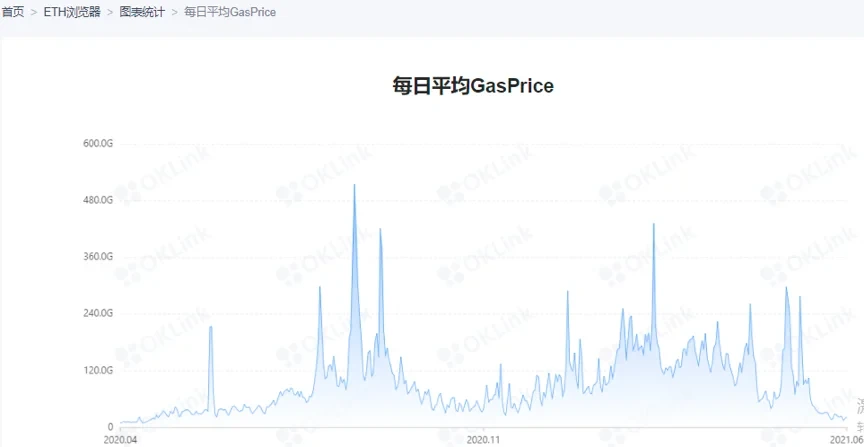
Ethereum daily transaction fees recently, source: OKLink
Of course, this situation is more a result of reduced activity in DeFi, NFT, and various Ethereum-based smart contract and dApp interactions due to the sluggish market. To more objectively compare the impact of the London upgrade, especially the deployment of EIP-1559, on Ethereum transaction fees, we need to wait until on-chain transactions return to a relatively active state for a fair comparison.
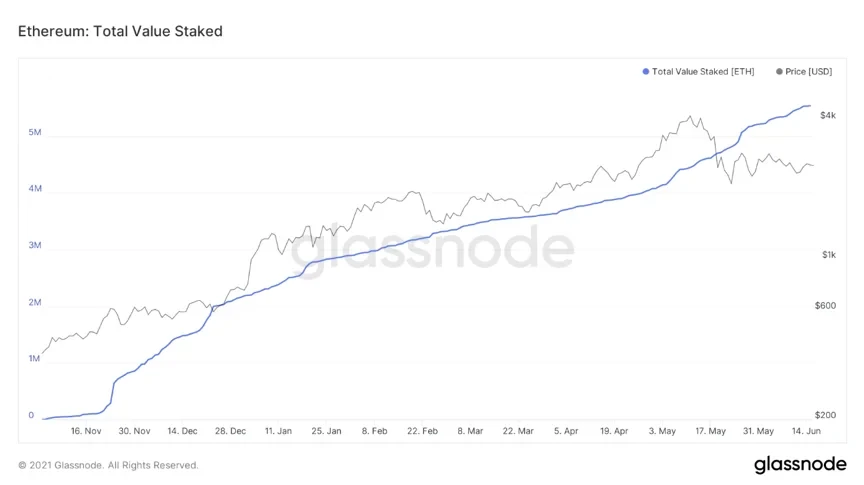
ETH2.0 staking amount, source: Glassnode
When discussing the London upgrade, we inevitably turn to ETH2.0. As early as March of this year, Mikhail Kalinin, a developer of the Ethereum 2.0 client Teku, stated that due to Vitalik's proposal for a fast merge, the ETH1.0 and ETH2.0 merge would be prioritized after the London upgrade. Currently, this process appears to be progressing steadily. According to Glassnode data, although the ETH price has fluctuated downward over the past two months, the amount of ETH staked by users in ETH2.0 has maintained a steady upward trend. As of June 16th, it has reached 5.535 million. On one hand, this reflects users' expectations for the ETH2.0 ecosystem. On the other hand, from a secondary market perspective, this is equivalent to locking up a massive sell wall.
Following the discussion on ETH price, let us return to the most important proposal in the London upgrade — EIP-1559. Above, we briefly introduced the main content of this proposal and its potential impact on transaction fees for both users and miners. Now, let's examine the potential impact of this proposal's deployment on ETH price. When a user's transaction is packaged into a block by a miner, the base fee will be burned. If the amount of Ethereum burned based on Gas fees exceeds the amount of Ethereum issued as block rewards, the total amount of Ethereum generated per block will be negative. In other words, Ethereum could become deflationary — simply put, supply falling short of demand — which from an economic perspective is a long-term bullish factor for ETH price.
However, on the other hand, if the above assumption holds, along with the rise in ETH price and the recovery of Ethereum network activity (under ideal conditions), Gas fees will also gradually climb until reaching a dynamic equilibrium. Therefore, after that dynamic equilibrium is established, the ETH price model will be reshaped, setting a new threshold. Overall, for Ethereum after the London upgrade, while transaction fees can be significantly reduced in the early stage, as the dynamic equilibrium stabilizes, fees may experience a rebound. Therefore, solutions to regulate Ethereum network transaction fees may need to continue in the long term. For example, the simultaneous Layer 2 exploration has also proposed innovative solutions in terms of scalability and transcending the limitations of the underlying platform, providing services that cannot be achieved on the Layer 1 network.
Objectively speaking, although the London upgrade cannot rival the scalability and flexibility offered by Layer 2 scaling solutions, nor can it compare to ETH2.0, we should still acknowledge that it has laid the right foundation for improving Ethereum's network transaction fee mechanism.
Disclaimer
This article may contain product-related content not applicable to your region. This article is intended to provide general information only and does not accept responsibility for any factual errors or omissions. This article represents the author's personal views only and does not represent the views of OKX. This article is not intended to provide any recommendations, including but not limited to: (i) investment advice or investment recommendations; (ii) offers or solicitations to buy, sell, or hold digital assets; or (iii) financial, accounting, legal, or tax advice. Holding digital assets (including stablecoins) involves high risk and prices may fluctuate significantly or even become worthless. You should carefully consider whether trading or holding digital assets is suitable for you based on your financial situation. For questions specific to your circumstances, please consult your legal/tax/investment professional. The information contained in this article (including market data and statistical information, where applicable) is provided for general reference purposes only. While we have taken all reasonable precautions in preparing such data and charts, we do not accept any responsibility for factual errors or omissions expressed herein. © 2025 OKX. This article may be reproduced or distributed in its entirety or in excerpts of 100 words or less, provided that such use is non-commercial in nature. Any reproduction or distribution of the full article must prominently state: "This article is copyrighted © 2025 OKX, used with permission." Permitted excerpts must cite the article title and include attribution, for example, "Article Title, [Author Name (if applicable)], © 2025 OKX." Some content may have been generated or assisted by artificial intelligence (AI) tools. Derivative works and other uses of this article are not permitted.
Show More
Recommended Reading
OKX Pay: Ushering in a New Era of Next-Generation Crypto Payments
The choice of tens of millions of users — Register on OKX and enjoy an exceptional trading experience and diverse wealth management products. A letter from OKX CEO Star: Today, we officially launch the first version of OKX Pay for over a hundred million global users. As the industry's first truly non-custodial and compliant payment application, OKX Pay will be embedded within the OKX App and is currently available in select markets, with a full global rollout expected in the coming months.
March 22, 2026

A New Chapter: Building the Next Generation of Financial Infrastructure Together
The partnership between OKX and the Intercontinental Exchange (ICE) represents a significant milestone for OKX and is equally meaningful for the evolution of the entire digital assets market. ICE builds and operates the world's most critical financial infrastructure, including the New York Stock Exchange and global derivatives and clearing platforms. This investment by ICE in OKX and its addition to our board reflects our shared belief — that digital assets technology will reshape financial markets.
March 10, 2026
Celebrating Another Year of Resilience and Progress
As OKX's CEO and a builder who stays true to his original vision, I take great pride in reflecting on the extraordinary growth and progress OKX has achieved this year. Despite numerous challenges, 2024 was a year defined by focus, innovation, and resilience. We not only expanded and optimized our products but also made significant strides in launching transparent and regulation-compliant localized businesses, while further strengthening our global management team. It is worth noting that after going through.
January 29, 2026

2025: Steady Progress Toward Financial Freedom
— An End-of-Year Letter to Global Users from Star, Founder and CEO of OKX "Financial freedom" is often misunderstood. It does not mean an absence of rules, but rather the right to have choices even when rules exist — and, when the system is truly put to the test, it remains reliable and effective. This is precisely what we have remained focused on throughout 2025. First and foremost, I would like to express my sincere gratitude to our global customers, partners, and regulators.
January 16, 2026

OKX Officially Launches in Germany and Poland
By Erald Ghoos, CEO of OKX Europe Today is a significant day for OKX — and for crypto users across Europe. We have officially launched a fully compliant centralized cryptocurrency trading platform in Germany and Poland! For us, this is not merely a geographic expansion, but a commitment to building the future of cryptocurrency the right way: safe, transparent, and tailored to local needs. If you are in Germany.
October 21, 2025
Partnership Upgrade! OKX and Standard Chartered Expand Into Europe
On October 15th, Erald Ghoos, CEO of OKX Europe, stated that OKX is expanding its strategic partnership with Standard Chartered into the European Economic Area (EEA). Earlier this year, OKX first partnered with Standard Chartered in the UAE, launching the collateral mirroring program — a key initiative that.
October 15, 2025