BCH Sidechain smart BCH Quietly Launches: Will "Big Blocks" Be the Solution to Bitcoin Scaling?
The debate over "big blocks" versus "small blocks" regarding Bitcoin is essentially a disagreement over different scaling paths. As is well known, since Bitcoin's price historically broke through $100 in April 2013, Bitcoin's fame has further expanded from the geek circle to a broader global audience. At the same time, with the increase in Bitcoin trading, trading confirmations on the Bitcoin network have become abnormally slow. If traders don't want to wait for a long time, they need to pay high trading fees. Against this backdrop, community members began discussing how to achieve scaling and speed improvements on the basis of the 1M block size limit set for the Bitcoin network. Ultimately, three solutions gained the most support: Lightning Network, Segregated Witness, and block expansion. Today, we will focus on introducing one of them—block expansion.
Why There's a Debate Over Bitcoin Block "Big vs. Small"
Block expansion is essentially a hard fork. The standard for determining hard forks versus soft forks is whether pre-upgrade nodes can compatible with post-upgrade nodes. If compatible, it's a soft fork; if not compatible, it's a hard fork. It can be simply understood that soft forks are backward compatible, while hard forks are not backward compatible. The first hard fork in Bitcoin history with significant influence was the birth of Bitcoin Cash (Bitcoin Cash, BCH/BCC) on August 1, 2017. By supporting raising the block size to 8M (later in May 2018, the block size limit was upgraded again to 32M), it improves trading efficiency, representing the on-chain scaling technical route. So why did this situation occur? All this traces back to a line of code left by Bitcoin whitepaper author Satoshi Nakamoto in the Bitcoin source code—this line limits the upper bound of Bitcoin block size.
We know that Bitcoin is essentially a distributed database, or can be understood as a bookkeeping system, and each block can be understood as a ledger in this bookkeeping system, the smallest bookkeeping unit in the system. Each ledger records all transfer trading records that occurred on the Bitcoin network within the recent ten minutes. Obviously, in such a system, the upper limit of block size directly determines the Bitcoin network's ability to process transactions per unit time.
Exploring Satoshi Nakamoto's original intention in adding this line of code, it was originally to maximally prevent spam trading attacks under low hashrate conditions. In the early days of Bitcoin development, namely during the CPU and GPU mining era, there were very few people trading Bitcoin. Malicious attackers could spend very little cost to submit large amounts of spam trading, which could fill up all nodes' hard drives. This could potentially strangle this epoch-making innovative system in its cradle. When adding this line of code, someone actually raised their concerns—would this limit Bitcoin network's development in the future? In this regard, Satoshi Nakamoto gave his answer: "We can increase the limit in advance when the time comes."
Unexpectedly, this prophecy came true. Just 9 years after the Bitcoin whitepaper came out, the scaling issue left unresolved at that time would actually lead to the later "big block" vs. "small block" dispute.
A Brief History of Bitcoin Block Expansion
As mentioned above, in Bitcoin's first bull market in 2013, after its price broke through $100, Bitcoin on-chain trading volume surged. By 2014, Bitcoin's block size had reached around 300KB and was rising at an exponential rate. At this point, someone formally proposed the "big block" scaling proposal. By early 2016, Bitcoin's block size first touched the 1MB upper limit, and discussions about achieving scaling through "big blocks" became even more heated.

Bitcoin network block size development history, source: bitinfocharts
However, due to the difference between soft forks and hard forks mentioned earlier, if Bitcoin network's block size is reduced from 1M to 512KB, this is a soft fork, and old nodes before this can still run normally without upgrading. If the block size is increased from 1M to 2M, it belongs to a hard fork, and old nodes must upgrade before they can run normally. Otherwise, according to the established program, blocks exceeding 1M in size will be considered illegal by old nodes.
The situation at the time was that although Bitcoin had undergone multiple soft fork upgrades in history, no hard fork had occurred. The reason is that core developers believed hard fork upgrades would very likely lead to Bitcoin network splits, which is a very dangerous thing. And clearly, scaling by increasing Bitcoin's block size upper limit is a hard fork behavior, whether scaling to 2M or upgrading to 8M, so this matter encountered great resistance.
However, as we later saw, on the evening of August 1, 2017, when Bitcoin network height reached 478559, the Bitcoin Cash (BCC/BCH) fork officially took effect. However, it wasn't until 2 AM on the 2nd that the first BCH block was mined. Although it was "difficult to birth" for several hours, this event objectively announced the opening of "big block" concept practice. After BCH, blockchain networks hard-forked from Bitcoin network emerged like bamboo shoots after rain. However, among these numerous fork networks, only a handful are influential, and only BCH and BSV, which forked again from its foundation, are worth mentioning.
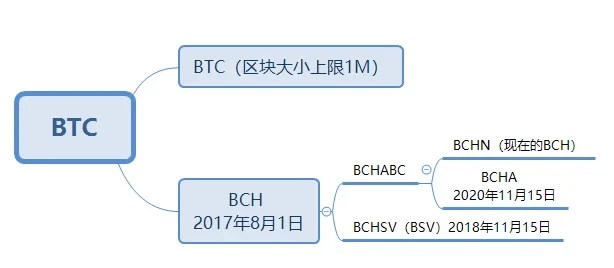
BTC-BCH-BSV fork diagram, created by OKX
From the above diagram, we can more intuitively understand the fork history of BCH and later BSV. Let's briefly review it:
First time: On August 1, 2017, because the first-generation Bitcoin block size could not meet demand, it forked into BTC and BCH (then called BCC). BTC is still the current BTC, while BCH is no longer the current BCH. Let's temporarily call it BCH 2.0.
Second time: On November 15, 2018, the BCH community disagreed again on the block size upper limit, so BCH 2.0 was forcibly forked into BCH 3.0 and BSV.
Third time: On November 15, 2020, BCH 3.0 forked into BCHA and BCH 4.0.
Here's a brief introduction to where BSV and BCH differ. Although both BSV and BCH are advocates and practitioners of "big blocks," the paths they take are not the same. From the perspective of their block size upper limit scaling goals, BCH can be considered the "moderate faction," advocating that block size should gradually increase with network demand and internet technological progress. Simply put, as long as the block size is sufficient, it's fine; if insufficient, continue scaling. BSV, on the other hand, appears relatively "extreme," initially advocating raising block size to very large. In the 2018 fork, it proposed scaling to 128M, and later even proposed an "unlimited block size" scaling plan. However, BSV's scaling concept obviously ignores crucial security issues at the current stage. According to Cointelegraph, around 23:45 Hong Kong time on August 3, BSV suffered a "massive" 51% attack, causing three versions of the chain to be mined simultaneously. This shows that unless hashrate is concentrated, networks like BSV pursuing 128MB block size upper limits may face serious security issues. But another question is: if hashrate is truly concentrated, how much difference is there from a centralized system? Meanwhile, from recent BSV average hashrate changes, it's currently only 392PH/s, at its historical low. The loss of hashrate is undoubtedly adding frost to snow for maintaining "big block" security.
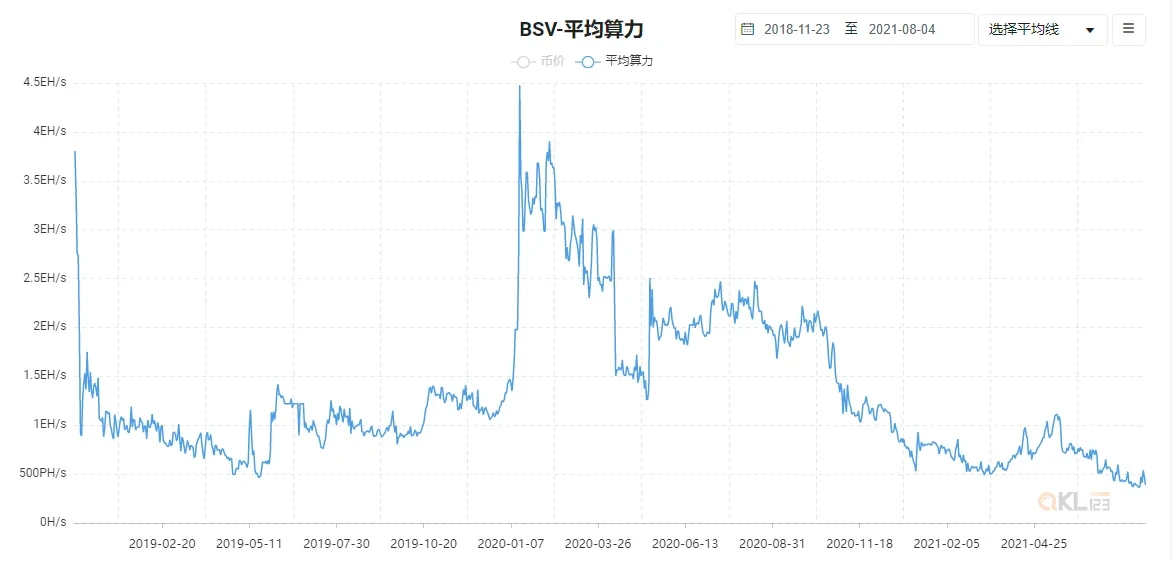
Recent BSV average hashrate, source: qkl123
In summary, appropriately increasing block size can alleviate throughput issues, but infinitely increasing block size will inevitably cause serious security hazards.
BCH Sidechain smart BCH Launches
According to media reports, Hong Kong time July 31, 2021, BCH sidechain smart BCH officially launched, with three nodes—BTC.com, ViaBTC, and Matrixport—becoming genesis validators. Currently smart BCH is in its first voting period, where more validators will be elected by miners. The smart BCH team stated that smart BCH's Moeing ADS data structure has been completed, can support 51,000 TPS, and can support smart BCH's development without changing its main data structure.
What changes will smart BCH bring? According to smart BCH's lead developer Wang Kui, smart BCH includes two updates: SEP101 (store values of arbitrary length) and SEP206 (convert native tokens to SEP20 tokens), is compatible with EVM and Web3.0 and greatly simplifies dApp developers' work. Meanwhile, Wang Kui also introduced the advantages of launching DeFi projects on smart BCH. Unlike what we've seen with DeFi trading volume surges leading to skyrocketing ETH trading fees, smart BCH will not follow the old path of "higher traffic leads to higher Gas prices." It will ensure that even if on-chain trading volume grows significantly, Gas prices remain very cheap by expanding blocks.
Conclusion
Since Bitcoin trading congestion, low on-chain transfer efficiency, and high fee issues were exposed, community members have proposed multiple solutions including Lightning Network, Segregated Witness, and block expansion. But so far, no solution has satisfactorily resolved the above problems. In the article "Lightning Network Accelerates Development: Can It Help Bitcoin Reach New Heights?", we focused on Lightning Network's development. But like Segregated Witness, although both have developed, they still cannot fully meet expectations. With smart BCH's launch this time, can it represent "big blocks" bringing us different performance? Ultimately, time will give us the answer.
Disclaimer
This article may contain product-related content not applicable to your region. This article is intended only to provide general information and does not assume responsibility for any factual errors or omissions therein. This article represents only the author's personal views and does not represent OKX's views. This article is not intended to provide any of the following advice, including but not limited to: (i) investment advice or investment recommendations; (ii) offers or solicitations to buy, sell, or hold digital assets; or (iii) financial, accounting, legal, or tax advice. Holding digital assets (including stablecoins) involves high risk, may fluctuate significantly, and may even become worthless. You should carefully consider whether trading or holding digital assets is suitable for you based on your financial situation. For questions about your specific situation, please consult your legal/tax/investment professional. The information appearing in this article (including market data and statistics, if any) is for general reference only. Although we have taken all reasonable precautions in preparing these data and charts, we assume no responsibility for any factual errors or omissions expressed herein. © 2025 OKX. This article may be reproduced or distributed in its entirety, or excerpts of 100 words or less from this article may be used, provided such use is non-commercial. Any reproduction or distribution of the entire article must also prominently state: "This article copyright © 2025 OKX, used with permission." Permitted excerpts must cite the article name and include the source, for example "Article Name, [Author Name (if applicable)], © 2025 OKX". Some content may be generated or assisted by artificial intelligence (AI) tools. Derivative works or other uses of this article are not permitted.
Show More
Recommended Reading
OKX Pay: Opening a New Era of Next-Gen Cryptocurrency Payments
The choice of tens of millions of users. Register OKX to enjoy ultimate trading experience and diverse wealth management products. A letter from OKX CEO Star: Today, we officially launch the first version of OKX Pay for over 100 million global users. As the industry's first payment application to truly achieve non-custodial and compliant integration, OKX Pay will be embedded in the OKX App, currently open to some markets, expected to fully launch within months
March 22, 2026

New Chapter: Building Next-Gen Financial Infrastructure Together
The partnership between OKX and Intercontinental Exchange (ICE) is an important moment for OKX and equally significant for the evolution of the entire digital assets market. ICE establishes and operates the world's most important financial infrastructure, including the New York Stock Exchange and global derivatives and clearing platforms. This ICE investment in OKX and joining our board reflects both parties' shared belief—digital assets technology will serve in financial markets
March 10, 2026
Tribute to Another Year of Forging Ahead
As OKX's CEO, and also a builder who stays true to our original mission, I proudly look back on OKX's extraordinary growth and progress this year. Despite many challenges, 2024 was still a year filled with focus, innovation, and resilience. We not only expanded and optimized our products, but also made important progress in launching transparent and compliant localized businesses, while further strengthening our global management team. Notably, after experiencing
January 29, 2026

2025: Steady Progress Toward Financial Freedom Together
— Year-end letter from OKX Founder and CEO Star to global users "Financial freedom" is often misunderstood. It doesn't mean no rules, but rather having the right to choose even when rules exist—and when the system is truly tested, it remains reliable and effective. This is exactly what we consistently focused on throughout 2025. First, I want to extend sincere gratitude to our global clients, partners, and regulatory authorities
January 16, 2026

OKX Officially Launches in Germany and Poland
Author: Erald Ghoos, CEO of OKX Europe Today is significant for OKX—and also for cryptocurrency users across Europe. We have officially launched a fully compliant centralized cryptocurrency trading platform in Germany and Poland! For us, this is not just a geographic expansion, but a commitment to building the cryptocurrency future the right way: secure, transparent, and meeting local needs. If you're in Germany
October 21, 2025

Partnership Upgrade! OKX Partners with Standard Chartered to Expand European Market
On October 15, OKX Europe CEO Erald Ghoos stated that OKX is expanding its strategic partnership with Standard Chartered to the European Economic Area (EEA). Earlier this year, OKX first partnered with Standard Chartered in the UAE to launch the collateral mirroring program—this is a
October 15, 2025