Amid Market Crash, Over $385 Million in Assets Liquidated on Ethereum DeFi Lending Protocols
AAVE +4.86%
According to data from OKLink, due to sharp price volatility in Ethereum, the liquidation volume on Ethereum lending protocols reached $385 million in the past 24 hours, hitting a record high. Among them, AAVE V2 recorded $177.5 million in liquidations, ranking first, followed by Compound at $135.2 million. The current total borrowing volume on Ethereum lending protocols stands at $15.9 billion.

24-hour liquidation volume on Ethereum DeFi lending protocols, Source: OKLink
For comparison, the last time Ethereum experienced a similar decline dates back to March 12-13 of last year. According to OKX market data, Ethereum's price fell from $195.6 to $87 within two days, a maximum drop of 55.5%. During the same period, assets worth $72 million were liquidated on Ethereum DeFi lending protocols. Over the course of one year, under similar market conditions, the liquidated asset amount increased by over 430%, which also provides a glimpse into the rapid development momentum of DeFi lending protocols over the past year.
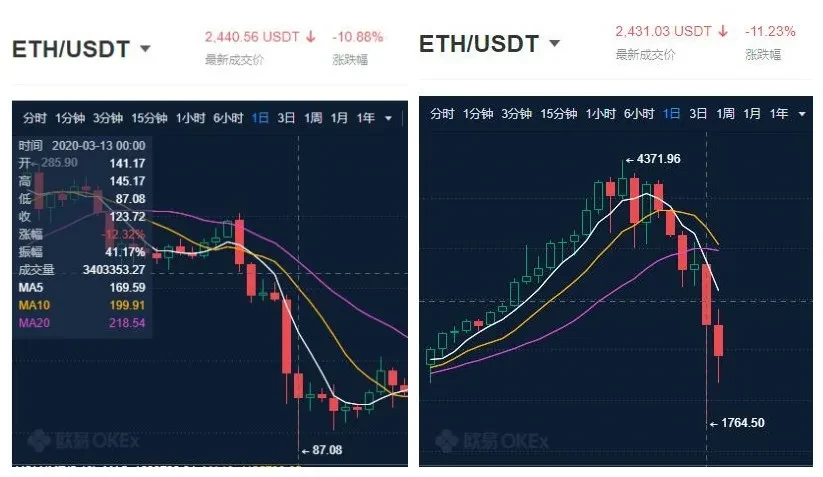
Ethereum price trends March 12-13, 2020 vs. May 19, 2021, Source: OKX
Next, we will continue to explore the development status of Ethereum-based DeFi lending protocols and focus on explaining the liquidation mechanism in DeFi lending protocols.
DeFi Lending Protocols
When discussing DeFi lending protocols, one must mention MakerDAO. The MakerDAO project launched in 2014 and is not only the first successful collateralized lending DeFi project on Ethereum, but is also considered a star project that opened the doors to DeFi. As a liquidity pool, MakerDAO provides a platform for both lenders and borrowers. Liquidity providers supply assets to the pool and earn interest, while borrowers borrow from the pool and repay debt with interest. Essentially, MakerDAO bridges the gap between lenders hoping to earn interest on idle funds and borrowers wishing to borrow for production or investment purposes.
The MakerDAO protocol is built on Ethereum, is fully open-source, operates transparently, and has a decentralized governance organization ensuring everyone understands what's happening—including current deposit volumes, borrowing volumes, interest rate changes, and the amount of assets pending liquidation. Every participant has equal access to all information.
Compared to lending services in traditional financial markets, DeFi protocols represented by MakerDAO provide a censorship-resistant, barrier-free financial service platform. Currently, MakerDAO supports multiple crypto assets such as ETH, BAT, USDC, WBTC, TUSD, KNC, ZRX, and others as collateral for its stablecoin Dai. Meanwhile, to ensure system stability and user asset safety, MakerDAO employs an over-collateralization model. Currently, the collateral ratio for ETH on MakerDAO is typically 150% (other collateral assets may vary slightly based on liquidity differences). This means if a borrower wants to obtain $100 worth of DAI, they need to deposit $150 worth of ETH as collateral.
In this process, borrowing rates are determined by algorithms comprehensively evaluating changes in borrowing and deposit volumes of that collateral asset on the platform. Obviously, this is a floating data point that can be expressed through the following mathematical formula:
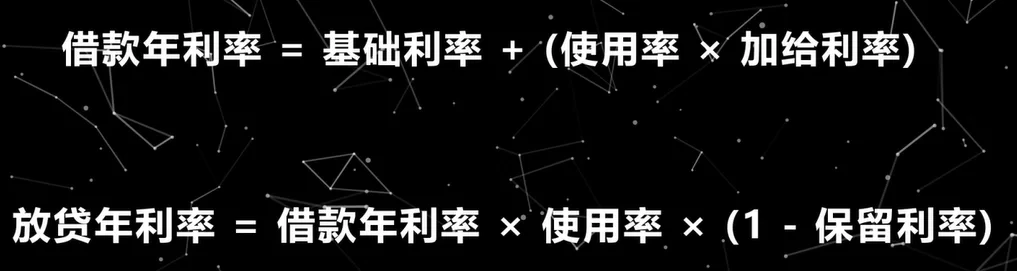
MakerDAO borrowing rate calculation method, Source: OKLink
Simply put, when the utilization rate (the proportion of assets deposited by users that are lent out) is higher, the corresponding lending rate also increases. The borrowing rate determines the level of deposit rates. Aside from a portion of borrowing interest that the platform collects as revenue, the remainder is distributed proportionally to all depositors as their interest.
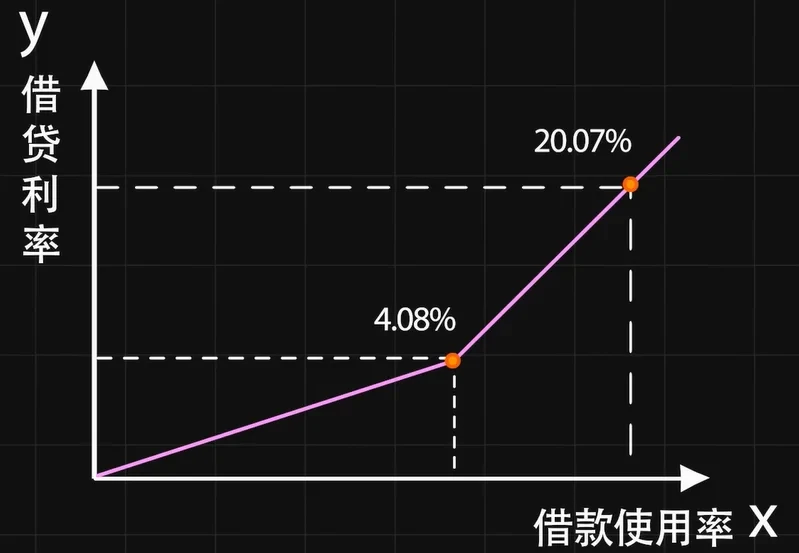
Changes in lending rates and utilization rate, Source: OKLink
However, it should be noted that a higher utilization rate in DeFi lending protocols is not necessarily better. When the utilization rate reaches 100%—meaning all deposited funds have been fully lent out—and if depositors decide to withdraw funds from the liquidity pool or collateral asset values sharply decline, an extreme situation may occur where deposits in the fund pool become less than borrowing amounts. This could lead to bank runs and fund pool liquidation risks. Therefore, DeFi lending systems are typically designed with an optimal utilization rate (the inflection point shown in the chart above). When fund utilization exceeds the optimal utilization rate, borrowing rates rise significantly to suppress further borrowing demand and protect fund pool safety. However, even with optimal utilization rate design, there remain risks from extreme market shocks like those on March 12, 2020, and May 19 this year. Thus, a liquidation mechanism is needed as a "fail-safe" double insurance.
What is Liquidation? Why Does Liquidation Exist?
What is liquidation? Fundamentally, liquidation in DeFi lending protocols is a mechanism that sells a portion of collateral assets below market price to repay the principal and interest that the borrower owes to the fund pool, thereby allowing the fund pool to continue operating healthily.
Why introduce a liquidation mechanism? As mentioned above, in DeFi collateralized lending protocols, when collateral asset values exceed borrowing values and the utilization rate is below optimal levels, this represents a relatively healthy operating state. In this state, borrowers can obtain liquidity without needing to sell their assets deposited in the protocol. However, when collateral asset values decline sharply or borrowing values increase, borrowers have incentives to avoid repayment, which could trap both lenders and borrowers in distress, potentially leading to bad debt.
Against this backdrop, liquidation emerges—when a borrower's collateral assets are insufficient to cover their loan, smart contracts execute the liquidation process. The borrower's collateral assets are purchased by others at approximately a 5% discount, and the borrower may also need to pay a certain penalty.
How to Conduct Liquidation?
Here we first need to introduce the concept of a "liquidator." The liquidator mechanism in DeFi collateralized lending protocols resembles the auction liquidation logic for distressed assets in traditional finance—both carrying risks and enormous profit potential. Through centralized methods, liquidation efficiency in extreme situations can be greatly improved, avoiding the risk of exacerbating on-chain congestion while maintaining the safe and stable operation of lending protocols as much as possible. It should be noted that in DeFi collateralized lending protocols, every participant is eligible to become a liquidator. Of course, a necessary prerequisite for becoming a liquidator is that there are collateral assets in the market needing liquidation—i.e., the bad debt mentioned above.
When does bad debt appear? Since most current DeFi collateralized lending protocols use over-collateralization, bad debt and liquidators emerge when the price of collateral assets themselves falls, causing the collateral ratio of the borrower's collateral assets to reach the liquidation threshold.
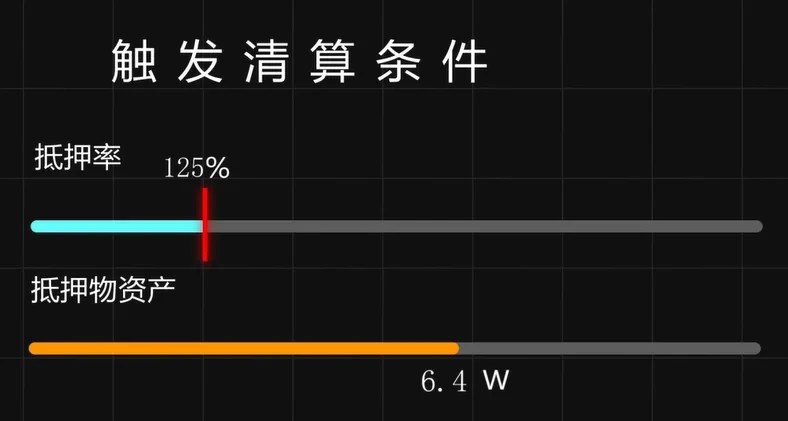
Conditions triggering liquidation in DeFi collateralized lending protocols, Source: OKLink
There are two common liquidation methods. One involves directly listing a portion of the borrower's collateral at a certain discount through the contract, allowing any user to repay the debt on behalf of the borrower and immediately resell for arbitrage. The other method involves openly auctioning the collateral starting from a base price with gradual price increases.
Generally, most liquidators prefer the first arbitrage method for trading. In DeFi collateralized lending protocols, to incentivize liquidators' participation, a parameter called liquidator discount is used to provide price benefits to liquidators. This liquidator discount is typically around 5%, meaning liquidators can repurchase collateral at a 5% discount. Upon seeing an account with bad debt where collateral assets are insufficient, liquidators can intervene by purchasing the collateral assets at a discount and supplementing some borrowed funds until the bad debt account's asset collateral ratio exceeds 150%. Liquidators can then conduct arbitrage by selling the collateral assets they purchased at a 95% discount on secondary markets, earning themselves a decent profit. Of course, as mentioned above, liquidators may obtain considerable returns during the liquidation process but also face certain risks. This risk lies in the possibility that the price of collateral assets they purchased at a 95% discount could decline further. If the decline exceeds their discount benefit, they risk losses. Additionally, they must consider trading fees for arbitrage trades and Gas fees for on-chain transactions. For example, in yesterday's market decline, we observed Ethereum's average transaction fee rose significantly, reaching 0.01838401 ETH per transaction at one point, whereas just two days prior, single transaction fees only required 0.00641721 ETH.
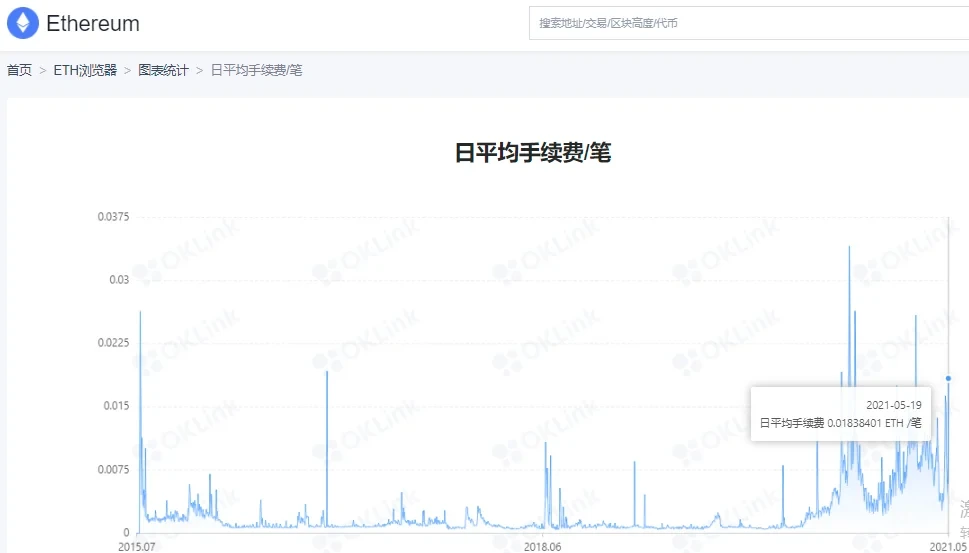
Ethereum single transaction fee on May 19, 2021, Source: OKLink
Conclusion
In the two extreme market events of last March and this May, significant liquidations occurred in DeFi collateralized lending protocols. This has again sounded an alarm for the market and DeFi participants. Since DeFi projects heavily rely on ETH collateral models, multi-layer nesting, and cyclical leverage amplification, they exhibit clear pro-cyclicality and instability. On one hand, practitioners need to further optimize lending protocols from an economic perspective. On the other hand, DeFi participants need to use leverage cautiously, maintain respect for the market, and always implement proper risk management measures.
Meanwhile, yesterday's temporary surge in Ethereum trading fees again exposed the problem of slow on-chain trading speeds limiting market clearing efficiency, requiring Ethereum 2.0 to focus on performance improvements.
Disclaimer
This article may contain product-related content not applicable to your region. This article is intended solely to provide general information and assumes no responsibility for any factual errors or omissions herein. This article represents only the author's personal views and does not represent the views of OKX. This article is not intended to provide any recommendations, including but not limited to: (i) investment advice or investment recommendations; (ii) offers or solicitations to buy, sell, or hold digital assets; or (iii) financial, accounting, legal, or tax advice. Holding digital assets (including stablecoins) involves high risk, may fluctuate significantly, and may even become worthless. You should carefully consider whether trading or holding digital assets is suitable for you based on your financial situation. For questions regarding your specific situation, please consult your legal/tax/investment professional. Information appearing in this article (including market data and statistics, if any) is for general reference only. While we have taken all reasonable precautions in preparing these data and charts, we assume no responsibility for any factual errors or omissions expressed herein. © 2025 OKX. This article may be reproduced or distributed in full, or excerpts of 100 words or less may be used, provided such use is non-commercial. Any reproduction or distribution of the entire article must prominently state: "Copyright © 2025 OKX. Used with permission." Permitted excerpts must cite the article title and include attribution, such as "Article Name, [Author Name (if applicable)], © 2025 OKX". Some content may be generated or assisted by artificial intelligence (AI) tools. Derivative works or other uses of this article are not permitted.
Show More
Recommended Reading
OKX Pay: Opening a New Era of Next-Gen Crypto Payments
The choice of tens of millions of users. Register with OKX to enjoy the ultimate trading experience and diverse wealth management products. A letter from OKX CEO Star: Today, we are officially launching the first version of OKX Pay to over 100 million global users. As the industry's first payment application to truly integrate non-custodial and compliant features, OKX Pay will be embedded within the OKX App, currently available to select markets, with full rollout expected within the coming
March 22, 2026

New Chapter: Building Next-Gen Financial Infrastructure Together
The partnership between OKX and Intercontinental Exchange (ICE) represents an important moment for OKX and holds equally profound significance for the evolution of the entire digital assets market. ICE establishes and operates the world's most important financial infrastructure, including the New York Stock Exchange and global derivatives and clearing platforms. This strategic investment by ICE in OKX and joining our board reflects both parties' shared belief—digital assets technology will transform financial markets
March 10, 2026
Tribute to Another Year of Forging Ahead
As OKX's CEO and a builder staying true to our original mission, I'm proud to look back on the remarkable growth and progress OKX achieved this year. Despite numerous challenges, 2024 remained a year of focus, innovation, and resilience. We not only expanded and optimized our products but also made significant progress in launching transparent and compliant localized operations, while further strengthening our global management team. Notably, after experiencing
January 29, 2026

2025: Steady Progress Toward Financial Freedom Together
— Year-end letter from OKX Founder and CEO Star to global users "Financial freedom" is often misunderstood. It doesn't mean the absence of rules, but rather having the right to choose within the framework of existing rules—and when the system is truly tested, it remains reliable and effective. This is exactly what we've remained focused on throughout 2025. First, I want to extend my sincere gratitude to our global clients, partners, and regulatory bodies
January 16, 2026

OKX Officially Launches in Germany and Poland
Author: Erald Ghoos, CEO of OKX Europe Today is significant for OKX—and for crypto users across Europe. We have officially launched our fully compliant centralized cryptocurrency trading platform in Germany and Poland! For us, this is more than just geographic expansion; it's a commitment to building the cryptocurrency future the right way: secure, transparent, and meeting local needs. If you're in Germany
October 21, 2025
Partnership Expanded! OKX Partners with Standard Chartered to Expand European Market
On October 15, OKX Europe CEO Erald Ghoos stated that OKX is expanding its strategic partnership with Standard Chartered to the European Economic Area (EEA). Earlier this year, OKX first partnered with Standard Chartered in the UAE to launch the collateral mirroring program—a
October 15, 2025