Is DeFi Cooling Off? Is NFT Taking Over? What You're Seeing May Not Be the Whole Picture
COMP+2. 73%
In the classic film "Swordsman II: The East is Red," there's a memorable line where Ren Wuxing says to Linghu Chong, who wants to retire from the martial arts world: "Where there are people, there are grudges; where there are grudges, there is a world of Wulin (martial arts). You are the Wulin. How can you possibly walk away?"
Of course, our topic today is not about martial arts stories. However, this quote seems quite fitting to open our discussion: In emerging investment markets, wherever Funds are focused becomes the hotspot, and where there are hotspots there is activity. As long as Funds don't pull out, the momentum won't fade—so who decides what's hot and what's not? That's right, today we're diving into DeFi and NFT.
Upon closer examination, DeFi and NFT do share many aspects worth comparing. For instance, in terms of timeline, DeFi took off during the DeFi Summer of 2020, while NFT gained recognition early this year, but its truly massive explosive growth didn't arrive until Q3. Another example: in terms of the underlying networks they rely on, DeFi was initially deployed through Ethereum's convenient and efficient smart contracts, while the vast majority of NFTs were also issued following the ERC-721 or ERC-1155 standards. Or looking at their development trajectories up to now, both have essentially gone through stages of launch, acceleration, and concentrated explosion. However, against the backdrop of the recent NFT surge, voices in several crypto communities have been asking: "Is DeFi cooling off?" and "Will NFT replace DeFi as Ethereum ecosystem's new growth engine?" So today, we'll examine these claims through key data metrics.
Has DeFi****Really Cooled Off?
Intuitively, since the mid-May broad crypto market correction, the total value of assets locked in DeFi protocols (TVL) did experience a precipitous drop. According to OK Link data, between May 10 and May 23, 2021, the value of assets locked in DeFi protocols plummeted from $113.57 billion to $62.6 billion, a decline of 44.9%. Additionally, on May 19, affected by ETH price drops, a massive $395 million liquidation occurred in DeFi lending protocols—the largest single liquidation event in DeFi history to date, dealing a considerable blow to the sector. The market then lingered in a slump for nearly two months, while the NFT market was surging under the surface, repeatedly becoming the "topic champion" of the crypto world. So it's no surprise that community members started raising these questions.
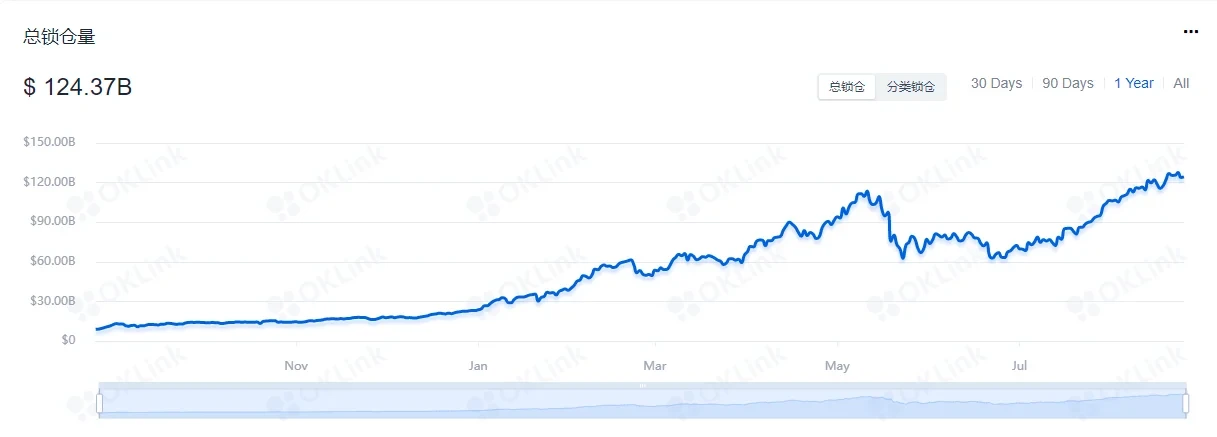
Changes in DeFi protocol TVL over the past year, source OK Link
One important point to note: although TVL is a frequently used metric in our analyses of DeFi development, strictly speaking, it is not a perfect measure of DeFi protocol adoption. However, when evaluating the degree to which market investors prioritize and trust DeFi, this metric still holds significant value.
So, looking at the latest DeFi TVL data from OK Link, it is easy to see that since late July, this figure has successfully surpassed the previous peak set in May, reaching $127.64 billion. While the growth rate may not match the concurrent development trajectory of NFT, in terms of absolute scale, $127.64 billion in Funds—whether in traditional financial markets or the crypto market—is undeniably a formidable force. The continued increase in this number also reflects investors' growing confidence in entrusting their assets to "blockchain code."
Delving deeper, in addition to TVL growth, many DeFi metrics have shown encouraging upward trends since August. For example, deposit and borrowing volumes in lending protocols have grown significantly alongside market stabilization, particularly as ETH prices stabilized above $3,000. According to OK Link, the total deposit volume in lending projects has now reached $59.38 billion, also breaking out of its trough to set a new record. The three leading players in the lending protocol space—Maker, Aave, and Compound—have collectively attracted over $42 billion in crypto assets from investors.
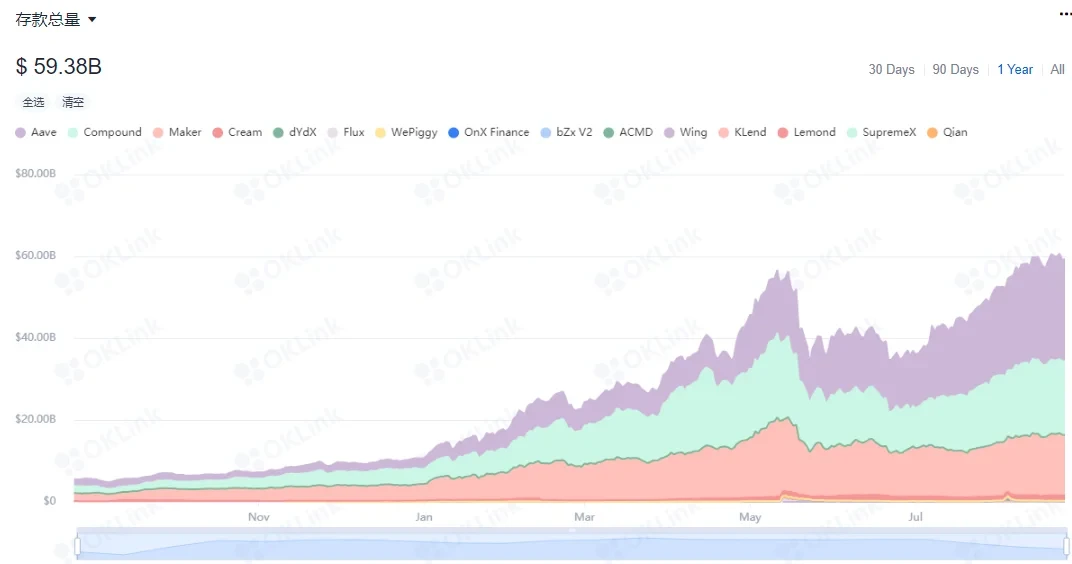
Changes in total deposits in DeFi lending protocols, source OK Link
Correspondingly, total borrowing in DeFi lending protocols has also grown considerably. According to OK Link, the current value of assets borrowed from DeFi lending protocols by market investors has reached $24.8 billion, representing a near 90% increase from the $13.38 billion interim low recorded on May 23.
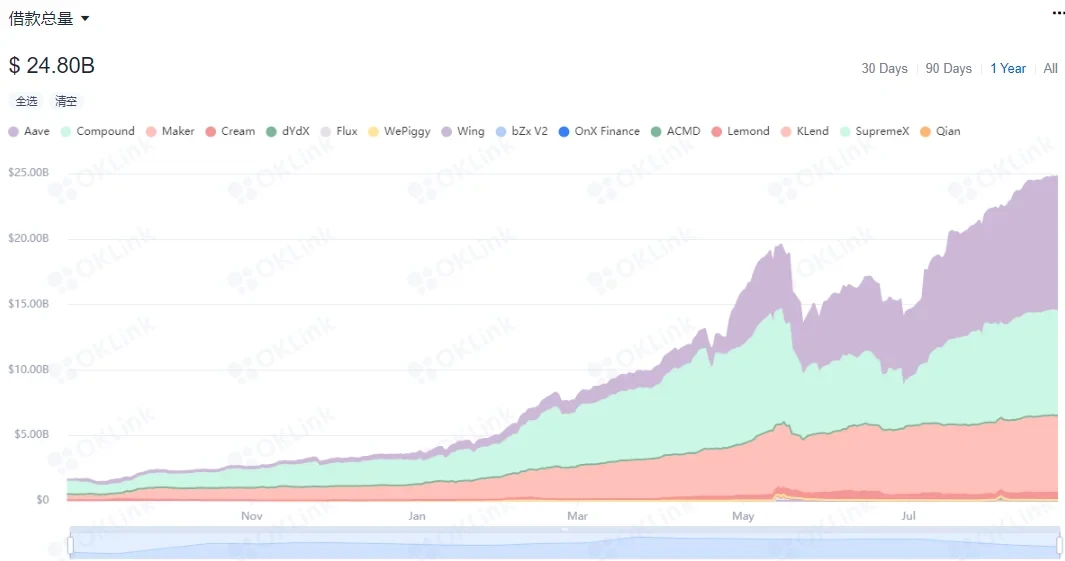
Changes in total borrowing in DeFi lending protocols, source OK Link
From the synchronized growth in both deposit and borrowing volumes, we can draw at least one clear conclusion: Market investors are regaining confidence in the DeFi lending market, and their risk tolerance is increasing—a clearly positive signal.
Meanwhile, DEX activity also appears healthier. According to glassnode's August 18 statistics, DEX trading volume in August alone is expected to surpass the previous highs set in June and July. As of the 18th, total DEX trading volume had already exceeded $46 billion. DeFi researcher Luke Posey estimates that total DEX trading volume could reach $80 billion by the end of August. If Luke's prediction holds true, it would be the second-highest trading month of the year, behind only May.
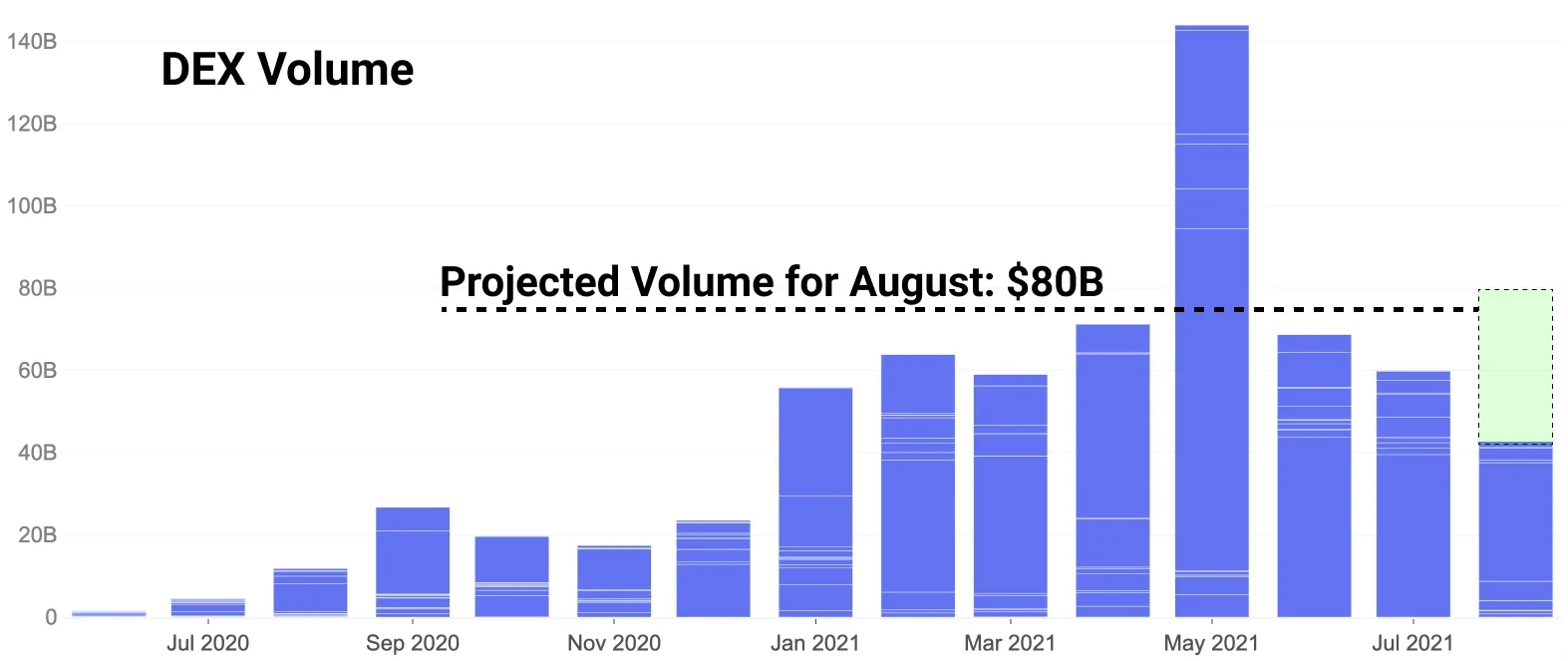
DEX total trading volume over the past year and August 2021 forecast, source glassnode
Another indicator that supports the rise in DEX trading activity is the amount of ETH burned as base gas fees since the launch of EIP-1559. According to qkl123, as of the time of writing, the ETH burned by DEX leader Uniswap's V2 and V3 versions totaled 6,602.1 ETH and 2,747.22 ETH respectively, combining for 9,349.32 ETH—just behind OpenSea, the current leader in the hot NFT space.
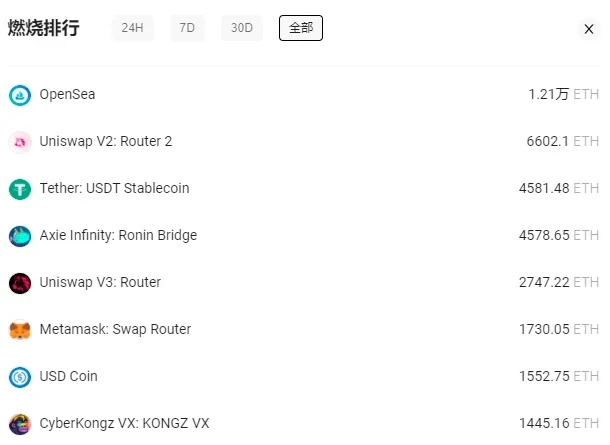
ETH burned by smart contracts on Ethereum since EIP-1559 launch, source qkl123
Beyond spot trading-focused DEXs, one dark horse that cannot be overlooked is dYdX, a derivatives-focused DEX. Although in DeFiPulse's DEX rankings, dYdX currently sits at only 28th, its growth in locked crypto assets, trading volume, and user count all point to enormous potential. In terms of locked crypto assets, dYdX rose from $160 million on July 21 to $392 million on August 25—a gain of 145%, far outpacing Curve (52.93%), Uniswap (32.61%), and Sushiswap (73.68%) over the same period.
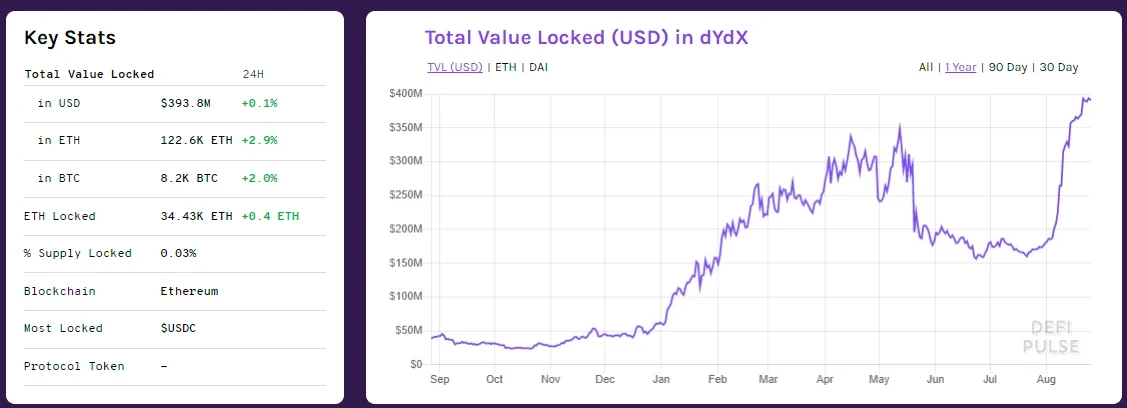
Changes in dYdX's locked assets over the past year, source DeFiPulse
On August 24, dYdX founder Antonio Juliano tweeted that since announcing the launch of the platform's governance token DYDX earlier this month, dYdX has seen significant data growth: daily trading volume exceeded $400 million for the first time, weekly revenue reached $1.8 million, and the total user base has grown to 73,500 (with 34,000 added in August alone).
What the dYdX example illustrates is that over the past year or so, our attention toward the DeFi sector has been largely concentrated on Compound-led lending and Uniswap-led spot trading DEXs. Beyond these, however, the DeFi landscape also encompasses numerous细分领域 with unlimited potential, such as derivatives DEXs, decentralized asset management, decentralized payments, and decentralized insurance. These could well become new growth engines driving DeFi's broader expansion.
How Hot Is NFT****Really?
Blockchain project rating and data research firm TokenInsight released an NFT industry analysis report earlier this month, noting: "The NFT and Metaverse markets rose rapidly in Q2, showing particularly strong momentum in July 2021. As of July 2021, the total NFT market sales reached $1 billion. July 2021 single-month sales increased 428% compared to Q4 2020." This gives us a general picture of the NFT market. Let's continue to examine it through detailed data for a more comprehensive understanding.
First, let's look at the growth in NFT sales volume since the start of 2021. According to NonFungible, daily NFT sales in January of this year were around 60,000, while by August 18, this figure had surged to 269,900—a staggering 349.83% increase.
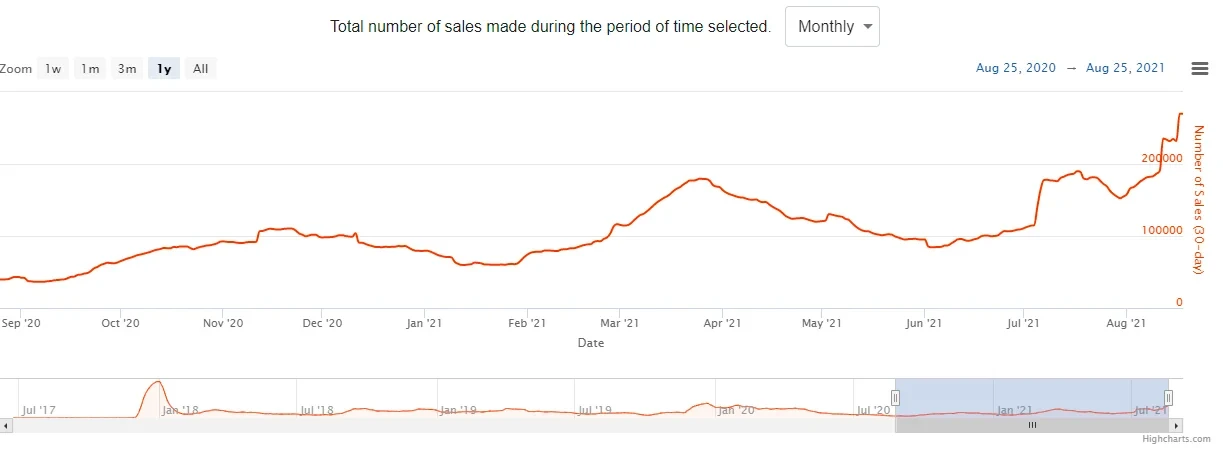
NFT sales volume growth since 2021, source NonFungible
Next, let's look at the trading volume growth driven by increased NFT sales. According to NonFungible, throughout January, the average daily NFT market trading volume hovered around $10 million, with trading sentiment fairly quiet. After entering August, trading volume rose nearly vertically, with the single-day volume on the 18th reaching $897 million—an 88.7x increase compared to January's average. Comparing trading volume with sales count, we can also observe that during this period, not only did NFT traders' enthusiasm surge, but NFT asset unit prices also rose substantially.
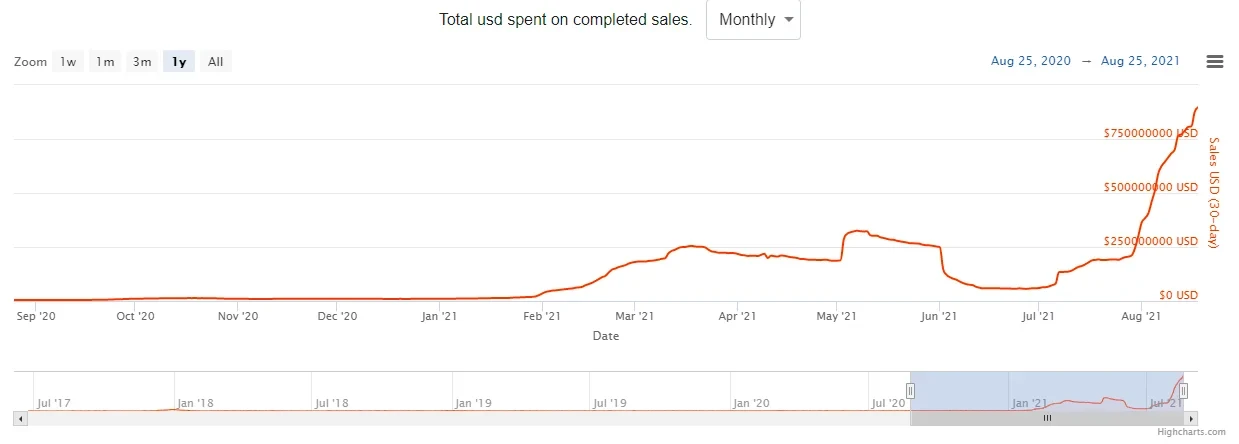
NFT market trading volume growth since 2021, source NonFungible
Then there is the change in the number of unique wallets participating in NFT trading. According to NonFungible data, approximately 15,000 unique wallets were active in NFT trading daily in January. By August 18, the number of wallets participating in trading had approached 70,000, reaching 69,300.
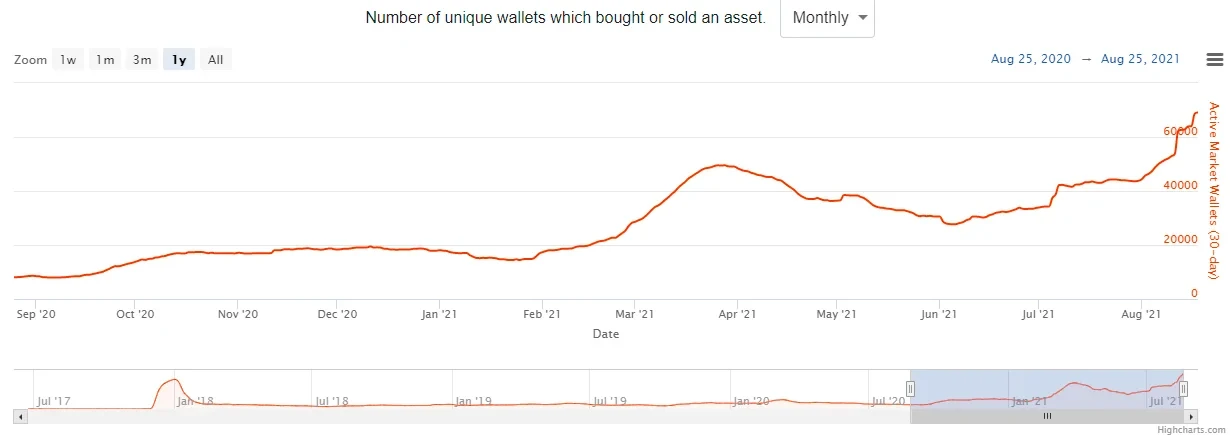
Number of unique wallets participating in NFT trading since 2021, source NonFungible
Beyond these tangible data points, the GameFi concept built on the NFT boom—and Axie Infinity in particular, the most well-known example—has also genuinely let players feel summer's heat well into the autumn season. So whether from a data perspective or based on prevailing market sentiment, NFT is undeniably extremely hot, with no clear signs of cooling off just yet.
Conclusion
When we want to make predictions about DeFi and NFT that are as close to reality as possible, we must first take a higher-level view of their development trajectories, the historical opportunities they have leveraged, their future potential for growth, and apply the most fundamental simple logic to make judgments. As two major sectors that rose successively atop the Ethereum ecosystem, both DeFi and NFT have proven their value and significance through market scrutiny. Each has created value for us in its respective domain, and it is foreseeable that they will continue to generate even greater value. Based on this assessment, in the long run, there will undoubtedly be a steady stream of Funds flowing into both DeFi and NFT. Therefore, as twin pillars of the Ethereum ecosystem, DeFi and NFT are not destined for a zero-sum relationship; rather, they will complement and mutually advance each other, collectively driving the continued progress of the Ethereum ecosystem and the metaverse.
Disclaimer
This article may contain product content not applicable to your region. This article is intended to provide general information only and makes no responsibility for any factual errors or omissions. This article represents the author's personal views only and does not represent the views of OKX. This article is not intended to provide any advice, including but not limited to: (i) investment advice or investment recommendations; (ii) offers or solicitations to buy, sell, or hold digital assets; or (iii) financial, accounting, legal, or tax advice. Holdings in digital assets (including stablecoins) involve a high degree of risk and may fluctuate significantly, or even become worthless. You should carefully consider whether trading or holding digital assets is appropriate for you based on your financial situation. For questions specific to your circumstances, please consult your legal/tax/investment professional. The information contained in this article (including market data and statistical information, where applicable) is for general reference purposes only. While all reasonable precautions have been taken in the preparation of such data and charts, we accept no responsibility for any factual errors or omissions expressed herein. © 2025 OKX. This article may be reproduced or distributed in its entirety or in excerpts of 100 words or less, provided that such use is non-commercial. Any reproduction or distribution of the full article must prominently state: "This article is copyrighted © 2025 OKX, used with permission." Permitted excerpts must cite the article title and include attribution, e.g., "Article title, [author name (if applicable)], © 2025 OKX." Some content may have been generated or assisted by artificial intelligence (AI) tools. Derivative works and other uses of this article are not permitted.
Show More
Recommended Reading
OKX Pay: Ushering in the Next Generation of Crypto Payments
Tens of millions of users' preferred choice. Register with OKX and enjoy an exceptional trading experience and diverse wealth management products. A letter from OKX CEO Star: Today, we officially launch the first version of OKX Pay for over 100 million global users. As the industry's first payment application to truly integrate non-custodial functionality with regulatory compliance, OKX Pay will be embedded within the OKX App, currently available in select markets with global rollout expected within months.
March 22, 2026

A New Chapter: Building the Next Generation of Financial Infrastructure Together
The partnership between OKX and Intercontinental Exchange (ICE) represents a significant milestone for OKX, and is equally meaningful for the evolution of the entire digital assets market. ICE operates and builds the world's most critical financial infrastructure, including the New York Stock Exchange and global derivatives and clearing platforms. This investment by ICE Select in OKX and its addition to our board reflects our shared conviction—that digital assets technology will transform financial markets.
March 10, 2026
Reflecting on Another Year of Building
As OKX's CEO and a builder who stays true to the original mission, I am proud to look back on the extraordinary growth and progress OKX has achieved this year. Despite formidable challenges, 2024 was a year marked by focus, innovation, and resilience. We not only expanded and improved our products, but also made significant strides in launching transparent and compliant localized businesses, while further strengthening our global management team. It is worth noting that after going through
January 29, 2026

2025: Steady Progress Toward Financial Freedom
— An End-of-Year Letter to Global Users from Star, Founder and CEO of OKX "Financial freedom" is often misunderstood. It does not mean the absence of rules, but rather having the right to choose—even when rules exist—and that the system remains reliable and effective when truly put to the test. This is precisely what we have remained focused on throughout 2025. First, I would like to express our sincere gratitude to our global customers, partners, and regulators.
January 16, 2026

OKX Officially Launches in Germany and Poland
By Erald Ghoos, CEO of OKX Europe Today is a significant day for OKX—and for crypto users across Europe. We have officially launched our fully compliant centralized cryptocurrency trading platform in Germany and Poland! For us, this is more than a geographic expansion; it is a commitment to building the future of cryptocurrency the right way: secure, transparent, and tailored to local needs. If you are in Germany
October 21, 2025
Partnership Upgrade! OKX and Standard Chartered Expand into Europe
On October 15, Erald Ghoos, CEO of OKX Europe, stated that OKX is expanding its strategic partnership with Standard Chartered to the European Economic Area (EEA). Earlier this year, OKX first teamed up with Standard Chartered in the UAE, launching a collateral mirroring program—a
October 15, 2025