Behind the Scenes of Ethereum MEV After EIP-1559 Launch
In the past year, Ethereum has undoubtedly been the "talk of the town" in the cryptocurrency market. On one hand, concepts based on the Ethereum ecosystem such as DeFi and NFTs have successively exploded, becoming hot investment sectors throughout the market; on the other hand, Ethereum itself continues to self-improve and upgrade - Ethereum 2.0, Berlin upgrade, London upgrade, and the upcoming Shanghai upgrade, with constant buzz. In the London upgrade completed on August 5th, the highly-anticipated EIP-1559 proposal was officially deployed, marking a major shift in Ethereum network transaction pricing mechanisms. Obviously, the most impacted in the short term are undoubtedly Ethereum miners. Regarding the specific measures involved in the EIP-1559 proposal, we have mentioned them in previous articles and will not repeat them here. Next, let's look at how much base fee has been burned in the 6 days since EIP-1559 went live.
"Disadvantaged" Ethereum Miners
According to statistics from watchtheburn website, since EIP-1559 went live, a total of 25,689.55 ETH has been burned in 6 days, accounting for 51.15% of the 50,218.07 ETH issued during the same period. Based on the average closing price of $3,021 for the ETH/USDT trading pair on OKX during this period, the total burned value reached $77.6081 million.
Amount of base fees burned on Ethereum chain since August 5th, source: watchtheburn
Although from a simple economic perspective, the deployment of EIP-1559 has brought deflationary expectations to Ethereum. Theoretically, as long as on-chain trading is active enough, the daily burned base fees could fully offset the daily newly issued portion, and may even result in more burning than issuance. From a long-term perspective, this would have a powerful boosting effect on ETH price growth. However, in the short term, it is an undisputed fact that Ethereum miners' interests have been compromised. Another easily overlooked fact is that Ethereum founder Vitalik Buterin's original intention in proposing EIP-1559 was to reduce on-chain transaction fees and alleviate Ethereum network congestion. As for the positive stimulus to ETH price, to be precise, it's merely a "byproduct" of the EIP-1559 proposal. So over these 6 days, with over 25,000 ETH burned, have Ethereum's on-chain transaction fees decreased?
According to data from OK Link, the daily average on-chain transaction fee for Ethereum on July 11th was 0.0013 ETH. On August 5th, the day EIP-1559 went live, the fee was 0.0043 ETH. By August 10th, the fee rose to 0.0054 ETH. At least judging from recent data, EIP-1559 has not yet played its intended role.
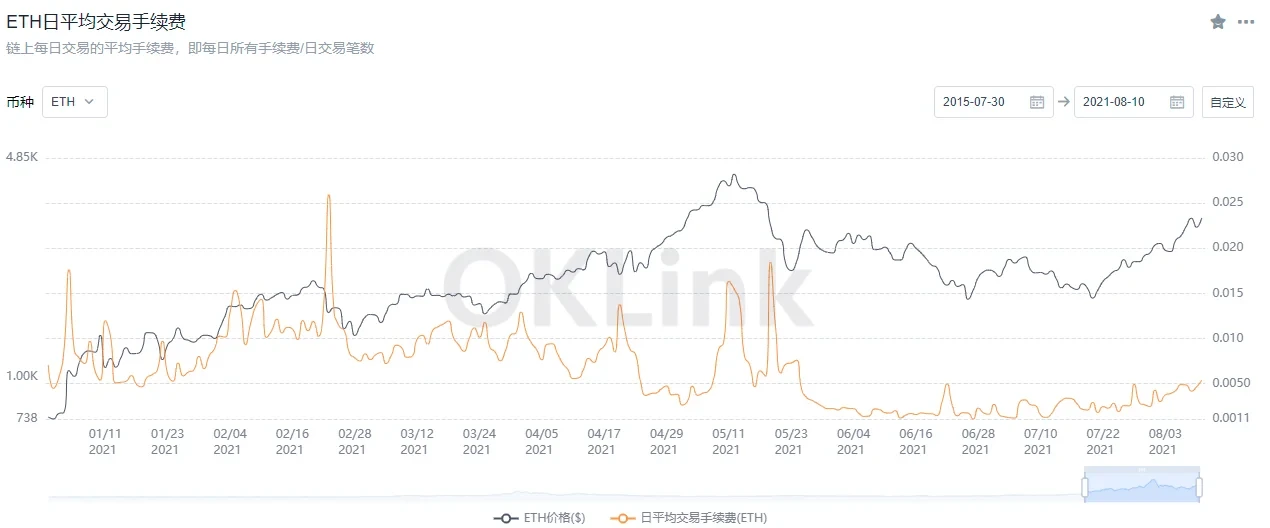
Recent changes in Ethereum daily average on-chain transaction fees, source: OK Link
On one hand, it has not achieved the goal of reducing fees, and on the other hand, it has reduced miners' returns. Can EIP-1559's contribution to the Ethereum ecosystem really reach the height people once expected? Or were industry expectations for EIP-1559 too high? In the past week, many industry analysts have begun to reflect on this. For example, Tech Flow believes that "from an algorithmic mechanism perspective, miners should be the masters of the blockchain, or at least partners. But since setting the difficulty bomb in 2015, Ethereum miners were destined to be only temporary workers, and they have not received the 'respect' they deserve." "Compared to Bitcoin miners, Ethereum miners have always been relatively disadvantaged." Indeed, in recent years, we often hear about Bitcoin mining conferences, but rarely news about Ethereum miners. Compared to Vitalik Buterin and the Ethereum Foundation, Ethereum miners seem to have much less presence. However, we must face the fact that regardless of how, for the current PoW consensus mechanism Ethereum, miners are ultimately a force that cannot be ignored. This compromise by Ethereum miners does not mean the disappearance of contradictions, and the hidden contradictions will eventually erupt on some future day. Tech Flow further predicts: "When ETH 2.0 arrives, a split is inevitable. EIP-1559 has previewed the conflict. Now it seems that V God and the Ethereum Foundation have won on the surface, but with consensus shattered, miners' counterattack may be on the way."
MEV**—Miners Using Another Method to Compensate for Losses**
Regarding MEV, we introduced it in our article "London Hard Fork Enters Countdown, MEV Has Extracted $766 Million" early last month. Here we'll summarize key points to quickly review the basic concept of MEV: MEV (narrow concept refers to Miner Extractable Value), translated as "miner extractable value," is a measure of profit obtained by miners through their ability to arbitrarily include, exclude, or reorder transactions within the blocks they produce. This concept was first proposed by Phil Daian and others in the 2019 "Flash Boys 2.0" report, referring to the fact that since on-chain transactions on Ethereum first enter the Mempool and are then packaged into blocks by miners, miners will prioritize packaging those transactions with higher gas fees. The behavior of offering high prices to have one's transaction prioritized is called "PGA (Priority Gas Auction)." However, with the massive outbreak of DeFi since summer 2020, nowadays not only miners, but many DeFi-focused traders and third-party arbitrage bots can also obtain MEV through arbitrage strategies. Therefore, this term has been further extended to "Maximum Extractable Value." The MEV discussed in this article mainly focuses on the generalized "Maximum Extractable Value."
We know that currently Ethereum miners' revenue mainly includes block rewards and transaction fees from users' daily on-chain transactions. Now fee income has been greatly reduced, and the increased value of block rewards brought by rising ETH prices is not enough to compensate for the burned base fees. MEV has undoubtedly become a revenue-generation method that miners need to focus on in the short term.
According to statistics from flashbots website, since January 2020, MEV extracted value has reached $687 million, of which MEV on January 1, 2021 was $165 million. This means that in half a year, MEV increased by $522 million, a growth rate of 316.4%.
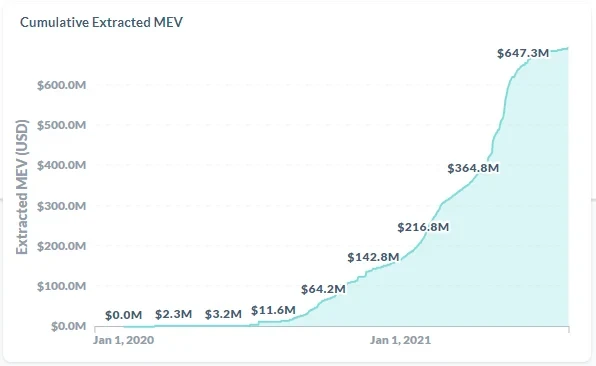
Changes in MEV extracted value from January 2020 to present, source: flashbots
Among them, single-day MEV even reached as high as $4.3 million.
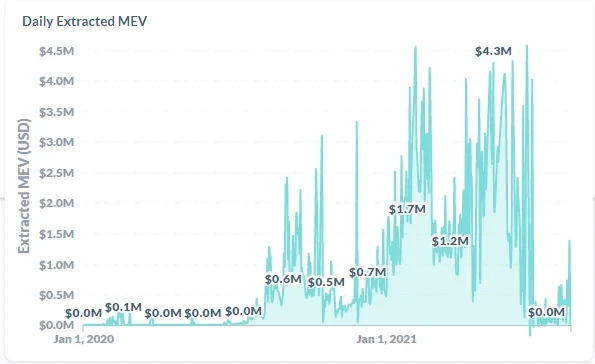
Daily MEV extracted value changes from January 2020 to present, source: flashbots
Concerns Raised by MEV
Based on the causes and potential consequences of MEV, it can be roughly divided into three types: benign MEV (i.e., protocol-inherent), malicious MEV, and catastrophic MEV.
1. Benign MEV: The operation of some protocols relies to a certain extent on MEV capture, such as liquidation of DeFi collateral lending protocols like Aave, Maker, and Compound, or maintaining market effectiveness through arbitrage between Uniswap and SushiSwap. The following figure shows the distribution of extracted MEV across different protocols, with Uniswap V2 accounting for the largest share at 45%, followed by Sushiswap, Balancer, dYdX, and Curve in second to fifth places respectively.
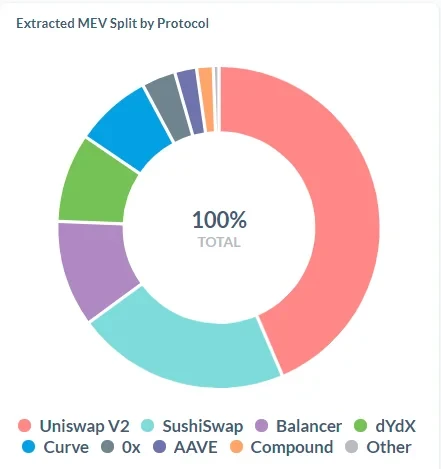
Distribution of extracted MEV across different protocols, source: flashbots
2. Malicious MEV: Mainly includes front-running transactions, sandwich attacks, etc. Front-running refers to an attack behavior where, while a normal transaction is waiting to be packaged, a front-running bot sets higher gas fees to jump ahead and complete the attack transaction, thereby capturing user interests. A recent well-known front-running case is the Punk 3860 from the Crypto Punk NFT series, valued at over $69,000, which was sold for less than 1 cent due to an operational error. According to Float Capital co-founder Jonathan Clark, the owner intended to sell the NFT in a whitelist sale for less than 1 cent but placed it on the public market. The buyer who first discovered this vulnerability set a fee as high as 22 ETH to "bribe" an Ethereum miner, thereby successfully obtaining the priority to have their transaction packaged in a block. Sandwich attacks are a very vivid description and a popular front-running method in DeFi. To form a "sandwich" transaction, the attacker finds a pending victim transaction and then attempts to sandwich the victim by executing transactions before and after.
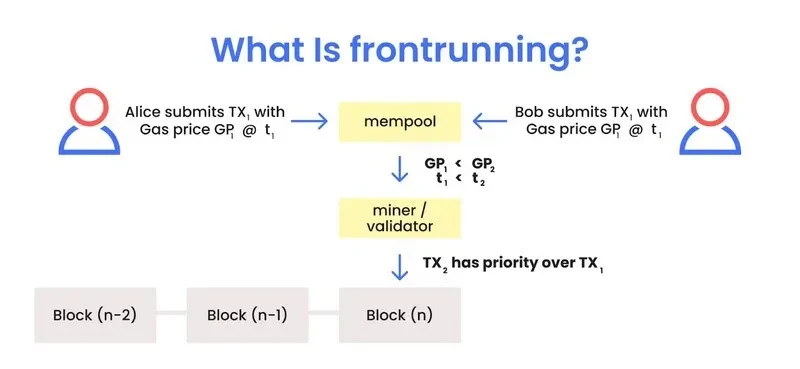
Front-running diagram, source: internet
3. Catastrophic MEV: Refers to threats to the consensus layer through reorg and time-bandit chain reorganization attacks. Although the probability of this situation is low, logically speaking, this risk always exists. Therefore, the concerns discussed in this section mainly refer to catastrophic MEV and malicious MEV.
Based on our discussion above about front-running and sandwich attacks, it can be seen that as long as the potential temptation is attractive enough, miners have the ability to reorder transactions to capture MEV opportunities. The Block once vividly illustrated the reorg drama in an article: "Simply put, miners may see profitable transactions in new blocks and then go back to reorganize blocks before transactions occur on the chain, creating a new sequence - replacing original transactions with their own, thereby taking the profits. This is also called a 'time-bandit attack' because it's like time travel on the blockchain."
And this potential risk can actually be summarized by a term we're very familiar with - double-spending. Double-spending risk is not only a problem faced by Ethereum, but also unavoidable for all blockchain networks. However, due to the explosive growth of the DeFi ecosystem based on Ethereum in the past year, this threat has become particularly prominent.
Clearly, MEV will not disappear from Ethereum anytime soon, but this may not be such a terrible thing. Ethereum founder Vitalik Buterin has recognized the above risks and proposed the EIP-3675 proposal for prevention. Judging by current development trends, MEV is unlikely to cause explosive continuous reorgs on Ethereum. As for the conflict between Ethereum miners and other stakeholders that has been hidden this time, we should also maintain an open mindset and look forward to better multi-party win-win solutions in the future.
Disclaimer
This article may contain product-related content not applicable to your region. This article is intended to provide general information only and does not take responsibility for any factual errors or omissions herein. This article represents only the author's personal views and does not represent OKX's views. This article is not intended to provide any advice, including but not limited to: (i) investment advice or investment recommendations; (ii) offers or solicitations to buy, sell, or hold digital assets; or (iii) financial, accounting, legal, or tax advice. Holding digital assets (including stablecoins) involves high risk, may fluctuate significantly, and may even become worthless. You should carefully consider whether trading or holding digital assets is suitable for you based on your financial situation. For questions about your specific situation, please consult your legal/tax/investment professional. The information appearing in this article (including market data and statistics, if any) is for general reference only. Although we have taken all reasonable precautions in preparing these data and charts, we accept no responsibility for any factual errors or omissions expressed herein. © 2025 OKX. This article may be reproduced or distributed in full, or excerpts of 100 words or less from this article may be used, provided such use is non-commercial. Any reproduction or distribution of the entire article must also prominently state: "Copyright © 2025 OKX, used with permission." Permitted excerpts must cite the article name and include attribution, such as "Article Name, [Author Name (if applicable)], © 2025 OKX". Some content may be generated or assisted by artificial intelligence (AI) tools. Derivative works or other uses of this article are not permitted.
Show More
Recommended Reading
OKX Pay: Opening a New Era of Next-Gen Cryptocurrency Payments
The choice of tens of millions of users. Register OKX and enjoy ultimate trading experience and diverse wealth management products. A letter from OKX CEO Star: Today, we officially launch the first version of OKX Pay to over 100 million global users. As the industry's first payment application that truly achieves non-custodial and compliant integration, OKX Pay will be embedded in the OKX App, currently available to select markets, expected to fully roll out within months
March 22, 2026

New Chapter: Building Next-Generation Financial Infrastructure Together
The partnership between OKX and Intercontinental Exchange (ICE) is an important moment for OKX and equally significant for the evolution of the entire digital assets market. ICE establishes and operates the world's most important financial infrastructure, including the New York Stock Exchange and global derivatives and clearing platforms. This investment by ICE in OKX and joining our board reflects both parties' shared belief - that digital assets technology will be in the financial markets
March 10, 2026
Tribute to Another Year of Forging Ahead
As OKX's CEO and also a builder who stays true to our original mission, I am proud to look back on the remarkable growth and progress OKX has achieved this year. Despite many challenges, 2024 was a year of focus, innovation, and resilience. We not only expanded and optimized our products, but also made significant progress in launching transparent and regulatory-compliant localized businesses, while further strengthening our global management team. Notably, after experiencing
January 29, 2026

2025: Steady Progress Toward Financial Freedom Together
— Annual letter from OKX Founder and CEO Star to global users. "Financial freedom" is often misunderstood. It doesn't mean no rules, but rather having the right to choose while rules exist - and when the system is truly tested, it remains reliable and effective. This is the direction we have remained focused on throughout 2025. First, I would like to extend sincere gratitude to our global clients, partners, and regulatory bodies
January 16, 2026

OKX Officially Launches in Germany and Poland
Author: Erald Ghoos, CEO of OKX Europe. Today is significant for OKX - and for cryptocurrency users across Europe. We have officially launched fully compliant centralized cryptocurrency trading platforms in Germany and Poland! For us, this is not just a geographic expansion, but a commitment to building the cryptocurrency future the right way: secure, transparent, and meeting local needs. If you are in Germany
October 21, 2025

Partnership Upgrade! OKX Partners with Standard Chartered to Expand European Market
On October 15th, OKX Europe CEO Erald Ghoos stated that OKX is expanding its strategic partnership with Standard Chartered to the European Economic Area (EEA). Earlier this year, OKX first partnered with Standard Chartered in the UAE to launch the collateral mirroring program - a
October 15, 2025