Ethereum London Upgrade Imminent, ETH2.0 Progressing Steadily: Can the Full PoS Era Arrive as Scheduled?
On July 15, the Ethereum Foundation finally released the latest plan regarding the London upgrade. Given that all client teams currently have essentially no objection to the mainnet upgrade timeline, and in the absence of any major security issues, the Ethereum mainnet will undergo the London upgrade when the block height reaches 12,965,000. Based on the current Ethereum network's block production rate, the upgrade is estimated to officially begin after approximately 21:00 on August 4 (Hong Kong time).
What Impacts Might the Ethereum London Upgrade Bring?
First, let's review what the Ethereum London upgrade is. In the article "Ethereum London Upgrade to Deploy These 5 EIPs, Which One Are You Bullish On?" published on June 16, we provided a detailed introduction to its background and the five important proposals included in this upgrade—EIP-1559, EIP-3198, EIP-3554, EIP-3541, and EIP-3529—so we won't focus on them in this article. Next, we'll examine the historical stage of the London upgrade and its potential impacts from a higher perspective based on the four development stages of Ethereum's roadmap: Frontier, Homestead, Metropolis, and Serenity.
Looking back on the development history of blockchain technology, it's not difficult to see that although cryptography, distributed storage, consensus mechanisms, and other important underlying technologies that constitute blockchain have been studied in academia for decades, blockchain technology as an independent technical discipline is just over a decade old. It wasn't until Satoshi Nakamoto's genius-like perfect integration of the above multiple technologies through Bitcoin that people began to believe that there could indeed be such a method to build a distributed database. As an imitator and improver of Bitcoin, Ethereum's development history is much shorter. It wasn't until July 2015, after undergoing a total of 9 stress tests over several months, that the Ethereum mainnet finally went live, marking the beginning of the Frontier era. However, early Ethereum only supported developers to mine ETH, develop dApps, and some simple tools on it. At best, it could be considered a "usable" blockchain, still quite far from today's grand scale. Therefore, after "Frontier," the Ethereum development team successively completed the "Homestead" and "Metropolis" upgrades, driving continuous progress in Ethereum network performance and ecosystem. "Metropolis" was launched in two phases: Byzantium (October 2017) and Constantinople (January 2019). The primary purpose of these upgrades was to make Ethereum lighter, faster, and more secure.
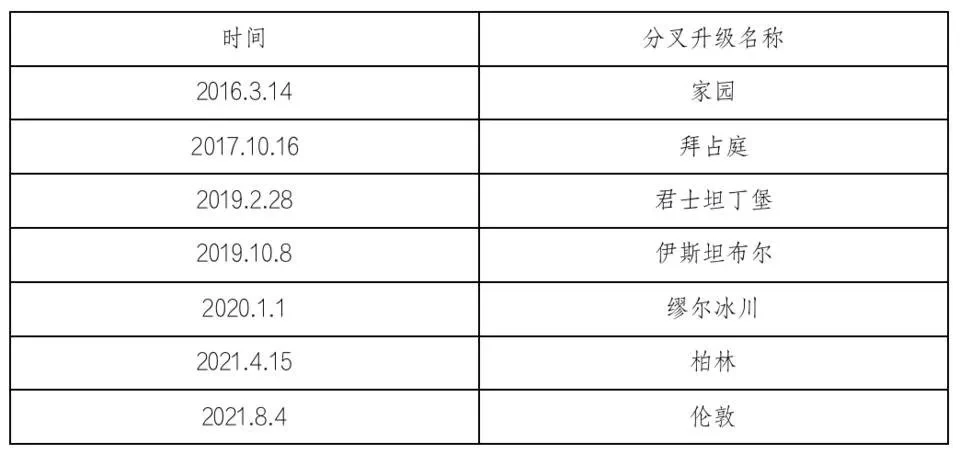
Ethereum's major fork upgrades in recent years, source: internet
With the full completion of the Constantinople upgrade this February, Ethereum has arrived at the doorstep of "Serenity" (also known as ETH2.0). If everything goes according to plan, after a series of hard forks and phased upgrades, we should soon be able to see a brand-new Ethereum. From a historical perspective, the London upgrade scheduled for early next month and the Shanghai upgrade following it恰好 fall at this critical historical moment.
The core philosophy of the current Ethereum upgrade is actually consistent with the theme of "lighter, faster, and more secure" from the Constantinople upgrade, as evidenced by the five improvement proposals adopted in the London upgrade, especially EIP-1559. Therefore, when discussing the potential impacts of this Ethereum London upgrade, EIP-1559 is an unavoidable focal point.
EIP-1559 was first proposed in April 2019 by core developers including Vitalik Buterin. It's essentially a solution regarding Ethereum network transaction pricing mechanisms. It includes a fixed base fee per block (i.e., the base fee) that will be burned, meaning miners won't receive this fee. It also features a dynamic elastic block size design to handle instantaneous network congestion. Once EIP-1559 is deployed, it will produce at least the following three impacts: First, for most ordinary traders, on-chain transaction fees and congestion times during peak periods will likely both decrease.
Second, for Ethereum miners, their ETH fee income from mining will likely decrease in the short term, but if calculated from a long-term perspective, there may be different findings regarding miners' overall returns. We know that current Ethereum miner revenue comes from three main sources: block rewards, transaction fees, and MEV (Miner Extractable Value). The subtlety lies in MEV. According to statistics, since January 2020, cumulative MEV has approached $800 million, a very substantial figure. Driven by profit, many arbitrageurs or liquidators closely monitor opportunities in the network. For example, after a large transaction causes price slippage, a $10,000 arbitrage opportunity appears on Uniswap. At this point, arbitrage bots will notice this opportunity and submit a transaction to capture it, immediately submitting an arbitrage transaction to miners with a $10 transaction fee. At this time, whether or not other arbitrage bots compete with it, miners can ultimately reap a significant return. Moreover, based on current trends, the proportion of base fees may become increasingly smaller, while the MEV component may have good room for growth, which could be considered a case of losing one thing but gaining another.
Finally, regarding the impact on the Ethereum network, improvements to the transaction fee mechanism may to some extent alleviate network congestion during peak transaction periods and improve transaction efficiency. The most direct effect is that after EIP-1559 is activated, the burned portion of base fees will cause a reduction in Ethereum's circulating supply. If the amount of burned ETH is sufficient to completely offset daily new issuance, it would be enough to shift Ethereum into a deflationary economic model. However, based on previous transaction activity, this would require very high on-chain transaction activity. Even if we take a step back, if the burned base fees can offset part of the newly issued ETH, it would also reduce the inflation rate to some extent. From an economic perspective, this is favorable for ETH's long-term price outlook. From an underlying logic perspective, Ethereum at that time would be very similar to Bitcoin.
How Is ETH2.0 Progressing?
In the previous section, we mentioned that Ethereum's development roadmap plans for a total of four stages. An important task in entering the fourth stage "Serenity" is the full launch of the ETH2.0 upgrade, which will bring the long-awaited PoS consensus, using the Casper consensus algorithm. All these updates will help Ethereum scale, increase Ethereum transaction speeds, and reduce transaction fees. Since the launch of ETH2.0 Phase 0 in December 2020, nearly 9 months have passed. So how is ETH2.0 progressing now?
First, let's look at the total amount of ETH staked in ETH2.0. According to rules published by the Ethereum community, to become an ETH2.0 validator, one must stake at least 32 ETH. Therefore, this data can be seen as a key indicator measuring the strength of ETH2.0 consensus.
According to OK Link statistics, the current total ETH2.0 staking has reached 6.4185 million ETH, accounting for 5.5% of ETH's total circulating supply (117 million). Based on the latest ETH price on the OKX platform, the total staking value exceeds $15 billion.
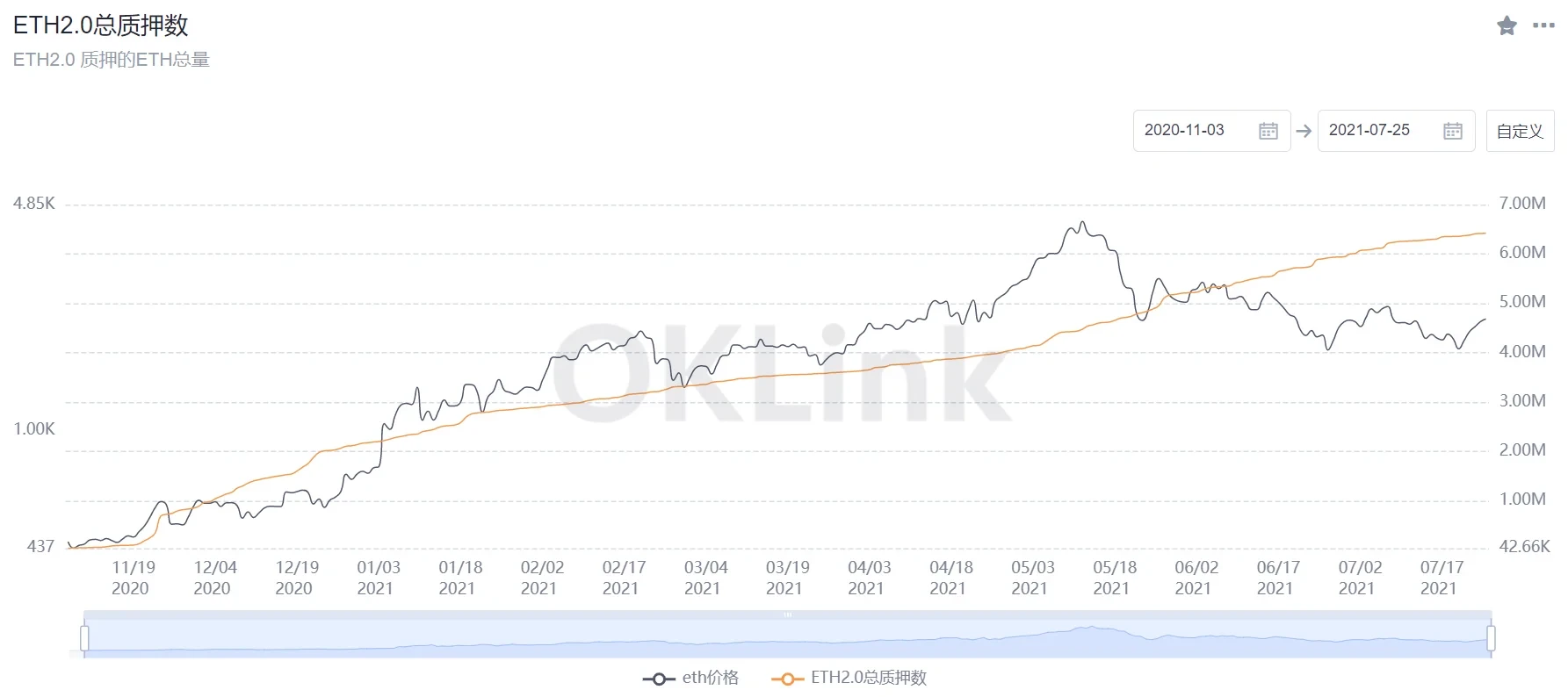
ETH2.0 total staking changes, source: OK Link
Additionally, looking at the change in total ETH2.0 validators, even during three consecutive months of unfavorable market conditions, the number of participants in ETH2.0 staking validation has continued to increase, even showing a slightly accelerated upward trend. According to OK Link statistics, as of Hong Kong time July 25, 2021, the number of Ethereum 2.0 validators has exceeded 200,000, reaching 200,201.
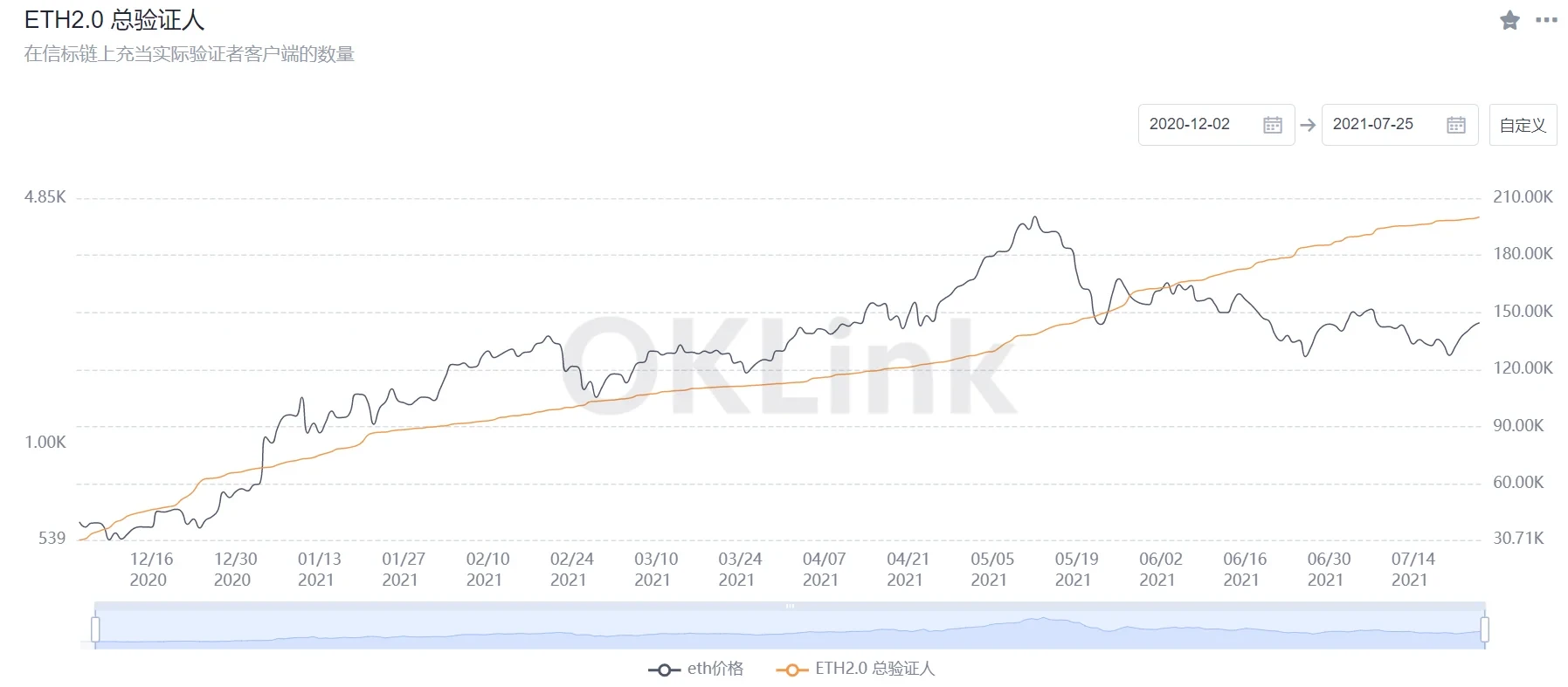
ETH2.0 total validator changes, source: OK Link
After reviewing the data, let's return to ETH2.0 development progress. According to estimates from core members of the Ethereum community, after the next Shanghai hard fork is implemented, the merger of Ethereum 1.X and the Beacon Chain is expected to be achieved. Meanwhile, another important proposal in this London upgrade—EIP-3554—delays the difficulty bomb so it can be implemented when the Beacon Chain's PoS consensus mechanism is fully ready, to encourage miners to abandon the PoW chain.
The key information of the EIP-3554 proposal is to delay the difficulty bomb until December 2021. In other words, if everything goes smoothly, we could see Ethereum transition from the PoW era to the PoS era as early as the end of this year. Of course, if unexpected events occur during this period, such as security issues or major community disagreements, this timeline will likely be delayed. In Ethereum's development history, "unexpected events" seem to have been more common than "on-time" occurrences. But jokes aside, expectations for Ethereum 2.0 won't be diminished because of this.
Disclaimer
This article may contain content related to products that are not available in your region. This article is intended to provide general information only and does not take responsibility for any factual errors or omissions contained herein. This article represents only the author's personal views and does not represent the views of OKX. This article is not intended to provide any of the following advice, including but not limited to: (i) investment advice or investment recommendations; (ii) offers or solicitations to buy, sell, or hold digital assets; or (iii) financial, accounting, legal, or tax advice. Holding digital assets (including stablecoins) involves high risk, may fluctuate significantly, and may even become worthless. You should carefully consider whether trading or holding digital assets is suitable for you based on your financial situation. For questions regarding your specific situation, please consult your legal/tax/investment professional. The information appearing in this article (including market data and statistics, if any) is for general reference only. Although we have taken all reasonable precautions in preparing these data and charts, we assume no responsibility for any factual errors or omissions expressed herein. © 2025 OKX. This article may be reproduced or distributed in full, or excerpts of 100 words or less from this article may be used, provided such use is non-commercial. Any reproduction or distribution of the entire article must also prominently state: "© 2025 OKX, used with permission." Permitted excerpts must cite the article name and include attribution, for example "Article Name, [Author Name (if applicable)], © 2025 OKX". Some content may be generated or assisted by artificial intelligence (AI) tools. Derivative works or other uses of this article are not permitted.
Show More
Recommended Reading
OKX Pay: Opening a New Era of Next-Generation Crypto Payments
The choice of tens of millions of users. Register on OKX and enjoy the ultimate trading experience and diverse wealth management products. A letter from OKX CEO Star: Today, we officially launch the first version of OKX Pay to over 100 million global users. As the industry's first payment application to truly achieve non-custodial and compliant integration, OKX Pay will be embedded in the OKX App, currently available in select markets, with full rollout expected within months
March 22, 2026

New Chapter: Building Next-Generation Financial Infrastructure Together
The partnership between OKX and Intercontinental Exchange (ICE) is an important moment for OKX and equally significant for the evolution of the entire digital assets market. ICE establishes and operates some of the world's most important financial infrastructure, including the New York Stock Exchange and global derivatives and clearing platforms. This strategic investment by ICE in OKX and joining our board reflects both parties' shared belief that digital assets technology will play a crucial role in financial markets
March 10, 2026
Tribute to Another Year of Forging Ahead
As OKX's CEO and a builder who stays true to our original mission, I proudly look back on the remarkable growth and progress OKX has achieved this year. Despite numerous challenges, 2024 was a year filled with focus, innovation, and resilience. We not only expanded and optimized our products but also made significant progress in launching transparent and compliant localized operations, while further strengthening our global management team. Notably, after experiencing
January 29, 2026

2025: Steady Progress Toward Financial Freedom Together
— Year-end letter from OKX Founder and CEO Star to global users. "Financial freedom" is often misunderstood. It doesn't mean no rules, but rather having the right to choose within the framework of rules—and when the system is truly tested, it remains reliable and effective. This has been our consistent focus throughout 2025. First, I want to extend my sincere gratitude to our global clients, partners, and regulatory authorities
January 16, 2026

OKX Officially Launches in Germany and Poland
Author: Erald Ghoos, CEO of OKX Europe. Today is significant for OKX—and for cryptocurrency users across Europe. We have officially launched our fully compliant centralized cryptocurrency trading platform in Germany and Poland! For us, this is not just a geographic expansion, but a commitment to building the cryptocurrency future the right way: secure, transparent, and meeting local needs. If you're in Germany
October 21, 2025
Partnership Expanded! OKX Partners with Standard Chartered to Expand into European Markets
On October 15, Erald Ghoos, CEO of OKX Europe, stated that OKX is expanding its strategic partnership with Standard Chartered to the European Economic Area (EEA). Earlier this year, OKX first partnered with Standard Chartered in the UAE to launch the collateral mirroring program—a
October 15, 2025