London Hard Fork Countdown Begins as MEV Reaches $766 Million in Extracted Value
As July arrives, the long-awaited London Hard Fork on the Ethereum network is approaching. This upgrade includes five improvement proposals: EIP-1559, EIP-3198, EIP-3529, EIP-3541, and EIP-3554. Once successfully upgraded, it is expected to bring significant changes to the fee market and token supply distribution on the Ethereum 1.0 chain.
Among the five improvement proposals, EIP-1559 has naturally generated the most discussion. From debate to live implementation, it has sparked considerable controversy. Several major mining pools and miners have publicly expressed opposition, while the market remains divided on whether EIP-1559 can truly solve the high gas fees and network congestion issues.
As of now, the testnets Ropsten, Goerli, and Rinkeby have all scheduled London upgrade plans. Ropsten and Goerli successfully deployed on June 24 and July 1 respectively, while Rinkeby is expected to execute the London upgrade on July 7 or July 8. Once all three testnets have successfully upgraded, the activation block height for the Ethereum mainnet upgrade will be determined.
In addition to the London Hard Fork advancing network upgrades and resolving on-chain congestion, developers are also pushing forward research on MEV (Miner Extractable Value). It is understood that MEV issues harm users and blockchain networks, causing network congestion and higher application costs, which could also hinder Ethereum's network effects and momentum. From early last year to the present, MEV has extracted $766 million. In response to this increasingly massive market, ETH Global hosted a virtual summit centered on the MEV theme on July 1.
Network Status and Upgrade Schedule Before London Upgrade
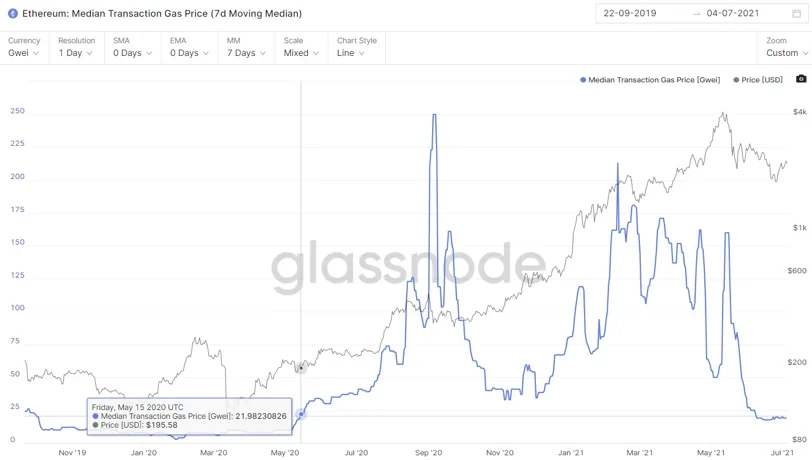
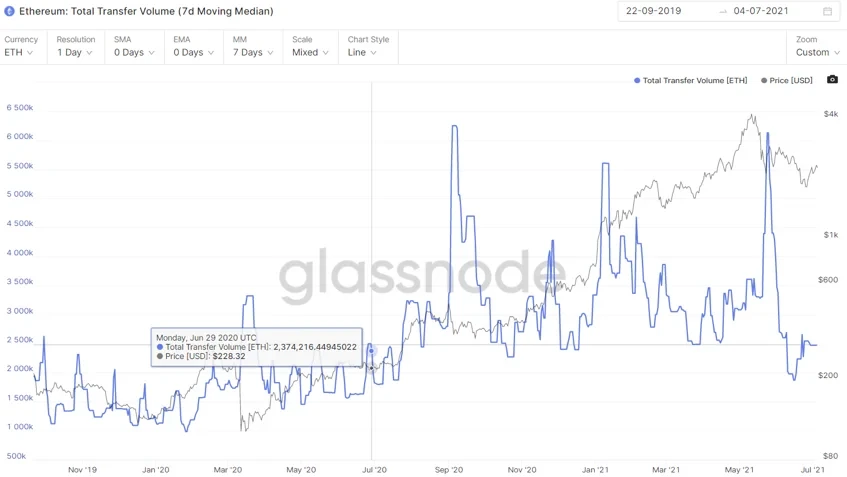
Before entering the London upgrade, it is necessary to understand the current state of the Ethereum network. According to Glassnode data, the total number of on-chain transactions on Ethereum has now retreated to levels seen in December 2020. The 7-day average of median gas prices has dropped to 19 Gwei, comparable to mid-May 2020, before the explosion of Ethereum's on-chain ecosystem. The 7-day average of total on-chain trading volume has also returned to levels similar to last July.
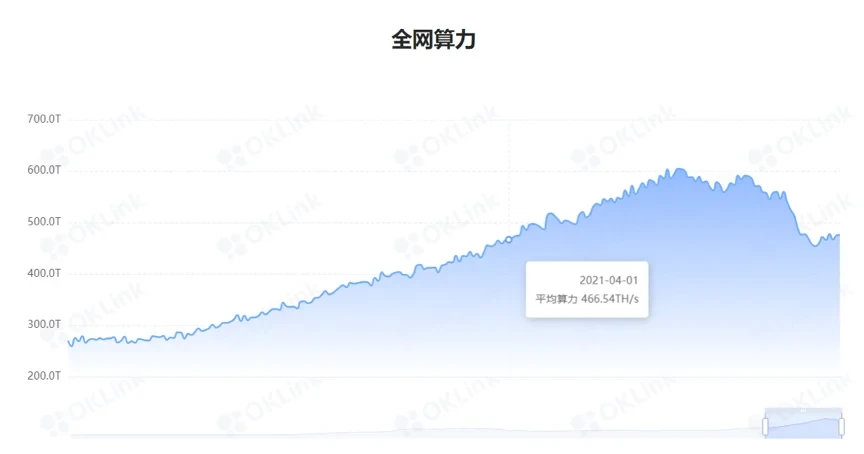
In terms of network hashrate, OK Link data shows it has dropped from a peak of 604.57 TH/s to 476.11 TH/s, representing a decline of 21%.
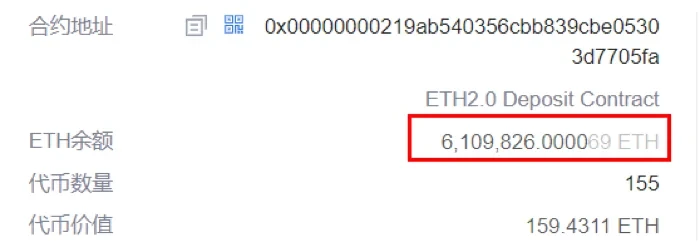
Regarding Ethereum 2.0 progress, OK Link shows that over 6.1 million Ethereum have been deposited into the Ethereum 2.0 deposit contract address. Given the current circulating supply of over 116 million Ethereum, over 5% of the total supply is locked. At the writing price of $2,267.22, this is worth approximately $13.83 billion.
On June 23, according to a call between developers, Ethereum 2.0 has finalized the specification for a complete transition to PoS (Proof of Stake), known as The Merge.
Regarding DeFi data related to Ethereum on-chain activity, affected by the recent market downturn, both the total value locked in DeFi and 24-hour DEX trading volume have declined to varying degrees.
As can be seen, before the London Hard Fork upgrade, various Ethereum network metrics have already declined significantly compared to the peak period in April and May. However, since we are currently in a consolidation phase, while metrics have retreated, the trend remains relatively stable.
Before the London upgrade officially launches, there will be a testnet upgrade schedule. Only after successful testnet upgrades will the block height for Ethereum mainnet activation of the London Hard Fork be announced. Ethereum developer Tim Beiko disclosed the plan in late April: Ropsten testnet deployment on June 16, followed by Goerli and Rinkeby executing the London upgrade on June 23, with the mainnet finally launching on July 14.
However, looking at current progress, the first two dates have both been delayed by 8 days. On June 24, Ropsten activated the London upgrade at block height 10,499,401. On July 1, the Goerli testnet successfully reached the London upgrade block height of 5,062,605. Next, Rinkeby will upgrade the London Hard Fork at block height 8,897,988, expected to be on July 7. It is reported that Kovan may upgrade after the mainnet.
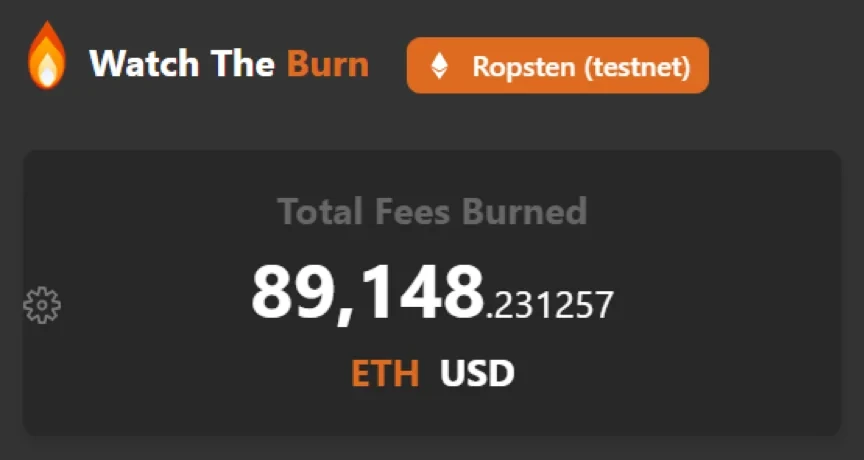
After successfully running for 11 days and 4 days respectively, the Ropsten testnet has destroyed 89,148 Ethereum, worth approximately $202 million, while Goerli destroyed 79 Ethereum, worth approximately $179,700. Although only test tokens on the testnets were destroyed, this burn rate has made many people see the tremendous significance of the London Hard Fork going live for Ethereum's supply. More network activity means more Ethereum consumption. Ethereum becomes scarce, thereby increasing the value of existing Ethereum.
Network upgrades mean changes to the underlying Ethereum protocol, creating new rules. Because it is a hard fork, the old rules will not accept legally created blocks under the new rules, deeming new-rule legal blocks as illegal. The new rules also will not accept blocks created under the old rules—the two are incompatible. If after the mainnet upgrade you continue using a client that does not support the London Hard Fork, nodes will not be able to operate on the new network or send transactions.
For specific information on the implementation of the five EIPs for the London Hard Fork, we introduced them in the article "Ethereum London Upgrade Confirmed to Deploy These 5 EIPs—Which One Do You Support?", which you can read for more details.
Understanding MEV: Ethereum's Dark Forest Accelerates Its Spread
On July 1, ETH Global hosted a virtual summit centered on the MEV theme. The summit explored four main topics: "The Evolution of MEV," "MEV Solutions," "Protocol-Level Responses to MEV," and "Application-Level Responses to MEV."
Let us first briefly introduce what MEV is. MEV (Miner Extractable Value), or "Miner Extractable Value" in translation, is a measure of the profit that miners obtain through their ability to arbitrarily include, exclude, or reorder transactions within the blocks they produce. This concept was first introduced by Phil Daian and others in the "Flash Boys 2.0" report published in 2019. It refers to the fact that since all on-chain Ethereum transactions first enter the Mempool and are then packaged into blocks by miners, miners prioritize packaging transactions with higher gas fees. The act of bidding up fees to have one's transactions processed first is called "PGA (Priority Gas Auction)."
Although we commonly use the term "Miner Extractable Value," with the explosion of DeFi in 2020, it is not just miners—most MEV activity is initiated by DeFi-focused traders and third-party arbitrage bots, extracting MEV through arbitrage strategies. Therefore, the more expansive term for this concept is "Maximum Extractable Value."
Previously, the use of Mempool packaging mechanism privileges was little-known but was a widespread unfair dark mechanism, hence the name "Dark Forest." After the rise of DeFi, the Ethereum network not only supports on-chain transfers and transactions but also expanded interactions with smart contracts such as mining, lending, AMMs, and derivatives. This increased the value that can be captured on-chain, and MEV-extracted value has been growing rapidly. Particularly since Flashbots launched the visual MEV product "MEV-Explore v0," MEV has been clearly presented before our eyes.
Flashbots is an R&D organization dedicated to reducing the negative externalities and existential risks that MEV poses to smart contract blockchains. They advocate for an ecosystem that remains permissionless, transparent, and fair for MEV value extraction.
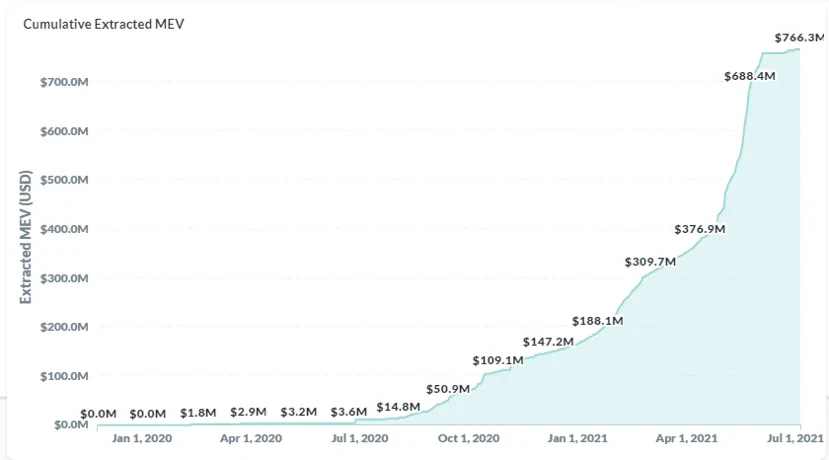
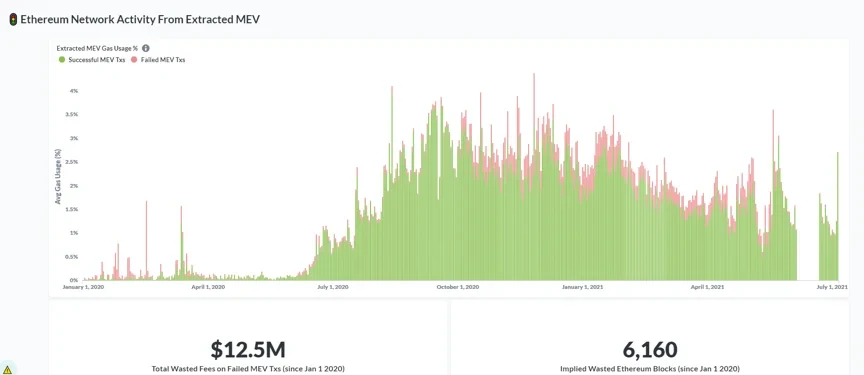
As can be seen from the chart below, from early 2020 to the present, MEV extracted value has reached $766 million, of which MEV on January 1, 2021 was $165 million. This means that in half a year, MEV increased by $601 million, a growth rate of 364%.
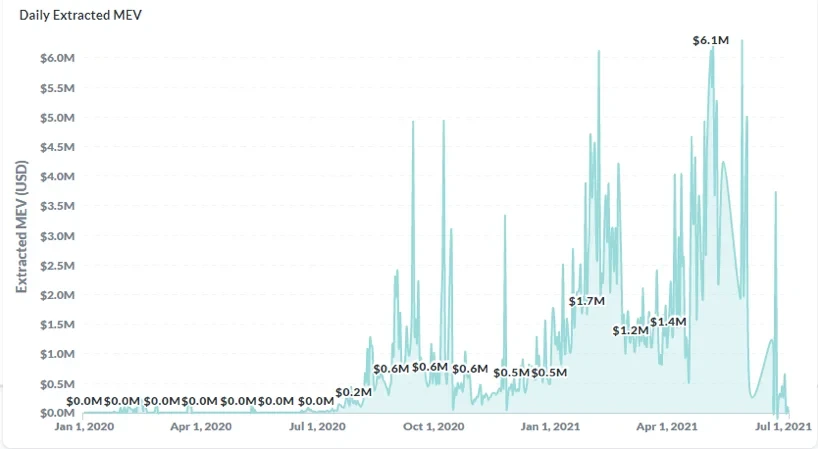
Among these, the highest single-day MEV even reached $61 million.
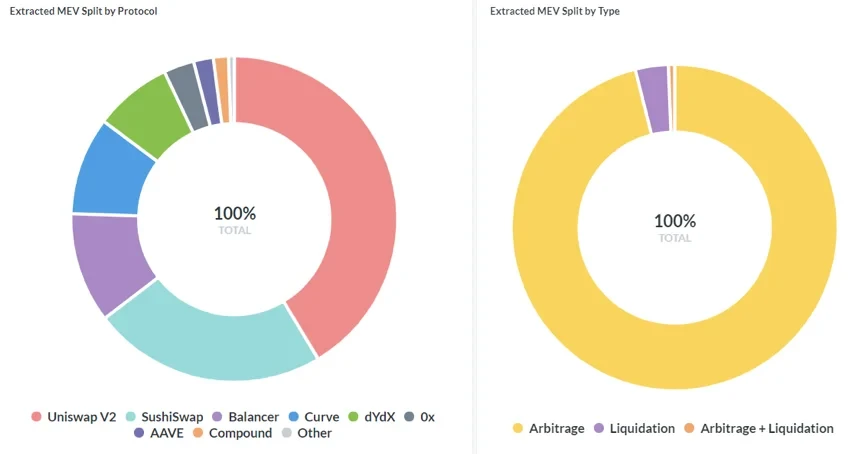
From the charts provided by MEV-Explore v0, it can be seen that currently, extracted MEV primarily occurs across eight DeFi protocols. These are also the DeFi projects with the most users and most concentrated trading on the Ethereum ecosystem: Uniswap (42%), SushiSwap (24%), Balancer (11%), Curve (9.7%), dYdX (7.6%), 0x (2.8%), AAVE (1.7%), and Compound (1.3%). Uniswap and SushiSwap combined account for 66%. Currently, the main type of MEV is arbitrage, accounting for as high as 97%, while liquidations account for 3%.
For example, after a large trade on Uniswap causes price slippage, a $10,000 arbitrage opportunity arises. At this point, DeFi traders or arbitrage bots will execute the arbitrage trade. If multiple parties notice this arbitrage opportunity, a Priority Gas Auction begins. If the eventual winner successfully secures the block inclusion opportunity with $6,000 in fees, then $6,000 is the MEV that the miner earns for packaging this transaction, and $4,000 is the MEV that the DeFi trader or arbitrage bot can extract. Of course, arbitrage occurs not only in large-trade scenarios—when premiums appear across different DEXs, traders also engage in arbitrage. As for liquidations, in DeFi collateralized lending protocols, when collateral assets reach the liquidation threshold, a liquidation process is triggered. Liquidators can obtain assets such as Ethereum at a certain discount, and this discount value is also MEV.
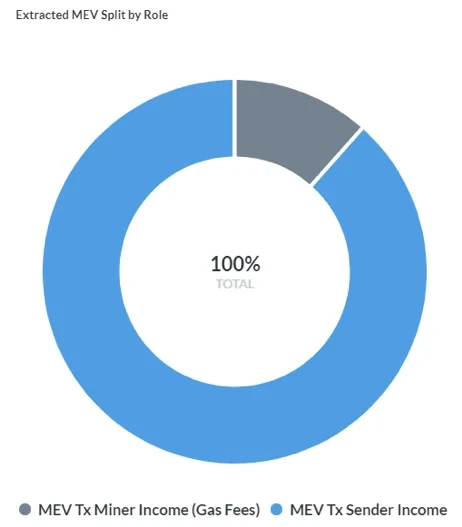
The extracted MEV primarily flows to two types of people: 89% of returns are taken by front-runners, while 11% flows to miners in the form of fees.
It is worth noting that front-running by raising gas fees to ensure priority transaction inclusion is not foolproof and can also fail. On the MEV-Explore v0 website, it can be seen that from January 1, 2020, failed front-run transactions consumed $12.5 million in fees, occurring across 6,160 blocks.
With the development of the Ethereum on-chain ecosystem, MEV will bring about unfair benefit distribution, bid-up gas fees, and network congestion—running counter to Ethereum's philosophy of openness, equality, and fairness. MEV inherently encourages consensus instability. Based on this, Flashbots plans to mitigate the impact of MEV through "Illuminating the Dark Forest," "Democratizing Value Extraction," and "Distributing Profits." To this end, Flashbots created visual MEV metrics for monitoring Ethereum blocks, as well as MEV-Geth, an upgraded version of the go-ethereum client in the value extraction democratization phase, to enable sealed-bid auction mechanisms for block space and transaction ordering. Flashbots continued to strengthen and advance its network in May and June. When publishing the "Flashbots Transparency Report—May & June 2021," it noted that mining pools accounting for over 84% of Ethereum's hashrate have adopted Flashbots.
With the arrival of the London Hard Fork, the Flashbots team has shifted focus to adding EIP-1559 support to MEV-Geth (an on-chain congestion node solution) and Flashbots Relay. Since EIP-1559 completely revolutionizes Ethereum's fee mechanism, it will have a significant impact on front-runners and miners. Front-runners will need to adjust their bots to use the new transaction format and pay a base fee for each transaction. This also means "zero-fee" transactions will no longer be possible—meaning collusion between front-runners and miners, or when miners see particularly profitable transactions, copying and front-running them. For miners, EIP-1559 will significantly affect their income, so EIP-1559 will further increase miners' desire to extract value from MEV.
Disclaimer
This article may contain product-related content not applicable to your region. This article is only intended to provide general information and makes no responsibility for any factual errors or omissions. This article represents the author's personal views only and does not represent the views of OKX. This article is not intended to provide any advice, including but not limited to: (i) investment advice or investment recommendations; (ii) offers or solicitations to buy, sell, or hold digital assets; or (iii) financial, accounting, legal, or tax advice. Holdings in digital assets (including stablecoins) involve a high degree of risk and may fluctuate significantly, or even become worthless. You should carefully consider whether trading or holding digital assets is suitable for you based on your financial situation. For questions about your specific circumstances, please consult your legal/tax/investment professionals. The information contained in this article (including market data and statistics, if any) is for general reference only. Although we have taken all reasonable precautions in preparing such data and charts, we assume no responsibility for any factual errors or omissions expressed herein. © 2025 OKX. This article may be reproduced or distributed in its entirety, or excerpts of 100 words or fewer may be used, provided that such use is non-commercial. Any reproduction or distribution of the full article must prominently state: "This article is copyrighted © 2025 OKX, used with permission." Permitted excerpts must cite the article title and include attribution, for example, "Article title, [author name (if applicable)], © 2025 OKX". Some content may have been generated or assisted by artificial intelligence (AI) tools. Derivative works and other uses of this article are not permitted.
Show More
Recommended Reading
OKX Pay: Ushering in a New Era of Next-Generation Crypto Payments
The preferred choice of tens of millions of users, register with OKX to enjoy an unparalleled trading experience and a diverse range of wealth management products. A letter from OKX CEO Star: Today, we officially launch the first version of OKX Pay for over 100 million global users. As the industry's first truly non-custodial and compliant payment application, OKX Pay will be embedded within the OKX App and is currently available in select markets, with full global rollout expected within months.
March 22, 2026

A New Chapter: Building the Next Generation of Financial Infrastructure Together
The partnership between OKX and the Intercontinental Exchange (ICE) marks a significant milestone for OKX and holds equally profound meaning for the evolution of the entire digital assets market. ICE establishes and operates the world's most critical financial infrastructure, including the New York Stock Exchange and global derivatives and clearing platforms. This investment by ICE Select in OKX and its joining of our Board of Directors reflects our shared conviction that digital assets technology will transform financial markets.
March 10, 2026
Celebrating Another Year of Resilience and Building
As CEO of OKX and a builder who stays true to his original vision, I am proud to look back on the extraordinary growth and progress OKX has achieved this year. Despite formidable challenges, 2024 was a year defined by focus, innovation, and resilience. We not only expanded and optimized our products but also made significant strides in launching transparent and regulation-compliant localized businesses, while further strengthening our global management team. It is worth noting that after going through.
January 29, 2026

2025: Steady Progress Toward Financial Freedom
— A Year-End Letter to Global Users from Star, Founder and CEO of OKX "Financial freedom" is often misunderstood. It does not mean the absence of rules, but rather having the freedom to choose—even when rules exist—and having systems that remain reliable and effective when truly put to the test. This is precisely what we remained focused on throughout 2025. First and foremost, I want to express my sincere gratitude to our global customers, partners, and regulators.
January 16, 2026

OKX Officially Launches in Germany and Poland
By Erald Ghoos, CEO of OKX Europe Today is significant for OKX—and for crypto users across Europe. We have officially launched a fully compliant centralized cryptocurrency trading platform in Germany and Poland! For us, this is more than just geographic expansion; it is a commitment to building the future of cryptocurrency the right way: secure, transparent, and tailored to local needs. If you are in Germany.
October 21, 2025
Partnership Upgrade! OKX Joins Forces with Standard Chartered to Expand into Europe
On October 15, Erald Ghoos, CEO of OKX Europe, stated that OKX is expanding its strategic partnership with Standard Chartered to the European Economic Area (EEA). Earlier this year, OKX first partnered with Standard Chartered in the UAE to launch the collateral mirroring program—a.
October 15, 2025