NFT Market Shines in Q1: Can It Experience a Second Breakthrough in June?
FLOW+0. 06%
According to the "NFT Industry Development Report 2021 Q1" jointly released by Cabin VC, Flow, and The Sandbox, the NFT market achieved a trading volume of $2 billion in Q1, exceeding the total 2020 trading volume by 8 times. Compared to the previous quarter alone, the quarter-on-quarter growth rate reached as high as 1,900%. Additionally, the trading sector showed significant polarization. According to the report, in Q1 trading, collectibles and art NFTs accounted for over 40% of total trading volume each, while gaming, metaverse, sports, and music NFTs accounted for less than 20% of total volume.
Beyond this, there are several other data points in the report worth our attention, such as actual trading participants and active wallet addresses.
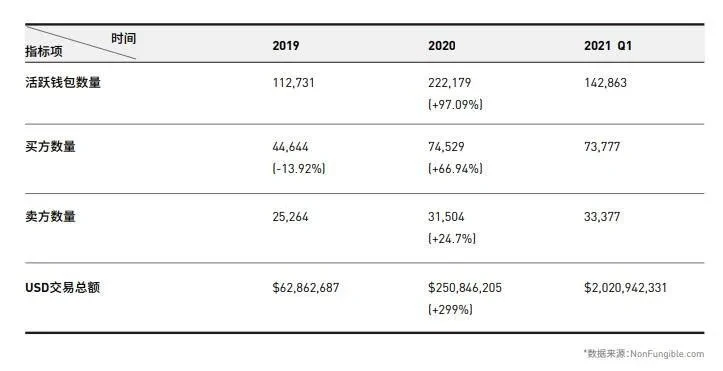
Regarding actual trading participants in the NFT market, Q1 saw buyer numbers more than double that of sellers, with 73,000 buyers and 33,000 sellers, showing explosive growth in people's interest in and purchasing of NFTs. This supply-demand asymmetry also indicates that newcomers have strong interest in NFTs. However, more existing investors are adopting a wait-and-see attitude, hoping to continue holding their assets, which has created market scarcity.
Theoretically, the higher the number of active wallets, the more active users there are. Typically, one person may hold more than one active wallet, so wallet usage repetition rates must be considered when incorporating relevant metrics. Both buyer and seller counts are positively correlated with active user counts — the more buyers and sellers, the larger the user base. In Q1, the number of active wallets approached 150,000, representing a growth of over 150% compared to one year prior. On the pricing front, recently, NFT prices have pulled back from their February highs, but the report indicates that the average NFT price still "rose significantly" in Q1. In Q4 of last year, the average sale price for an artwork on Super Rare was $1,231, which rose to $6,585 on the secondary market in Q1.
Regarding NFT price fluctuations over recent months, we have been continuously monitoring the situation. In our article published earlier last month, "NFT Momentum Declines as It Enters Correction Phase, Possibly Building Momentum for a New Outbreak," we focused on the rapid development of NFTs in art and sports, as well as explorations into NFT financialization. In the following sections of this article, we will continue to examine the opportunities and challenges for NFTs in June through the lens of NFT financialization.
Based on NFT weekly trading volume data from The Block, it is clear that after the "brief glory" of Q1, particularly the concentrated outbreak in February, the NFT market's momentum rapidly declined after entering April, with trading volume dropping significantly. Of course, this was influenced by both the overall weakening of the crypto market and capital outflows from the NFT sector itself. The combined effect of these dual factors led the NFT market into a correction period.
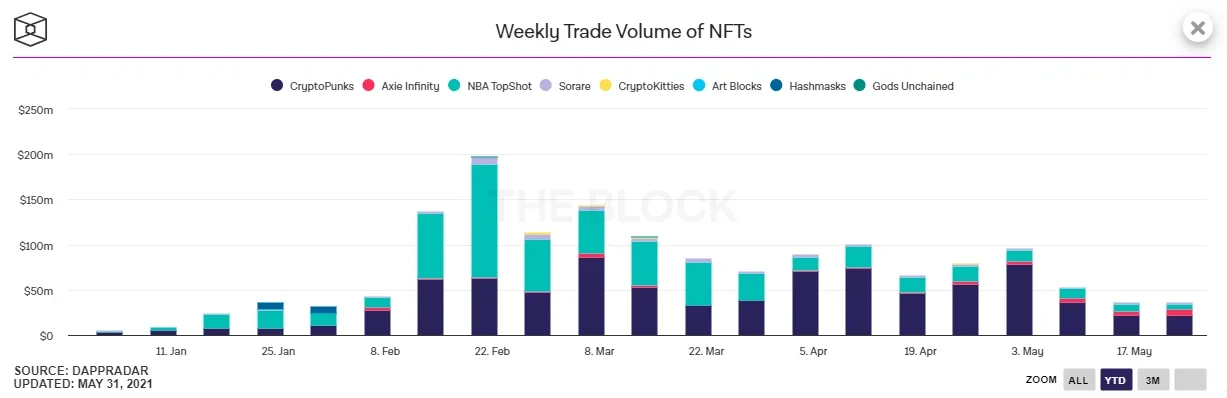
NFT market weekly trading volume from January to May 2021, Source: The Block
However, viewed dialectically, for the entire NFT market, the current correction period may not be a bad thing. When the hype subsides and the bubble bursts, it is often an excellent window to discover problems and explore solutions, much like DeFi, which experienced a boom in summer 2020, then cooled in Q3, only to surge again. Of course, today's NFTs cannot be compared to DeFi in its early days in terms of business models and development stages, but what is undeniable is that solutions with real practical value will eventually gain market recognition after passing the test of time.
Specifically, at the current stage, NFTs, leveraging the global influence of multiple channels such as the NBA, MLB, and traditional auction houses, have already made significant progress on the path of "breaking through circles" in 2021. For example, in mid-May, e-commerce giant eBay stated it would allow the sale of trading cards, images, or video clips as digital collectible NFTs on its platform. On May 19th, crypto artist Sean Williams posted on Twitter that Instagram might be launching an NFT platform, currently communicating with artists to sign relevant agreements. Taobao's Ali Auction's 520 Festival also launched an NFT digital art special session, auctioning off multiple digital artworks including artist Wan Wenguang's "U107-Waste-Free Planet Series-Van Gogh of the Cabinet Dwellers." NFT's influence is continuously expanding — it seems like everything can become an NFT. So, what comes after "breaking through circles"?
NFTs have long been criticized for poor liquidity. Even after the major development of the NFT market in Q1 2021, resulting in considerable market growth and significant changes in asset category structure — where tickets, coupons, artworks, fund shares, and other real-world assets can all utilize NFT technology for digitalization through functions such as embedded rights, verifiability — it must be said that the current diversity of NFT asset categories is still insufficient to boost overall market liquidity. Limited liquidity remains one of the challenges facing the current NFT ecosystem.
Clearly, after "breaking through circles," an urgent issue NFTs need to address is enhancing liquidity, and accelerating financialization exploration is a direction worth serious consideration. For example, through the integration of NFTs and DeFi, the NFT market can be pushed deeper into the crypto world, while also building a smoother bridge between the real world and the crypto world.
In fact, DeFi has already begun empowering the NFT sector. Taking the DEX leader Uniswap as an example, its latest V3 version introduced many innovations, such as concentrated liquidity, multiple fee tiers, and range orders. All these new features can be implemented using NFTs, which represents a massive breakthrough and innovation for expanding NFT application boundaries. NFTs are gradually entering the real world, with many things beginning to tokenize as NFTs. Once DeFi and NFTs are connected, it will undoubtedly strengthen NFTs' role as a bridge linking the real world with the crypto world.
Bringing the topic back to liquidity enhancement, the technical essence of NFTs is a set of technical standards for digitizing assets. By bringing physical assets such as artworks and collectibles on-chain, they can solve financing difficulties arising from low circulation efficiency of such assets. Digitized real-world assets or virtual assets will further improve the underlying asset structure of the DeFi ecosystem. Combined with the DeFi liquidity mining model, this can address part of the liquidity issues in the NFT asset trading market.
In addition, a group of NFT entrepreneurs has provided new solutions, such as NFT asset fragmentation platforms. NFT asset fragmentation platforms can convert ERC721 or ERC1155 into tradable fungible ERC20 tokens. This innovation may bring greater liquidity improvement possibilities to NFTs and other collectibles.
High-value NFT asset fragmentation began with the Metapurse fund, who were the buyers of Beeple's Everydays 5000 (an NFT worth $69.3 million). The Metapurse fund fragmented the work, creating the B20 token, which was released in two phases. However, looking at the price trend, it has also been affected by the overall NFT market, continuing to decline since March.
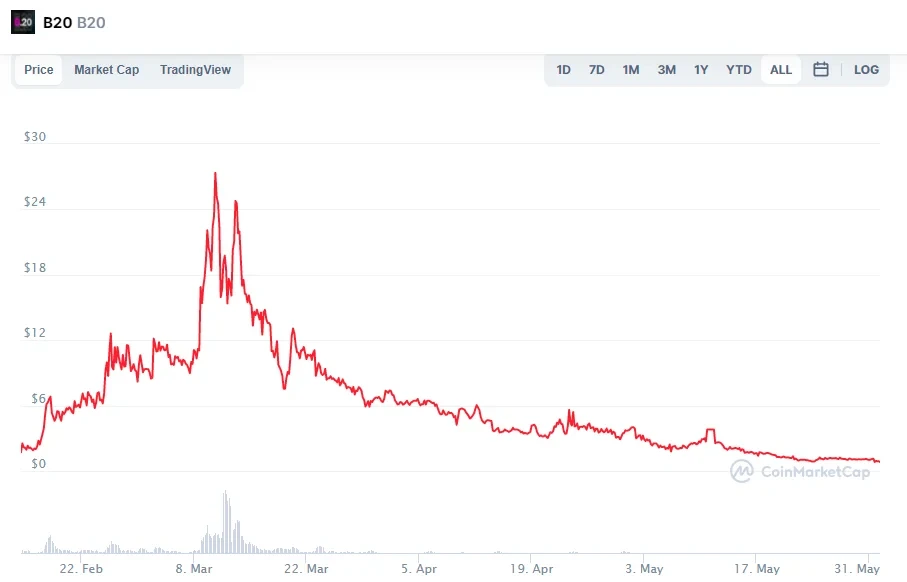
B20 asset price trend, Source: CMC
Although we cannot predict how long the NFT market's correction period will last, one thing we can be certain of at present is that, as a ownership protocol for tradable financial assets, the numerous innovative mechanisms derived from NFTs — whether NFT fragmentation or liquidity mining combined with DeFi — will make NFTs into more useful financial assets in the future. This has already been initially validated by the market. Therefore, we should also exercise more patience and give NFT entrepreneurs more time to propose better solutions. As for when the moment of exponential growth for NFTs as financial assets will arrive, that seems to have become less important.
Disclaimer
This article may contain product-related content not applicable to your region. This article is only intended to provide general information and does not accept responsibility for any factual errors or omissions. This article represents only the author's personal views and does not represent OKX's views. This article is not intended to provide any advice, including but not limited to: (i) investment advice or investment recommendations; (ii) offers or solicitations to buy, sell, or hold digital assets; or (iii) financial, accounting, legal, or tax advice. Holding digital assets (including stablecoins) involves high risk and may experience significant volatility or even become worthless. You should carefully consider whether trading or holding digital assets is suitable for you based on your financial situation. For questions about your specific circumstances, please consult your legal/tax/investment professional. The information in this article (including market data and statistics, where applicable) is for general reference purposes only. Although we have taken all reasonable precautions in preparing this data and these charts, we do not accept any responsibility for any factual errors or omissions expressed herein. © 2025 OKX. This article may be reproduced or distributed in its entirety, or excerpts of 100 words or less may be used, provided that such use is non-commercial. Any reproduction or distribution of the full article must prominently state: "This article is copyrighted © 2025 OKX, used with permission." Permitted excerpts must cite the article title and include attribution, for example, "Article title, [author name (if applicable)], © 2025 OKX." Some content may have been generated or assisted by artificial intelligence (AI) tools. Derivative works and other uses of this article are not permitted.
Show More
Recommended Reading
OKX Pay: Ushering in a New Era of Next-Gen Crypto Payments
The choice of tens of millions of users. Register with OKX to enjoy an exceptional trading experience and diverse wealth management products. A letter from OKX CEO Star: Today, we officially launched the first version of OKX Pay for over 100 million global users. As the industry's first payment application to truly achieve a fusion of non-custodial and compliant solutions, OKX Pay will be embedded within the OKX App, currently available in select markets, with a full global rollout expected within
March 22, 2026

A New Chapter: Building the Next Generation of Financial Infrastructure Together
The partnership between OKX and the Intercontinental Exchange (ICE) marks a significant moment for OKX and holds profound meaning for the evolution of the entire digital assets market. ICE builds and operates the world's most critical financial infrastructure, including the New York Stock Exchange and global derivatives and clearing platforms. This investment by ICE Select in OKX and joining our board reflects our shared belief that digital assets technology will transform financial markets.
March 10, 2026
Reflecting on Another Year of Dedication and Progress
As OKX's CEO and a builder who stays true to the original mission, I take great pride in looking back on the remarkable growth and progress OKX has achieved this year. Despite formidable challenges, 2024 was a year of focus, innovation, and resilience. We not only expanded and optimized our products, but also made significant strides in launching transparent and regulation-compliant localized businesses, while further strengthening our global management team. It is worth noting that after going through
January 29, 2026

2025: Steady Progress Toward Financial Freedom
— A Year-End Letter to Global Users from Star, Founder and CEO of OKX "Financial freedom" is often misunderstood. It does not mean the absence of rules, but rather having the right to choose even when rules exist — and, when the system is truly tested, it remains reliable and effective. This is precisely what we focused on throughout 2025. First and foremost, I would like to extend my sincere gratitude to our global customers, partners, and regulators.
January 16, 2026
OKX Officially Launches in Germany and Poland
By Erald Ghoos, CEO of OKX Europe Today is a significant day for OKX — and for crypto users across Europe. We have officially launched a fully compliant centralized cryptocurrency exchange in Germany and Poland! For us, this is not just a geographic expansion, but a commitment to building the future of cryptocurrency the right way: secure, transparent, and tailored to local needs. If you are in Germany
October 21, 2025
Partnership Upgrade! OKX Joins Forces with Standard Chartered to Expand into Europe
On October 15th, Erald Ghoos, CEO of OKX Europe, stated that OKX is expanding its strategic partnership with Standard Chartered into the European Economic Area (EEA). Earlier this year, OKX first partnered with Standard Chartered in the UAE to launch a collateral mirroring program — an initiative that
October 15, 2025