OKX Research | Account Abstraction's 10-Year Evolution: The Final Battle, Exploring the Past and Future Through EIP-7702
OKX Research Report is here! The first issue focuses on the hottest topic in the community recently — EIP-7702. We've prepared an in-depth analysis of nearly 10,000 characters to help you understand its origins and developments: Why it's being called the "ultimate form" of Account Abstraction? What problems does it actually solve? What does the Pectra upgrade mean for wallets, developers, and ordinary users?
Author: shisilu
Pectra is the first major upgrade after Ethereum Dencun, encompassing the Prague execution layer hard fork and Electra consensus layer update, integrating the most EIPs in history — 11 in total, significantly improving validator flexibility, network scalability, and execution efficiency. As the Ethereum mainnet Pectra hard fork is expected to officially activate on May 7, 2025, the "ultimate form" of Account Abstraction — EIP-7702, has officially entered the public eye!
If any EVM-based Web3 wallet does not support EIP-7702, **then there is no doubt that it means giving up the entire Ethereum ecosystem and users.** This is the determination of Vitalik and the EF, and it is also the prologue to the Pandora's Box about to be opened! Currently, to support the Ethereum ecosystem, OKX Wallet has taken the lead in supporting Ethereum's latest Account Abstraction standard EIP-7702, and has opened an official portal for users willing to try it out. You can upgrade through 【OKX Wallet homepage feature area - More - 7702 upgrade】 to experience safe and professional EIP-7702. A kind reminder: You can choose whether to upgrade and experience it based on your needs; not upgrading will not affect the normal use of existing ecosystems and applications. To ensure asset safety, be sure to operate through official channels, beware of phishing links and malicious websites, and avoid assets suffering losses.
Please follow this article to comprehensively understand the evolutionary history of Account Abstraction, the user value and market changes brought by EIP-7702, as well as the dangers lurking within.
Overview
-
The code involved in this article is located at okx/js-wallet-sdk, the EIP-7702 SDK implementation used by OKX Wallet is fully open source to community partners.
-
EIP-7702 introduces a new transaction type, allowing ordinary EOA to set a certain contract address as its logic proxy contract.
-
Due to "cost advantages" and "flexibility," EIP-7702 will fully inherit and surpass the ecosystem built by ERC-4337 over the years.
-
EIP-7702 also carries hidden risks for ordinary users — even if users do not upgrade, it may cause transaction failures or security asset losses in specific scenarios.
-
EIP-7702 will bring a brand new user experience. When the user subject undergoes contract-based migration, market applications will also evolve accordingly. Gas abstraction, hierarchical family accounts, and other long-awaited seamless experiences will lead one billion people to enter the Web3 world at low cost.
-
For exchanges, DApps, and other applications, adopting EIP-7702 features will bring cost reductions of over 50%, leading to a full embrace of the contract account era.
Why Does Account Need Abstraction?
It is hard to imagine that the vision of account abstraction actually predates Ethereum itself.
At this year's HK Web3 Festival, Vitalik repeatedly emphasized that through a series of solutions such as multi-signature (Multi-sig), Account Abstraction, and ZK Email, Ethereum has now completed 50% of the "iPhone moment" goal.
Is it fast or slow? Is it optimistic or limited? Let us delve into the underlying layers and see why AA has such an impact! After all, after a 10-year long journey, Vitalik has finally ushered in the endgame he has longed for in the AA field, adding a bold and significant stroke to the Ethereum roadmap he mapped out in 2023.

What Exactly Is Account Abstraction For?
In fact, the essence solves the problem of separation of ownership, because currently the EOA (Externally Owned Account) ownership and signing authority are actually held by the same entity (both rely on private keys to control any instructions), which stems from Ethereum's transaction structure — in fact, Ethereum's standard transactions do not have a From field; during execution, the From address is reverse-parsed through its VRS parameters (i.e., user signature).
Moreover, as Ethereum is designed as a "world-class state machine," it completely relies on transactions to implement on-chain state changes. Combined with the inability to specify a From field, this couples transaction execution authority with the highest ownership.
This is the root of a series of usability problems with EOA despite its simplicity:
-
Private keys are difficult to protect: Users losing their private keys (loss, hacker attacks, quantum cracking) means losing all assets.
-
Few signature algorithms: Different signature algorithms bring different performance costs, as well as on-chain storage costs.
-
High signing permissions: EOA's native private keys have all these rights.
-
High gas fees for complex transactions: Gas fees can only be paid through ETH, arbitrary token transfers, etc., cannot sponsor gas for other users.
, even a single operation requires a base fee of at least 21,000.
Trading has no privacy. Even though there was a confidential ERC-20 proposal from Circle, it never became mainstream.
In the final analysis, the current blockchain world is overly complex for users entering and exiting it. Users need to understand concepts like Gas price, Gas limit, and transaction ordering (Nonce sequence). Hiding complex information from regular users is the core problem that EIP-7702 aims to solve.
What are the core differences between ERC-4337 and EIP-7702?
Around the goal of AA, there are actually more than ten different proposals, which the author has previously explored. After a comprehensive review, there are essentially two approaches:
Route 1: Let EOA addresses drive CA addresses
ERC-4337 is a typical example of this approach. In one sentence: it introduces a new transaction object called User Operation, where users send this object to the mempool, and bundlers batch-package instructions and execute Trading transactions individually through delivery contracts. Essentially, it brings the underlying Trading and Account operations to the contract layer for execution.
The execution principle is illustrated below:
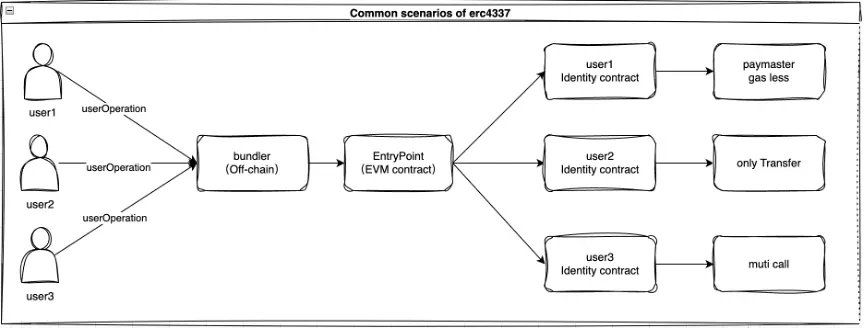
Through the bundler role, this solution can address batch Trading, gas-free transactions, fewer signature algorithms, and more. However, what it cannot solve are complexity, user Trading costs, and the single point of failure risk of bundlers and Entry Point.
Because once users migrate to ERC-4337, even if a user like user2 in the diagram just wants to make a single Transfer transaction, their Trading fees will double compared to using an EOA.
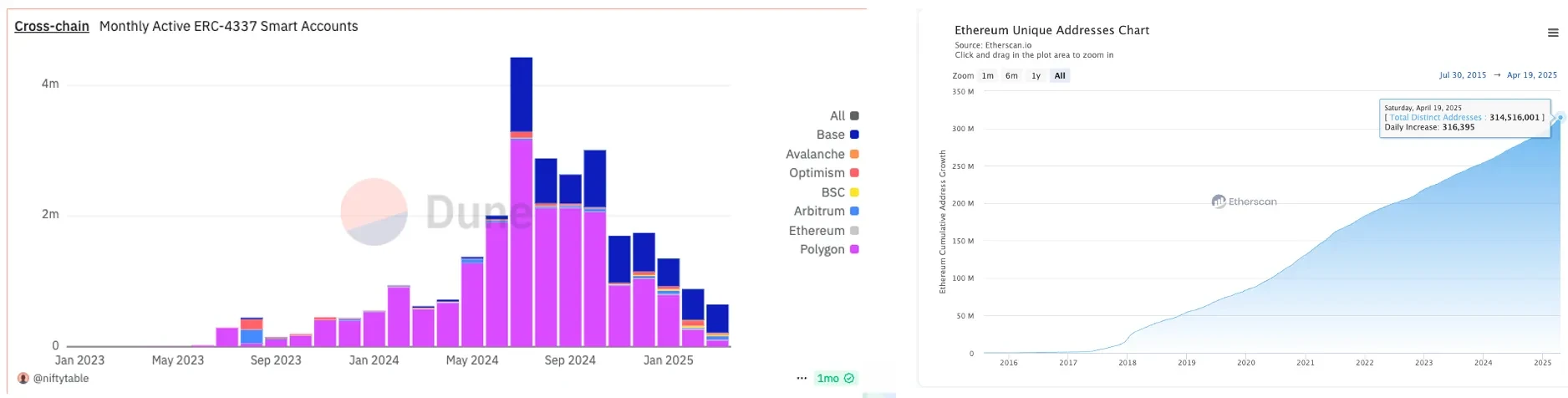
Looking at the latest user data for CAs and EOAs, even if some users are advanced players heavily relying on on-chain CA-based operations and batch calls, why not just use a regular CA in the first place?
Thanks to the bundler design, it avoids hard fork-level upgrades and can be launched at the application layer. However, ERC-4337 also brings doubled cost expenses, single point of failure risk, and users lose the inherent flexibility of EOAs. So, faced with diverse user needs, the current market clearly hasn't embraced the ERC-4337 solution enthusiastically. Over its two years of development, the overall trend has been declining significantly. Even at its peak, the user count was still far from Ethereum's 300 million unique addresses.
Of course, we are not criticizing ERC-4337's shortcomings. Rather, alongside its development, the Paymaster, Gas abstraction, and other roles and concepts built upon it are actually being applied once again in EIP-7702.
The author believes that no industry develops overnight. What matters is being able to discover patterns and draw lessons from the rise and fall of the past.
Route 2: Turn EOA addresses into CA addresses
As early as November 2015, Vitalik proposed EIP-101, using contracts as the new structure for Accounts. This changes addresses to have only code and storage, replacing fee payment with ERC20 Payment, and using precompiled contracts to convert native tokens into quasi-ERC20 tokens to store balances (which can have features like deduction authorization). In January 2018, there was the EIP-859 proposal, whose core function was to deploy a contract wallet if the transaction sender's contract had not been deployed — using the code parameter attached to the transaction to execute the deployment. Ultimately, EIP-7702 was further deduced from the EIP-3074 approach and has been included in the Ethereum mainnet!
The concept and effect of EIP-7702 are actually quite simple. It completes initialization through a new transaction type, allowing EOAs to temporarily and optionally gain smart contract functionality within a single transaction, thereby enabling batch Trading, gasless Trading, and custom permission management at the business level. The most critical capability is giving users temporary and optional flexibility.
Additionally, multiple people can share the same logic contract, significantly reducing the cost of user migration. To complete EIP-7702 setup, users only need 80,000 Gas, approximately 0.06 USD. To set a new contract or remove the logic contract setup, only 40,000 Gas is needed.
After completing the setup, users will see significant Gas optimization during batch Trading. See the table below:
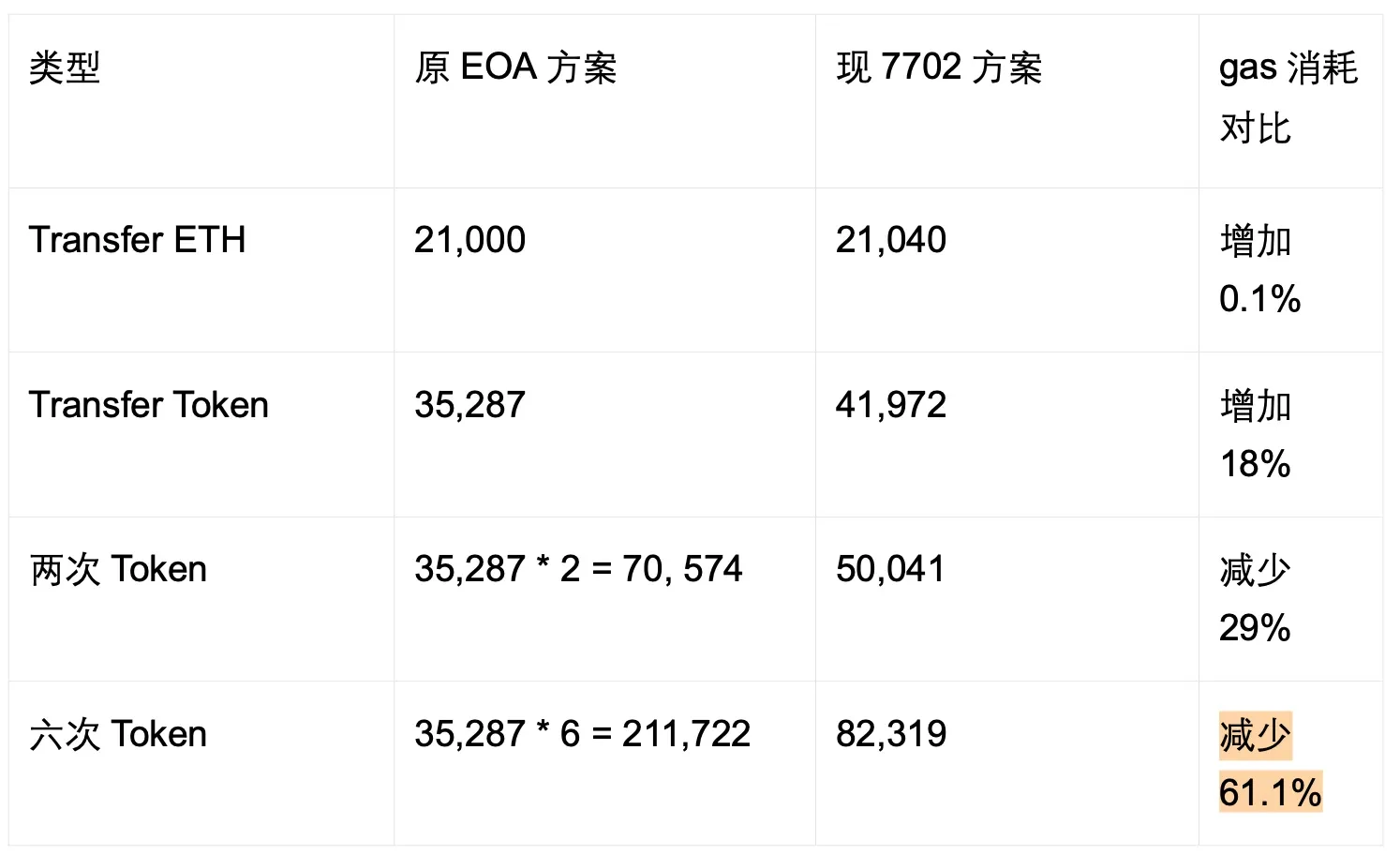
Of course, you might wonder, is it really necessary to do two or even six Token Transfers?
Since regular users are already accustomed to doing one thing per transaction, this may seem like a niche scenario. However, in diverse application scenarios like Web3 Games and Web3 Pay, such cases actually occur quite frequently. For example, spending with both copper coins (in-game currency) and silver coins (user-deposited currency) at the same time. Or participating in an event that consumes both an NFT ticket and an entry fee.
Even if we don't imagine overly complex scenarios, returning to the most mainstream on-chain Swap demand, the same applies.
approve and Transfer in batches. Moreover, nowadays users can make a simple tool to quickly help them delete their useless approve authorizations. The effect is easy to compare — obviously, costs can be directly reduced by about 40%.

Core Principles of EIP-7702
To explore why it has such effects, we need to return to its principles. Actually, its core consists of two logics, divided into user setup phase and daily usage phase
Setup Logic Contract Phase
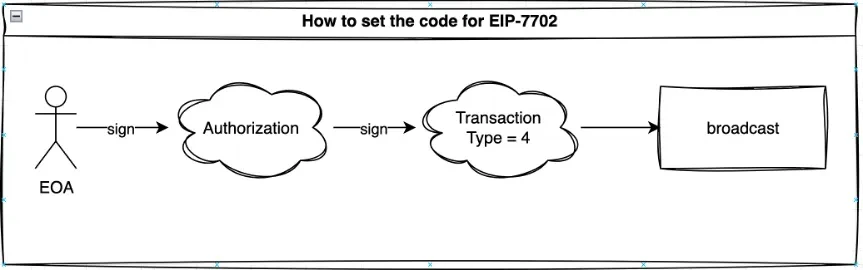
Core process is as follows:
-
Step 1: Signature authorization, through the original EOA's private key, sign a special hash string. The content is constructed by encoding chain_id, address, and nonce. Here, Address is the logic contract address to be set, while Nonce is the strategy to ensure transactions are not replayed.
-
Step 2: Signature transaction, with the authorization information from Step 1, anyone can then construct a type 4 transaction, which can include multiple authorization pieces, setting up authorizations for multiple addresses at once.
-
Step 3: Broadcast to chain, when the transaction completes processing the internal Authorization, the logic contract is already in effect.
There are more technical details here, you can refer to: OKX open-source JS SDK implementation, to see the underlying data encoding process. Of course, this solution also has some hidden security risks and complexities, which we will describe in detail below.
Execute Logic Contract Phase
When you complete the setup, then when any transaction's To address points to you, it will be just like calling a smart contract. The system will "load" your pre-set logic contract code into your current EOA state to execute its logic.
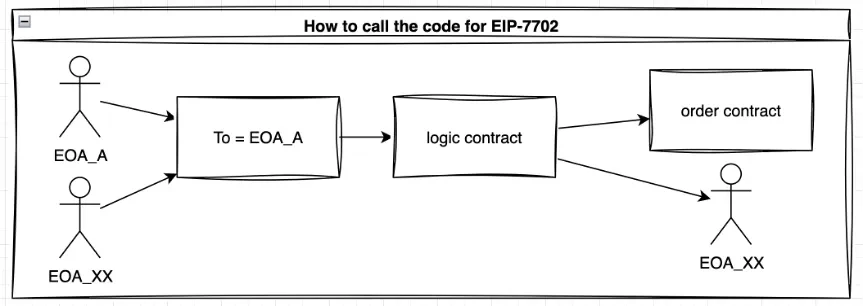
Likewise, let's look at 2 scenarios:
First, you call yourself
If you set up something like the OKX 7702 Smart Contract with high security and custom control capabilities, then you can specify through pre-written calldata to complete multiple instructions in one operation. For example, you can simultaneously complete Approve+Transfer, or simultaneously complete Approve+Swap.
Don't underestimate this — among the current total of 2.7 billion Ethereum transactions, Approve accounts for about 75 million. Calculating at 80,000 Gas per transaction, that's 460,000 ETH consumed. At an ETH market price of $1,700, that's nearly $800 million.
Second, others call you
Previously, Ethereum didn't have the scenario of others calling an EOA address. But now you are a versatile contract, fully customizable. You can create sub-accounts with separate permissions, or whitelist a few Paymasters to allow designated DApp accounts to initiate transactions on your behalf, completely eliminating the dilemma of repeatedly requiring signature popups in traditional blockchain applications.
What powerful capabilities! This is why almost all mainstream wallets — OKX Wallet, Metamask, Wallet Connect, Biconomy, Base Wallet, Rhinestone, Zero Dev, Trust Wallet, Safe, and related teams — are rapidly responding with support.
Is EIP-7702 the Final Form of Account Abstraction?
Yes, because this time users will choose it!
It's not that EOA isn't good enough. Objectively speaking, EOA is simple, clear, simple, and safe. **But in this Prague upgrade, after introducing EIP-7702, EOA will be even better.** Because of cost, because of experience. When Jobs pulled the iPhone out of his jeans pocket, that was an experience users hadn't initially imagined could be like this.
Account abstraction is actually an area that many chains are exploring and actively trying. For example:
-
Starknet, as a ZK-Rollup (Layer 2), has contract accounts by default, with no EOA.
-
zkSync Era, using AA accounts is the default method, and without the complexity of Bundlers.
-
Nervos CKB, similar to UTXO model, but it also allows all Acc
-
Aptos / Sui, as pivotal players in the Move-based Layer1 ecosystem, though not EVM-style AA, also possess Account customization capabilities, supporting modular signature permissions, multi-signature verification, and more.
-
For EVM-based chains such as Linea / Base / Mantle / Polygon / Arbitrum / Optimism and their respective ecosystems, they not only already support ERC4337 Complete AA, but will also nearly all follow up with EIP-7702 upgrades, similar to the Ethereum mainnet.
Infrastructure in the wallet and AA-related space is making even more comprehensive preparations for EIP-7702.
Core experience optimizations for EIP-7702 include: batch trading, Gas abstraction (i.e., gasless and other no-gas solutions), and Account custodianship — services like Coinbase, MetaMask, Biconomy, ZeroDev, Rhinestone, Ithaca, and others fully support these features.
These capabilities are further refined adaptations built upon the ERC-4337 era, which is also a major advantage of EIP-7702: the end result is an Account主体 that is both an EOA and a CA, meaning a vast amount of existing AA infrastructure can be migrated and adapted.
Now let us use a table to illustrate the differences in final effects between EOA, ERC-4337, and EIP-7702.
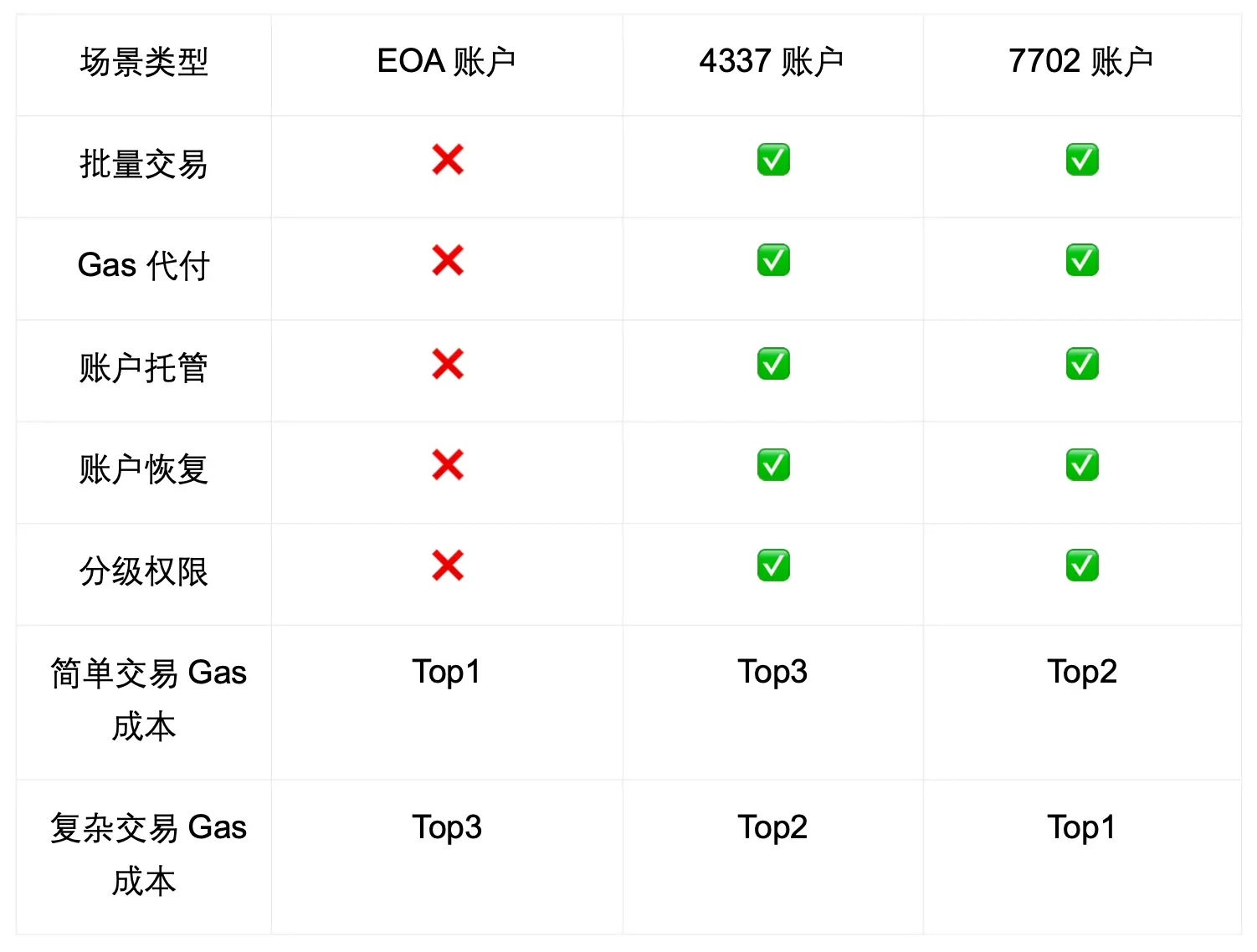
Objectively speaking, the Ethereum ecosystem carries a far heavier historical burden than other chains. This is why the community voiced opposition to Vitalik's proposed changes to the EVM, and why ERC-4337 was the不得已的选择 early on. However, once a better option exists — EIP-7702, which can achieve both backward compatibility with historical burdens and excellent cost optimization — users welcome their "iPhone moment."
Alongside the transformation of the underlying architecture, further derivative forms can be envisioned:
-
Users can implement wallet control using Passkey or Google Account, enabling experiences like conditional signature-free transactions.
-
Users can set up methods like ZK Email to enable Recovery capabilities and private key retrieval.
-
For heavy on-chain users, bundling multiple trades into a single transaction can significantly reduce block waiting time, making on-chain swaps faster, and through consecutive trading, lower the risk of trade failure.
Time has a tremendous impact on user experience. As the blockchain world's second-ranked consensus system (second only to BTC), ETH cannot casually reduce block time from 3s to 1.5s like BSC can, just to improve user experience. Therefore, wallet tools built on EIP-7702 serve as the most critical bridge for user experience.
So, combining our earlier discussion of the underlying architecture, it can be said that EIP-7702 is the ultimate form of Account Abstraction!
However, saying that all users will universally adopt it is also unlikely. Since its application requires caution, and after integrating complex smart contracts, the security risks it introduces are considerable — some attack methods are even highly covert. Therefore, after the Ethereum Prague upgrade activates on May 7, 2025, what users need most is a truly secure wallet, safeguarding them with technical expertise.
Is the Final Battle Over?
No.
Indeed, Pectra is Ethereum's most ambitious upgrade to date, covering 11 EIPs — a record number! The many benefits of EIP-7702 are evident to all, and we have provided our assessment based on the principles and data discussed above.
However, it is precisely after users participate in the selection that the market will face a chaotic battle.
As the AA ecosystem continues to evolve, it has gradually shown signs of fragmentation. Among the EIPs that define Account Abstraction at the framework level, there are already interface standards such as ERC-4337, ERC-6900, and ERC-7579. However, significant differences exist between different implementation solutions in terms of user experience, interface specifications, and behavioral expectations. Different wallet implementation solutions all focus on similar application scenarios and a limited set of core functionalities, yet each adopts incompatible design assumptions and implementation logic.
A most typical hidden issue is storage disorder.
After the introduction of EIP-7702, the storage space under EOA Accounts becomes accessible to contracts. This storage space is not exclusively owned by a single contract but may be jointly used and switched between by multiple smart Account providers.
When a user initiates a "switch proxy contract" (re-delegation) operation, the original Account contract is replaced by a new one. However, the state data written by the old contract is not cleared along with it and remains in the EOA's storage. This means the new proxy contract can access or even modify storage data written by the old contract, introducing the risk of "storage pollution", which may interfere with or even break the current contract's execution logic.
Although various solutions have emerged in the community, such as isolating storage through namespaces (ERC-7201) to reduce the impact of storage conflicts, no matter which solution is adopted, there is still a lack of mandatory unified standards in the ecosystem to ensure nonce uniqueness and security.
Another typical issue is the disorder of execution standards.
As revealed in this article: 《
From Fragmentation to Unity: The Necessity of Smart Account Standardization
Today, Safe, Biconomy, and Zero Dev have each implemented their own versions of batch call functionality, but the function naming, interface parameters, and result handling methods of all three are completely different. Among them, Zero Dev has considered the scenario of batch call failures, while Safe and Biconomy have not addressed such cases.
The industry's "every faction for itself" approach to standards inevitably brings chaos. And users, DApps, and developers all become victims. Therefore, the introduction of EIP-7702 is not only a technological innovation but also an opportunity to establish a universal infrastructure for smart accounts. It provides us with a window for "rebuilding consensus," pushing the entire Web3 wallet ecosystem from functional diversity toward structural unification, achieving true sustainable development.
Three Essential Security Understandings After EIP-7702 Activation
Now, let's switch perspectives — from users, from DApps, from exchanges and other organizations — to comprehensively examine how this system affects us. It brings opportunities as well as risks. Only by understanding the risks can we more perfectly enjoy the benefits this system brings.
Is EIP-7702 too complex? Can I skip the upgrade?
Of course, you can choose not to upgrade proactively, but there is a risk you need to be aware of: after the Prague upgrade, a message signature you sign could inadvertently put you in danger.
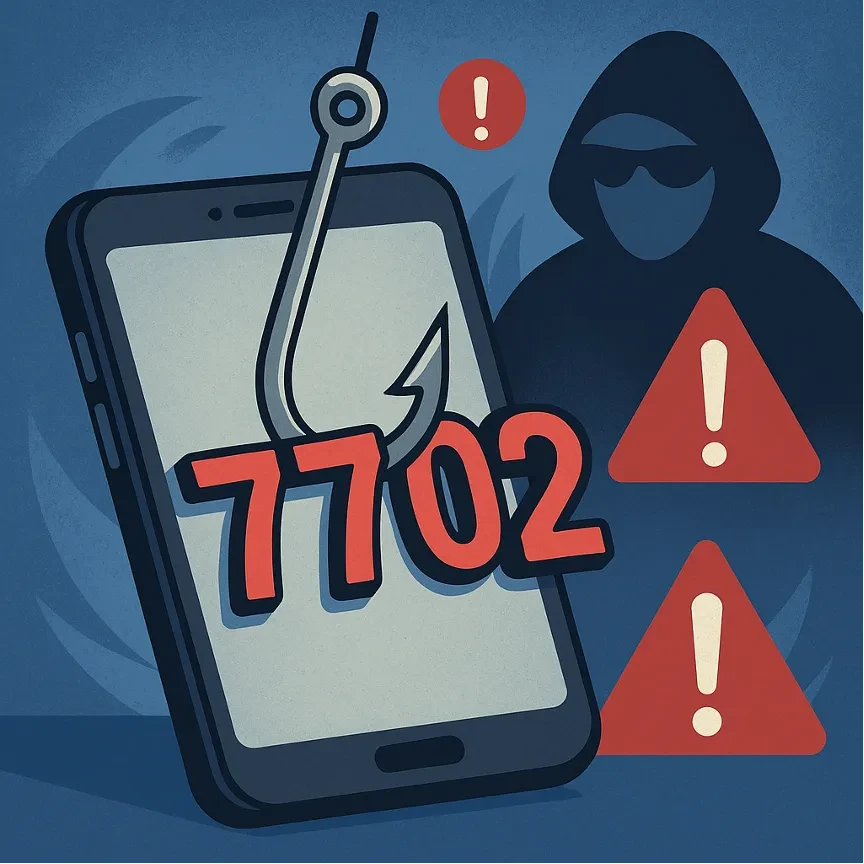
EIP-7702 does have a strong phishing risk because its Authorization parameters are composed of: address, nonce, and chainId. If the chainId is 0, the signature authorization can be valid on any chain as long as the nonce condition is met.
Through the specific implementation method of the 7702 process in the signature SDK open-sourced by OKX, you can see that to comply with this standard, users ultimately sign a hash value: 0xabc, calculated as follows:

The keccak here is the mainstream hash algorithm on Ethereum, characterized by its ability to compute a fixed 32-byte output from data of any length. RLP is a set of message encoding methods, and Magic is a fixed value.
However, since the final result is a hash value whose specific content cannot be understood, if users rashly sign a message and others can carry your authorization on-chain to take effect, you may unknowingly have code set on your account, triggering a zero-day level attack event. And because setting code is mandatory, you cannot assume that because you have previously set a secure contract, it cannot be replaced.
Therefore, secure wallets will all prevent users from signing arbitrary hash values — this was also the case before (because hash values could also represent a regular transaction).
If I accidentally upgrade a risky contract, how do I protect myself?
This risk is also very common; after all, there is no way to ensure you will never be phished.
To guard against this issue, you must first understand a technical background: in the Ethereum system, transactions must be processed in nonce order, and only by maintaining continuity can they be recognized on-chain.
Therefore, there are 2 attack methods.
The first scenario is where the hacker steals the next nonce value of your current address to sign an Authorization. The fix is simple: if you are attacked, quickly use a wallet that allows custom gas fees, such as OKX Wallet or another secure wallet, to quickly transfer ETH (to another of your safe addresses). This action can on one hand transfer ETH-level funds, and on the other hand replace the currently valid nonce value, rendering the hacker's invalid.
The second scenario is where the hacker steals a subsequent nonce value. Then it is possible that your current transaction actually makes the Authorization in the hacker's possession become valid. Since you are unsure of the exact nonce, no action can guarantee absolute safety. You can only quickly transfer assets to protect yourself.
It seems like EIP-7702 is more dangerous? Actually, no!
For blockchain, a system that truly returns sovereignty to users' private key ownership, careless signing at any time can lead to fund losses. But the key point here is that, setting aside the case of large-sum users being specifically targeted and poisoned, most risks arise because users frequently take their important private keys out and use them.
If you have already implemented combined functionality for family accounts and personal sub-accounts through AA, and set spending limits for each sub-account, then basically your main account only needs to be used when modifying system-level settings.
To invoke, while for regular daily use, you only need a small Account to handle it.
Why do some common Trading failures occur after upgrading?
This situation often occurs in wallet tools that do not support EIP-7702.
First, let me provide some technical background. During the contract call process on Ethereum, the system first checks the code field of the user's current address. If content exists, it executes the corresponding logic by going through its default acceptance function.
Based on this, for ordinary users, this means that if you have Completed the EIP-7702 contract settings, you will basically have the default acceptance function functionality. Then any ordinary ETH Transfer Trading will execute some contract logic, thereby increasing the overall Gas use. If you set the Gas Limit for ordinary Trading to 21000, it will naturally fail.
Similarly, since many NFT projects will detect whether the recipient address is a black hole address (that is, an address that cannot transfer out Assets) and thereby prohibit Trading, if your acceptance function is not handled properly, it will also cause ERC20 and ERC721 Assets to be unable to be accepted, resulting in losses.
In this regard, it is recommended to use wallets that explicitly support EIP-7702 for settings, or to use well-audited and user-recognized logic contracts, such as:https://github.com/okx/wallet-core
What other changes are there in the Ethereum mainnet Pectra upgrade?
There are many voices in the market suggesting that Ethereum seems to have lost its way? Why do many upgrades seem irrelevant to users? Is this really the case? Let's take a look at other EIPs in this upgrade to find the answer. Of course, EIP-7702 is the biggest upgrade change that users can feel, but there are 10 other EIPs that bring changes to the Ethereum ecosystem in different dimensions.
**First is cryptographic support. **Through EIP-2537, precompiled operations for the BLS12-381 elliptic curve are introduced, which can optimize complex encryption operations such as BLS signature verification, providing higher security (120+ bit security) and computational efficiency (Gas optimization).
**There are multiple optimization points for staking scenarios. **Objectively speaking, staking does need optimization. All along, Ethereum's validator cluster has grown rapidly, with nearly one million staking addresses for validators. This is because MAX_EFFECTIVE_BALANCE is limited to 32 ETH, and node operators need to create multiple validator Accounts to manage larger staked Assets. **This has led to the existence of many "redundant validators". **Therefore, through EIP-7251, the maximum limit is increased. For aggregation staking protocols like Lido, this can reduce the number of control Accounts and reduce system complexity, but this may exacerbate decentralization issues and make the ETH staking market more centralized.
After this upgrade, larger-scale node operators can merge multiple validator Accounts, while also bringing more flexibility to small validators. For example, they can increase returns through compound returns accumulation or more flexible staking increments. This is very important. Originally, after reaching 32 ETH, if you generated 10 ETH in new returns, you actually wouldn't continue to stake them in ETH, because you still needed to accumulate to 32 to open a new Account. But after this update, you can directly stake 42 ETH. Then obviously your compound returns can return to the ETH system, which has both user experience convenience and implies a certain reduction in ETH liquidity.
**Finally, there is a significant optimization for the L2 ecosystem. **Ethereum is firmly on the path of an L2 ecosystem community. Other SVM-based and MOVE-based chains are essentially still developing their own L1, and even exploring L2 on top of them has certain contradictions and conflicts. The root cause is that the high performance of these chains also relatively doesn't depend as much on doing L2.
To encourage more L2s to efficiently interact with the Ethereum mainnet, EIP-7623 directly increases the gas fees for calldata in Trading from 4/16 gas per byte to 10/40 gas. This forces L2s not to use calldata, but to use Blob more.
Also through **EIP-7691**, **increase the blob capacity in blocks, thereby supporting larger-scale L2 storage space. In the previous Cancun upgrade, there were two core parameters representing blobs: target and max, used to indicate the target blob count per block and the maximum blob count per block.
Cancun had 3 and 6, now after Prague, the parameters become 6 and 9. In short, it's expanded.
So Ethereum achieves its own improvement through L2's TPS. Although there are many issues, such as liquidity fragmentation, cross-chain complexity, emergency escape capacity, etc. Therefore, in the current Pectra upgrade, Ethereum is adding "highways" for L2, but how to solve "traffic management" and "different highway charging standards" in the future is the most fundamental issue.
Glimpsing the Future
This article spans nearly ten thousand words. We started from the developmental roots of Account abstraction, to the two routes represented by ERC-4337 and EIP-7702 and their comparison, then delved into the principles and mechanisms of EIP-7702, analyzing its pros and cons for mainstream user scenarios and adjustment effects.
The author believes that "Not your keys, Not your money" is a great concept. EIP-7702 is not subverting it, but rather complementing and perfecting it in another dimension, giving it both sovereignty and usability. As Ethereum Foundation researcher Yoav Weiss said, "The next billion users won't write 12 words on paper."
Then through the comparison of the two, it can be said that EIP-7702 has significant optimizations over ERC-4337, giving users space and flexibility, making it easier to be recognized by users in the subsequent market and used. Once users start adopting CA as the on-chain entity, complex Trading types will emerge in large numbers on EVM-based chains.
From this, we catch a glimpse of the future With the underlying Account entity and the richness of Trading types, many application experience issues that were once bottlenecks will also be resolved. It will no longer force users to understand logic such as Nonce and Gas, but instead uniformly provide simplified processing through entry service tools such as wallets.
Although facing industry-level diversity, bringing a certain degree of interface standard and storage space confusion, the author also optimistically sees that the more valuable the chaos, the more a unified standard can emerge. Decentralized multi-party games will ultimately promote the development of the industry in reverse. It is precisely because of this that after EIP-7702 goes online, it will not immediately set off the ecosystem on Ethereum. Because it is a spiraling technological infrastructure upgrade, and such upgrades often lead market applications by 2-3 years, leaving time for the application layer to gradually ferment.
Moreover, starting from this upgrade, user security will depend more on the service quality of the entry tool layer. Open source is to bring user security
Transparency and openness are crucial, which is why the EIP-7702 underlying SDK implementation integrated by OKX Wallet this time has also been open-sourced, publicly subjected to scrutiny from both the community and the market. There are also many wallets committed to openness that are going further on the self-custody path, providing users with absolute autonomy through the fairness of open source.
Finally, returning to the Pectra upgrade itself, we can once again see Ethereum's thinking and commitment to its future direction. Now that the L2 grand strategy has entered a period of stable execution, Ethereum's roadmap has undergone many detailed changes over the past decade, but its core objectives have remained surprisingly consistent: to have a secure, decentralized, green (POS) blockchain that is both highly scalable and easy to verify. Proposals like EIP-7702 that effectively improve user experience, introduced through hard forks, represent Ethereum's continuous exploration of how to enhance competitiveness across multiple chains while maintaining decentralization—even in the face of competition from new-generation public blockchains as formidable as Solana—and how to become the ideal supercomputer!
References:
-
https://github.com/ethereum/EIPs/blob/master/EIPS/eip-7702.md
-
https://www.okx.com/zh-hans/learn/smart-account-standardization
-
https://metamask.io/news/account-abstraction-past-present-future
About "OKX Research"
The "OKX Research" column is grounded in an institutional-grade research perspective, focusing on phenomenon-level hotspots, innovative applications, and cutting-edge technological developments in the crypto industry. Through data analysis, on-chain behavior analysis, and cross-market correlation analysis, it aims to reveal the core reasons and potential impacts behind market dynamics, with the goal of promoting knowledge sharing, intellectual exchange, and deep discussion within the industry, and supporting the healthy development of the crypto ecosystem.
Disclaimer
This article may contain product-related content that does not apply to your region. This article is only committed to providing general information and is not responsible for any factual errors or omissions. This article represents only the author's personal views and does not represent OKX's views. This article is not intended to provide any advice, including but not limited to: (i) investment advice or investment recommendations; (ii) offers or solicitations to purchase, sell, or hold digital assets; or (iii) financial, accounting, legal, or tax advice. Holding digital assets (including stablecoins) involves high risk and may fluctuate significantly, or even become worthless. You should carefully consider whether trading or holding digital assets is suitable for you based on your financial situation. For questions about your specific circumstances, please consult your legal/tax/investment professionals. The information contained in this article (including market data and statistical information, if any) is for general reference purposes only. Although we have taken all reasonable precautions in preparing such data and charts, we do not accept any responsibility for any factual errors or omissions expressed herein. © 2025 OKX. This article may be reproduced or distributed in its entirety, and excerpts of 100 words or less from this article may be used, provided that such use is non-commercial. Any reproduction or distribution of the full article must prominently state: "This article is copyrighted © 2025 OKX, used with permission." Permitted excerpts must cite the article title and include attribution, for example, "Article title, [author name (if applicable)], © 2025 OKX." Portions of this content may have been generated or assisted by artificial intelligence (AI) tools. Derivative works and other uses of this article are not permitted.
Show More
Overview
Why Account Abstraction?
Core Differences Between ERC-4337 and EIP-7702?
Core Principles of EIP-7702
Is EIP-7702 the Endgame for Account Abstraction?
After EIP-7702 Activation, Three Essential Security Considerations
What Other Changes Does Ethereum Mainnet Pectra Bring?
Glimpsing the Future
Recommended Reading
OKX Pay: Ushering in a New Era of Next-Gen Crypto Payments
Preferred by tens of millions of users, register with OKX to enjoy an exceptional trading experience and diverse wealth management products. A letter from OKX CEO Star: Today, we officially launch the first version of OKX Pay for over 100 million global users. As the industry's first Payment application to truly integrate non-custodial and compliant features, OKX Pay will be embedded directly within the OKX App, and is currently available to select markets, with full global rollout expected within the coming months.
March 22, 2026
"/zh-hans/learn/okx-ice-nyse-partnership">

A New Chapter: Building Next-Generation Financial Infrastructure Together
OKX's partnership with Intercontinental Exchange (ICE) marks an important moment for OKX and holds profound significance for the evolution of the entire digital assets market. ICE establishes and operates the world's most important financial infrastructure, including the New York Stock Exchange as well as global derivatives and clearing platforms. This strategic investment in OKX by ICE and their joining our board reflects our shared belief—that digital assets technology will transform financial markets
March 10, 2026
Tribute to Another Year of Forging Ahead
As OKX's CEO, and also a builder who remains true to our original mission, I am proud to look back on the extraordinary growth and progress OKX has achieved this year. Despite numerous challenges, 2024 has been a year of focus, innovation, and resilience. We have not only expanded and optimized our products, but also made significant progress in launching transparent and compliant localized operations, while further strengthening our global management team. Notably, after experiencing
January 29, 2026

2025: Steady Progress Toward Financial Freedom Together
— A Year-End Letter from Star, OKX Founder and CEO, to Global Users "Financial freedom" is often misunderstood. It doesn't mean the absence of rules, but rather having choices within a framework of rules—and when the system is truly tested, it remains reliable and effective. This is exactly what we have remained focused on throughout 2025. First, I want to express my sincere gratitude to our global clients, partners, and regulatory authorities
January 16, 2026

OKX Officially Launches in Germany and Poland
Author: Erald Ghoos, CEO of OKX Europe Today is a significant day for OKX—and for crypto users across Europe. We have officially launched our fully compliant centralized cryptocurrency trading platform in Germany and Poland! For us, this is more than just geographic expansion; it's a commitment to building the cryptocurrency future the right way: secure, transparent, and responsive to local needs. If you're in Germany
October 21, 2025

Partnership Expanded! OKX Partners with Standard Chartered to Expand in European Markets
On October 15, Erald Ghoos, CEO of OKX Europe, announced that OKX is expanding its strategic partnership with Standard Chartered to the European Economic Area (EEA). Earlier this year, OKX first partnered with Standard Chartered in the UAE to launch the collateral mirroring program—a
October 15, 2025