OKX Research Institute: Who Created the NFT Boom Myth?
On the evening of March 11, world-renowned art auction house Christie's held its first auction of a pure digital artwork presented as an NFT—Beeple's "Everydays: The First 5000 Days." As the auction hammer fell, the work ultimately sold for an astronomical price of $69.346 million, breaking the highest auction price record for an NFT work; meanwhile, Beeple, as a "living artist," saw his work price rank third globally, surpassed only by the resounding names of Jeff Koons and David Hockney.
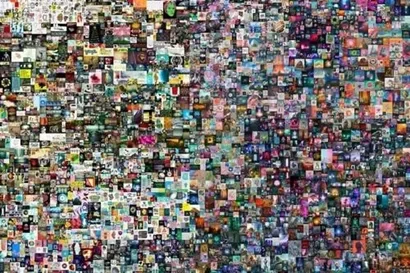
(Figure 1. Everydays: The First 5000 Days, Beeple's work)
As many artist friends candidly admit, compared to traditional art creators, Beeple's resume is not outstanding, lacking education from prestigious schools, and has remained obscure. Therefore, when Beeple, this "nobody," suddenly burst onto the scene, with an electronic image that does not exist in the real world—a digital work that anyone can browse, download, and save—sold for a nearly $70 million jaw-dropping price, the impact on their cognition and imagination was immense.
Not only that, this NFT work's astronomical auction event was like a water droplet falling into a calm lake, causing ripples across the entire surface. For a time, major media competed to report, everyone talked about NFT, and various NFT exhibitions sprung up like bamboo shoots after rain. NFT, a term mentioned in the "crypto circle" as early as 2017, has unexpectedly "gone mainstream" in 2021.
1. What is an NFT?
To understand what an NFT is, we need to understand several token development standards in the current blockchain industry. We all know that Ethereum can issue tokens. From a technical perspective, these tokens can be divided into the following two types:
- **Fungible Token (FT): ** Also known as interchangeable tokens, mainly generated by the ERC-20 standard, where tokens can be freely exchanged, split, and combined;
- **Non-Fungible Token (NFT): ** Also known as non-interchangeable tokens, mainly generated by the ERC-721 standard, with a minimum unit of 1, indivisible and mutually non-substitutable;
Table 1. Differences between various token standards
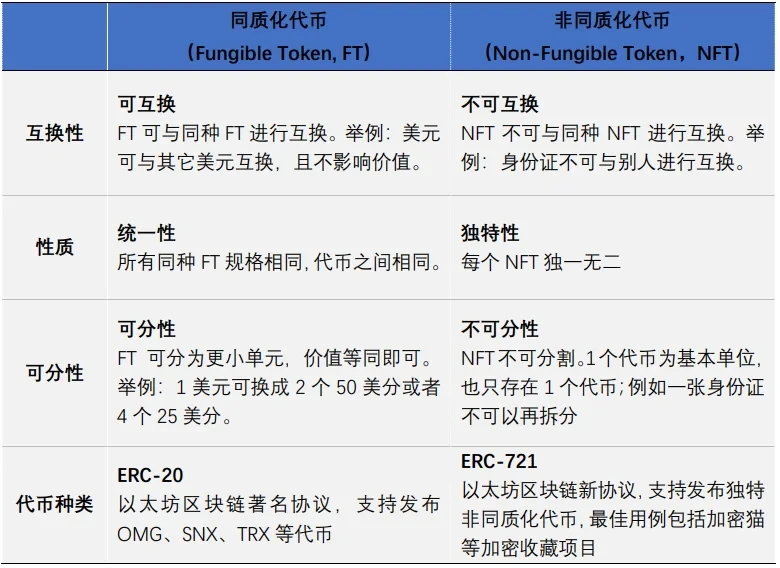
Source: OKX Research Institute
For people outside the blockchain industry, NFT is still a new thing. But in fact, NFTs appeared very early—namely the Crypto Cats game on Ethereum in late 2017. In this game, each Crypto Cat is a unique breed; no two cats are identical. After users purchase a Crypto Cat with Ether, they obtain its exclusive ownership, which cannot be copied, taken away, or destroyed. When this game was launched, it became an instant sensation and once caused congestion on the Ethereum network.
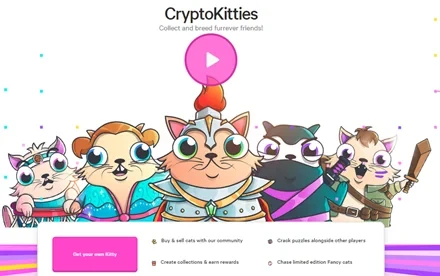
(Figure 2. Crypto Cats official website screenshot)
Although NFT and FT are defined as non-fungible tokens and fungible tokens, it is more vivid to distinguish the two using "standardized" and "non-standardized."
So-called "standardization" is like industrial assembly line products, where products are homogeneous. For example, common daily consumer goods and toys in the market are all produced using unified standard molds; their quality and characteristics are the same; while "non-standardization" is like independent boutiques pursuing high quality and personalization, conducting "private customization" according to customer requirements, where all customized products are unique and belong to products tailored for high-net-worth clients. Therefore, NFTs are widely used in fields such as artwork, domain names, and collectibles.
2. Who Created the NFT Boom Miracle?
With NFTs completely going mainstream in early 2021, the NFT market began rapid growth. Taking the top five NFT platforms (NBA TOP Shot, OpenSea, CryptoPunks, Rarible, Sorare) as examples, since January 2021, daily active users and daily trading volume (in USD) on major platforms have shown exponential explosions.
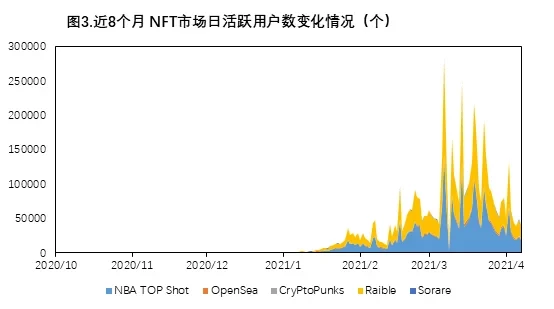
Source: OKX Research Institute, DappRadar
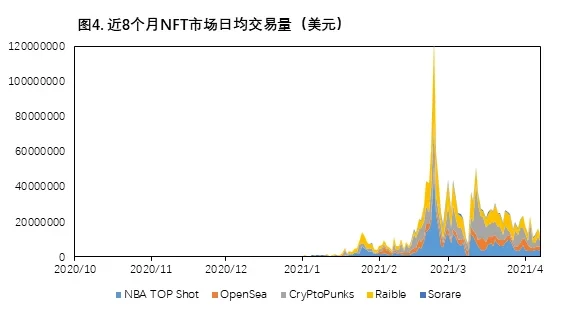
Source: OKX Research Institute, DappRadar
Many people are surprised by NFTs' sudden rise, believing that behind their boom miracle is merely speculation by funds. Objectively speaking, the current NFT market has indeed shown obvious bubbles, but is this the full picture of the event?
Before digital art appeared, all artworks existed in physical form. Our ownership of a physical artwork means we have the rights to possess, use, returns, and dispose of it; we can hang it in our bedroom, exhibit it externally, or even sell it to others; this right is absolute, exclusive, and perpetual.
However, in the digital economy era, all this has changed: digital artworks do not exist in physical form. How do we reflect our exclusive possession of it? Anyone can copy and use it without difference; how do we ensure our disposition and returns rights over digital art are not infringed?
So what can NFT bring to digital art? —Perfect proof of property rights!
The modern property rights theory of new institutional economics tells us: in a market with efficient resource allocation, property rights must be clear, exclusive, transferable, and operable. NFTs in the digital economy era恰恰 satisfy all the above characteristics: NFTs provide unique copyright proof for creators' works; although still presented in electronic form, they are distinguished from other replicas, and owning an NFT means having exclusive possession rights, strongly protecting creators' copyrights; NFTs' convenient and fast circulation and transfer on blockchain networks makes them easy to operate in practice, allowing these works to be sold at the most appropriate prices, stimulating creative enthusiasm.
Today, as the digital economy continues to deepen, rather than saying NFTs' sudden explosion is surprising, it's better to ask why it took until today for us to have NFTs to protect our digital property rights. So we can see that currently more and more artists are attempting to create works in NFT form—this day has arrived too late.
Of course, we also find that behind NFTs' rise, there are many figures from the "crypto circle." This is another main reason for NFTs' current boom miracle.
The buyer who purchased Beeple's work for nearly $70 million this time, Indian buyer Metakovan, is the founder of the NFT fund Metapurse and himself a senior figure in the cryptocurrency field; while the buyer who offered the second-highest price of $60 million to purchase Beeple's painting may be more familiar to everyone—Tron founder Justin Sun.
Even more interestingly, after a domestic self-media writer wrote an article about NFTs, people from the crypto circle flocked to watch, with very peculiar behavior—no comments, no likes, no follows, just clicking appreciation, leaving a sum of money, and turning to leave. This left the self-media writer puzzled, who directly stated, "I hope movie companies and publishing house-related personnel will find the gap between themselves and crypto circle people."
As mentioned earlier, NFTs actually appeared as early as three years ago. The so-called NFT applications are by no means as narrow as labeling an image or video. When outsiders are still full of curiosity and surprise about NFTs, so-called "crypto circle people" or blockchain practitioners are already thinking about how to apply NFTs to broader fields.
So why are crypto circle people willing to "watch," or even spend real money to drive this market's prosperity?
In Maslow's hierarchy of needs theory, human needs are divided into five levels: physiological needs, safety needs, belonging and love, respect needs, and self-actualization; and needs are formed and satisfied level by level from low to high. Due to the continuous chaos in the "crypto circle" itself, plus many objective factors, the "crypto circle" has been repeatedly stigmatized in recent years. However, it is undeniable that after nearly a decade of development, a new wealthy class that made their fortune from cryptocurrency has emerged in society. This is similar to the new wealthy group that rose from the internet twenty years ago.
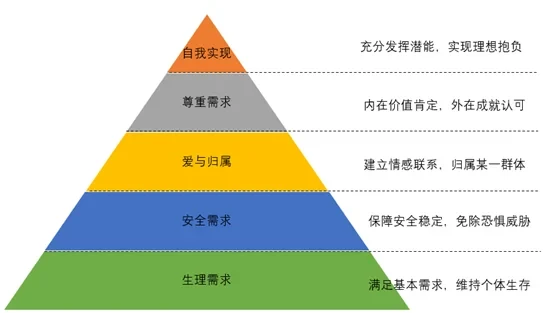
For the many new rich in the cryptocurrency industry, current deficiency needs such as physiological and safety needs have been satisfied, but respect needs have not been met. Respect needs include both personal feelings of achievement or self-worth and others' recognition and respect for oneself.
Although blockchain technology has gradually received countries' attention in recent years, blockchain industry practitioners and "crypto circle people" have not truly gained social recognition and respect. It can be said that in recent years, "crypto circle people" and blockchain practitioners have lived very frustrated lives. Therefore, when seeing NFTs start to go mainstream and receive world attention, "crypto circle people" are also willing to spend money to watch and cheer for it. This is the emotion of one's own industry being recognized, released from respect needs being satisfied.
Of course, this is also mixed with some "crypto circle people's" attempts to use NFTs to speculate for personal gain. As mentioned above, Metakovan, who purchased Beeple's painting, is also the issuer of the art index fund B.20. B.20 index fund's operation model is to use Beeple's 20 works as underlying assets, then issue fund shares. Due to the auction of Beeple's works, it directly raised the overall valuation of B.20 fund; this is like Zhao Danyang, who spent two million dollars to bid for lunch with Buffett more than a decade ago, and during the lunch recommended his heavily held stocks to the other party, directly generating tens of millions of dollars in paper profits.
Although NFTs indeed bring new opportunities to digital artworks, at the same time, large amounts of funds have begun pouring into the NFT market, NFT works have risen with the tide, and large amounts of inferior artworks have begun appearing and selling in NFT form. The market's craziness has exceeded artists' imagination, and criticism of digital art has followed one after another. Interestingly, Beeple, the current biggest beneficiary of NFTs, when receiving payment in Ether (ETH) after the auction ended, immediately converted all the Ether (ETH) to US dollars; and directly stated, "I'm not a pure cryptocurrency believer. I've been engaged in digital art creation for a long time. If all these NFT things disappeared tomorrow, I would still be engaged in digital art creation." This statement directly led many NFT loyal fans to feel that Beeple had betrayed NFTs.
Did NFT hurt art, or did art hurt NFT?
Disclaimer: digital asset trading involves significant risk, this material should not be used as a basis for investment decisions, nor should it be construed as advice to engage in investment trading. Please ensure full understanding of the risks involved and invest cautiously. OKX Academy only provides information reference and does not constitute any investment advice; users' all investment behaviors are unrelated to this site.
`
Disclaimer
This article may contain product-related content not applicable to your region. This article is intended only to provide general information and is not responsible for any factual errors or omissions contained herein. This article represents only the author's personal views and does not represent OKX's views. This article is not intended to provide any advice, including but not limited to: (i) investment advice or investment recommendations; (ii) offers or solicitations to buy, sell, or hold digital assets; or (iii) financial, accounting, legal, or tax advice. Holding digital assets (including stablecoins) involves high risk, may fluctuate significantly, and even become worthless. You should carefully consider whether trading or holding digital assets is suitable for you based on your financial situation. For questions about your specific situation, please consult your legal/tax/investment professional. The information appearing in this article (including market data and statistical information, if any) is for general reference only. Although we have taken all reasonable precautions in preparing these data and charts, we assume no responsibility for any factual errors or omissions expressed herein. © 2025 OKX. This article may be reproduced or distributed in its entirety, or excerpts of 100 words or less from this article may be used, provided such use is non-commercial. Any reproduction or distribution of the entire article must also prominently state: "This article is copyrighted © 2025 OKX, used with permission." Permitted excerpts must cite the article name and include attribution, for example "Article Name, [Author Name (if applicable)], © 2025 OKX". Some content may be generated or assisted by artificial intelligence (AI) tools. Derivative works or other uses of this article are not permitted.
Show More
Recommended Reading
OKX Pay: Opening a New Era of Next-Generation Crypto Payments
The choice of tens of millions of users. Register OKX and enjoy ultimate trading experience and diverse wealth management products. A letter from OKX CEO Star: Today, we officially launch the first version of OKX Pay for over 100 million global users. As the industry's first payment application that truly achieves non-custodial and compliant integration, OKX Pay will be embedded in the OKX App, currently available to some markets, expected to fully launch within months
March 22, 2026

New Chapter: Building Next-Generation Financial Infrastructure Together
OKX's partnership with Intercontinental Exchange (ICE) is an important moment for OKX and equally significant for the evolution of the entire digital asset market. ICE establishes and operates the world's most important financial infrastructure, including the New York Stock Exchange and global derivatives and clearing platforms. This ICE strategic investment in OKX and joining our board reflects both parties' shared belief—digital asset technology will transform financial markets
March 10, 2026
Tribute to Another Year of Forging Ahead
As OKX's CEO, and also a builder who never forgets his original intention, I am proud to review OKX's extraordinary growth and progress this year. Despite many challenges, 2024 was still a year filled with focus, innovation, and resilience. We not only expanded and optimized our products but also made important progress in launching transparent and regulatory-compliant localized businesses, while further strengthening our global management team. Notably, after experiencing
January 29, 2026

2025: Steady Progress Toward Financial Freedom Together
— Annual letter from OKX Founder and CEO Star to Global Users "Financial freedom" is often misunderstood. It doesn't mean no rules, but rather having the right to choose even when rules exist—and when the system is truly tested, it remains reliable and effective. This is precisely the direction we remained focused on throughout 2025. First, I want to extend sincere gratitude to our global clients, partners, and regulatory bodies
January 16, 2026
OKX Officially Launches in Germany and Poland
Author: Erald Ghoos, CEO of OKX Europe Today is significant for OKX—and equally so for crypto users across Europe. We have officially launched a fully compliant centralized cryptocurrency trading platform in Germany and Poland! For us, this is not just a geographic expansion, but a commitment to building the cryptocurrency future the right way: secure, transparent, and meeting local needs. If you're in Germany
October 21, 2025

Partnership Upgrade! OKX Partners with Standard Chartered to Expand European Market
On October 15, OKX Europe CEO Erald Ghoos stated that OKX is expanding its strategic partnership with Standard Chartered to the European Economic Area (EEA). Earlier this year, OKX first partnered with Standard Chartered in the UAE to launch the collateral mirroring program—a
October 15, 2025