Goldman Sachs Files DeFi ETF Application with SEC — What Are the Odds of Approval?
According to media reports, Goldman Sachs recently filed an exchange-traded fund (ETF) application with the U.S. Securities and Exchange Commission (SEC). The ETF, named "Goldman Sachs Innovate DeFi and Blockchain Equity ETF," aims to track the decentralized finance and blockchain index provided by German financial index provider Solactive.
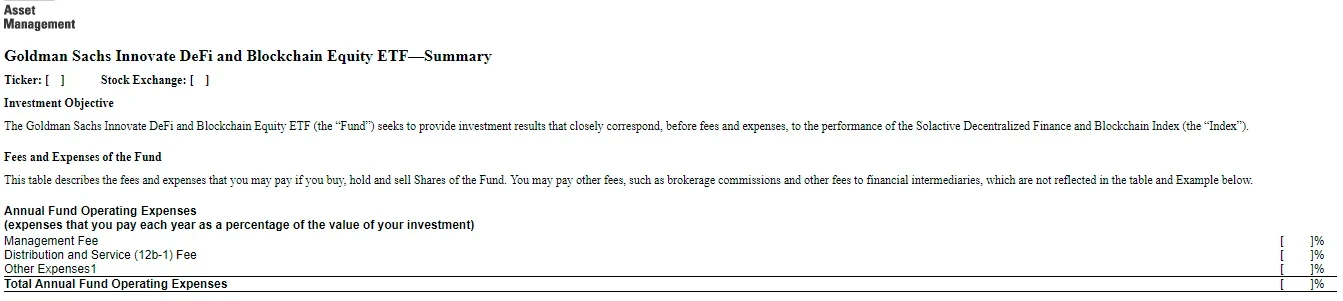
Goldman Sachs Innovate DeFi and Blockchain Equity ETF — Key Information, Source: SEC Official Website
At first glance, this appears to be a significant step by a traditional Wall Street financial giant into the crypto assets market, and many industry analysts have interpreted it as a key move by Goldman Sachs to position itself in DeFi. But is that really the case? Let's take a deep dive into the application documents Goldman Sachs submitted to the SEC.
Inside the "Goldman Sachs Innovate DeFi and Blockchain Equity ETF"
In the documents Goldman Sachs filed with the SEC, its primary investment strategy is described as follows: "The Goldman Sachs Innovate DeFi and Blockchain Equity ETF will invest at least 80% of its assets (excluding collateral held for securities lending) in securities included in its relevant index, depositary receipts representing securities included in its relevant index, and related stocks to achieve its investment objective. The index seeks to provide exposure to companies aligned with two key themes: the implementation of blockchain technology and financial digitalization." So, how do we interpret these two "key themes"? Goldman Sachs provided its own definitions in the filing:
1) Blockchain technology is defined as the underlying technology of distributed ledgers, applicable to areas and industries that rely on trusted intermediaries such as payments and currencies.
2) Financial digitalization is defined as the digital transformation of traditional financial services, including the support and delivery of payments, trading services, lending, and insurance.
These two "key themes" alone don't reveal anything unusual on the surface. However, after carefully reviewing Goldman Sachs's application in full, we found no indication of which companies Solactive AG plans to include in the aforementioned "index." If we look at Solactive AG's existing "Solactive Blockchain Technology Performance Index," we can see that this index covers 20 companies in total. Among them, besides publicly listed companies with multiple blockchain patents such as Alibaba, Baidu, Tencent, Facebook, and IBM, there are also traditional tech enterprises like Nokia and Sony that only entered the blockchain space in recent years. This inevitably raises a big question mark about the actual "crypto content" of the "DeFi and Blockchain Equity ETF" Goldman Sachs is applying for.
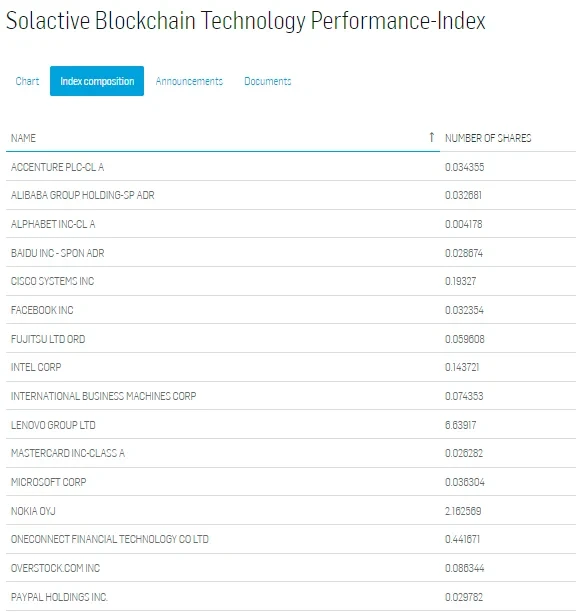
Solactive Blockchain Technology Performance Index — Composition (Partial), Source: Solactive Official Website
Of course, our analysis above is based on the composition of Solactive's existing blockchain-related index. So, could there be a breakthrough in the index that Solactive AG ultimately compiles for Goldman Sachs's ETF? Unlikely.
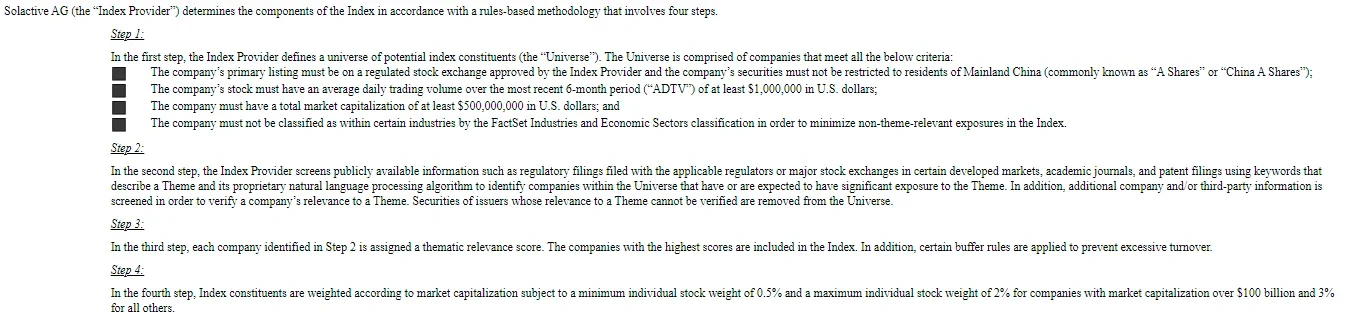
Rules for Determining Index Components Disclosed in Goldman Sachs's Application, Source: SEC Official Website
Why is it unlikely? Let's continue searching for answers in Goldman Sachs's application: The image above shows several rules disclosed by Goldman Sachs that must be followed when determining the index's components. The first rule specifically states that companies to be included in the index in the future must meet the following conditions — 1) Listed on a regulated securities exchange; 2) Average daily trading volume of at least $1 million over the most recent six months, with a total market capitalization of at least $500 million; 3) Not classified by FactSet industry and economic sectors into certain industries, so as to minimize the index's exposure to risks unrelated to the aforementioned themes. Obviously, just these three rules alone would exclude major DeFi leaders we're familiar with, such as Uniswap, AAVE , and Compound.
Grandstanding or Something Else?
Since news broke of Goldman Sachs's ETF filing with the SEC, it quickly sparked heated discussions among crypto enthusiasts, with no shortage of mockery aimed at Goldman Sachs. Nansen data analyst and CEO Alex Svanevik was even more blunt, calling Goldman Sachs's move a "scam."
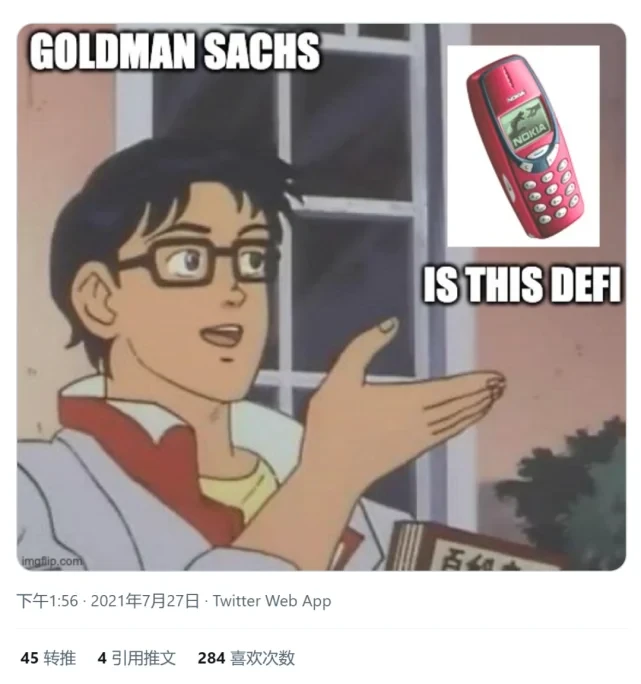
Overseas Crypto Enthusiasts' "Mockery" of Goldman Sachs, Source: Internet
So, is the "Goldman Sachs Innovate DeFi and Blockchain Equity ETF" merely a publicity stunt by Goldman Sachs? It would seem not. In fact, as a dominant financial giant on Wall Street, Goldman Sachs has at least four years of history in the crypto market. In October 2017, it was reported that Goldman Sachs formed an internal working group within its foreign exchange trading division dedicated to researching crypto assets. Subsequently, in December 2017, it announced plans to launch a crypto assets trading division expected to begin operations by summer 2018. However, in September 2018, Goldman Sachs announced an indefinite postponement of the crypto assets trading division launch. It wasn't until May 2021 — three years later — that Rajesh Venkataramani, Head of Foreign Exchange Options Trading at Goldman Sachs Global Currency and Emerging Markets, announced that Goldman Sachs's crypto assets trading team was officially established and had successfully executed Bitcoin price-linked nondeliverable forwards (NDFs) and CME Bitcoin futures trading . Given Goldman Sachs's deep insights into the crypto market, we have every reason to believe it wouldn't make such an elementary mistake.
So, what else could be at play? Let's look at another set of developments. In June, Thailand explicitly stated it would regulate DeFi. In July, Japan's financial regulator published a report hinting at possible regulations targeting DeFi. That same month, a U.S. Commodity Futures Trading Commission (CFTC) official stated that unregulated DeFi markets in the U.S. could be illegal. Last week, Uniswap Labs — the development team behind the Uniswap protocol — announced it would review its website frontend and proactively delist risky crypto assets due to mounting pressure. Given this series of moves, DeFi, which has flourished since 2020, has now come onto regulators' radar. Against this backdrop, it becomes easier to understand why Goldman Sachs's ETF application in this instance appears so "misaligned with its name."
Additionally, in the aforementioned application documents, we also found proactive blockchain technology investment risk disclosures made by Goldman Sachs. Goldman Sachs noted that blockchain technology is an emerging and developing technology, and risks associated with these technologies may not fully materialize until they are widely adopted (though as blockchain technology applications deepen, other unforeseeable risks may emerge — author's note). Private keys required for certain crypto asset transactions may be stolen, lost, or destroyed, which could adversely affect a company's business or operations if it relies on blockchain technology. Currently, relatively few companies depend on crypto assets as an attributable and substantial source of revenue. Therefore, the performance of companies included in the index may not reflect their connection to blockchain technology and may instead be driven by other business operations. These companies may also fail to develop blockchain technology applications or be unable to leverage them. Blockchain technology may also never be fully implemented, which could adversely affect the companies included in the index. Furthermore, emerging technologies and intensifying competition may have a material adverse effect on the revenues and business prospects of the companies included in the index. Companies utilizing blockchain technology may also face cybersecurity risks and risks arising from intellectual property claims conflicts. Additionally, certain decentralized features of blockchain technology may reduce the likelihood of coordinated responses, thereby increasing the risk of fraud or cyberattacks. Operational failures and system disruptions may hinder the functionality of blockchain technology and adversely affect the companies in the index.
Having pieced together all this information, it may help us understand the cautious approach Goldman Sachs has demonstrated in this application.
How Does the "Goldman Sachs Innovate DeFi and Blockchain Equity ETF" Differ from Bitcoin ETFs?
ETFs are essentially open-ended index funds, which means they necessarily track an index, and that index must ultimately contain different companies or business entities. The primary difference between the "Goldman Sachs Innovate DeFi and Blockchain Equity ETF" and Bitcoin ETFs is reflected here. As we explored above, the index tracked by the Goldman Sachs Innovate DeFi and Blockchain Equity ETF will most likely consist of sizable companies listed on regulated securities exchanges. In contrast, most Bitcoin ETF applications submitted to the SEC for review track indexes compiled around Bitcoin prices. This difference means that the "Goldman Sachs Innovate DeFi and Blockchain Equity ETF" and Bitcoin ETFs may receive different treatment when facing SEC review.
Over the years, multiple institutions or individuals have filed Bitcoin ETF applications with the SEC, but none have been approved to date. In June 2019, then-SEC Chairman Jay Clayton stated, "Price manipulation is a potential concern for the SEC." Even as we moved into 2021, multiple Bitcoin ETF applications that entered the review process in the first half of the year continued to face repeated delays with no resolution. Against this backdrop, Goldman Sachs's approach of partnering with Solactive AG to bundle multiple listed companies with blockchain concepts into a new decentralized finance and blockchain index to launch an Innovate DeFi and Blockchain Equity ETF and file a listing application with the SEC is undoubtedly a shrewd compromise. Compared to Bitcoin ETFs, the Goldman Sachs Innovate DeFi and Blockchain Equity ETF clearly aligns more closely with the SEC's review requirements. With that in mind, let's exercise a bit more patience and wait to see how it unfolds.
>>> Can decentralized finance become the future trend? Trade DeFi tokens on OKX , get 100% cashback vouchers — individual users can earn up to 1,000 USDT in cashback. Click to claim now
Disclaimer
This article may contain product-related content not applicable to your region. This article is intended solely to provide general information and makes no representation as to the accuracy or completeness of any facts presented. The views expressed herein are those of the author and do not necessarily reflect the views of OKX. This article is not intended to provide, and should not be relied upon as, any form of advice, including but not limited to: (i) investment advice or investment recommendations; (ii) offers or solicitations to buy, sell, or hold digital assets; or (iii) financial, accounting, legal, or tax advice. Holding digital assets (including stablecoins) involves a high degree of risk and the value of such assets may fluctuate significantly or even become worthless. You should carefully consider whether trading or holding digital assets is appropriate for you in light of your financial situation. Please consult your legal/tax/investment professional regarding any questions you may have about your specific circumstances. Any information contained herein (including market data and statistics, if applicable) is provided for general reference purposes only. While all reasonable precautions have been taken in preparing such data and charts, we accept no responsibility for any factual errors or omissions expressed herein. © 2025 OKX. This article may be reproduced or distributed in its entirety, or used in excerpts of 100 words or fewer, provided that such use is non-commercial in nature. Any reproduction or distribution of the full article must prominently state: "This article is copyrighted © 2025 OKX, used with permission." Permitted excerpts must cite the article title and include attribution, e.g., "Article title, [author name, if applicable], © 2025 OKX." Some content may have been generated or assisted by artificial intelligence (AI) tools. Derivative works and other uses of this article are not permitted.
Show More
Recommended Reading
OKX Pay: Ushering in a New Era of Next-Gen Crypto Payments
The choice of tens of millions of users. Register with OKX to enjoy an exceptional trading experience and a wide range of wealth management products. A letter from OKX CEO Star: Today, we officially launch the first version of OKX Pay to over 100 million global users. As the industry's first payment application to truly achieve a fusion of non-custodial and compliant services, OKX Pay will be embedded directly within the OKX App, currently available in select markets with a full global rollout expected in the coming months.
March 22, 2026

A New Chapter: Building the Next Generation of Financial Infrastructure Together
The partnership between OKX and the Intercontinental Exchange (ICE) represents a significant milestone for OKX and carries profound implications for the evolution of the entire digital assets market. ICE builds and operates the world's most critical financial infrastructure, including the New York Stock Exchange and global derivatives and clearing platforms. This investment by ICE Select in OKX and its addition to our Board of Directors reflects our shared conviction — that digital assets technology will transform financial markets.
March 10, 2026
Reflecting on Another Year of Determination and Progress
As the CEO of OKX and a builder who stays true to his original vision, I take great pride in looking back on the extraordinary growth and progress OKX has achieved this year. Despite formidable challenges, 2024 was a year marked by focus, innovation, and resilience. We not only expanded and refined our product offerings but also made significant strides in launching transparent and regulation-compliant localized businesses, while further strengthening our global management team. It is particularly worth noting that after navigating through.
January 29, 2026

2025: Steady Progress Toward Financial Freedom
— An End-of-Year Letter to Global Users from Star, Founder and CEO of OKX "Financial freedom" is often misunderstood. It doesn't mean the absence of rules, but rather having the freedom to choose even when rules exist — and, when the system is truly put to the test, it remains reliable and effective. This has been our unwavering focus throughout 2025. First and foremost, I want to extend my sincere gratitude to our global customers, partners, and regulators.
January 16, 2026

OKX Officially Launches in Germany and Poland
By Erald Ghoos, CEO of OKX Europe Today marks a momentous occasion for OKX — and for crypto users across Europe. We have officially launched our fully compliant centralized cryptocurrency trading platform in Germany and Poland! For us, this is more than just a geographic expansion — it is a commitment to building the future of cryptocurrency the right way: secure, transparent, and tailored to local needs. If you are in Germany.
October 21, 2025
Partnership Elevated! OKX Joins Forces with Standard Chartered to Expand into Europe
On October 15, Erald Ghoos, CEO of OKX Europe, stated that OKX is expanding its strategic partnership with Standard Chartered into the European Economic Area (EEA). Earlier this year, OKX partnered with Standard Chartered for the first time in the UAE, launching the Collateral Mirroring program — a.
October 15, 2025