Where Do Public Chains Like Solana Go From Here After Their Tokens Surge 100x?
In the past month of August, the price of Solana's token (SOL) skyrocketed, achieving a 5x increase in just one month. The surge in token price is significantly related to Solana's ecosystem growth, but behind Solana's popularity, it also faced serious downtime crises.
Amid the explosive growth of the DeFi market, public chains like Terra, Polygon, Near, Avalanche, Fantom, and OKTC all welcomed rapid growth in the first half of 2021. The ecosystem explosion on these public chains has set off a new wave of public chain fever, also signaling the rise of opportunities for a new generation of public chains. This article will use Solana's boom and crisis as an entry point to briefly discuss how to evaluate the value of smart contract public chains, development opportunities, and the problems they face.
Solana's Explosive Growth Meets Crisis
Solana is a decentralized and permissionless node network aimed at building high performance. During the 2021 DeFi and NFT wave, Solana's ecosystem experienced explosive growth, developing into one of the well-known blockchains in the crypto assets field. Data from the Solana Beach website shows that the Solana network currently has 1,042 validators, with Active Stake exceeding 380 million SOL tokens, and a staking rate as high as 75.5%. In terms of ecosystem, Solana's current ecosystem projects mainly cover sectors including DeFi, NFTs, chain games, wallets, and cross-chain, such as decentralized exchanges Saber, Raydium, Serum, Oxygen, and the chain game sector's Star Atlas, Aurory, and DeFi Land.
Thanks to Solana's ecosystem growth, Solana's native token SOL has also shown惊人的涨幅 over the past month. According to OKX platform data, the SOL token price reached a historic high of $216 on September 9, with the highest point up 540.38% from early August (nearly a month), and soaring 10,700% from $2 in January.
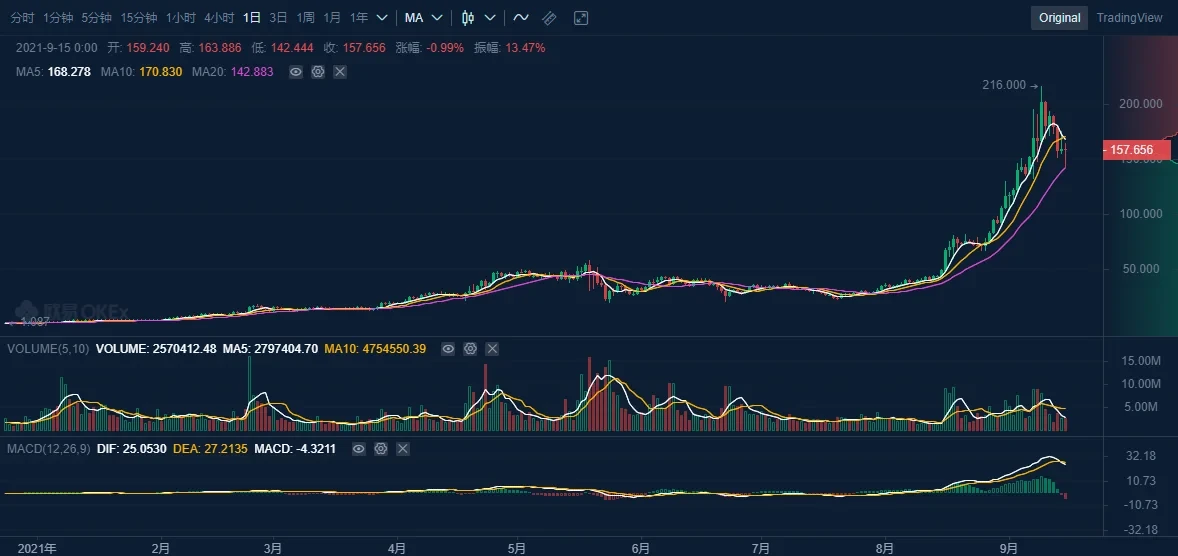
SOL Token Price Trend Changes
At its core, the key reason Solana's network can capture enormous value mainly lies in its scalability and transaction processing efficiency, with the core being its consensus mechanism. Solana's Proof of History (PoH) mechanism decouples time and state through the blockchain (in mathematics, this means variables no longer simultaneously and directly affect the result of an equation), to achieve maximum efficiency and throughput.
But recently Solana's network also encountered a huge "crisis." From 19:52 Beijing time on September 14 to 10:00 AM on September 15, Solana's Mainnet Beta experienced intermittent instability for over 13 hours, during which all applications on the Solana chain could not operate normally. Subsequently, the Solana validator community worked together to restart the network. By 2:00 PM on September 15, after upgrading to 1.6.25, the community completed the Mainnet Beta restart, after which DApps, block explorers, and support systems gradually recovered.
Regarding the cause of the downtime, Solana Status said in a statement on their Twitter account: "Solana Mainnet Beta transaction load increased significantly, reaching a peak of 400,000 TPS. These transactions flooded the transaction processing queue, lacking prioritization of key network information, causing the network to start forking. This forking led to excessive memory consumption, with some nodes going offline.
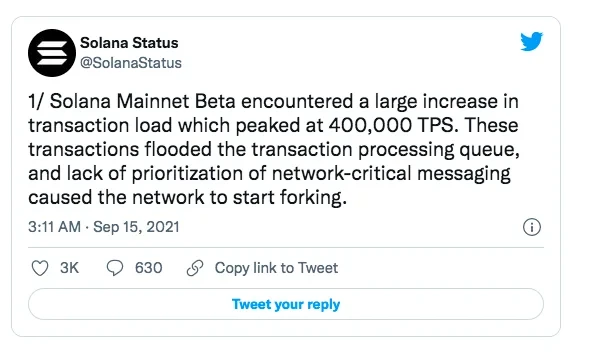
Solana once claimed it could reach 65,000-100,000 TPS, but when real traffic arrived, it couldn't handle it. Does this mean that blindly pursuing high TPS will inevitably bring problems?
This crash incident has indeed greatly reduced many people's confidence in Solana. Some have begun to question whether Solana has the ability to carry institutional-level traffic. After all, DeFi applications like DEXs, lending, and more are all built on smart contract public chains. The consequences and risks of downtime for these financial services are unimaginable. For example, if the market happens to experience huge volatility, crypto assets derivatives will suffer cascading liquidations, and players and users will suffer huge losses.
Exploring the Value of Public Chains
It is undeniable that this year's explosive DeFi market and successive waves of NFT fever have indeed provided more opportunities for public chains to perform. Many public chains have begun to rise rapidly and gradually build up ecosystems, further driving the popularity of NFT and GameFi projects. According to data from DeFi Llama, one of the most prominent performers among all public chains in the past 7 days is OKTC, with locked value growing 15,560% in the past 7 days, and on-chain TVL reaching $1.26 billion as of September 17. OKTC currently has 32,748,725 total transactions, 1,116,525 coin-holding addresses, and current TPS of 20.8.
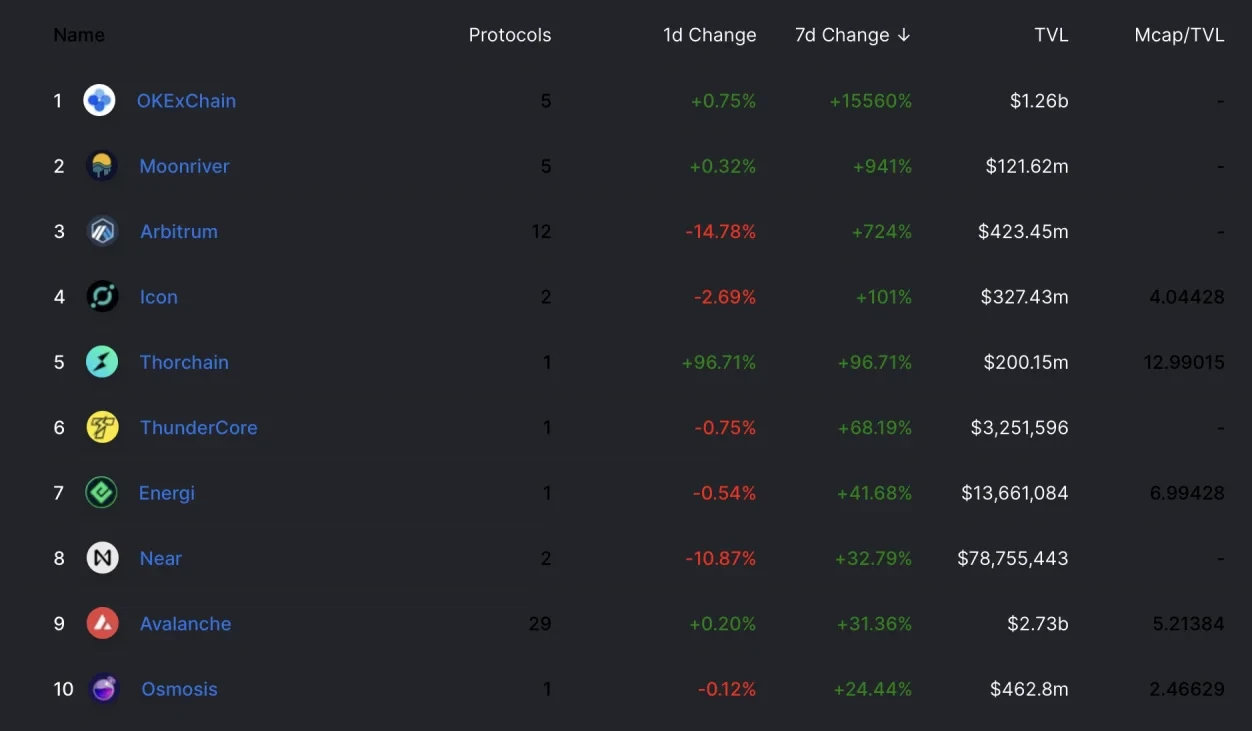
In this year's GameFi and metaverse wave, OKTC has taken some measures to help develop the blockchain ecosystem, such as launching OKTC Hackathon Season 2 in August, supporting the OKX $100 million fund metaverse plan. In addition, it has also attracted many GameFi projects, DeFi applications, and NFT platforms to join the OKTC ecosystem, such as Crypto Gladiator, SIL Finance, SOTA, and others.
So, when more and more public chains appear, how do we evaluate the value of a public chain and its chain tokens? How can public chains quickly seize market share in fierce competition?
First, fundamentally, it must be about public chain performance and experience. From the user or investor's perspective, this mainly manifests in transaction processing efficiency and transaction fees. Fast transaction speeds and low transaction fees can greatly improve transaction and usage experience, lowering transaction barriers for DeFi users. At the same time, it will also attract more DApps with high transaction needs to build ecosystems on that public chain, bringing increases in user volume and activity. This is also why many smart contract public chains are entering the race with slogans of high performance and "Ethereum killer." Then there are transaction fees. The current average transaction fee on Ethereum is around $12.26. Historically, transaction fees on Ethereum have even reached hundreds of dollars in Gas fees, which is extremely unfriendly to ordinary users. Therefore, transaction fees are also a key point for public chains to demonstrate value and establish advantages.
Second, fundamentally, as ordinary investors, you can evaluate public chains and their on-chain native assets from some important dimensions, such as Total Value Locked, transfer amounts, number of coin-holding addresses, community activity, developer interest, etc. Evaluating these fundamental elements is, on one hand, to understand their historical data changes, and on the other hand, to predict their future potential based on the current foundation. At the same time, you must also consider the impact of macroeconomic conditions and market sentiment. As for public chain token value, it's mainly considered from three angles: capital attribute, commodity attribute, and value storage attribute, which is also called the intrinsic value triangle. Capital attribute means whether it can bring you income, commodity attribute is whether it can be used for transactions and consumed, and value storage attribute represents whether it can still maintain your purchasing power in the future.
In addition, some public chains will also take certain incentive measures to quickly attract users to their chains, which is also an angle that can be considered for evaluation.
Public Chain Competitors Still Have Huge Space
In this "red ocean" of public chains, each unique blockchain may have its own value for existence, making it difficult to judge the quality of a certain public chain from a single level. From one perspective, the many public chain competitors still have huge development space. At the same time, they also face enormous opportunities and challenges, while outbreaks like DeFi and NFTs have magnified the development potential and fierce competition of public chains several times or even hundreds of times.
First, in terms of opportunities, the explosion of NFTs and Ethereum's performance issues have provided huge development space for other public chains. As the leader of public chains, Ethereum has always faced scalability and transaction efficiency issues. With the opening of 2020's DeFi Summer, its performance issues have become further highlighted. High transaction fees and congested transaction speeds have always been one of the biggest shackles to DeFi's further development and one of users' biggest pain points. Therefore, many decentralized public chains focusing on high performance and low transaction fees have begun to rise, digging for more persuasive value narratives and broader development space.
From this perspective, facing the future industry explosion and a market cap cake of trillions of dollars, the explosion of public chains represented by Solana and their crazy market cap surges don't seem too surprising.
Second, in terms of challenges, Ethereum's public chain competitors want to solidify their market position, mainly facing challenges in three dimensions: their own performance and security, Ethereum's dominant existence, and the explosion of Layer 2. A public chain's own performance and security directly affect its usage experience and development potential, especially whether it can withstand the "test" during a bull market. For example, the Solana downtime incident we mentioned earlier, as well as hacking incidents discovered historically - if they cannot successfully navigate the "crisis," they may be submerged in this "red ocean."
The second challenge comes from the maturity and explosion of Layer 2. After the launch of Arbitrum and Optimism, the development speed of Ethereum Layer 2 may exceed our expectations. In the article "After DeFi and NFTs, Will Layer 2 Become Ethereum's Next Explosion Point? (Part 1)", we mentioned that according to recent statistics from L2BEAT.co, the Total Value Locked of all Layer 2 solutions on Ethereum has exceeded $1 billion, among which the TVL of the dYdX protocol based on StarkEx is nearly $290 million, Nahmii 1.0's locked amount is $159 million, and Optimism's locked amount is $157 million. And Arbitrum One mainnet, which launched just a week ago, has already reached over $66 million in TVL. As Arbitrum and Optimism mainnets gradually mature and improve, some high-quality projects are migrating to Layer 2. At the same time, the two-layer network solution can largely alleviate Ethereum's congestion in the future. So at that time, will the development space of public chain competitors be squeezed?
The last challenge is Ethereum's dominant position. Although Ethereum is not unsurpassable by other public chains, it does indeed possess considerable "monopoly" advantages in terms of ecosystem. From last year to this year, the explosions of DeFi and NFTs have made Ethereum gain the attention and favor of many institutions. Crypto market funds are limited, so other public chains' market share must be a zero-sum game, and they will still be suppressed by Ethereum in the medium to long term. Even if public chain tokens like SOL surge in price, their market caps are still only a small fraction compared to Ethereum. Regardless of how the "Ethereum killer" slogan is evaluated, public chain competitors must at least first surpass Layer 2 in ecosystem applications, liquidity, locked asset amounts, transaction numbers, and active user numbers before they can face Ethereum and challenge its position.
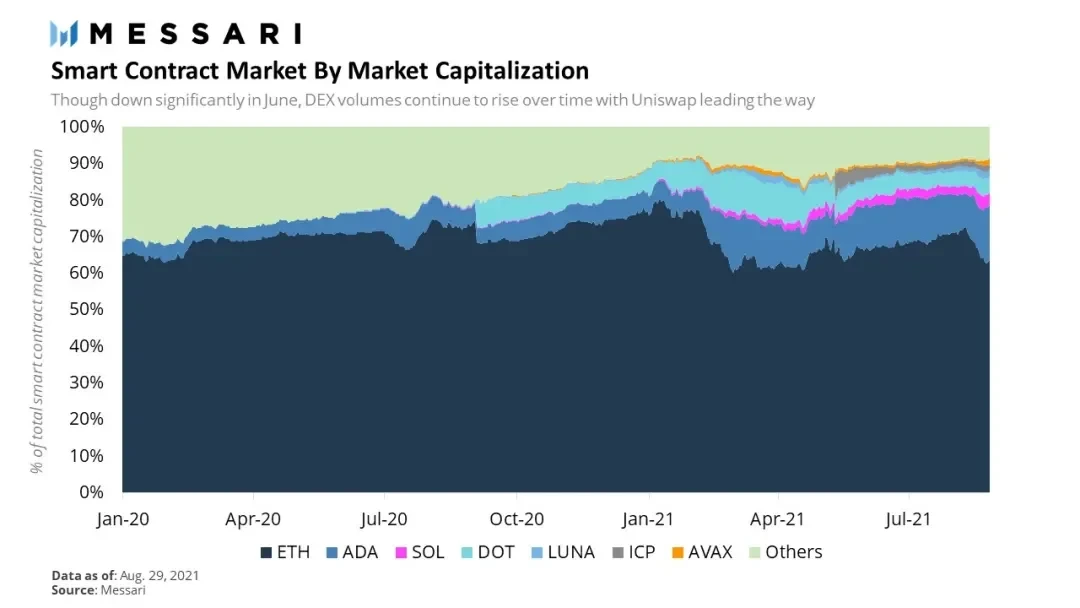
Public Chain Platform Market Cap Share Change Trend
In summary, it can be foreseen that the public chain war will be difficult to end for a while, and we will be in a multi-chain coexistence world for a long time. The term "Ethereum killer" should continue to appear in our vision. When the next "star public chain" appears, what we need to do is look through the phenomenon to the essence. Behind the popularity there may be FOMO sentiment. When the heat fades and the violent bull market comes, can many public chains like Solana withstand the test and maintain a good ecosystem? This is the key to insight into the true strength of public chain competitors.
Disclaimer
This article may contain product-related content not applicable to your region. This article is committed to providing general information only and is not responsible for any factual errors or omissions therein. This article represents only the author's personal views and does not represent OKX's views. This article is not intended to provide any advice, including but not limited to: (i) investment advice or investment recommendations; (ii) offers or solicitations to buy, sell, or hold digital assets; or (iii) financial, accounting, legal, or tax advice. Holding digital assets (including stablecoins) involves high risk, may fluctuate significantly, and may even become worthless. You should carefully consider whether trading or holding digital assets is suitable for you based on your financial situation. For questions about your specific situation, please consult your legal/tax/investment professional. The information appearing in this article (including market data and statistics, if any) is for general reference only. Although we have taken all reasonable precautions in preparing these data and charts, we assume no responsibility for any factual errors or omissions expressed herein. © 2025 OKX. This article may be reproduced or distributed in full, or excerpts of 100 words or less from this article may be used, provided such use is non-commercial. Any reproduction or distribution of the entire article must also prominently state: "This article is copyrighted © 2025 OKX, used with permission." Permitted excerpts must cite the article name and include the source, for example "Article Name, [Author Name (if applicable)], © 2025 OKX". Some content may be generated or assisted by artificial intelligence (AI) tools. Derivative works or other uses of this article are not permitted.
Show More
Recommended Reading
OKX Pay: Opening a New Era of Next-Generation Crypto Payments
The choice of tens of millions of users. Register OKX and enjoy ultimate trading experience and diverse wealth management products. A letter from OKX CEO Star: Today, we officially launch the first version of OKX Pay to over 100 million global users. As the industry's first payment application to truly achieve non-custodial and compliant integration, OKX Pay will be embedded in the OKX App and is currently open to some markets, expected to fully
March 22, 2026

New Chapter: Building Next-Generation Financial Infrastructure Together
OKX's partnership with Intercontinental Exchange (ICE) is an important moment for OKX and equally significant for the evolution of the entire digital assets market. ICE establishes and operates the world's most important financial infrastructure, including the New York Stock Exchange as well as global derivatives and clearing platforms. This investment by ICE in OKX and joining our board demonstrates both parties' shared belief—digital assets technology will be in the financial markets
March 10, 2026
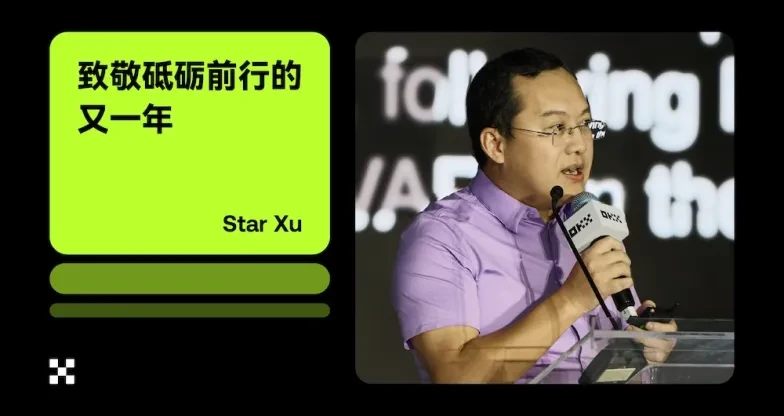
Tribute to Another Year of Forging Ahead
As OKX's CEO, and also a builder who stays true to our original mission, I am proud to look back on OKX's extraordinary growth and progress this year. Despite many challenges, 2024 has been a year of focus, innovation, and resilience. We not only expanded and optimized our products, but also made important progress in launching transparent and compliant localized businesses, while further strengthening our global management team. Notably, after experiencing
January 29, 2026

2025: Steady Progress Toward Financial Freedom Together
— Year-end letter from OKX Founder and CEO Star to global users. "Financial freedom" is often misunderstood. It doesn't mean no rules, but rather having the right to choose even when rules exist—and when the system is truly tested, it remains reliable and effective. This is exactly what we focused on throughout 2025. First, I want to extend my sincere gratitude to our global clients, partners, and regulatory authorities
January 16, 2026
OKX Officially Launches in Germany and Poland
Author: Erald Ghoos, CEO of OKX Europe. Today is significant for OKX—and also for crypto users across Europe. We have officially launched our fully compliant centralized cryptocurrency trading platform in Germany and Poland! For us, this is not just a geographic expansion, but a commitment to building the cryptocurrency future the right way: secure, transparent, and meeting local needs. If you are in Germany
October 21, 2025
Partnership Upgrade! OKX Partners with Standard Chartered to Expand European Market
On October 15, OKX Europe CEO Erald Ghoos stated that OKX is expanding its strategic partnership with Standard Chartered to the European Economic Area (EEA). Earlier this year, OKC first partnered with Standard Chartered in the UAE to launch the collateral mirroring program—this is a
October 15, 2025