UNI Hits New High, DEX Growth Surges But Shortcomings Remain Evident
CRV+3. 34%
According to OKX market data, as of April 28, 2021 at 10:00 AM, UNI price peaked at 42 USDT, hitting a new all-time high once again. Since the sharp drop on April 18th, the rebound has approached 60%, ranking first among the top ten crypto assets by market cap.
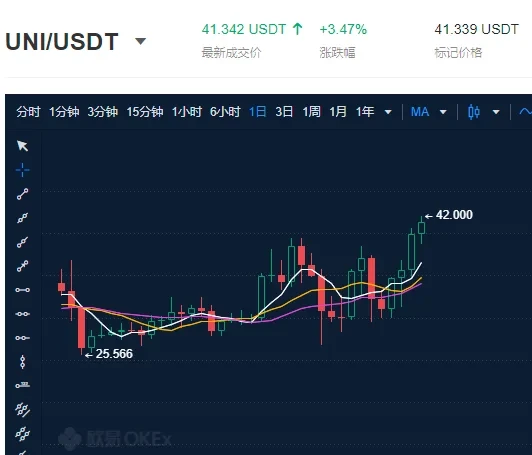
UNI price trend, source OKX
Since the DeFi explosion last year, DEX (decentralized exchanges) have attracted widespread attention thanks to strong user demand and wealth-creation effects. Among them, Uniswap can be regarded as the true pioneer in the DEX space, and UNI——as the native governance token of the Uniswap exchange——its price surge undoubtedly confirms market recognition of this emerging phenomenon. Of course, it's not just UNI's price; other Uniswap metrics are equally impressive.
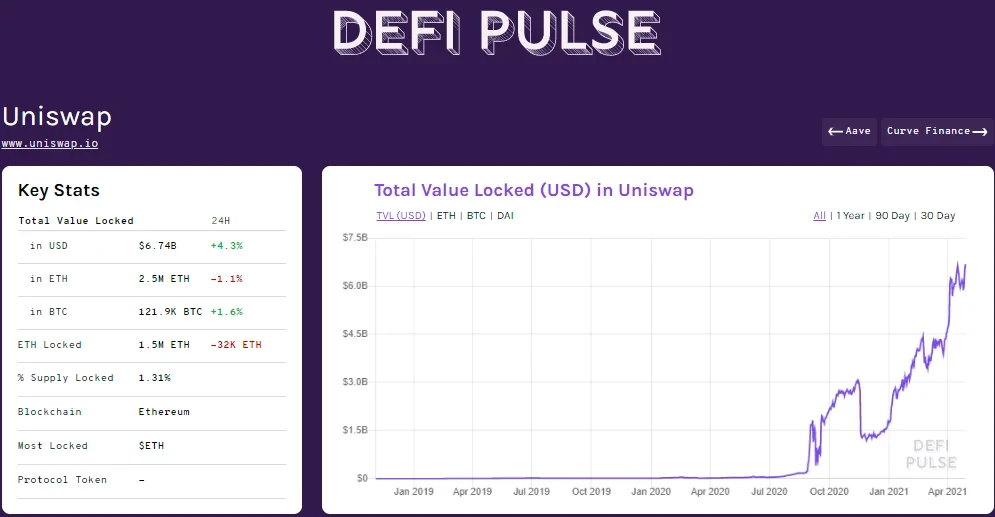
Uniswap TVL growth trend, source defipulse
Let's start with TVL (Total Value Locked of on-chain assets) on Uniswap. At the end of April 2020, Uniswap's TVL was only $17 million; one year later today, this figure has grown to $6.74 billion, an increase of 395 times.
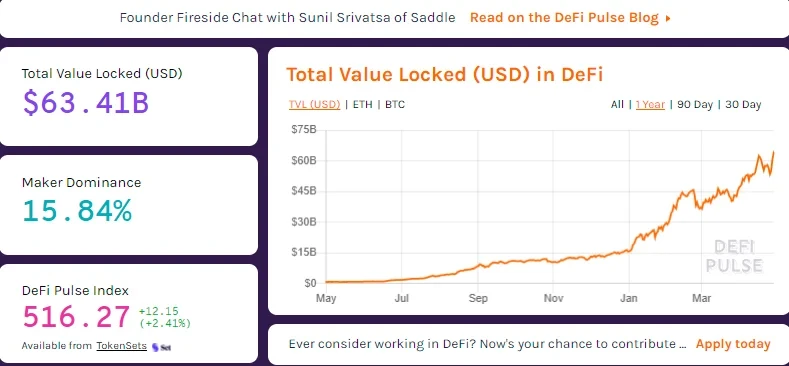
For comparison, according to defipulse data, the total locked value of the DeFi market over the same period was $63.4 billion, meaning Uniswap's locked value alone accounts for more than 10% of the entire DeFi market.
Next, let's look at Uniswap's liquidity changes. In early May 2020, Uniswap was still an无人问津的"加密荒地" (an obscure crypto wasteland); in less than a year, Uniswap's liquidity underwent a dramatic transformation, from $0.99 to $8.93 billion, comparable to many centralized exchanges.
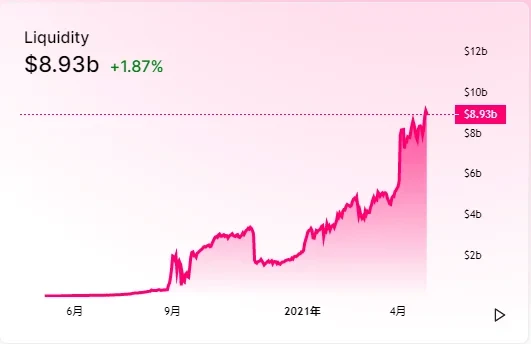
Uniswap liquidity, source Uniswap.org
Finally, let's examine Uniswap's scale changes. Within the same period of less than a year, it grew from zero to a size of $1.3 billion—a testament to its rapid development.
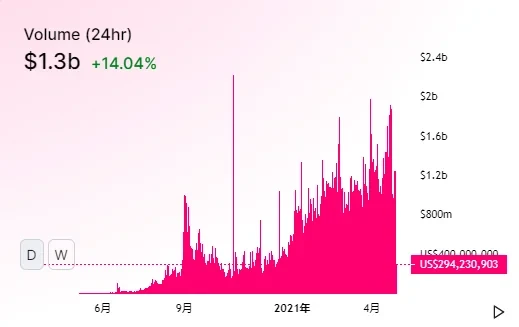
Uniswap scale, source Uniswap.org
Using Uniswap's achievements over the past year as an introduction, let's now take a look at the overall DEX market situation.
DEX Overview
——How Does a DEX Work?
Generally speaking, based on different trading models, DEX can be divided into three types: First, an order book model where custody and trade matching are completed off-chain, solving issues such as slow on-chain trading speed, insufficient depth, high slippage, and impermanent loss—examples include Loopring and 0x; second, an AMM (automated market maker) model that supports instant human-machine trading, allowing anyone to become a market maker and greatly increasing trading depth, solving the drawbacks of on-chain trading—this is currently the most widely adopted model, such as Uniswap, SushiSwap, and Curve; third, a hybrid of the two models.
Among these, the AMM automated market maker model deserves special attention. After years of development and evolution, the AMM automated market maker model has proven to be one of the most impactful DeFi innovations. To further subdivide, AMM can be categorized into Constant Product Market Maker (CPMM), Constant Sum Market Maker (CSMM), Constant Mean Market Maker (CMMM), and advanced hybrid constant function market makers (CFMM). We won't dive deeper into these here; instead, we'll focus on the macroeconomic model's method of operation from a macro perspective.
The AMM automated market maker model has fundamentally changed the way users trade crypto assets. Unlike traditional order book trading models, both parties in an AMM trade interact with on-chain liquidity asset pools. Liquidity pools allow users to seamlessly switch between crypto assets on-chain in a fully decentralized and non-custodial manner. Liquidity providers earn passive income through trading fees, which are calculated based on their percentage contribution to the asset pool.
Although the AMM automated market maker model was first proposed by Bancor, it was Uniswap that truly brought it to prominence—it would not be an exaggeration to say that Uniswap gave AMM its life.
In its current version, Uniswap allows anyone with internet access, an Ethereum wallet, and ETH (or ERC20 crypto assets) to seamlessly swap assets in a permissionless manner. The simplified trading process is roughly as follows:
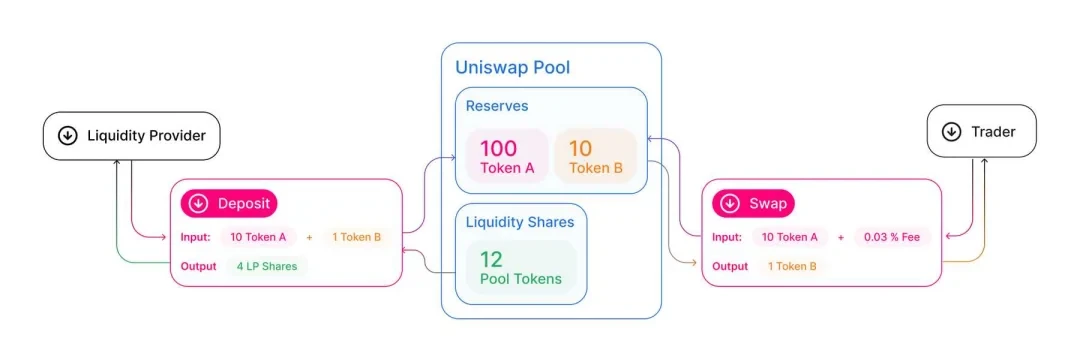
Uniswap trading process, source network
As we can see from the diagram above, there are two participants in a complete Uniswap trading process: traders and liquidity providers (LP). LPs first inject a certain amount of crypto assets into the pool to provide trading liquidity, while earning fees paid by traders. At the same time, the Uniswap protocol allocates the corresponding governance token UNI to LPs as rewards for providing liquidity.
In this process, for liquidity providers, the act of earning returns by providing liquidity is what we commonly refer to as liquidity mining—primarily meaning obtaining the native governance token of a DEX. Currently, most DEX use this method to distribute native governance tokens to genuine community users—that is, the project's most authentic stakeholders. However, due to the existence of impermanent loss, LPs participating in liquidity mining cannot guarantee stable returns. Regarding impermanent loss, we will continue to discuss this in the next section.
——What is the Current State of DEX?
According to CoinGecko data, DEX total trading volume in the past 24 hours reached $9.5 billion, accounting for 4.2% of the total global crypto market trading volume over the same period, with more than 57 million monthly visits.

DEX market overview, source CoinGecko
In the entire DEX market, Uniswap dominates with an overwhelming 54.5% market share.
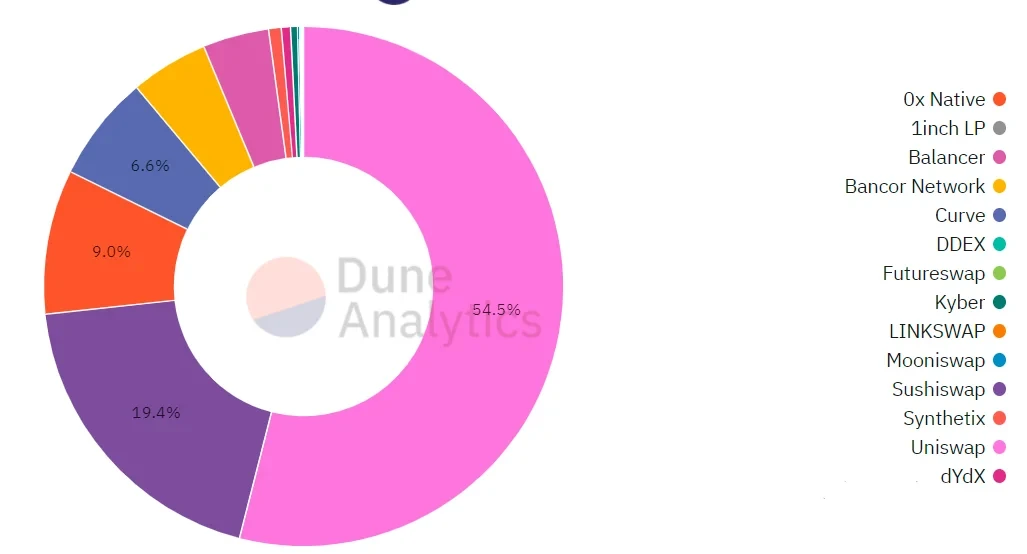
DEX market share distribution, source Dune Analytics
If we extend the timeline, we can see the rapid development of the DEX market more intuitively.
For example, examining DEX trading volume changes on a monthly basis, we can find that in early 2019, not only were there very few DEX (only Uniswap, Kyber, and IDEX), but the trading volume was less than $40 million. By February 2021, DEX monthly trading volume once exceeded $60 billion, showing explosive growth since entering 2021.
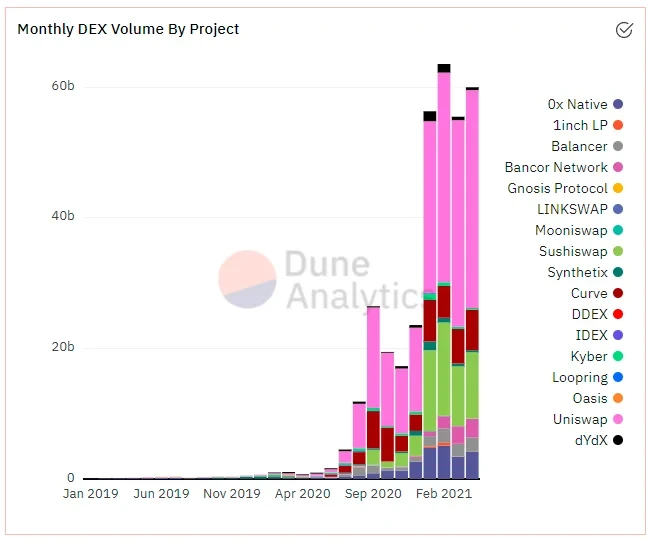
DEX monthly trading volume changes, source Dune Analytics
The number of people who have participated in DEX trading has also reached 19 million.
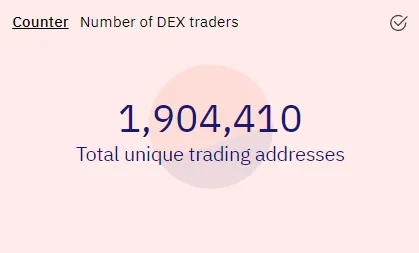
For comparison, let's look at the number of U.S. citizens who participate in stock market investment. According to statistics from the Securities Industry and Financial Markets Association (SIFMA), approximately 37.6% of Americans own stocks. Based on a total U.S. population of 300 million, this is roughly 110 million people. In other words, DEX has attracted a user base equivalent to 18% of American stock investors in less than 2 years—an impressive achievement in the crypto market.
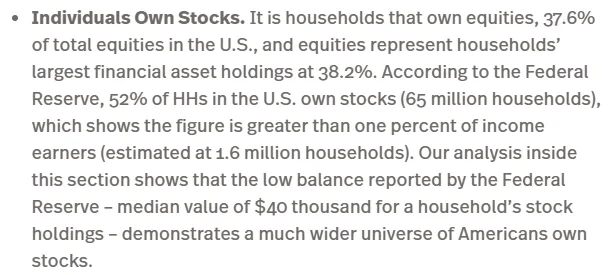
U.S. citizen stock ownership ratio, source SIFMA
What Are the Shortcomings Hindering Further DEX Development?
As the saying goes: success and failure both stem from the same factor. One of the key法宝 (secret weapons) that makes DEX so popular among crypto investors is the AMM automated market making mechanism. However, it's undeniable that the impermanent loss that AMM may bring is also a key reason hindering more small and medium-sized investors from entering.
The primary and most common unknown risk for users providing liquidity to AMM pools is impermanent loss (IL)—the value difference that occurs when crypto assets deposited in an AMM are compared to simply holding them in a wallet. This loss occurs when the market price of crypto assets in the AMM deviates in any direction. Since AMM does not automatically adjust exchange rates, arbitrageurs need to buy underpriced assets or sell overpriced assets until the price offered by the AMM matches the entire market price of external markets. Arbitrageurs drain profits from the pockets of liquidity providers, causing losses. Additionally, due to high Ethereum on-chain gas fees for a long time, if combined with impermanent loss, it's very possible that LP governance token rewards are insufficient to cover their costs.
Beyond impermanent loss, DEX still lacks user-friendliness in terms of interface design and operational barriers—there is still significant room for improvement. Although Uniswap and other DEX have made some improvements in interface design and operational guidance over the past year, they remain inconvenient for many newcomers. In our previous article "DeFi Total Value Locked Exceeds $60 Billion—How to Maintain Appeal to Investors," we envisioned DeFi's future development prospects and made the following judgment: the large population in developing countries without bank accounts will be the blue ocean market for future DeFi development. However, based on current DEX design, it is far from meeting the needs of this enormous group.
However, thankfully, we have already seen promising changes. In late March, Uniswap V3 was released, showing us something far more elegant than any solution currently on the market—granular-controlled AMM aggregated liquidity. In theory, it can improve capital efficiency by up to 4,000 times. Now, by allowing LPs to place funds within specified price ranges on the curve, provided LPs' price judgments are relatively accurate, they can earn the same trading fees with far less capital than before.
At the same time, for those LPs who are very averse to impermanent loss, they can now use this price range control to have complete control over the percentage of impermanent loss they are willing to accept. This improvement in capital efficiency is clearly a result we are glad to see.
Additionally, as DeFi develops further, especially with more capital inflows, we have reason to believe that more DeFi entrepreneurs will dive into more细分领域 (niche segments), making more user-friendly improvements to the interaction design of various DeFi products. Once this wave of decentralized financial social transformation begins, it is difficult to stop. Inclusive, fair, and equal financial society is both our goal and the driving force behind current practitioners' continuous efforts. Let's look forward to a better future together.
Disclaimer
This article may contain product-related content not applicable to your region. This article is intended to provide general information only and makes no responsibility for any factual errors or omissions. This article represents the author's personal views only and does not constitute OKX's views. This article is not intended to provide any advice, including but not limited to: (i) investment advice or investment recommendations; (ii) offers or solicitations to buy, sell, or hold digital assets; or (iii) financial, accounting, legal, or tax advice. Holdings of digital assets (including stablecoins) involve high risk and may fluctuate significantly, or even become worthless. You should carefully consider whether trading or holding digital assets is suitable for you based on your financial situation. For questions regarding your specific circumstances, please consult your legal/tax/investment professional. Information appearing in this article (including market data and statistics, if any) is for general reference purposes only. While all reasonable precautions have been taken in preparing such data and charts, we assume no responsibility for any factual errors or omissions expressed herein. © 2025 OKX. This article may be reproduced or distributed in its entirety, or excerpts of 100 words or less may be used, provided that such use is non-commercial. Any reproduction or distribution of the full article must prominently state: "This article is copyrighted © 2025 OKX, used with permission." Permitted excerpts must cite the article title and include attribution, for example, "Article Title, [Author Name (if applicable)], © 2025 OKX." Some content may have been generated or assisted by artificial intelligence (AI) tools. Derivative works and other uses of this article are not permitted.
Show More
Recommended Reading
OKX Pay: Ushering in a New Era of Next-Generation Crypto Payments
The preferred platform for tens of millions of users. Register with OKX and enjoy an exceptional trading experience and diverse wealth management products. A letter from OKX CEO Star: Today, we officially launched the first version of OKX Pay for over 100 million global users. As the industry's first payment application truly achieving the fusion of non-custodial and compliant services, OKX Pay will be embedded within the OKX App and is currently available in select markets, with full availability expected within
March 22, 2026

A New Chapter: Building the Next Generation of Financial Infrastructure Together
The partnership between OKX and the Intercontinental Exchange (ICE) represents a significant milestone for OKX and holds equally profound meaning for the evolution of the entire digital assets market. ICE establishes and operates the world's most important financial infrastructure, including the New York Stock Exchange and global derivatives and clearing platforms. This investment by ICE Select in OKX and its addition to our board reflects our shared belief—that digital assets technology will play a transformative role in the financial市
March 10, 2026
Tribute to Another Year of Perseverance and Progress
As OKX's CEO and a builder who stays true to the original mission, I take great pride in reflecting on the extraordinary growth and progress OKX has achieved this year. Despite numerous challenges, 2024 was nonetheless a year filled with focus, innovation, and resilience. We not only expanded and optimized our products, but also made significant strides in launching transparent and regulation-compliant localized businesses, while further strengthening our global management team. It is worth noting that after going through
January 29, 2026

2025: Steady Progress Toward Financial Freedom Together
—— Year-End Letter to Global Users from Star, Founder and CEO of OKX "Financial freedom" is often misunderstood. It doesn't mean the absence of rules, but rather having the right to choose even when rules exist—and moreover, when the system is truly tested, it remains reliable and effective. This is precisely what we remained focused on throughout 2025. First, I would like to express our sincere gratitude to global customers, partners, and regulators
January 16, 2026

OKX Officially Launches in Germany and Poland
By Erald Ghoos, CEO of OKX Europe Today is significant for OKX—and for crypto users across Europe. We have officially launched our fully compliant centralized cryptocurrency trading platform in Germany and Poland! For us, this is not just a geographic expansion, but a commitment to building the future of cryptocurrency the right way: safe, transparent, and tailored to local needs. If you are in Germany
October 21, 2025

Partnership Upgrade! OKX and Standard Chartered Join Forces to Expand into European Markets
On October 15th, Erald Ghoos, CEO of OKX Europe, stated that OKX is expanding its strategic partnership with Standard Chartered to the European Economic Area (EEA). Earlier this year, OKX and Standard Chartered first partnered in the UAE, launching a collateral mirroring program——this is a
October 15, 2025