XRP Surges 130% in One Week, But the Showdown Between Ripple and the SEC Continues to Simmer
Recently, XRP's meteoric rise has captured market sentiment. As one of the top ten mainstream coins by market cap, XRP took just one week to overtake ADA, DOT, and USDT, climbing to fourth place with a weekly gain of nearly 130%.
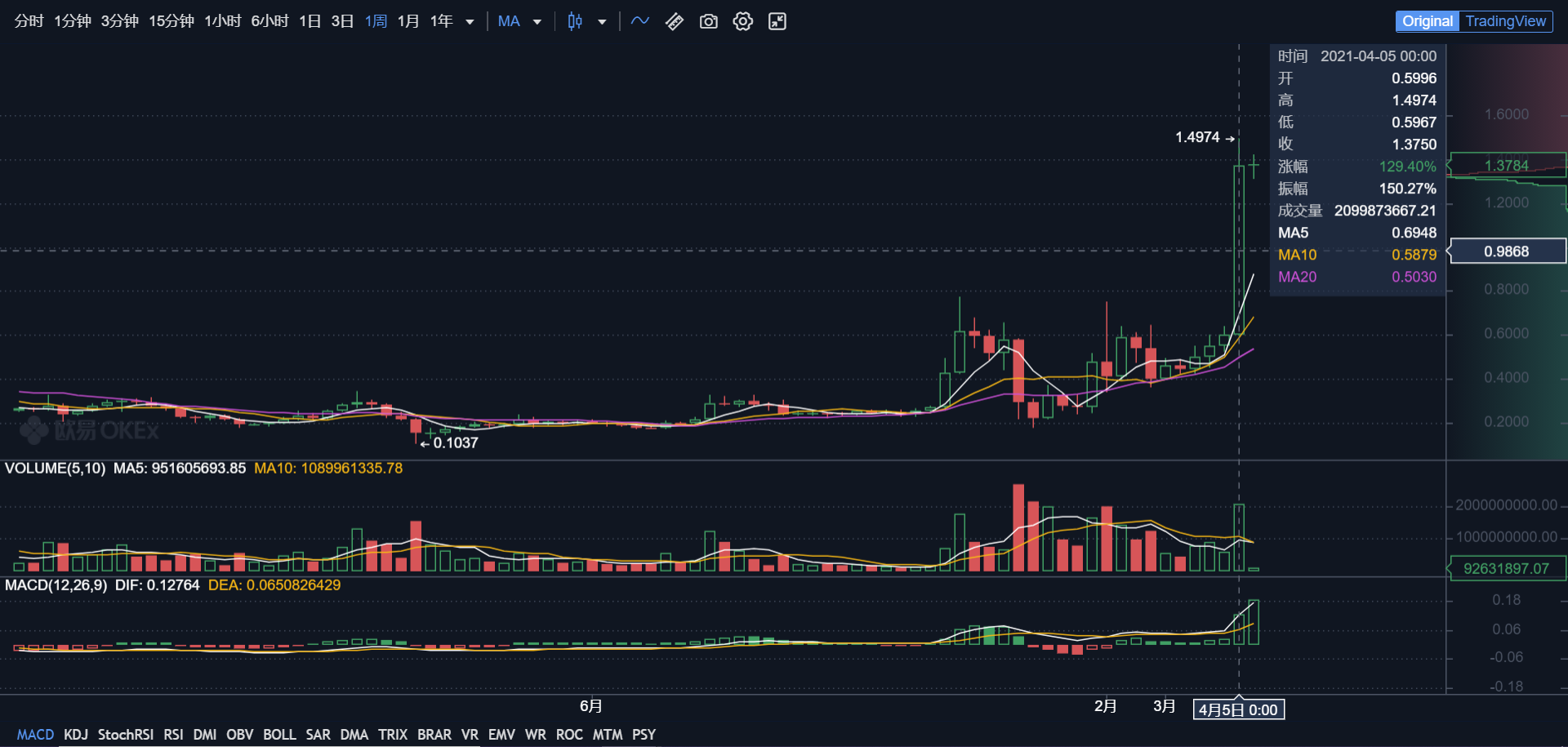
As of press time, OKX market data shows XRP trading at $1.376, down 8.08% from its intraday high of $1.497. However, holding above $1.37 still marks a new all-time high since January 22, 2018. Compared to its historical peak of $3.539, XRP still has 60% of "lost ground" to recover.
In the short term, Ripple has secured some substantive victories in its showdown with the SEC. But as long as the legal battle remains unresolved, it remains a sword of Damocles hanging over Ripple and XRP holders.
XRP surges nearly 470%
Over the just-concluded weekend, XRP delivered an outstanding performance. OKX real-time data shows XRP rose as much as 50% over two days, with a single-day surge of 29.39% on April 10, further solidifying its position as the fourth-largest cryptocurrency by market cap.
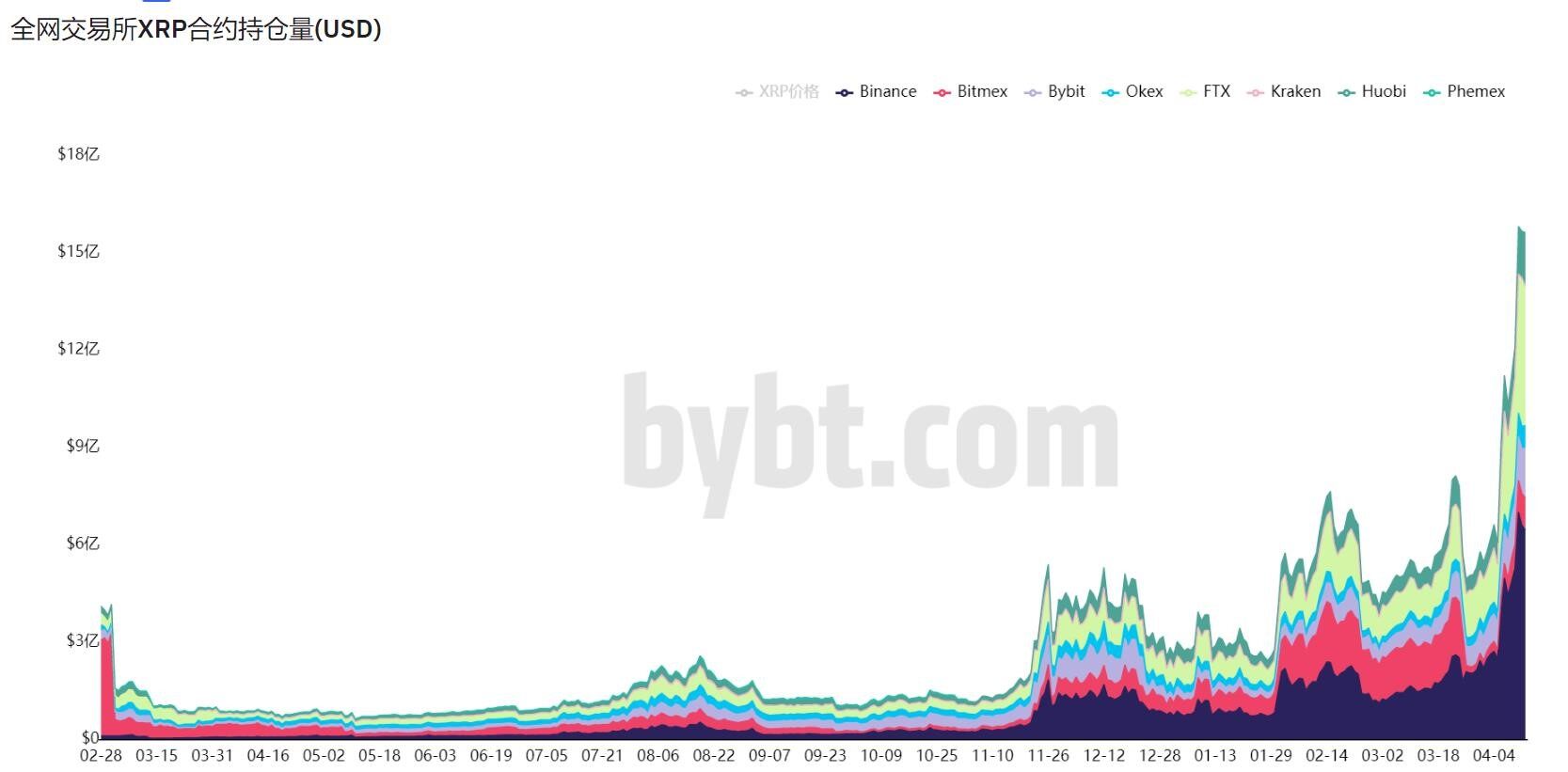
According to Bybt data, XRP's open interest hit a record high of $1.581 billion on April 11.
Galaxy Digital CEO Mike Novogratz suggested that XRP's recent sustained rally may indicate progress in settlement negotiations between Ripple and the U.S. SEC.
In fact, U.S. District Judge Sarah Netburn in the Southern District of New York denied the SEC's request to disclose Ripple executives' personal financial records, stating they were irrelevant to the case. It is reported that last month, the SEC demanded that Ripple CEO Brad Garlinghouse and former CEO and co-founder Chris Larsen provide eight years of financial records, claiming these would support its ongoing lawsuit against Ripple.
Moreover, Ripple has achieved consecutive substantive victories in its clashes with the SEC.
On March 22, the SEC and Ripple held their first online pretrial hearing. Judge Netburn explicitly stated her understanding of XRP as having not only monetary value but also utility, and that this utility distinguishes XRP from Bitcoin and Ethereum. This statement was interpreted as a potential signal that XRP may not constitute a security.
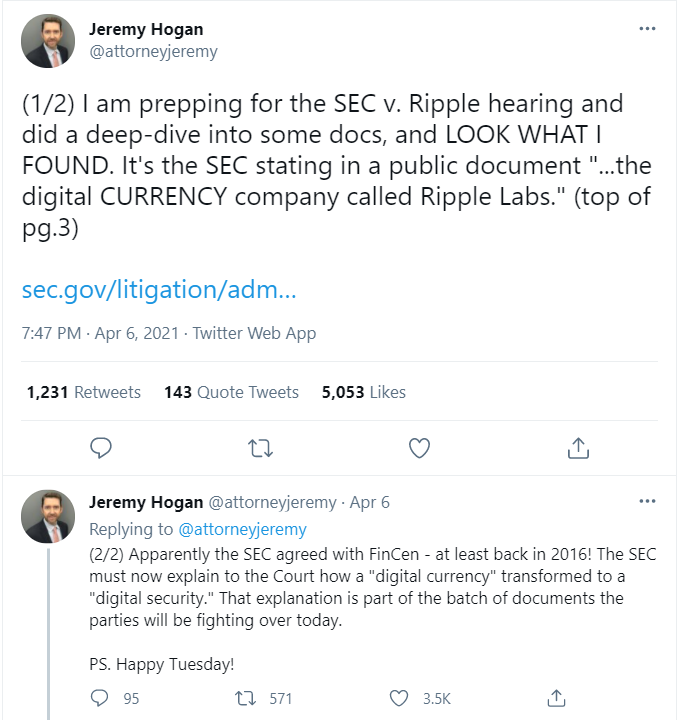
On April 3, the SEC and Ripple reached an agreement allowing Ripple to partially amend two高管 emails to avoid disclosing confidential data. Three days later, Jeremy Hogan, partner at the Hogan & Hogan law firm, tweeted asking the SEC to explain why it referred to Ripple as "the digital CURRENCY company called Ripple Labs" in an official 2016 document.
Ripple has seized on this as well. On one hand, they challenged the SEC's lawsuit, arguing that XRP is similar to Bitcoin or Ethereum—both of which the SEC has classified as commodities. On the other hand, they criticized the agency for waiting eight years before bringing charges against Ripple.
In response, on April 7, Judge Netburn granted Ripple's motion requiring the SEC to produce internal documents related to Bitcoin and Ethereum (email communications between staff do not need to be produced). Ripple was granted access to SEC meeting minutes or memoranda concerning cryptocurrencies, which could help Ripple's lawyers find evidence of the SEC's self-contradictions in these internal materials. If successful, Ripple would have a strong chance of overturning the SEC's claims.
Driven by a string of positive developments, XRP's price performed strongly. Starting April 5, XRP surged nearly 130% in a single week.
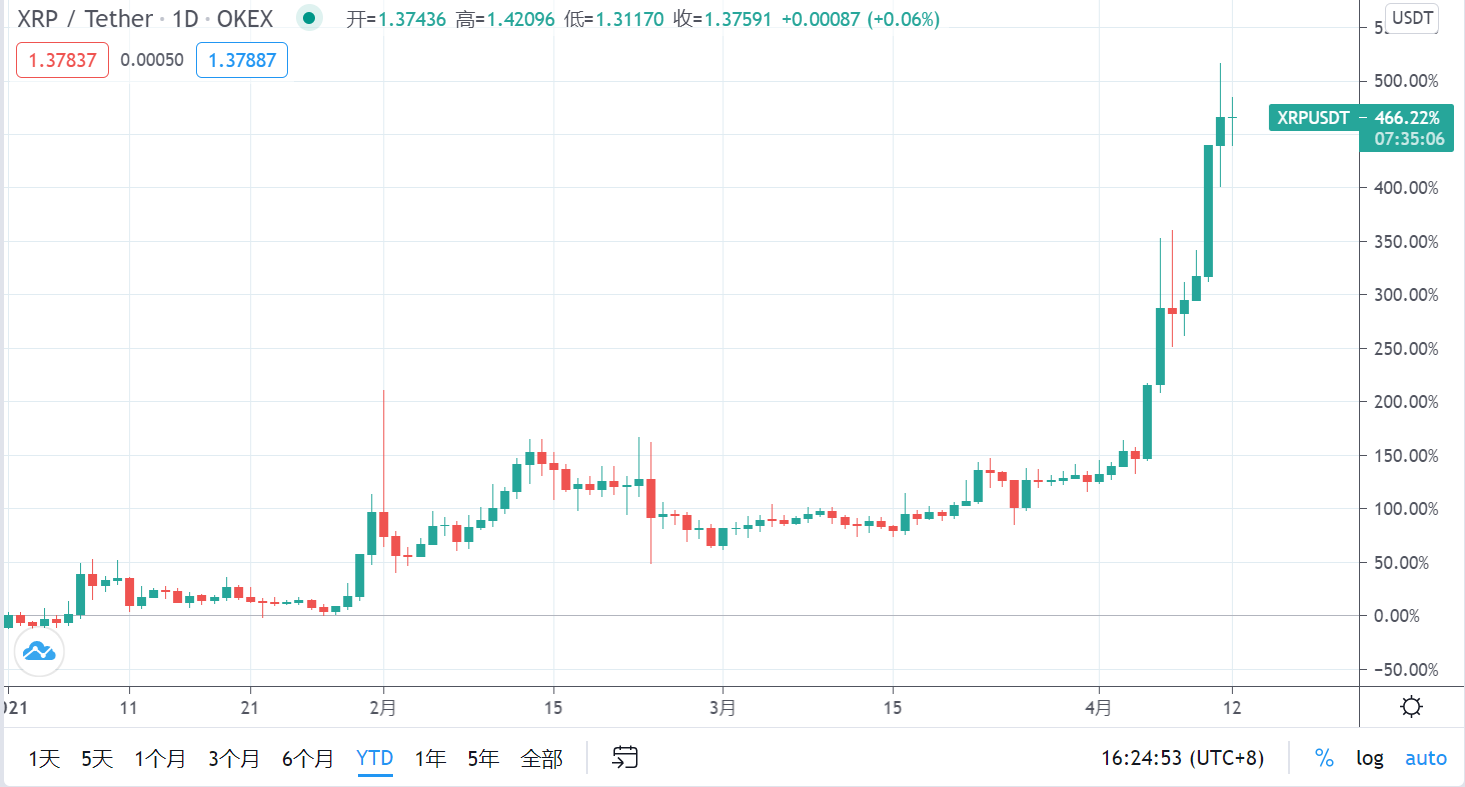
If we extend the timeline, XRP's year-to-date gain reached 466.22%, with the main rally occurring in late March and April—which coincides precisely with Ripple's substantial progress in its case against the SEC.
Additionally, reports indicate that South Korean investors are also a factor behind XRP's sustained rally. Data from Korea's two major exchanges, Bithumb and Upbit, shows that the XRP/KRW trading pair is the most actively traded.
The Ripple vs. SEC case has attracted significant attention from both within and outside the crypto community, as the outcome will directly influence how U.S. regulators define and enforce "cryptocurrency as a security" going forward. It is worth revisiting the history between Ripple and the SEC.
The Storm Around Ripple
After a prolonged period of consolidation, XRP broke out on November 19, 2020, closing higher for seven consecutive days. It skyrocketed from an opening price of $0.286 to a closing price of $0.705 on November 25—a gain of 146.50%. Analysts suggested this may be linked to five key bullish catalysts.
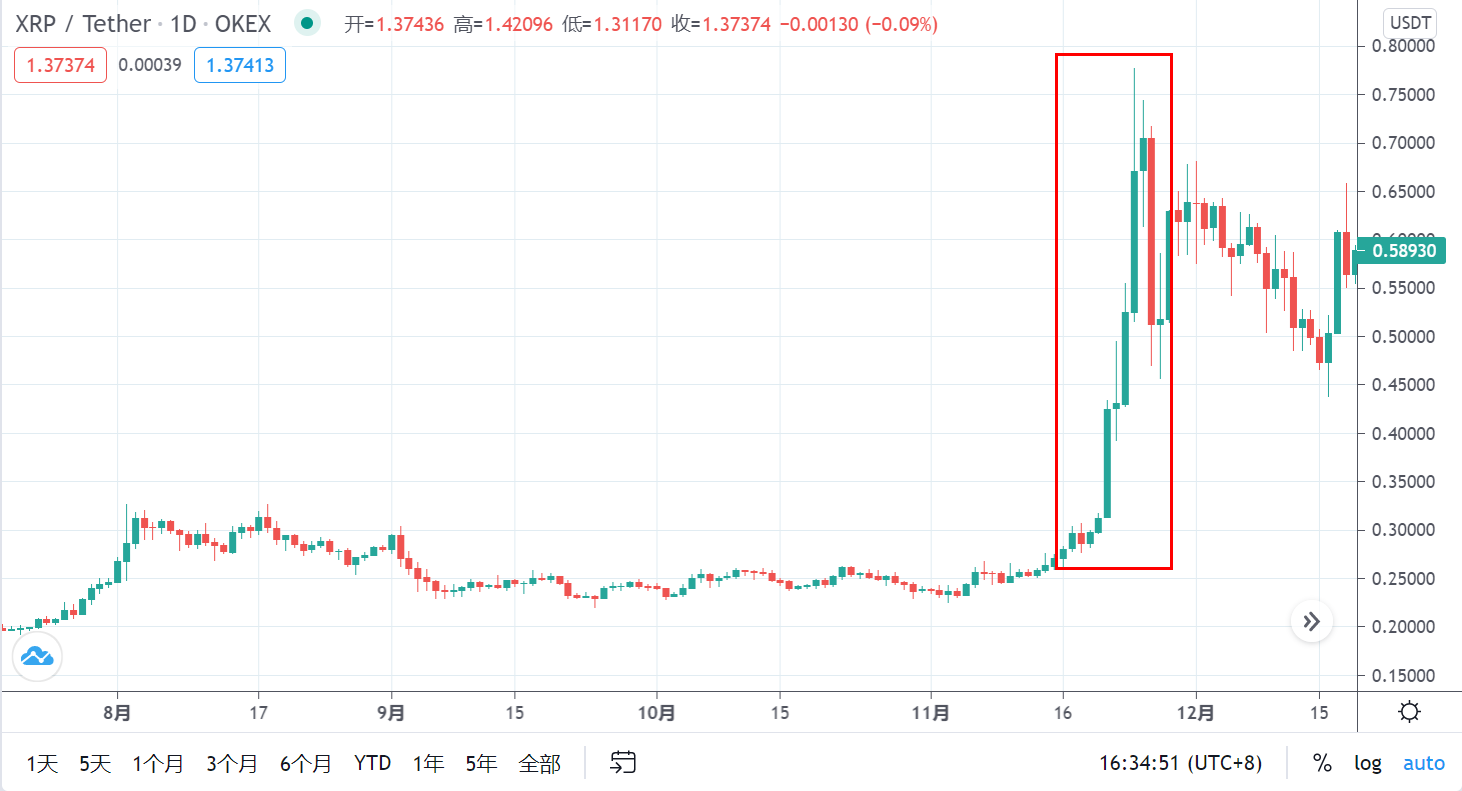
First, Ripple's official XRP buyback. On November 10, 2020, Ripple's official Q3 report revealed that the company repurchased $46 million worth of XRP in Q3 2020 and stated it would continue repurchasing XRP in the future.
Second, Flare Networks—one of the most anticipated Ripple (partner) projects—planned to airdrop SPARK tokens to XRP holders on December 12.
Third, Ripple reached a strategic partnership with PNC, the seventh-largest bank in the United States. PNC became the first U.S. bank to use a blockchain platform to process cross-border payment services for customers.
Fourth, Ripple filed new trademarks for its new product Pay String under the categories of "insurance and financial" and "advertising and business." The product could be used for electronic financial services such as fiat and virtual currency exchange and remittances.
Fifth, the Grayscale whale effect. After Grayscale drove Bitcoin's price ever higher, its trust products became a bellwether for the crypto community, which also contributed to XRP's rally.
Additionally, there is an interesting explanation. Bitcoin's price surge attracted a wave of retail investors entering the market for the first time. Among the top ten mainstream coins, they noticed that XRP's price was low enough to be accessible, leading them to believe that cheaper coins could see stronger future gains—thus buying XRP.
Long-time members of the crypto community will know that the biggest issue XRP faced in the mid-term was whether it would be deemed a security by the SEC, subjecting it to securities regulation and causing significant harm. The Howey Test is the framework the SEC uses to determine whether a cryptocurrency qualifies as a security, analyzing four key dimensions: 1) an investment of money; 2) in a common enterprise; 3) with an expectation of profit; 4) derived from the efforts of the promoter or a third party.
XRP's primary strategy to avoid being classified as a security has been to draw a clear line between Ripple and XRP, so that the third and fourth prongs of the Howey Test cannot be satisfied. Therefore, Ripple has consistently worked to distance itself from XRP—its CEO emphasized that XRP is independent of Ripple, that XRP holders do not own equity in Ripple, and will not receive dividends. Ripple has also stated that it does not consider XRP to be an investment and has never claimed XRP's price would rise, so no profit should be expected from purchasing XRP.
However, because Ripple controls the majority of the token supply and is responsible for most of the software development and value-related work, the accusation that "XRP is a security" has always loomed over this delicate symbiosis. The SEC alleged that Ripple and its founders sold more than 14.6 billion digital asset securities "XRP" in exchange for at least $1.38 billion in funds, that defendants failed to register their offers and sales of XRP, and obtained no exemption from registration, violating the registration requirements of federal securities laws. Accordingly, the SEC formally sued Ripple and two of its executives—CEO Brad Garlinghouse and co-founder Chris Larsen—on December 22.
From the news breaking to its formal announcement, XRP's price nearly halved in three days, plummeting from an opening price of $0.528 on December 22 to a closing price of $0.272 on December 24. Major exchanges,纷纷宣布下架XRP, at which point this once third-ranked cryptocurrency plummeted to its lowest point.
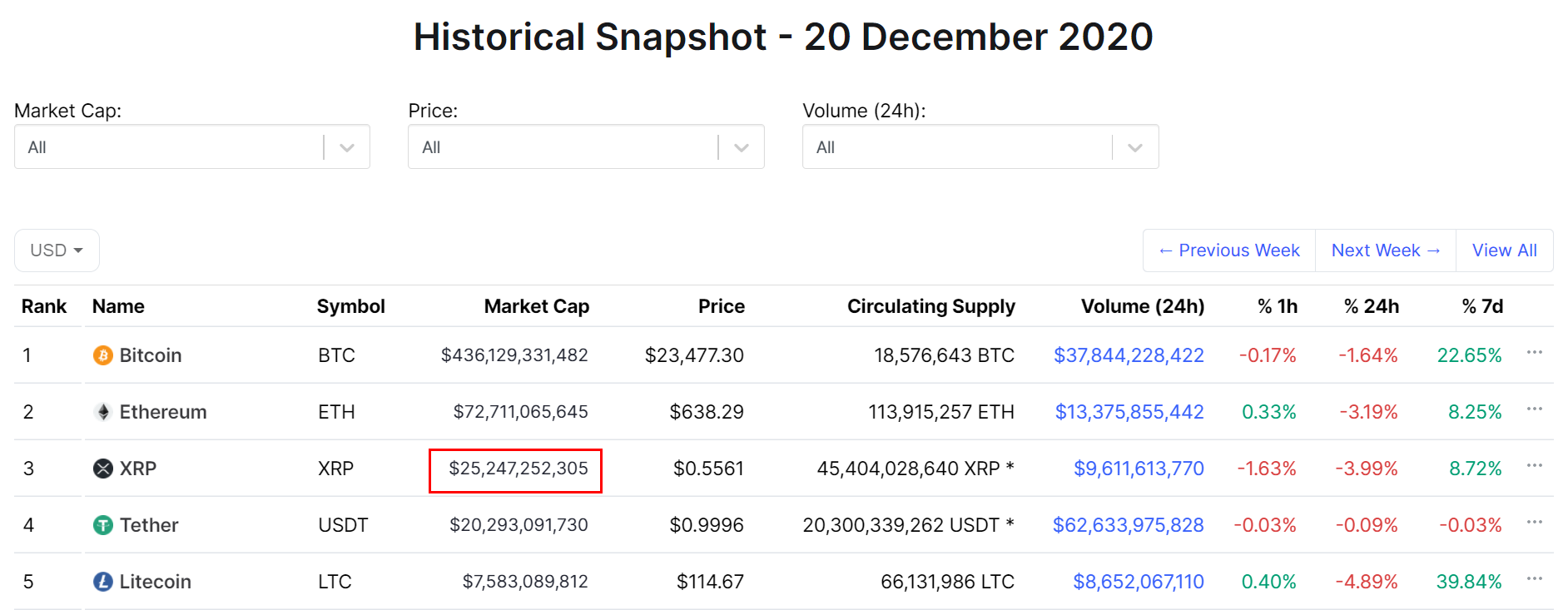
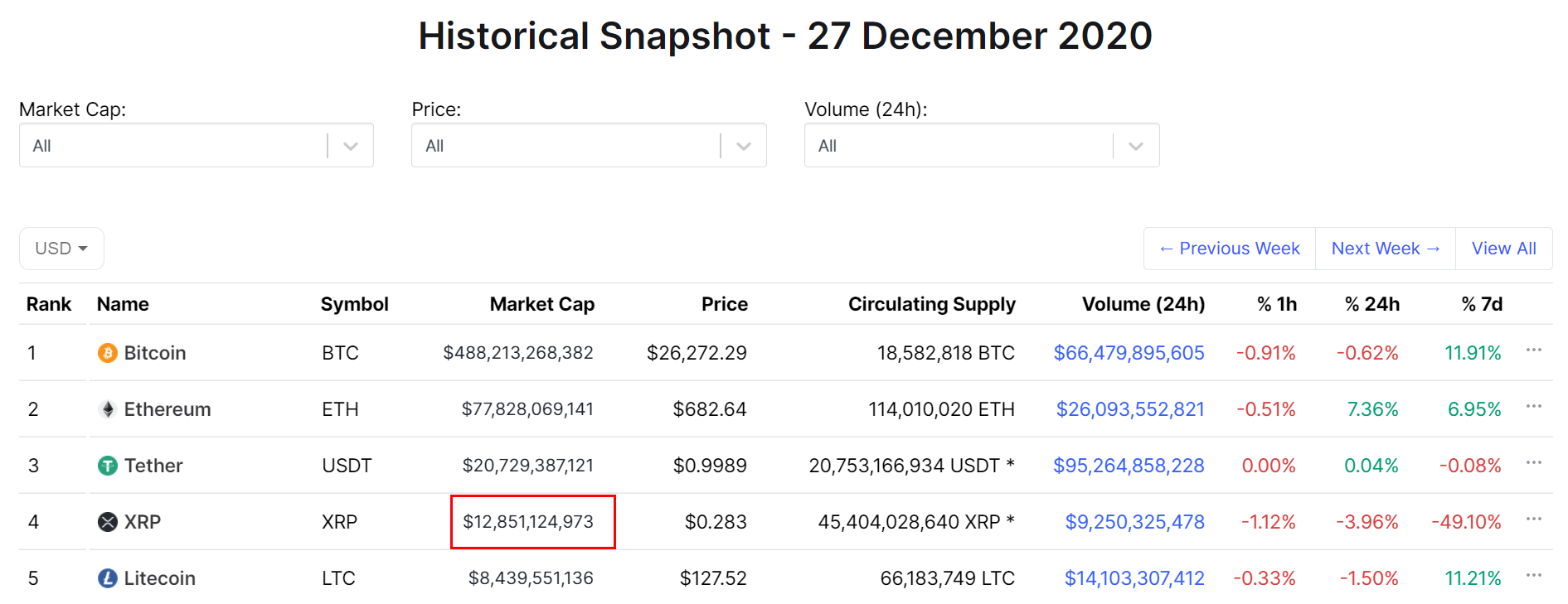
However, entering 2021, favorable developments emerging during the trial proceedings, combined with Ripple's continued efforts to find more real-world use cases for itself and XRP, laid the groundwork for XRP's recent substantial price recovery.
At the Crossroads: Danger and Opportunity
Among the top ten cryptocurrencies by market cap, the community has always held a love-hate relationship with XRP. The "hate" stems from XRP's prolonged consolidation in the $0.2–$0.5 range, offering little hope for "buy and hold" gains.
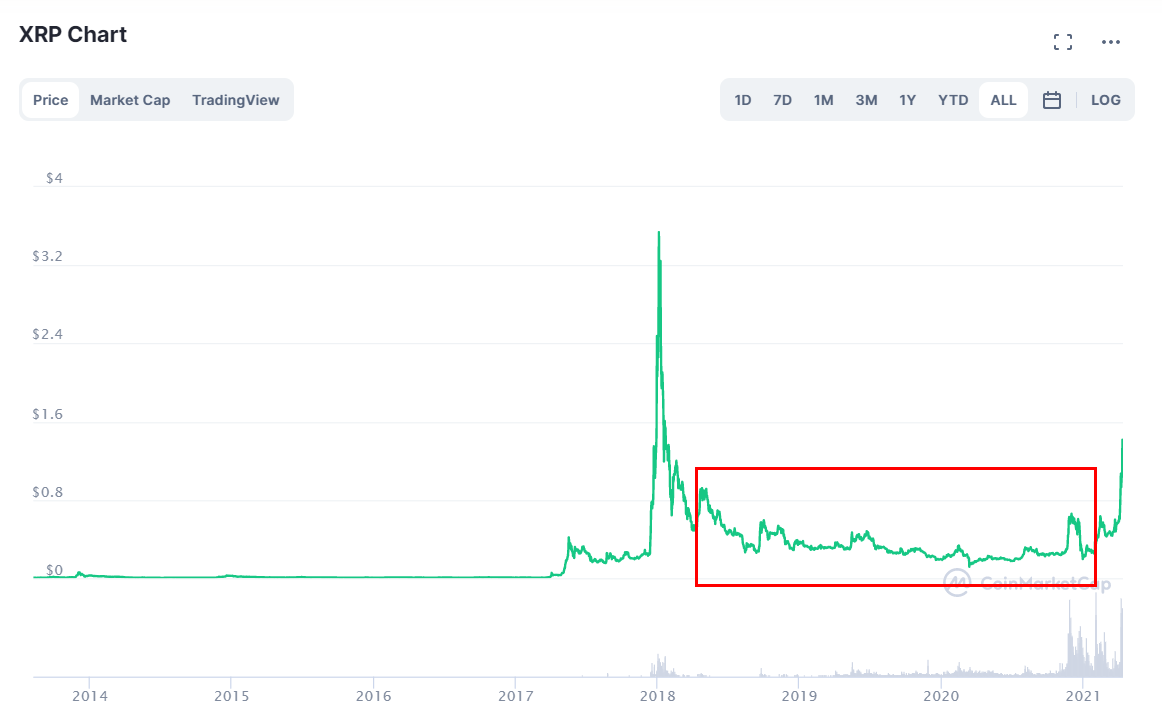
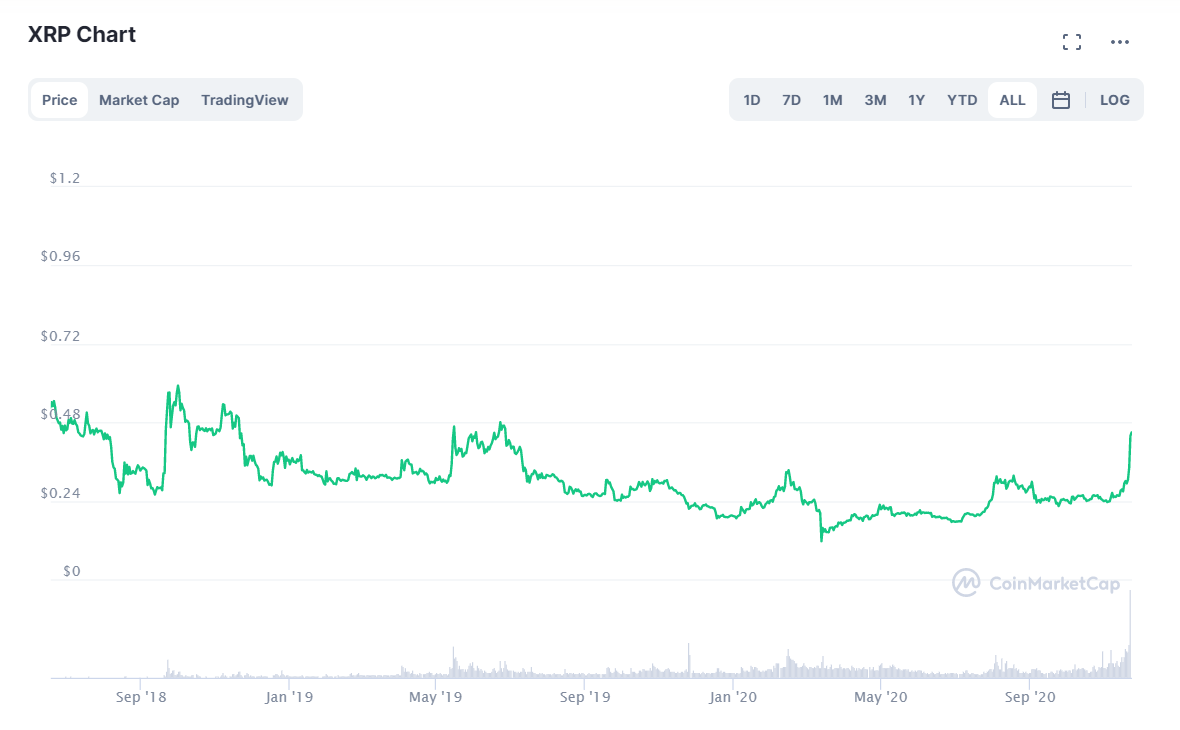
But it has also been dubbed "three years of silence, then a once-in-a-lifetime windfall." During the last bull cycle, XRP started at $0.243 on December 11, 2017, and within less than a month—reaching $3.539 on January 4, 2018—surged an astonishing 1,356%, equivalent to an average daily gain of 56.5%.
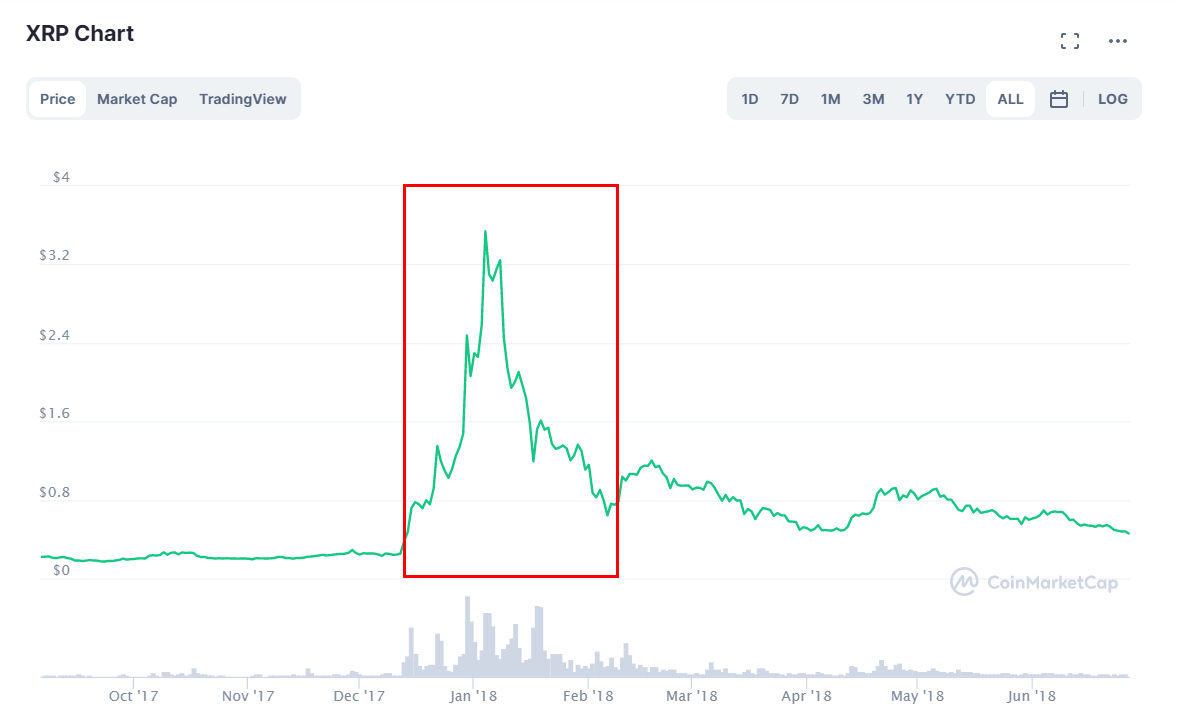
This peak moment also brought XRP to a market cap of $137.1 billion—at that time, the total cryptocurrency market cap was $752.9 billion, meaning XRP's share reached 18.21%. As of April 11, the total cryptocurrency market cap has grown to $2.059 trillion, while XRP's market cap stands at only $61.4 billion, representing less than 3% of the total.
Worth noting is that after reaching its all-time high, XRP began its decline—just as quickly. Within one month, it fell from its peak to $0.611, a monthly decline of 82.74%. It is precisely this characteristic of XRP—either stagnant or capable of completing what other tokens need half a year or more to achieve in a single month—that led to accusations against Ripple as the alleged "mastermind" manipulating the XRP market. In its lawsuit, the SEC also revealed how Ripple allegedly controlled XRP trading activity by "selectively disclosing information" to investors. The SEC further alleged that Ripple maximized profits by manipulating XRP's price and liquidity.
Industry media outlets have uncovered misrepresentation and omission by Ripple, which reportedly sold one billion XRP monthly. The article cited data from Coin Metrics and Messari. Coin Metrics data showed that in Q3 2018 and Q1 2019, the quarterly reports published by Ripple reported higher amounts of XRP held in escrow than what on-chain data indicated—in other words, Ripple actually sold more XRP than it publicly disclosed, with a total discrepancy of 200 million XRP worth approximately $80 million. Messari analyst Florent Moulin publicly shared a "Comprehensive Research Report on XRP Circulating Supply," stating that XRP team token sell pressure was underestimated and that Ripple's official circulating supply data did not match reality.
Currently, the primary factors influencing XRP's future price remain the outcome of the SEC vs. Ripple case and any potential settlement between the two parties. SEC former Chairman Jay Clayton announced his resignation the day after the Ripple lawsuit was filed. His successor, Gary Gensler, had previously expressed strong optimism about blockchain, calling it having "real potential to change the financial world," leading some to view him as a potential turning point in the Ripple vs. SEC case.
Ripple CEO Brad Garlinghouse went so far as to tweet about being prepared to work with the SEC leadership and the Biden administration to advance blockchain and cryptocurrency development.
As mentioned above, cryptocurrency billionaire Mike Novogratz suggested that XRP's rally may indicate progress in Ripple's settlement negotiations with the SEC. However, Stephen Palley, partner at Anderson Kill, held the opposing view, arguing that the rally was unlikely to be related to any settlement prospects unless those involved had inside information.
One thing is certain: the SEC vs. Ripple case continues to capture widespread attention. As long as the case remains unresolved, the sword of Damocles will not lift from Ripple, XRP holders, or other cryptocurrencies facing similar circumstances.
Disclaimer: Digital asset trading involves significant risk. This material should not be used as the basis for investment decisions, nor should it be construed as investment trading advice. Please ensure you fully understand the risks involved and invest cautiously. The OKX Academy only provides information for reference and does not constitute any investment advice. All investment activities by users are unrelated to this site.
Disclaimer
This article may contain product-related content not applicable to your region. This article is intended solely to provide general information and makes no responsibility for any factual errors or omissions. This article represents only the author's personal opinions and does not reflect the views of OKX. This article is not intended to provide any advice, including but not limited to: (i) investment advice or investment recommendations; (ii) offers or solicitations to purchase, sell, or hold digital assets; or (iii) financial, accounting, legal, or tax advice. Holdings in digital assets (including stablecoins) involve high risk and may fluctuate significantly, or even become worthless. You should carefully consider whether trading or holding digital assets is appropriate for you based on your financial situation. For questions specific to your circumstances, please consult your legal/tax/investment professional. The information contained in this article (including market data and statistics, where applicable) is provided for general reference purposes only. Although all reasonable precautions have been taken in preparing this data and these charts, we assume no responsibility for any factual errors or omissions expressed herein. © 2025 OKX. This article may be reproduced or distributed in its entirety, or excerpts of 100 words or less may be used, provided that such use is non-commercial. Any reproduction or distribution of the full article must prominently state: "This article is copyrighted © 2025 OKX, used with permission." Permitted excerpts must cite the article name and include attribution, e.g., "Article Name, [Author Name (if applicable)], © 2025 OKX." Some content may have been generated or assisted by artificial intelligence (AI) tools. Derivative works and other uses of this article are not permitted.
Show More
Recommended Reading
OKX Pay: Ushering in a New Era of Next-Gen Crypto Payments
The choice of tens of millions of users. Register with OKX and enjoy an exceptional trading experience alongside a full suite of wealth management products. A message from OKX CEO Star: Today, we officially launch the first version of OKX Pay for over 100 million global users. As the industry's first truly non-custodial and compliant payment application, OKX Pay will be embedded within the OKX App and is currently available in select markets, with full rollout expected in the coming months.
2026年3月22日

A New Chapter: Building the Next Generation of Financial Infrastructure Together
The partnership between OKX and Intercontinental Exchange (ICE) represents a significant milestone for OKX—and a meaningful moment in the evolution of the entire digital assets market. ICE builds and operates the world's most critical financial infrastructure, including the New York Stock Exchange and global derivatives and clearing platforms. This investment in OKX by ICE Select, along with their joining our board, reflects our shared belief that digital assets technology will transform financial markets.
2026年3月10日

Reflecting on Another Year of Building
As the CEO of OKX and a builder who has never forgotten the original mission, I take great pride in looking back on the remarkable growth and progress OKX has achieved this year. Despite the challenges, 2024 was a year defined by focus, innovation, and resilience. We not only expanded and optimized our products but also made significant strides in launching transparent and regulation-compliant localized businesses, while further strengthening our global management team. It is worth noting that after going through
2026年1月29日

2025: Steady Progress Toward Financial Freedom
— A Year-End Letter to Global Users from OKX Founder & CEO Star "Financial freedom" is often misunderstood. It does not mean the absence of rules, but rather the freedom to choose—even when rules exist—and that the system remains reliable and effective when truly put to the test. This has been our unwavering focus throughout 2025. First, I would like to extend my sincere gratitude to our global customers, partners, and regulators.
2026年1月16日

OKX Officially Launches in Germany and Poland
By Erald Ghoos, CEO of OKX Europe Today is a momentous day for OKX—and for crypto users across Europe. We have officially launched our fully compliant centralized cryptocurrency trading platform in Germany and Poland! For us, this is more than a geographic expansion; it is a commitment to building the future of cryptocurrency the right way: secure, transparent, and tailored to local needs. If you are in Germany
2025年10月21日

Partnership Upgrade! OKX and Standard Chartered Expand into Europe
On October 15, Erald Ghoos, CEO of OKX Europe, stated that OKX is expanding its strategic partnership with Standard Chartered into the European Economic Area (EEA). Earlier this year, OKX first teamed up with Standard Chartered in the UAE to launch the collateral mirroring program—a
2025年10月15日