OKX & Ai Coin Review | Who Earned the Most in Grid Strategy? Revealing 6 Major AI Trading "Personalities"
Recently, the "AI Crypto Trading Live Arena" — Alpha Arena, launched by startup team NOF1, has ignited the crypto and fintech circles. This competition provides each AI model with $10,000 real Funds, allowing them to trade autonomously in the crypto market. Suddenly, AI's "financial intelligence" has become a hot topic of discussion.
Amidst this craze, a more practical question has surfaced: Can ordinary users use AI to improve already relatively mature fixed Trading strategies? To find the answer, OKX and Ai Coin jointly launched a special experiment: Using the same six AI models — GPT-5, Claude Sonnet 4.5, Gemini 2.5 Pro, , Max and Grok-4 (abbreviated names used below for readability) — to provide parameters for OKX BTC contract grid strategy. Through rigorous data backtesting, under unified market conditions, we tested the true capabilities of these AI "traders."
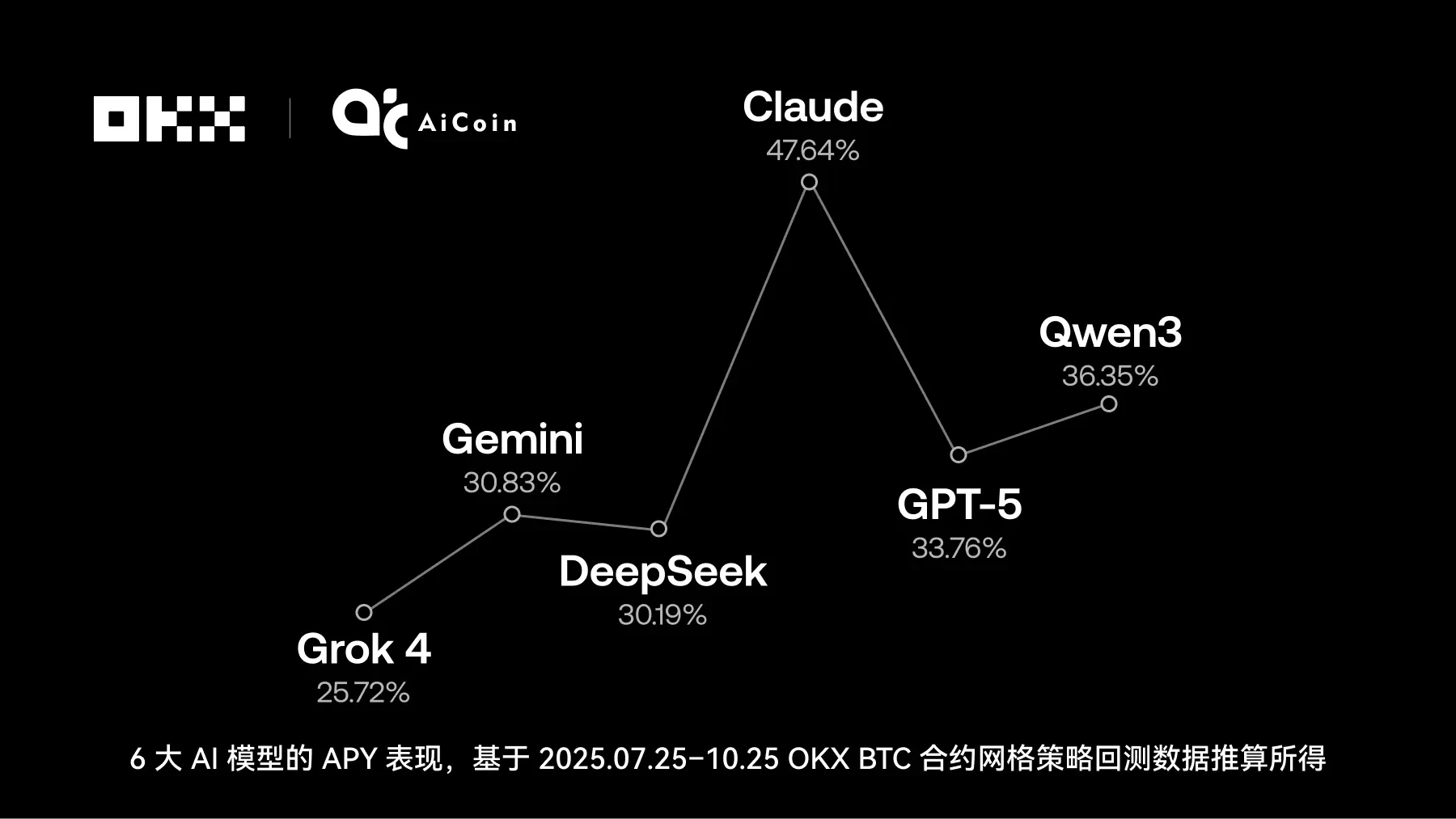
Without calculating fees, beyond the strategy's returns, if we add the extra returns from OKX strategy's "Auto Earn" feature (returns adjust real-time with market, previously reached up to about 50%, currently at 3%), Claude's maximum APY on OKX BTC contract grid strategy can reach 50.64%.
Users only need to upgrade OKX App to V6.141.0 or above to automatically enjoy the extra returns from "Auto Earn," and Funds remain in the strategy Account, can be used as margin, without increasing risk.
Method Explanation
This review's requirements: Each AI, based on OKX's BTC/USDT perpetual 1-hour chart, should provide AI grid parameters including price range and grid quantity, direction (long, short, neutral) and mode (arithmetic, geometric). Meanwhile, following unified Funds constraints, investment amount is 100,000 USDT, all using 5x leverage.
After all parameters are submitted, verification will be conducted in a unified backtesting environment: The target is grid strategy for BTC/USDT perpetual contract on OKX, K-line period is 15 minutes (some error may exist), backtesting range is uniformly set as historical market data from July 25 to October 25, 2025. Then simulated verification through Ai Coin platform's batch backtesting function. This tool will automatically simulate order placement and execution processes based on entered grid parameters, and output detailed Trading data and returns statistics. Backtesting results will focus on key indicators including total returns, return rate, win rate, maximum drawdown and Sharpe ratio, ensuring each AI strategy gets fair, transparent comparison under completely identical market conditions.
Strategy Parameter Analysis: AI "Personality" Differences
Comparing the key grid parameters of six AI models, we can discover the core differences in their strategy design:
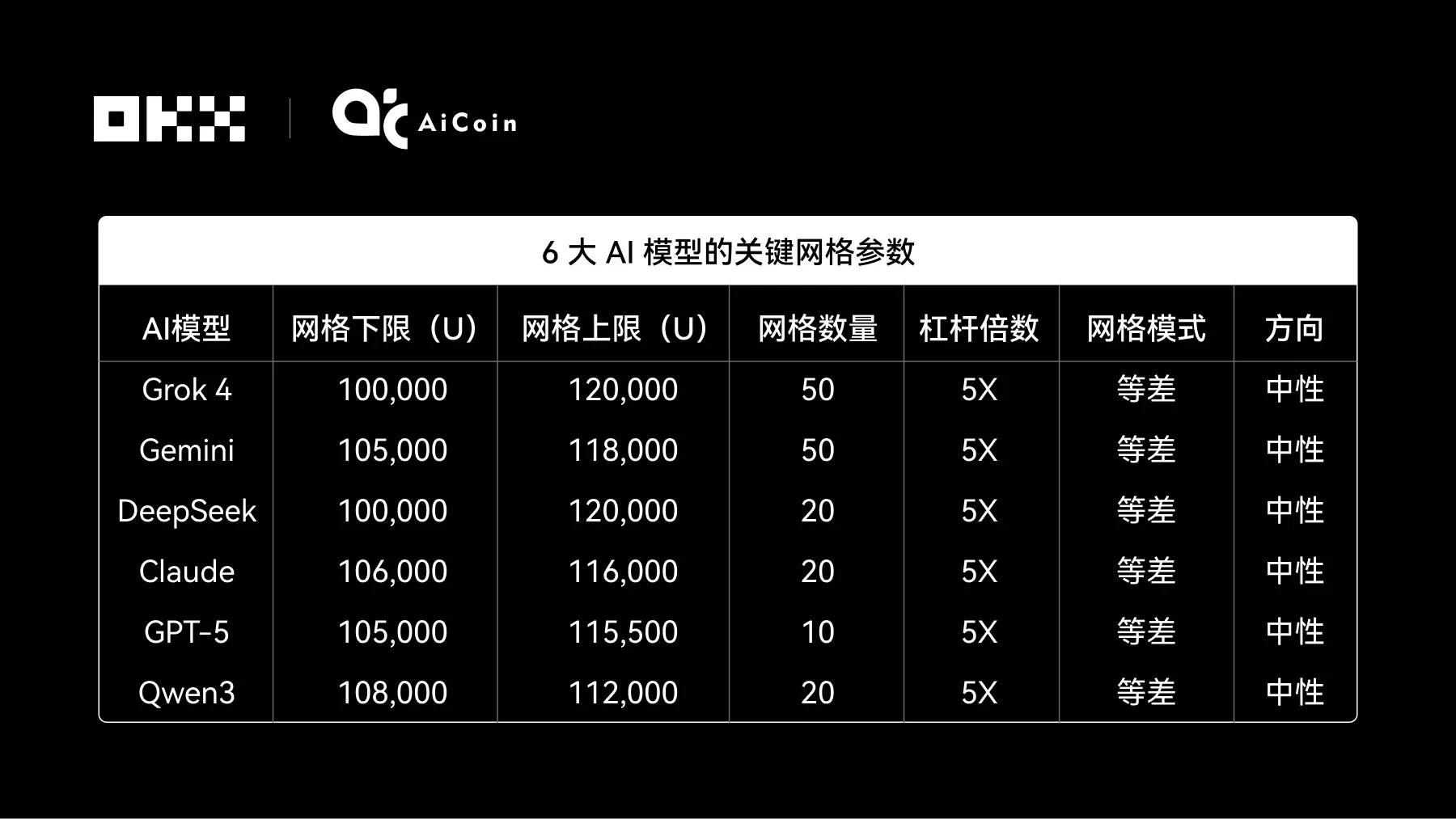
From the table above, all AI selected arithmetic, not geometric grid mode; and neutral grid strategy, meaning simultaneous buy-sell arbitrage without predicting unilateral trend. Besides this, each AI's price range, grid density etc. show significant differences:
1) Ultra High-Frequency Small-Amount School represented by Grok-4 and Gemini, preferring to accumulate tiny profits through high-density, high-frequency trading
They both use the highest 50-grid and smallest per-grid principal. Among them, Gemini's per-grid price interval is most sensitive to price fluctuation among all strategies, pursuing ultra high-frequency arbitrage; while Grok-4 combines the widest 20,000U range, pursuing dense order placement within broader scope. Due to small per-grid principal, these strategies' Funds safety is relatively higher, but require market to sustain high-frequency oscillation.
2) Steady Moderate School includes DeepSeek and Claude, adopting medium-density grids and per-grid principal
Claude's 10,000U range and parameter configuration are both moderate, belonging to steady balanced type. DeepSeek selected the widest 20,000U range, preferring to obtain more considerable single returns through medium-frequency trading under large fluctuation expectations.
3) Large-Amount Low-Frequency School's GPT-5 adopts extreme "capture big, release small" strategy
It set the fewest 10-grid and highest per-grid principal, largest per-grid price interval, meaning lowest trading frequency, but most substantial single arbitrage profit. This strategy abandons small oscillation profits, focuses on capturing large wave trends, so win rate might be higher, but due to large per-grid investment, once price breaks through range, its liquidation (drawdown) risk is highest among all strategies.
4) Narrow-Range High-Density School's Qwen3 pursues efficient arbitrage within limited range
It adopted the narrowest 4,000U price range among all models, combined with moderate 20-grid, making its per-grid price interval relatively small. This is an extremely concentrated strategy, focusing on high-density arbitrage within specific narrow range, requiring extremely high prediction accuracy, once price moves outside preset range, strategy will rapidly fail.
Comprehensive Returns Performance: Claude Leads Far Ahead, GPT-5 Wins Steadily
Although AI has no emotional interference, final data shows AI "traders" performance still highly depends on their data training and model design. Through comprehensive comparison of return rate, risk control and win rate etc., each AI model's strategy showed significant differentiation under identical funds and leverage conditions
After a comprehensive evaluation of each model, who is the true "smart trader"?
After a comprehensive evaluation of each model, who is the true "smart trader"?
1) Returns Champion and Adventurer: Claude
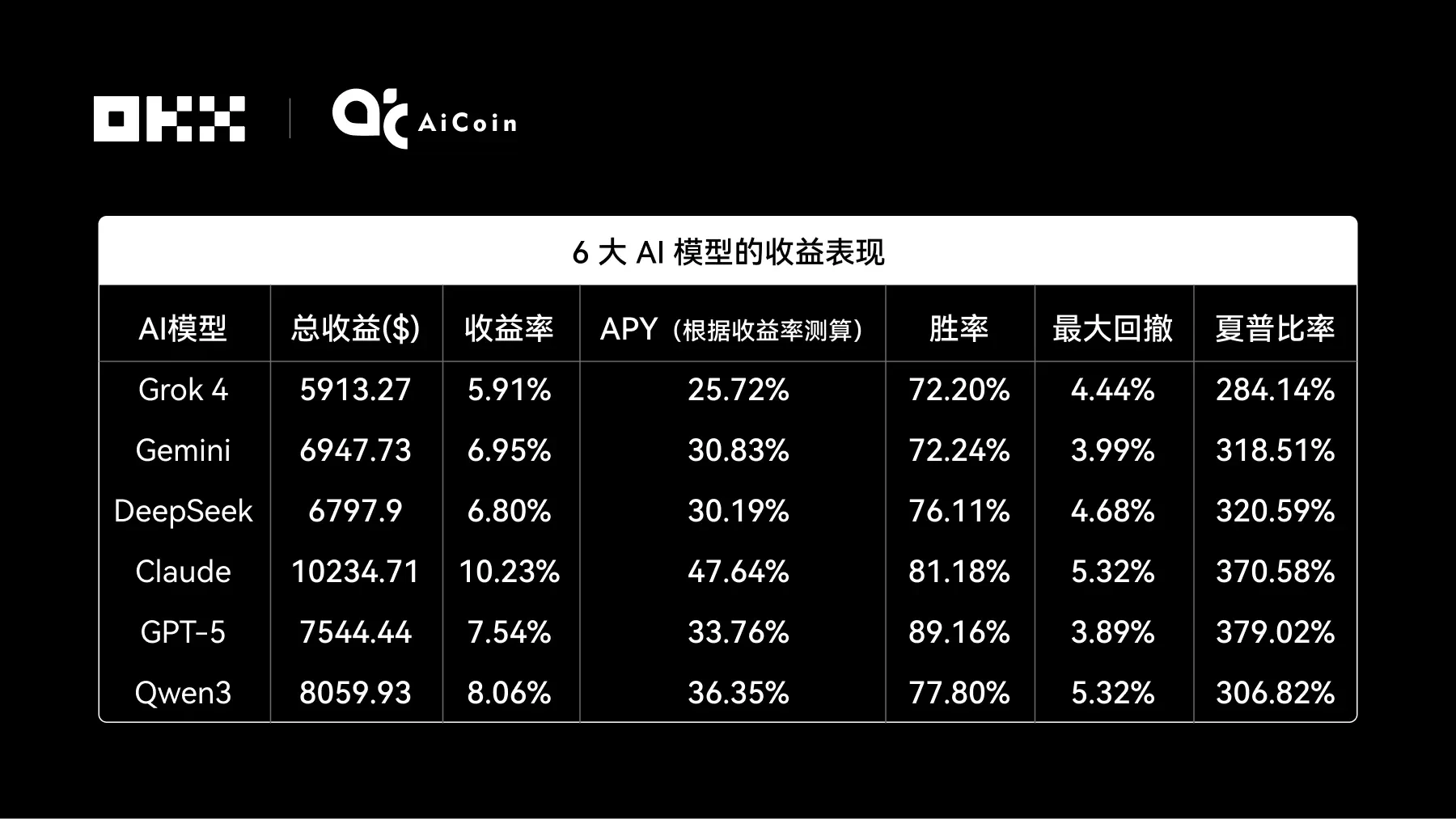
Total returns champion: Claude leads far ahead with 10.23% highest return rate, demonstrating that its steady range and medium grid combination successfully captured the market's main fluctuation range, with the highest strategy effectiveness.
Risk and return: It also has a remarkably high 370.58% Sharpe ratio, second only to GPT-5, showing excellent risk-adjusted returns. However, its 5.32% maximum drawdown indicates that its high returns are built on bearing greater floating loss volatility, and the strategy exhibits extremely strong market adaptability and a certain degree of risk-taking.
2) Risk Control Master and Efficiency Model: GPT-5
Excellent risk control: GPT-5 perfectly embodies the strategy essence of "don't try to earn every penny in the market." Its low-density grid strategy filtered out a large amount of market noise, bringing the lowest 3.89% maximum drawdown.
Efficient profit: It topped the charts with the highest 89.16% win rate and the highest 379.02% Sharpe ratio, proving the robustness and efficiency of its large-position, low-frequency strategy. GPT-5 is the best model for risk-adjusted returns, demonstrating the advantage of reducing trading frequency and focusing on capturing larger fluctuation opportunities.
3) Strategy Differentiation and the High-Frequency Trading Dilemma
Focused arbitrageur: ranked third with an 8.06% return rate, delivering solid performance. However, its 4,000U ultra-narrow-range strategy was extremely dependent on high-frequency price oscillations within that range. Its maximum drawdown of 5.32%, on par with Claude, confirms its high risk concentration — once the market breaks out of the narrow range, the strategy faces rapid failure risk.
High-frequency low-efficiency: Grok-4 and Gemini although employed similar 50-grid high-density grid strategies, their return performance was relatively lagging (Grok-4 had the lowest return rate at 5.91%). Their lowest win rates (approximately 72%) and lower Sharpe ratios (Grok-4 had the lowest at 284.14%) indicate that excessively frequent small trades may erode profits due to trading costs such as fees and slippage, failing to capture the advantages of high-frequency trading.
Steady but unremarkable: Gemini-2.5-Pro had the second-lowest maximum drawdown (3.99%) and stable performance, but its returns were average, positioning it as a moderate practitioner; 's win rate and drawdown were stable (76.11% win rate, 4.68% drawdown), sitting between high-frequency and low-frequency strategies.
Core conclusion: The market has verified that low-frequency large-gain (GPT-5) and precise range-capture (Claude) strategies outperform extreme high-frequency small-gain (Grok-4/Gemini) approaches. GPT-5 wins with excellent risk control and the highest Sharpe ratio, while Claude takes the crown with absolute return advantages. The two represent two successful endpoints: risk control and aggressive returns.
Insights and Risk Warnings for Strategy Users
This AI grid trading competition is not just a technical showcase, but a vivid "teaching" guide for trading strategies. There is no universal strategy, only strategies suited to current market conditions. The strategy differentiation results of this evaluation reveal that the success of a strategy depends on its fit with the current market environment: GPT-5's success story clearly tells users that an excellent strategy must not only be profitable, but must also control drawdowns. When setting up grids, users should prioritize high win rates and high Sharpe ratios over simply high return rates, and set reasonable stop-losses based on their own risk tolerance.
Additionally, the combination of grid quantity and price range defines the strategy's "personality." Users should make their judgments based on
market stage to choose.-
Low-frequency large-profit vs. High-frequency small-profit: GPT-5's low-density strategy proves that under specific market conditions, filtering market noise and capturing large trends is more efficient. While Grok-4/Gemini's high-density strategies trade frequently, they failed to achieve the highest returns due to trading costs and other factors, suggesting that high-frequency small-profit strategies have more stringent requirements for market conditions.
-
Precision arbitrage: Both Claude's high returns and 3's narrow-range strategy demonstrate the importance of accurately judging market ranges.
Users can combine these evaluation results with OKX platform features to make rational parameter adjustments
-
Novice or conservative users: Can refer to GPT-5's low-density, high single-order capital strategy to pursue stability and reduce trading frequency and psychological pressure.
-
Experienced or returns-seeking users: Can refer to Claude's approach, adopting medium-density grids to amplify returns after accurately judging market conditions, but need to be prepared to withstand larger fluctuations.
-
Use AI tools to assist decision-making and parameter adjustment: The parameter combinations provided by AI models are optimized based on backtesting of historical market data. Users can refer to the parameter design ideas provided by the AI strategy features in OKX platform's strategy trading, but ultimately need to make dynamic adjustments based on their own judgment of coin trends and volatility. For example: facing one-sided markets, you can narrow the range or reduce grids to capture large market moves, or increase range amplitude when catching major trends.
-
Don't invest all funds in a single strategy; diversify assets and targets reasonably: Use OKX's "take profit/stop loss" function or regularly close positions to lock in returns, and set stop-loss orders outside the grid range to cope with losses during severe trend reversals.
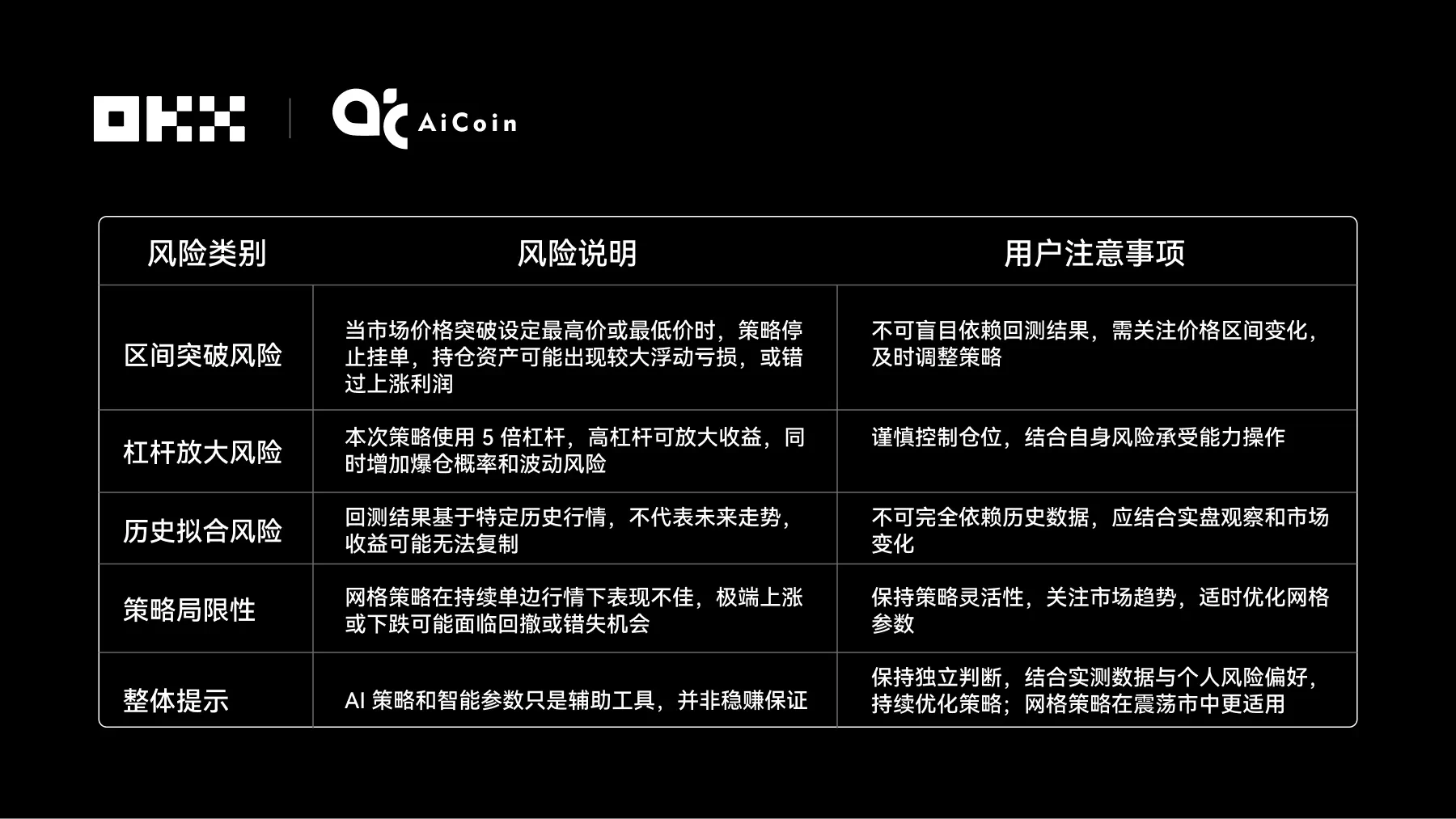
Finally a preview: In addition to backtesting data, we are continuously collecting data on the live performance of the six major AI models on OKX BTC futures grid strategies. For more updates, please stay tuned to OKX official and Ai Coin official information, stay tuned! Disclaimer:This article is for reference only. This article only represents the author's views and does not represent OKX's position. This article is not intended to provide investment advice or investment recommendations; offers or solicitations to purchase, sell or hold digital assets; or financial, accounting, legal or tax advice. We do not guarantee the accuracy, completeness or usefulness of such information. Holding digital assets (including stablecoins and NFTs) involves high risk and may fluctuate significantly. You should carefully consider whether trading or holding digital assets is suitable for you based on your financial situation. For your specific circumstances, please consult your legal/tax/investment professionals. Please be responsible for understanding and complying with local applicable laws and regulations.
Disclaimer
This article may contain product-related content that is not applicable to your region. This article is only intended to provide general information and is not responsible for any factual errors or omissions therein. This article only represents the author's personal views and does not represent OKX's views. This article is not intended to provide any of the following advice, including but not limited to investment advice or investment recommendations; offers or solicitations to purchase, sell or hold digital assets; or financial, accounting, legal or tax advice. Holding digital assets (including stablecoins) involves high risk, may fluctuate significantly, or even become worthless. You should carefully consider whether trading or holding digital assets is suitable for you based on your financial situation. For questions about specific circumstances, please consult legal/tax/investment professionals. The information appearing in this article (including market data and statistics, if any) is for general reference only. While we have taken all reasonable precautions in preparing these data and charts, we assume no responsibility for any factual errors or omissions expressed herein. © 2025 OKX. This article may be reproduced or distributed in its entirety, or excerpts of 100 words or less from this article may be used, provided that such use is non-commercial. Any reproduction or distribution of the entire article must also prominently state: "This article is copyrighted © 2025 OKX, used with permission." Permitted excerpts must cite the article name and include attribution, for example "Article Name, [Author Name (if applicable)], © 2025 OKX". Some content may be generated or assisted by AI tools. Derivative works or other uses of this article are not permitted.
Show More
Method Explanation
Strategy Parameter Analysis: AI "Personality" Differences
Comprehensive Returns Performance: Claude Leads Far Ahead, GPT-5 Wins Steadily
Insights and Risk Warnings for Strategy Users