
10 Essential Crypto Analysis Indicators (Part 2)
The article "10 Essential Crypto Analysis Indicators (Part 1)" introduced four essential crypto analysis indicators: Bitcoin UTXO Age Distribution, Bitcoin Rainbow Chart, S2F Price Model, and arh999 DCA Index. Bitcoin UTXO Age Distribution reveals on-chain activity through UTXO distribution statistics, the Bitcoin Rainbow Chart clearly marks Bitcoin prices at different stages, the S2F Price Model measures Bitcoin's scarcity and predicts medium to long-term prices, and the arh999 DCA Index defines dollar-cost averaging and bottom-fishing thresholds.
This article continues with the remaining six crypto indicators: Altseason Index, RHODL Ratio, Jiang Zhuoer's 60-Day Cumulative Market Cap Growth, Whale Holdings Changes, CFTC Asset Manager Position Trends, and Bitcoin Halving.
These indicators sense the industry's pulse from both macro and micro perspectives. Through these indicators, we can significantly lower the industry's cognitive barriers and provide strong reference points for crypto activities.
5. Altseason Index
According to blockchaincenter's definition of the Altseason Index, if 75% of the top 50 tokens by market cap outperform Bitcoin over a consecutive 90-day period, the crypto market is in altseason.
Reviewing digital asset history, the market experienced 2 altseasons during the last bull cycle. The first occurred between June and July 2017, and the second in early 2018. Each altseason lasted approximately one month or less. Without exception, deep corrections followed every altseason. For example, after the early 2018 altseason, the crypto market entered a 2-year bear market. Subsequently, in April 2021, the crypto market entered altseason, followed by the "5.19" crash and a monthly-level correction.
Therefore, when monitoring indicates the market is in an altcoin explosion period, it likely means prices have reached a parabolic top, presenting an excellent arbitrage opportunity.
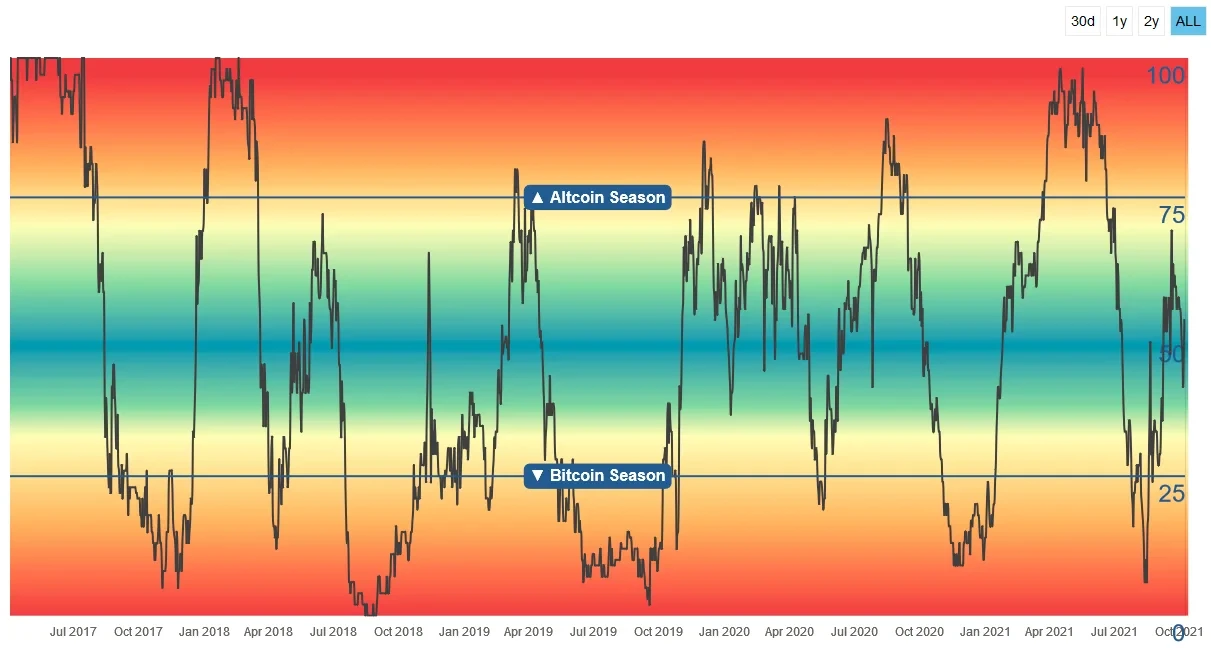
Data source: https://www.blockchaincenter.net/altcoin-season-index/
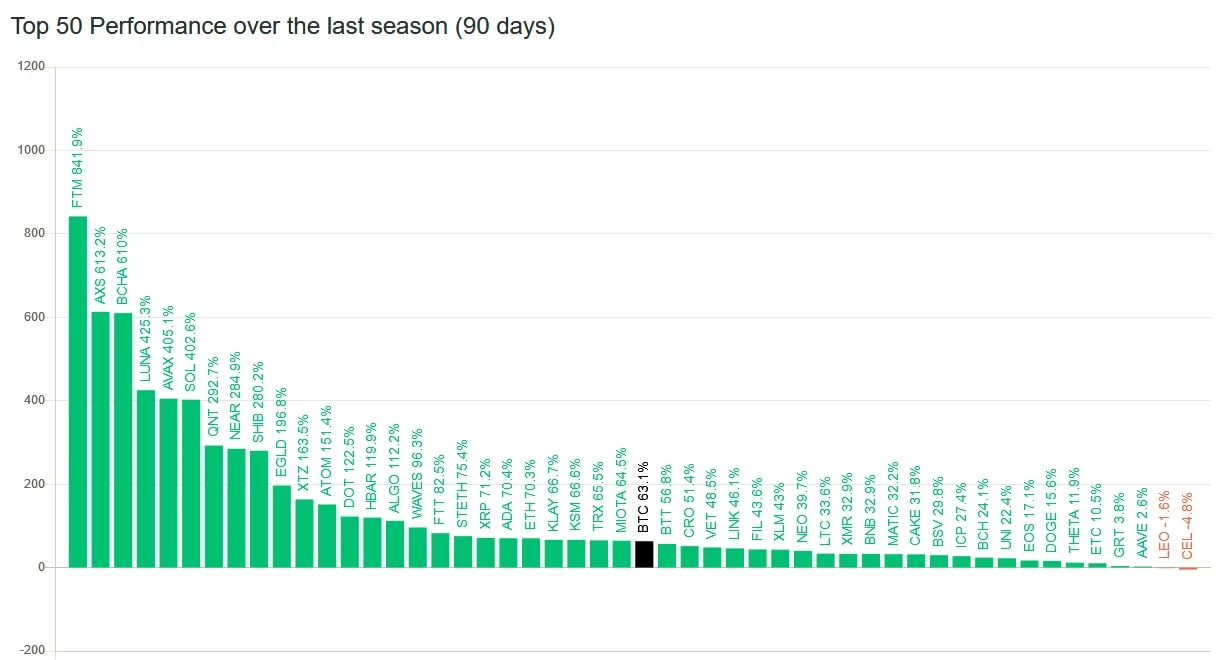
So, is it altseason now (October 2021)?
According to Altseason, currently 26 of the top 50 tokens by market cap are outperforming Bitcoin, so the current market is not in altseason.
6. RHODL Ratio
RHODL Ratio was created by Twitter blogger Philip Swift (@positivecrypto) in June 2020. The indicator formula is as follows:

The numerator and denominator are weighted by the Realized Value of tokens in each segment. Realized Value is the value of Bitcoin when it was last transferred from one wallet to another. RHODL Ratio specifically refers to the ratio of realized value within 1 week to realized value from 1-2 years. When the 1-week value is significantly higher than the 1-2 year value, meaning too many Bitcoins moved within 1 week, it indicates excessive market heat.
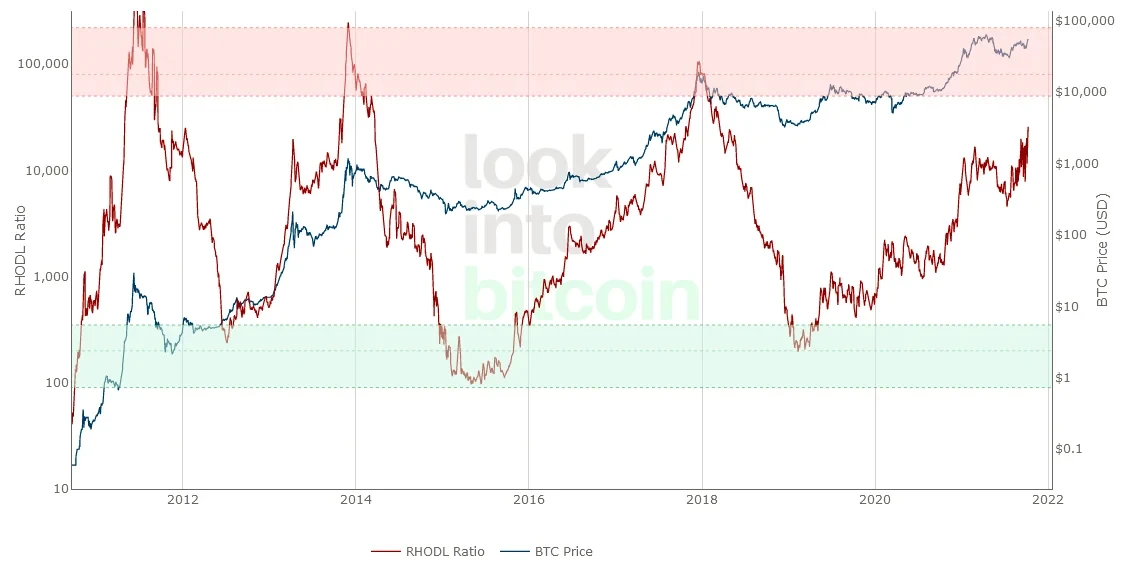
Data source: https://www.lookintobitcoin.com/charts/rhodl-ratio/
This indicator can relatively accurately identify Bitcoin's price highs and lows in each macro cycle. As shown above, when RHODL Ratio enters the red zone, the market is approaching the cycle top—a good time for investors to take profits. Entering the green zone indicates the market has reached the cycle bottom—a good time for investors to buy the dip. Looking back at historical crypto bull-bear cycles, RHODL Ratio has accurately marked bull-bear transition points.
Another indicator with similar functionality worth noting is The Puell Multiple, created by Twitter blogger David Puell in March 2019.
This indicator focuses on examining Bitcoin miners and their revenue, exploring market cycles from a mining revenue perspective. Bitcoin miners are known as forced sellers because they must pay fixed costs for mining hardware and electricity. Therefore, miner revenue affects prices over time.
The Puell Multiple is calculated by dividing Bitcoin's daily issuance value (in USD) by the 365-day moving average of daily issuance. The formula is:

The graphical representation of The Puell Multiple is as follows:
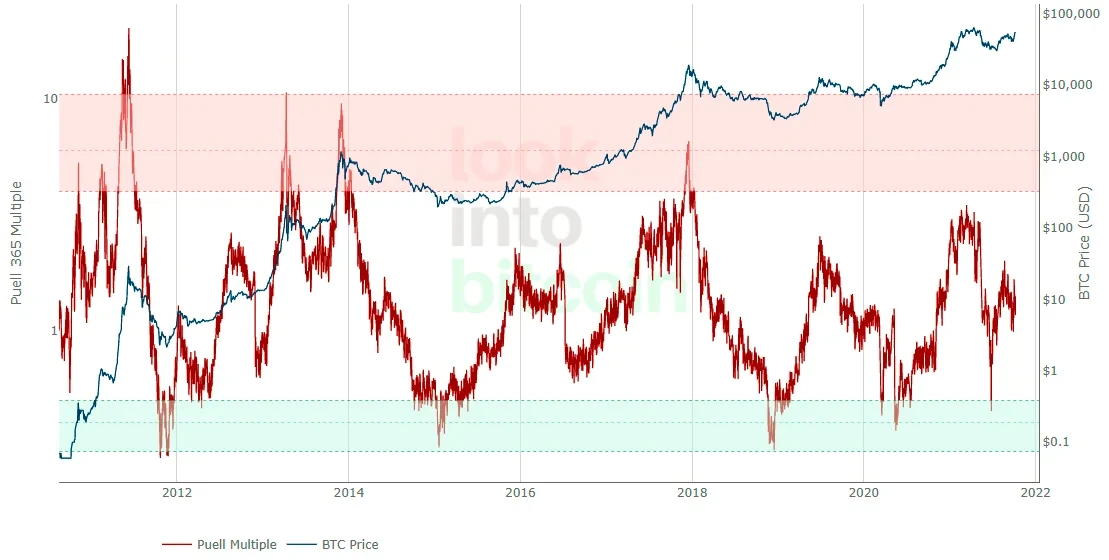
Data source: https://www.lookintobitcoin.com/charts/puell-multiple/
The Puell Multiple shows changes in Bitcoin's daily issuance value. When this indicator reaches historically extreme lows, Puell Multiple enters the green box zone. Buying Bitcoin here has brought investors massive returns. Conversely, when this indicator reaches historically extreme highs, Puell Multiple enters the red box zone. Selling Bitcoin here allows investors to take profits.
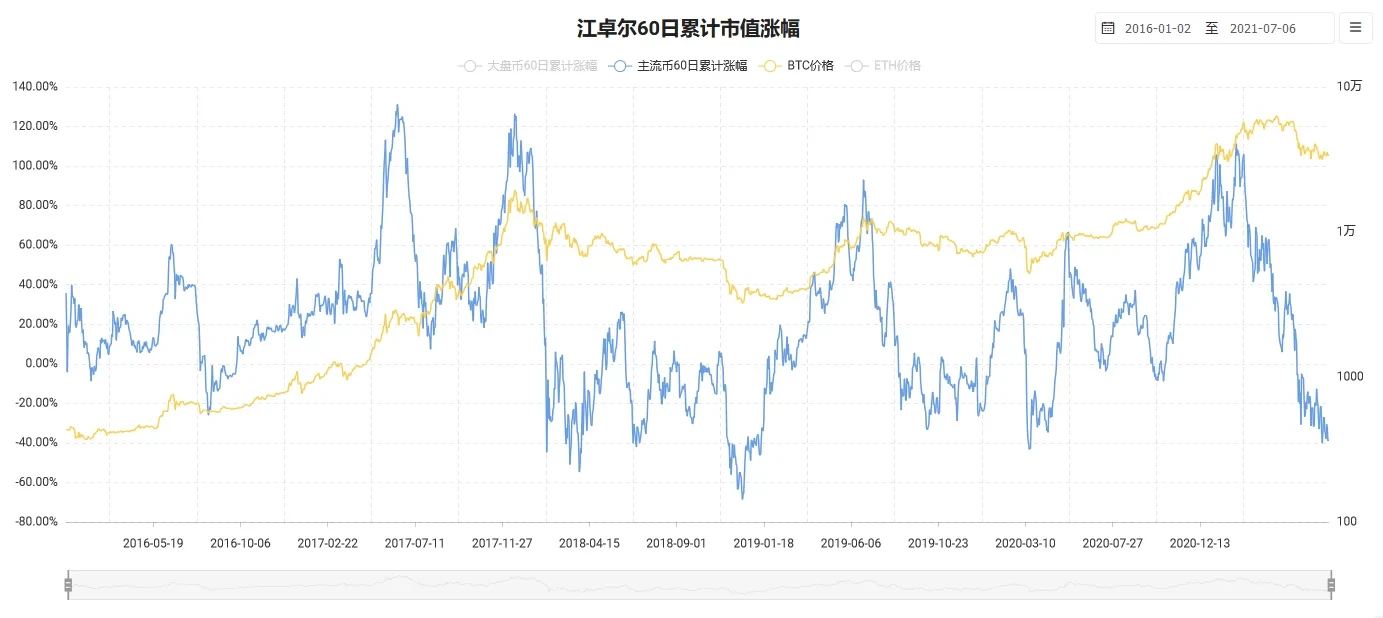
7. Jiang Zhuoer's 60-Day Cumulative Market Cap Growth
This indicator was created by Lebit Mining Pool CEO Jiang Zhuoer. The creator believes that in late bull markets, the market enters an emotional frenzy phase with severe bubbles across the crypto market, causing large-cap and mainstream coins to rise faster than new capital inflows. This leads to bull market bubble bursts and subsequent bear markets—when "60-day cumulative growth" is too high.
Data source: https://www.qkl123.com/data/marketvalue-increase
8. Whale Addresses: Bitcoin Wallet Sizes > 1,000 BTC
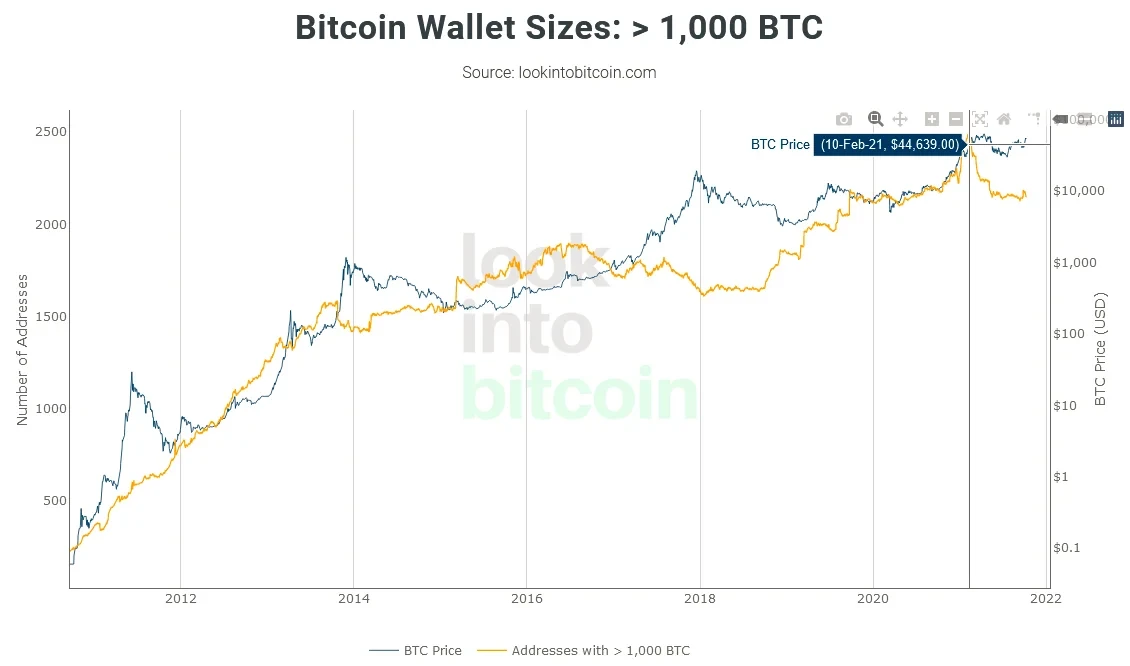
Generally, when a Bitcoin address holds more than 1,000 BTC, it's considered a whale address. Changes in the total quantity in these addresses can significantly impact crypto market trends. When the number of these addresses decreases, the crypto market likely enters a correction phase. Conversely, it indicates the crypto market will enter a growth period.
Taking the crypto bull market since 2020 as an example, whale addresses surged from 2,100 in May 2020 to 2,400 in February 2021, then began declining. In May, the crypto market experienced the brutal "5.19" crash. This shows a relatively close relationship between whale addresses and crypto market trends.
Data source: https://www.lookintobitcoin.com/charts/wallets-greater-than-1000-[btc](/zh-hans/trade-spot/btc-usdt "BTC")/
9. CFTC Asset Manager Position Trends
The CFTC Commitments of Traders (COT) report is position data routinely published by the U.S. Commodity Futures Trading Commission (CFTC) every Friday at 15:30 local time, or Saturday at 3:30 AM Beijing time (daylight saving) or 4:30 AM (standard time). This report reflects position holdings as of Tuesday's close that week.
CFTC requires futures exchange clearing members and futures brokers to submit daily position reports, similar to domestic exchanges' futures company position rankings. The purpose of publishing position reports is to increase market transparency and prevent any trader's position from becoming too large and manipulating the market.
According to ChainNews, there are four main CFTC report types: Legacy, Supplemental, Disaggregated, and Traders in Financial Futures (TFF).
Bitcoin futures data that crypto investors follow is classified under Traders in Financial Futures reports. Besides Bitcoin, this report includes position data for financial contracts like currencies, U.S. Treasuries, securities, and Bloomberg Commodity Index. The TFF report divides open interest into four categories: Dealer/Intermediary (such as banks), Asset Manager/Institutional (such as large hedge funds), Leveraged Funds (generally small institutions, private equity, etc.), Other Reportables (large traders), and Nonreportable Positions (retail).
CFTC position reports effectively reflect market capital flows. By tracking main market players' dynamics and combining statistical analysis of historical patterns, they help judge corresponding asset price trends. Especially for capital-dominated markets, tracking capital flows helps assess market activity. Through analyzing historical patterns, one can even judge when market turning points will arrive.
The most noteworthy aspect of this report is total positions—total open interest. This data measures market activity. According to the latest CFTC position report (published October 5), translated by ChainNews as "Market Participation Heat Surges, But Large Institutions Unexpectedly 'Pour Cold Water,'" total positions are as follows:
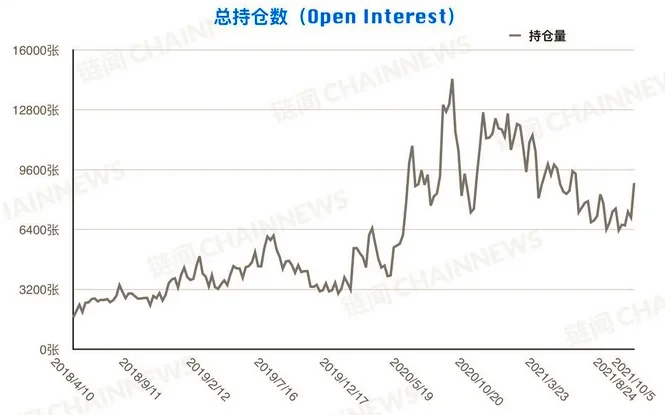
Current total positions are rising, indicating market heat is recovering.
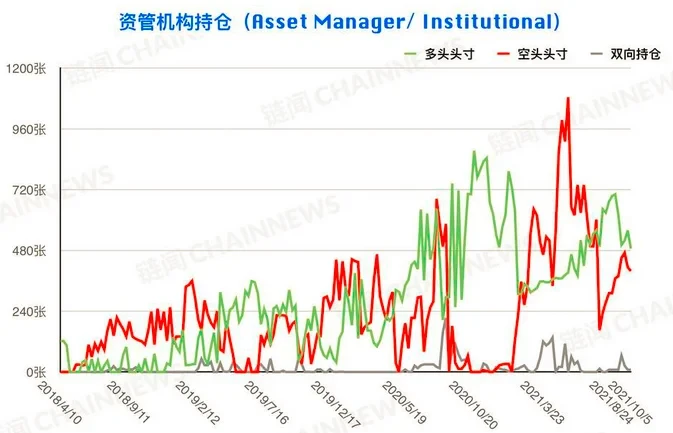
Another noteworthy indicator is Asset Manager/Institutional position data. The latest report shows long positions underwent relatively significant reduction, indicating asset managers actually gave bearish judgments despite the market rally.
Data source: https://www.chainnews.com/articles/414096660358.htm#
10. Bitcoin Halving
Bitcoin generates a block every 10 minutes. In Bitcoin's first four years, 50 new Bitcoins were issued every 10 minutes. Every four years thereafter, this number halves. The halving day is called "Bitcoin halving" or "Bitcoin reduction."
In 2012, new Bitcoins issued every 10 minutes dropped from 50 to 25. In 2016, from 25 to 12.5. In the most recent May 11, 2020 halving, rewards dropped from 12.5 BTC per block to 6.25 BTC. At the 2024 halving, rewards will drop from 6.25 BTC per block to 3.125 BTC. The 2024 halving will occur at block 840,000, currently about 900 days away from the fourth halving.
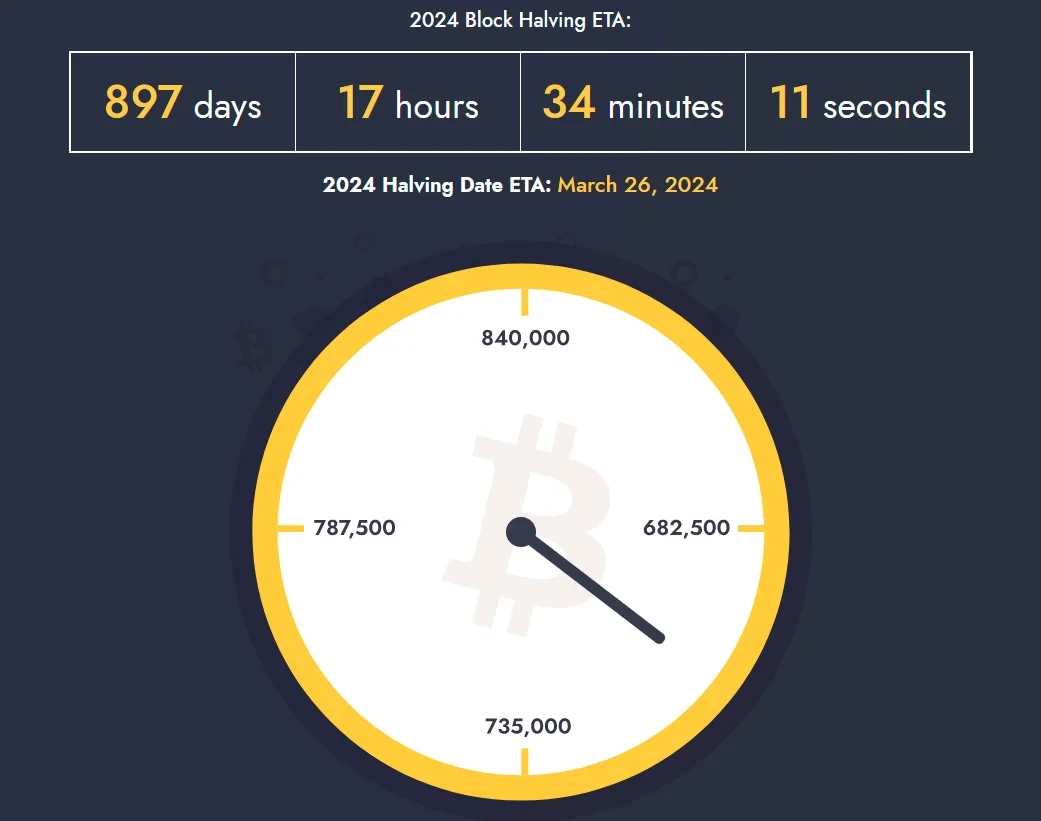
Data source: https://www.buybitcoinworldwide.com/bitcoin-clock/
What's the relationship between Bitcoin halving and Bitcoin price? Typically, reduced supply leads to price increases. In the chart below, vertical blue lines represent the previous three halvings (2012-11-28, 2016-7-9, and 2020-5-11).
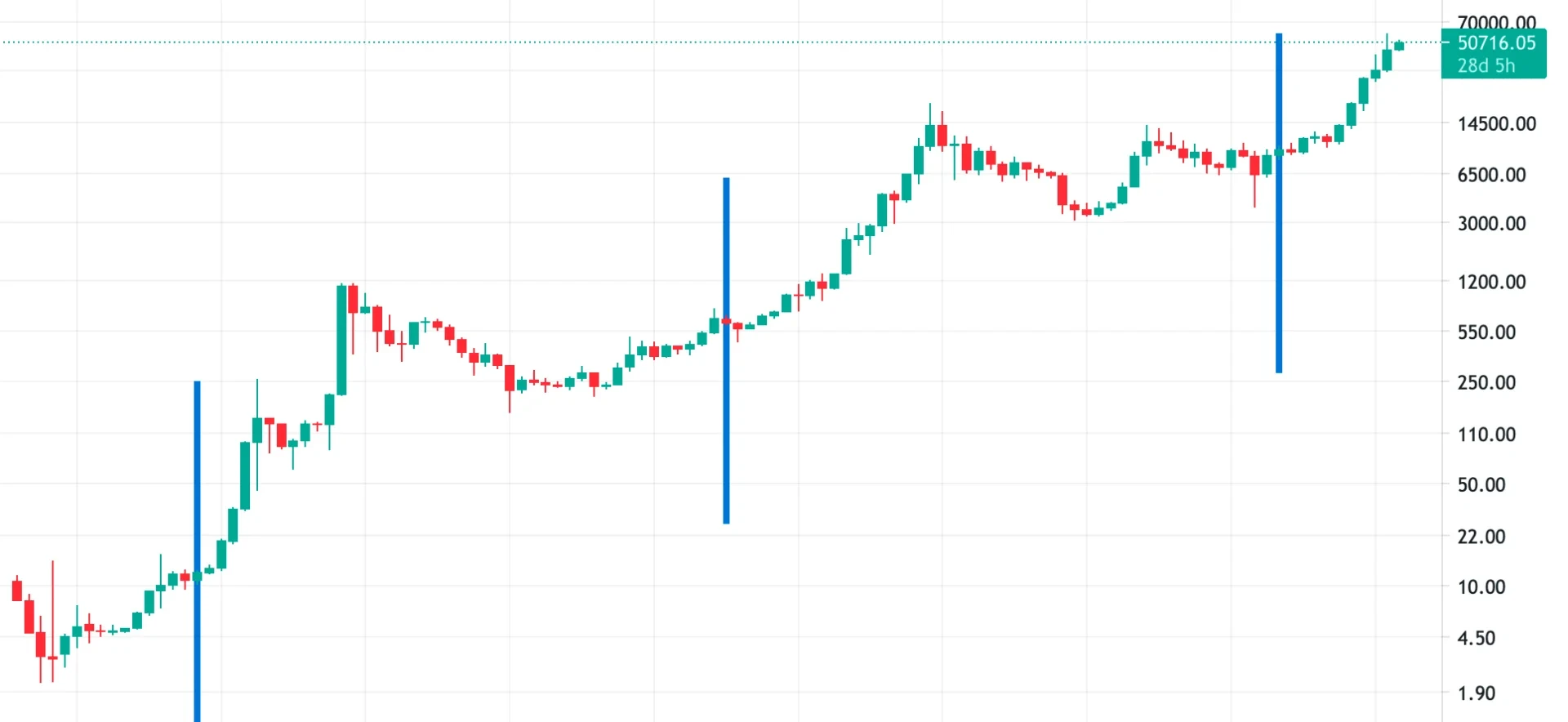
In summary, the "Altseason Index" measures the relationship between top 50 altcoin gains during altcoin explosion periods and Bitcoin price. "RHODL Ratio" can relatively accurately identify Bitcoin's price highs and lows in each macro cycle. "Jiang Zhuoer's 60-Day Cumulative Market Cap Growth" warns of market overheating by monitoring Bitcoin's consecutive 60-day gains. "Whale Bitcoin Wallet Sizes" reflects the smartest crypto capital's market views by monitoring whale wallet quantity changes. "CFTC Asset Manager Position Trends" clearly shows large institutional crypto trading position changes. "Bitcoin Halving" demonstrates crypto industry cycle changes from a macro perspective.
Disclaimer
This article may contain content related to products not available in your region. This article is intended to provide general information only and is not responsible for any factual errors or omissions. This article represents only the author's personal views and does not represent OKX's views. This article is not intended to provide any advice, including but not limited to: (i) investment advice or investment recommendations; (ii) offers or solicitations to buy, sell, or hold digital assets; or (iii) financial, accounting, legal, or tax advice. Holding digital assets (including stablecoins) involves high risk and may fluctuate significantly or become worthless. You should carefully consider whether trading or holding digital assets is suitable for you based on your financial situation. Please consult your legal/tax/investment professionals regarding your specific circumstances. Information appearing in this article (including market data and statistics, if any) is for general reference only. While we have taken all reasonable care in preparing this data and charts, we assume no responsibility for any factual errors or omissions expressed herein. © 2025 OKX. This article may be reproduced or distributed in its entirety, or excerpts of 100 words or less from this article may be used, provided such use is non-commercial. Any reproduction or distribution of the entire article must also prominently state: "This article is © 2025 OKX and used with permission." Permitted excerpts must cite the article name and include attribution, such as "Article Name, [Author Name (if applicable)], © 2025 OKX." Some content may be generated or assisted by artificial intelligence (AI) tools. No derivative works or other uses of this article are permitted.
Expand
Related Recommendations

2025 KOL Most Used OKX Products Ranking
In the cryptocurrency industry, professional players' choices are always direct and pure. In 2025, KOLs cast their most authentic votes for industry tools and ecosystem development through year-long capital investment and time commitment. We explored four core questions—"What was your biggest achievement this year?", "What OKX products did you use most and love most in 2025 while achieving results?", "Why do you like it?", "This product
January 5, 2026

2026 Investment Outlook: Asset Tokenization, Intelligence, and Privacy | OKX Annual Record
Three major trends in Crypto's future: asset transformation, entity transformation, and rule transformation. As we approach 2026, leaving behind four years focused on "building roads" infrastructure, the crypto industry is experiencing a profound paradigm shift. OKX Ventures defines this as the opening of the "Kinetic Finance" era, where the core is no longer how fast the network is, but the flow and profitability of on-chain assets
December 31, 2025

Voting with Data: Insights into 2025 Popular Trading Products | OKX Annual Record
Looking at market trends alone cannot explain the return differences among exchange users in 2025. What truly determines returns depends on account-level operational methods, not just market volatility itself. OKX annual reports show that mainstream coins remain the core for capital turnover and return generation, supporting trading and strategy execution. Emerging coins are more used to amplify volatility and provide phased opportunities, but are not stable, long-term return sources. What truly contributes sustained returns
December 30, 2025
Fusaka in Practice: What Ethereum's Latest Upgrade Means for L2, Nodes, and Users
Ethereum mainnet has completed the Fusaka fork. From a protocol perspective, this upgrade mainly includes four parts. The full text presents core viewpoints and frontline experience from three guests in Q&A format: Ahmad (@smartprogrammer) – Nethermind execution client / Ethereum core development Manu (@manunalepa) – Prysm / Of
December 16, 2025

OKX Research | Why RWA Became a Key Narrative in 2025
RWA (Real World Assets) is becoming the "new favorite" of global capital. Simply put, RWA means taking valuable, ownership-bearing things from the real world—such as houses, bonds, stocks, and other traditional financial assets, even art, private lending, carbon credits, and other assets that are typically difficult to trade directly—and moving them onto blockchain, transforming them into tradable, programmable crypto assets. This way
November 20, 2025
Claude Wins Championship: 6 AI Grid Strategy Showdown Truth | OKX & AiCoin Live Evaluation
Is Qwen3, the short-term trading champion, also king in grid strategies? The "AI Trading Live Arena" Season 1 launched by NOF1 finally concluded on November 4, 2025 at 6 AM, keeping crypto, tech, and finance circles on edge. But the ending of this "AI IQ public test" was somewhat unexpected. The six models' combined $60,000 principal was reduced to only $4.3
November 6, 2025