2021 Public Chain Race Review: A Hundred Flowers Bloom, Multi-Chain Prosperity
2021 is destined to be a year etched in cryptocurrency history. The combined bullish effects of Bitcoin's halving in the previous year and the Federal Reserve's massive monetary expansion spawned an unprecedented grand bull market. The total cryptocurrency market capitalization surged from $779.5 billion at the beginning of the year to a record-breaking $3 trillion in November.
With the emergence of new concepts and gameplay such as DeFi, NFTs, meme coins, GameFi, Metaverse, and Web3.0, the frequency of trending topic updates in the industry far exceeded previous years. There were numerous milestone events like Coinbase's Nasdaq listing. In sync with this excitement, the public chain race—the industry infrastructure that carries on-chain applications and connects ordinary users—saw significant growth across various data metrics in 2021.
The DeFi boom that began in the second half of 2020 provided a continuous stream of users to major public chains. According to DeFi Pulse data, as of December 27, the Total Value Locked (TVL) in assets across DeFi protocols in various ecosystems exceeded $243.2 billion.
Meanwhile, Dune Analytics data shows that the number of unique addresses that have ever interacted with DeFi protocols surpassed the 4 million mark for the first time at year's end. This massive user growth benefit allowed emerging public chains positioning themselves as Ethereum alternatives—such as Solana, Avalanche, and BSC—to rise to prominence in the first half of the year. In the second half, as industry momentum shifted from DeFi to NFTs, vertical public chains focusing on the NFT niche like Flow and Tezos gained significant attention. Additionally, Ethereum's London upgrade and Polkadot's parachain slot auctions both launched as scheduled this year, which will have far-reaching impacts on the future of the entire public chain race.
Looking back, this article attempts to outline several important threads of the public chain race in 2021 and bring some reflections to users.
I. Ethereum's Dominant Position Remains Unshakable
The enormous market rewards have provided broad space for emerging public chains, but careful analysis reveals that among public chains with TVL exceeding $10 billion, only Solana is not Ethereum-compatible. It can be said that these new players claiming to challenge Ethereum are almost entirely riding Ethereum's coattails. Despite numerous competitors, Ethereum's king position is difficult to shake.
Data shows that ETH price rose from $750 at the beginning of the year to a high of $4,860 (November 10), currently reporting around $4,050, a 50% increase from the start of the year. Ethereum's market capitalization share also rose from 11% at the beginning of the year to the current 21%, a 10% increase.
Although gas fees continue to rise and transaction speeds remain low, Ethereum's powerful network effects and first-mover advantage still make most DApp developers view it as their first stop. After application logic is proven, they then migrate to other "high cost-performance ratio" public chains to complete "multi-chain deployment." Of course, users have long suffered from high gas fees. If Ethereum doesn't make changes in this regard, it could lead to significant user loss. Therefore, the EIP-1559 proposal was passed in the London upgrade in August, cumulatively burning 124,300 ETH (approximately $5 billion), transitioning Ethereum from an inflationary to a deflationary model and constituting a significant positive for subsequent prices. According to a Coindesk report, if the EIP-1559 proposal is implemented, transaction fees could consume about 4% of Ethereum's current annual supply increase. Market data shows ETH price reached a high of $4,870 in November.
Beyond cost reduction and efficiency improvement, Ethereum also focused heavily on Layer2 scaling solutions this year. The four major Rollup scaling solutions all completed tens of millions or even hundreds of millions of dollars in financing this year. Currently, Optimism and Arbitrum have launched on mainnet, while zkSync and Starkware have also made development progress. L2BEAT data shows that as of December 27, the Total Value Locked (TVL) on Ethereum Layer2 reached $5.6 billion. The scaling solution with the highest locked value is Arbitrum at approximately $2.52 billion, accounting for 44.99%.
Despite wearing the Ethereum Layer2 halo, all four solutions have faced some质疑 due to technical limitations, and their future progress remains to be seen.
Currently, Ethereum still sits firmly in the top position of the public chain race. Its market capitalization and price have risen with the industry's growth, and its approach to technical iteration and ecosystem layout has gradually become an industry风向标. However, the old pattern of one dominant player no longer exists, and Ethereum needs to adapt to the pursuit and impact of latecomers.
II. Fierce Competition for Second Place Among Public Chains
Defi Llama data shows that the current DeFi TVL on the Terra chain reaches $20.89 billion, ranking second among public chains. Currently, the top 5 public chains by TVL are Ethereum ($159.84 billion), Terra ($20.89 billion), BSC ($17.27 billion), Avalanche ($12.27 billion), and Solana ($12.25 billion). Ethereum is in an absolutely leading position, with total locked value nearly 8 times that of second place.
A public chain that doesn't want to replace Ethereum is not a good public chain, even if only in thought. Driven by the bull market, in 2021 a group of new public chains chose to target Ethereum, addressing Ethereum's pain points of high gas fees and low transaction speeds, and absorbing a large number of overflowing project teams and developers. Of course, they know they cannot shake Ethereum's position, so they focus more on intensely competing for the second spot among public chains.
The first to enjoy Ethereum's overflow benefits was undoubtedly the BSC public chain. BSC's platform strength and resource advantages need no elaboration. Although it was only established in September of the previous year, with platform traffic support, BSC's TVL consistently ranked second in the public chain race in the second quarter, aiming directly at Ethereum.
Ultra-high TVL means a more ample funding pool, larger user base, and more imaginative stories for capital markets. In the first half, various public chains engaged in an arms race around TVL rankings. Solana came from behind and successfully took the baton from BSC. Unlike BSC, Solana's customer acquisition strategy was to attract seed users by hosting generously rewarded hackathons, then leveraging excellent performance to form powerful word-of-mouth effects and complete viral growth. According to statistics, just the May hackathon brought 326 new projects to Solana. Additionally, when discussing Solana, one must mention the deep-pocketed backer SBF and the CEX FTX continuously funding it. As of this writing, Solana's open-source repositories reach 5,985, and its on-chain wallet Phantom has 1.6 million users.
Avalanche, which gained momentum around the same time as Solana this year, also focuses on cost-performance ratio and high-reward strategies. On July 29, Avalanche updated its previous cross-chain bridge Avalanche-Ethereum Bridge (AEB) to Avalanche Bridge (AB). The new cross-chain bridge is built using Intel SGX Enclave technology, solving the previous pain point of difficult asset transfers and improving performance and security. Currently, Ethereum's cross-chain confirmation time is about 5 minutes, while Avalanche can complete it within 10 seconds, with gas fees at 1/10 of Ethereum's.
In September, the Avalanche Foundation announced the launch of a $180 million liquidity mining reward program called Avalanche Rush, encouraging more applications and assets to join the Avalanche DeFi ecosystem, pushing Avalanche ecosystem enthusiasm to new heights. Additionally, Avalanche's economic model is similar to Ethereum's 1559 protocol, including a transaction fee burning mechanism, which makes its token AVAX potentially deflationary, thereby triggering user FOMO and elevating AVAX's price.
Fantom also adopted a similar approach to Avalanche, attracting a significant number of developers and players focused on short-term returns by building cross-chain bridges plus liquidity incentives. In just a few days in late October, TVL volume surged 50-fold to a high of $5.78 billion. Yearn (YFI) founder Andre Cronje (AC) also repeatedly promoted it on social platforms.
Admittedly, the method of massive bonus incentives has obvious short-term stimulus effects, but is unsustainable in the long term and mortgages the entire project's potential. The result, referencing the money-burning model of the internet sector, may ultimately end in disaster.
By year's end, Terra suddenly erupted, taking the crown among emerging public chains. Unlike ETH, BSC, and Solana, Terra was founded to create stablecoins that combine price stability with decentralization. Its representative product is Terra USD, or UST. Terra's vision is very ambitious, aiming to use blockchain technology to build a payment system, issue price-stable cryptocurrency tokens in a decentralized form, and ultimately achieve mass adoption of cryptocurrency. This South Korean-born startup project already possesses a complete on-chain financial ecosystem prototype, with over 70 DApps covering DEX, lending, and derivatives. Additionally, its payment application Chai had nearly 50,000 daily users last year, connecting to over 10 banks while issuing physical cards. As of this writing, Terra's token LUNA's market capitalization has entered the top ten crypto assets, and UST has surpassed DAI to become the largest decentralized stablecoin by market cap. In the past week, Terra averaged 3,199 new registered accounts daily.
While these public chain upstarts stole Ethereum's thunder and benefits, they also to some extent alleviated Ethereum's on-chain congestion. However, what users widely criticize is that behind high performance and low costs lies a compromise in decentralization, which clearly contradicts the spiritual philosophy of the Crypto world.
III. Cross-Chain Bridge Demand Surges, But Cross-Chain Twins Perform Mediocrely
According to statistics by Dmitriy Berenzon, partner in charge of data research at Zenith Ventures, the number of cross-chain bridge projects exceeded 40 as early as September 8. According to the latest data, by the end of this year, cumulative cross-chain bridge projects exceeded 100. It's not difficult to judge that the wealth effect combined with the prosperity of major public chain ecosystems has awakened users' long-dormant demand for cross-chain asset transfers. Currently, cross-chain bridges have gradually become the mainstream method for users to transfer on-chain assets due to their突出的 universality and flexibility advantages.
According to the latest Dune Analytics data, the total TVL on Ethereum cross-chain bridges reached $25.23 billion. The top 5 cross-chain bridges by TVL are Ronin Bridge ($6.776 billion), Polygon Bridges ($6.658 billion), Avalanche Bridge ($6.14 billion), Arbitrum Bridges ($2.584 billion), and Fantom Anyswap Bridge ($1.424 billion).
Worth noting is that focusing on the specific operation of user cross-chain asset transfers has spawned two more segmented tracks. One is native cross-chain bridges led by the original underlying development teams, such as Arbitrum Bridge, Avalanche Bridge, Optimism Gateway, etc. The other is third-party cross-chain protocols like Multichain (formerly Anyswap), cBridge, Hop Protocol, etc. Among them, Multichain recently completed $60 million in new financing with participation from top-tier institutions like Sequoia Capital and Three Arrows Capital, pointing to the prospects of this track. Additionally, cBridge has made significant achievements in reducing asset interaction and transfer times, able to control transfer confirmation time within 20 minutes. Currently it not only supports cross-chain transfers between major public chains like Ethereum, Polygon, Fantom, Avalanche, and other current mainstream public chains, but also provides direct interaction between L2s, as well as from L2 to public chains other than Ethereum like BSC, Fantom, etc. However, cross-chain bridge projects, due to technical complexity and asset density, are very likely to be targeted by hackers. Security remains unclear, and future trends cannot yet be determined.
Of course, when discussing the cross-chain concept, one naturally cannot bypass the "cross-chain twins" Polkadot and Cosmos. Polkadot has long been viewed as Ethereum's most formidable competitor, or even a potential replacement. Polkadot founder and CEO Dr. Gavin Wood was formerly Ethereum's CTO. His Web3.0 concept proposed earlier became a phenomenal topic by the end of this year. This year, Polkadot and Kusama's parachain slot auctions launched as scheduled after long community anticipation. This was viewed as a milestone event in the cross-chain track, because projects that had been preparing for years could access the Polkadot ecosystem by successfully bidding for slots, enjoying quality technical infrastructure and ecosystem benefits.
However, user expectations seem not to have materialized. Currently, Polkadot's total market capitalization only ranks tenth, and its TVL falls far short of emerging public chains like Solana. The reason lies in the slot auction mechanism, which requires project teams to stake a considerable amount of DOT, representing a huge burden for developers who haven't yet generated commercial value, thereby inhibiting the vitality of on-chain projects. Therefore, it's not surprising that DOT value declined continuously from early November when parachain slot auctions began. At the end of last year, Phala CEO Tong Lin had publicly stated that the annual interest cost of each Polkadot parachain slot alone is as high as $30 million, not including the cost of locked DOT.
Despite this, for project teams, successful bidding is undoubtedly a symbol of status or an endorsement of strength, and also provides strong assistance for subsequent financing and operations. Whether Polkadot can leverage its powerful technical advantages and comprehensive ecosystem in the later stages to fully empower successful bidders, thereby emerging from the downturn, remains worth watching. After all, this is a deeply rooted veteran project.
In contrast, the other of the cross-chain twins—Cosmos—appears much dimmer. Cosmos was greatly weakened by internal team discord in 2019, and the 2020 bear market also dealt it a blow. However, Cosmos's strength in cross-chain transfers should not be underestimated. Cosmos network explorer data shows that Cosmos's native cross-chain protocol IBC has processed 5.8 million transfers, with IBC protocol processing 1.89 million transfers in November alone, an all-time high. Additionally, according to official Cosmos messages, since launching 8 months ago, 25 public chains have already connected to the IBC protocol. Its ecosystem tokens (ATOM, OSMO, LUNA, CRO, SCRT, etc.) have a total market capitalization exceeding $60 billion, with 5.8 million cumulative IBC transactions. In 2022, the IBC protocol also plans to connect cross-chain with public chain networks like Bitcoin, Ethereum, Polkadot, Avalanche, Harmony, and Celo, further releasing massive blockchain liquidity. Surprisingly, the previously mentioned Terra public chain is developed based on Cosmos SDK.
IV. Vertical NFT Public Chains Begin to Emerge
According to DappRadar statistics, in mid-July 2021, chain game and wallet interactions reached 3.31 million, surpassing DeFi for the first time. In the same period, NFT profile picture trading became widespread on OpenSea, with floor prices even creating new highs of thousands of dollars. Removing current hype水分, NFTs' unique advantages in rights confirmation, circulation, and trading of entertainment works have led to sustained enthusiasm from both inside and outside the industry. Therefore, some developers abandoned the approach of following trends to build general-purpose public chains, instead focusing on providing underlying infrastructure for the NFT ecosystem.
Flow is a typical representative, launched by Dapper Labs and gaining mainstream attention in the first half of this year due to NBA Top Shot. It's reported that only about 20% of users purchasing NBA Top Shot trading cards were cryptocurrency users, with the vast majority being ordinary basketball fans or collecting enthusiasts. Flow's native projects also include the massively multiplayer online role-playing game Chainmonsters, and the avatar and peripheral trading market Genies.
Veteran public chain WAX also went all-in on NFTs this year. The WAX public chain was developed by the founding team of online game virtual item trading platform OP Skins. The team claims it has the capacity to process approximately 2 million trades weekly, providing guarantee for WAX's transaction speed. The WAX official homepage "immodestly" displays the words "King of NFTs" in large letters. According to DappRadar data, there are already 27 NFT game projects on the WAX chain.
Another low-key veteran player Tezos also made NFTs its transformation direction. This year, Tezos's on-chain art collection platform Hic Et Nunc was widely praised by NFT enthusiasts because its artworks are high-quality and affordable, available for just a few dollars or even free, with similarly low gas fees. Interestingly, Tezos emphasizes the eco-friendly blockchain concept, winning favor from mainstream circles.
This year, PwC Consulting stated in a report that since transitioning from PoW mining consensus to PoS consensus, Tezos has made tremendous improvements in energy efficiency. The report emphasizes that despite increased Tezos network activity, its carbon emissions have significantly decreased. With 50 million transactions on the Tezos blockchain, the entire network's energy footprint equals only that of 17 global citizens. Network transaction energy efficiency improved by 70%, while estimated power demand per transaction decreased by 30% compared to 2020.
Southeast Asia became a hotbed for chain games due to Axie Infinity. The Merit Circle guild, positioning itself against YGG, shouted the slogan of making chain games affordable for users in low-income countries, gaining numerous fans in the Philippines and other countries. KardiaChain, claiming to be Southeast Asia's number one public chain, also entered everyone's vision in 2021 by focusing on NFT and chain game projects. The hugely popular My DeFi Pet mid-year was incubated by KardiaChain. Well-known NFT applications like THETAN ARENA, DEFILY, BECOSWAP, and SLEEPEARN FINANCE are also in its project library.
V. In Blue Ocean Markets, New-Old Alternation Trends Are Obvious
The above public chain projects gained attention this year either because they were at the forefront, rode the trends, had impressive data, or employed novel strategies. Amidst the excitement, many players in the same track also conducted a series of meaningful experiments:
The TRON core team and BitTorrent jointly built the heterogeneous cross-chain interoperability scaling protocol BitTorrent Chain (BTTC), whose mainnet officially launched around December 12, with the vision of building a distributed global financial underlying protocol;
DFINITY also launched its mainnet on May 8 under much attention with the quite超前 "Internet Computer" concept, making a deep exploration for public chains in underlying internet technology;
Algorand continuously optimizes and iterates on the blockchain "impossible trinity," with its TPS reaching 125 times that of Bitcoin. This year, Algorand continued to strengthen its positioning as a compliant financial public chain, echoing epic events like Bitcoin becoming El Salvador's legal tender;
Near and Conflux, two localized public chains, also continued exploring Layer2, NFT, DeFi ecosystems, and cross-chain technology, striving to win a place in the turbulent public chain tide.
Of course, it's regrettable that EOS, once viewed as blockchain 3.0, completely fell behind this year. Beyond users, funds, technology, and ecosystem, the project team that lost BM even lost the ability to create topics, causing sighs and reflections on industry changes.
Overall, the 2021 public chain race prospered from the super grand bull market. Its heat was ignited by the DeFi explosion, gained romantic and fervent artistic colors as NFTs gradually became traffic core, and was viewed by year's end as the carrier of WEB3.0 and the foundation of the metaverse.
This year, Ethereum's dominant position no longer exists, but its absolute advantage remains obvious, firmly holding the top spot in the race. BSC, Solana, Terra, and Avalanche each combined their advantages, launched differentiated gameplay, and stably occupied the throne of the emerging public chain race in different periods. Cross-chain demand was stimulated by increasing users and public chain numbers, but the market segment is not yet mature, though still worth anticipating. The cross-chain twins were buried in the narrative of承接 Ethereum overflow projects and布局 DeFi+NFT two major hotspot ecosystems, missing strategic opportunities, though the future remains promising given their deep foundations. Vertical public chains like Flow and WAX anchoring the NFT field continue to receive attention. Whether the NFT breakout effect can quickly bring these public chains into ordinary households deserves special attention. Other large and small players in the public chain race, while witnessing the magnificent bull market picture, are also actively exploring directions belonging to themselves.
We look forward to this 2021 industry pattern of a hundred flowers blooming and multi-chain prosperity leaving rich gifts for future markets, successors, and the future cryptocurrency world.
Disclaimer
This article may contain product-related content not applicable to your region. This article is intended only to provide general information and does not take responsibility for any factual errors or omissions herein. This article represents only the author's personal views and does not represent OKX's views. This article is not intended to provide any advice, including but not limited to: (i) investment advice or investment recommendations; (ii) offers or solicitations to buy, sell or hold digital assets; or (iii) financial, accounting, legal or tax advice. Holding digital assets (including stablecoins) involves high risk, may fluctuate significantly, and even become worthless. You should carefully consider whether trading or holding digital assets suits you based on your financial situation. For questions about your specific situation, please consult your legal/tax/investment professional. The information appearing in this article (including market data and statistics, if any) is for general reference only. Although we have taken all reasonable precautions in preparing these data and charts, we assume no responsibility for any factual errors or omissions expressed herein. © 2025 OKX. This article may be reproduced or distributed in full, or excerpts of 100 words or less from this article may be used, provided such use is non-commercial. Any reproduction or distribution of the entire article must also prominently state: "Copyright © 2025 OKX. Used with permission." Permitted excerpts must cite the article name and include attribution, for example "Article Name, [Author Name (if applicable)], © 2025 OKX". Some content may be generated or assisted by artificial intelligence (AI) tools. Derivative works or other uses of this article are not permitted.
Show More
Recommended Reading

2025 KOL Most-Used OKX Products Ranking Overview
In the cryptocurrency industry, professional players' choices are always direct and pure. In 2025, KOLs used a full year of fund investment and time accumulation to cast the most authentic votes for industry tools and ecosystem development. We focus on four core questions—"What was the biggest achievement this year?", "Given the achievements, what OKX products did you use most and like most in 2025?", "Why do you like it?", and "This
January 5, 2026

2026 Investment Outlook: Assets On-Chain, Intelligence and Privacy | OKX Annual Record
Crypto's three major future trends: asset transformation, entity transformation, and rule transformation. As we enter 2026, bidding farewell to the past four years of infrastructure-focused "road building," the cryptocurrency industry is welcoming a profound paradigm shift. OKX Ventures defines this as the opening of the "Kinetic Finance" era, where the core is no longer how fast the network is, but the flow and earning of on-chain assets
December 31, 2025

Voting with Data: Insights into 2025 Hot Trading Products | OKX Annual Record
If looking only at market行情, it's hard to explain the returns differences among 2025 trading users. What truly determines returns also depends on account-level operation methods, not just market volatility itself. The OKX annual statement shows that mainstream coins remain the core of fund turnover and returns承载, supporting trading and strategy execution. Emerging coins are more used to amplify volatility and provide phased opportunities, but are not stable, long-term return sources. What truly continuously contributes returns,
December 30, 2025
Fusaka in Practice: What Ethereum's Latest Upgrade Means for L2, Nodes, and Users
The Ethereum mainnet has completed the Fusaka fork. At the protocol level, this upgrade mainly includes four components. The full text presents the core views and frontline experience of three guests in Q&A format: Ahmad (@smartprogrammer) – Nethermind execution client / Ethereum core developer Manu (@manunalepa) – Prysm / Of
December 16, 2025
OKX Research Institute | Why Did RWA Become a Key Narrative in 2025?
RWA (Real World Assets) is becoming a global capital "new favorite." Simply put, RWA means moving valuable, ownership-bearing things from the real world—like houses, bonds, stocks and other traditional financial assets, or even art, private lending, carbon credits and other assets not easily traded directly—onto the blockchain, turning them into tradeable, programmable crypto assets. This way, no
November 20, 2025
Claude Takes Championship, 6 Major AI Grid Strategy Showdown Truth | OKX & Ai Coin Live Trading Review
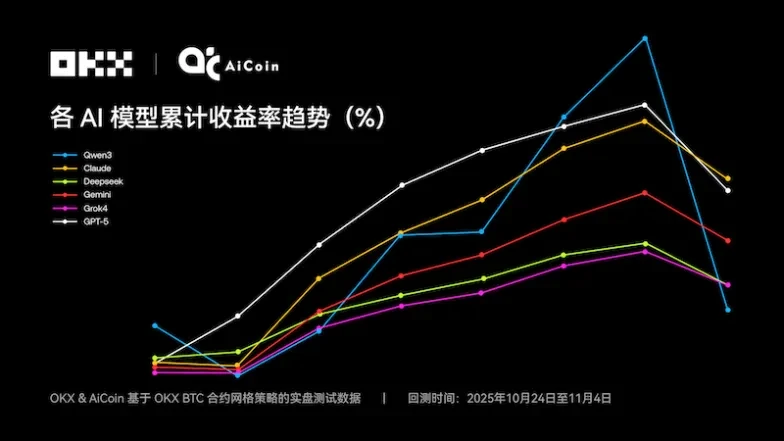
Short-term trading champion Qwen3—is it also king in grid strategies? The first season of the "AI Trading Live Arena" launched by NOF1 finally concluded at 6 AM on November 4, 2025, whetting the appetites of the cryptocurrency, technology, and金融 circles. But the ending of this "AI IQ public test" was somewhat unexpected. The six models' total $60,000 principal was only $4.3
November 6, 2025