2026 Investment Outlook: Assets On-Chain, Intelligence and Privacy | OKX Year in Review
As we approach 2026, bidding farewell to the past four years focused on infrastructure "road-building," the cryptocurrency industry is welcoming a profound paradigm shift. OKX Ventures defines this as the dawn of the "Kinetic Finance" era, where the core focus is no longer on how fast the network is, but on how efficiently on-chain assets flow and generate returns.
Let's get straight to the point: we believe future crypto opportunities will concentrate on three core transformations:
-
Asset Transformation: From "on-chain" to "global settlement". RWA will enable everything in the real world (US Treasuries, real estate, IP) to flow seamlessly 24/7 on-chain, bringing a qualitative leap in capital efficiency.
-
Entity Transformation: From "humans" to "AI Agents". The protagonists of trading will shift from humans to AI. DeFi protocols will become "financial APIs" called by AI, and funds will actively seek optimal global returns as if possessed of intelligence.
-
Rule Transformation: From "ex-post regulation" to "code-based compliance". Privacy and compliance are no longer obstacles, but infrastructure embedded in code, paving the final path for大规模 institutional funds like Wall Street to enter.
We firmly believe that projects capable of using code to solve real-world trust costs and enhance capital efficiency will become the cornerstones of the new era. OKX Ventures' investment logic in infrastructure over the past few years has primarily focused on the robustness of underlying protocols and the expansion of network capacity. Moving forward, we will continue to seek and support these future-defining builders.
In 2025, the industry witnessed numerous significant milestones: In terms of compliant fund channels, the approval of Bitcoin spot ETFs opened pathways for traditional capital, with cumulative net inflows surpassing the $50 billion mark, making crypto assets a standard component of global macro hedging; At the underlying technology level, Ethereum's Pectra upgrade in May and subsequent Fusaka phase progression reduced consensus layer communication load by over 90% and increased network Blob data throughput 4-fold, while native Account Abstraction capabilities cleared barriers for high-frequency interactions from hundreds of millions of users; On-chain trading performance saw a qualitative leap, with high-performance DEXs like Hyperliquid repeatedly setting daily trading volume records of $20 billion; In asset scaling, RWA completed a critical breakthrough, with BlackRock's BUIDL fund alone surpassing $2.5 billion by year-end, proving the complete "two-way valve" between on-chain and off-chain liquidity.
In 2025 alone, OKX Ventures participated in investments in dozens of projects across multiple tracks including RWA, Infra, DeFi, AI, stablecoins, and consumer applications, continuously committed to supporting industry innovation.
I. Deep Financialization of RWA
RWA is no longer simply about issuing "digital receipts" for real-world assets (like houses, bonds). We are entering the RWA 2.0 phase, whose core is transforming blockchain into a global 24/7 settlement center. Imagine: selling an asset used to take two days to settle (T+2), but now using blockchain, we can achieve instant settlement (T+0). This isn't just faster—it fundamentally changes the operational efficiency of global capital.
RWA Asset Stratification: From On-Chain US Treasuries to Synthetic US Stocks and Non-Standard Credit
The US dollar is a globally accepted currency, enabling stablecoins USDT and USDC to map and develop rapidly, followed by US stocks. Therefore, we see quite a few DEXs and CEXs entering US stock tokenization. However, a massive portion of global assets is non-denominated in USD. Assets naturally have liquidity stratification. For example, US Treasuries have extremely high liquidity, while real estate and private credit belong to deep non-standard assets. The core of RWA 2.0 lies in abandoning the "one-size-fits-all" AMM model and building adapted issuance and trading architectures for different asset levels.Standardized assets are the easiest to on-board and scale. According to RWA.xyz data, tokenized US Treasury scale has surpassed $7.3 billion (over 300% year-on-year growth). On-chain US stocks are becoming the second major standardized asset growth driver after US Treasuries, currently at about $500 million in scale, with core value in breaking traditional stock trading time restrictions (achieving 24/7 trading) and regional access barriers. This trend indicates that on-chain finance will possess not only "risk-free rates" (US Treasuries) but also "equity risk assets" (US stocks), thereby constructing a complete on-chain investment portfolio. In contrast,non-standard assets like private credit maintain active loan volumes around $800 million. This enormous gap indicates: high-yield non-standard assets remain constrained by pricing and circulation challenges. BCG predicts that by 2030, the RWA market scale will reach $16 trillion, and 2026 will be a critical inflection point in this growth curve, with on-chain non-stablecoin RWA scale expected to surpass the $100 billion mark. We believe this is significant because it marks RWA's transition from a niche experiment to a trillion-dollar market mainstream narrative. RWA has evolved beyond simple mapping to a stratified architecture based on asset liquidity characteristics.
Stablecoins Reshaping Global Settlement Networks
**Undoubtedly, stablecoins are themselves crypto's killer product. They are far more than just trading pairs in trading—they are alternatives for cross-border payments, **expected to gradually replace traditional SWIFT systems. Traditional cross-border payments typically involve 3-5% fees and 2-3 day settlement cycles. In contrast, on-chain stablecoin payment fees are below 1% with nearly instant settlement. As of November 2025, annual on-chain stablecoin settlement volume has surpassed $12 trillion, officially exceeding Visa's full-year settlement volume. Current stablecoin market cap has stabilized above $210 billion, with over 40% of trading volume occurring during non-trading hours (traditional bank closure times), filling the "liquidity vacuum" in global financial infrastructure. Additionally, the composability of full asset tokenization deserves attention: leading DeFi protocols (like Aave, MakerDAO) have completed RWA asset integration, forming a "Lego effect". Whether US Treasuries (like BUIDL, USDY), real estate, or private credit, all successfully serve as underlying collateral for DeFi lending protocols. By end-2025, BlackRock's BUIDL fund and Ondo Finance's USDY officially integrated with Aave V4 and Sky (formerly MakerDAO) protocols. Approximately 30% of on-chain tokenized US Treasuries (~$2.2 billion) is being directly used as underlying collateral for lending protocols, rather than sitting idle in wallets. Traditional financial institutions will leverage on-chain T+0 real-time settlement capabilities to improve fund utilization by 2-3x, completing substantial migration of backend infrastructure to decentralized ledgers.
OKX Ventures Key Focus Projects
OKX Ventures focuses on investing in infrastructure-level projects capable of compressing trust costs and efficiency friction at scale, addressing the three core bottlenecks in current on-chain capital markets (including RWA 2.0): (1) settlement depth and capital liquidity, (2) verifiability and auditability, (3) sustainable returns—i.e., a reliable on-chain money market rate.
-
Axis is building a verifiable, cross-multi-strategy on-chain delta-neutral (market-neutral) arbitrage engine, packaging execution capabilities previously exclusive to institutions into composable return primitives. Unlike products relying on single trades (e.g., basis), Axis dynamically allocates across a basket of market structure opportunities: funding/basis arbitrage, cross-venue spot price spreads, CEX-DEX spreads, and cross-currency/regional premiums, making return sources more diversified and resilient during AUM expansion. Its first product USDx (and staked sUSDx) packages this engine as a USD-anchored asset, providing machine-readable transparency (high-frequency PoR/NAV disclosure, segregated custody/segregated collateral proof, and independent third-party verification), thereby reducing black-box return discounts and counterparty risk premiums. Longer term, the same execution infrastructure will extend to OTC/RFQ execution, quote/pricing APIs, and liquidity provision scenarios, making Axis an on-chain arbitrage-as-infrastructure layer for USD (subsequently expanding to BTC and gold-related products).
-
Accountable is building privacy-preserving verification infrastructure, transforming institutional trust into machine-readable engineering primitives. Its Data Verification Network (DVN) can be deployed in customer environments, connecting exchanges, wallets, custodians, and banks as data sources, outputting cryptographically verifiable proofs—allowing trading counterparties to verify assets, liabilities, and asset-restricted/pledged status without exposing original positions or surrendering sensitive account permissions, underpinned by zkTLS and secure computing capabilities. This effectively upgrades PoR from periodic reporting to continuous, insurable verification: stronger audit granularity, lower information asymmetry, ultimately reflected in lower counterparty risk premiums. DVN already provides real-time PoR/NAV workflow support for real issuers in production environments. Longer term, this verification rail will extend to Vault-as-a-Service and other trusted distribution surfaces, making verification not just a compliance cost but an advantage component for enhancing capital efficiency and product go-to-market.
II. Deep Integration of AI and the Crypto World
The AI wave is sweeping the globe. As today's most watched technological wave, its every move profoundly impacts all aspects of society. In the future, what sparks will AI ignite in the crypto domain? We believe AI will have great potential in areas like agents and machine payments.
AI Agent Economy and M2M Payment Networks
In multi-agent collaboration networks, different agents (like data analysts, trading executors, risk controllers) need high-frequency interaction. Blockchain smart contracts provide permissionless trust foundations and payment rails for this machine-to-machine (M2M) collaboration. This is mainly reflected in three aspects: **The AI payment track has entered an early explosion stage. **Google AP2, OpenAI × Stripe ACP, Visa Agentic Commerce, x402—four giants are simultaneously laying out agent payment infrastructure. Google introduced the AP2 protocol standardizing agent payment interfaces, Stripe's ACP (Agentic Checkout Protocol) processes over 2 million API calls daily. Visa's Agentic Commerce pilot shows AI agent-autonomous e-commerce payments achieve 98.5% success rates, far exceeding traditional automation scripts. **M2M payments will also see rapid growth. **Van Eck predicts that with the proliferation of Web3-native agent payment protocols like x402, AI agent-driven on-chain automated trading volume will reach $5 billion daily by 2027, with a compound annual growth rate (CAGR) expected to exceed 120%. **Service invocation costs significantly reduced. **Using blockchain micropayments for on-demand agent service calls, compared to traditional Web2-era API subscription models (SaaS), reduces service invocation costs by 60%, with single interaction costs as low as $0.0001, greatly reducing economic friction and loss in multi-agent collaboration. When Agent A completes a specific task, Agent B can achieve millisecond-level USDC micropayments through Lightning Network or Layer 2 protocols, all without human intervention, establishing an automated value circulation system.
AI and Verifiable Data Layers
With AI's evolution, deep learning pioneer Yann LeCun's proposed JEPA and "world models" like Sora are replacing pure LLMs. Their core demand has shifted from text generation to precise simulation of physical world causal laws (Physics & Causality). AI needs more authentic and reliable data from the real world. Gartner predicts that by 2026, 75% of global AI training data will consist of synthetic data, and data loops lacking real physical feedback will very likely lead to "Model Collapse" effects. According to Messari market analysis, cryptographically verifiable real-world datasets command market valuations typically 15 to 20 times higher than ordinary web-crawled data due to their scarcity and authenticity. High-fidelity training of world models critically depends on high-dimensional physical data including 3D space, depth information, and motion trajectories. Blockchain, through cryptographic signature technology, provides tamper-proof on-chain verification for every data point collected by sensors, fundamentally solving the "data contamination" and "synthetic fraud" problems prevalent in AI training, building a trusted bridge between the physical world and digital models. As of Q3 2025, active edge sensor nodes on blockchain networks have surpassed 4.5 million, with these nodes providing approximately 20 PB of verifiable physical data daily for various world models, becoming the cornerstone supporting next-generation AI cognition.
zkML and Decentralized Edge Computing: Trusted On-Device Inference Under Privacy Protection
The performance leap of high-performance small-parameter models (SLMs) like Llama 3-8B and Phi-3, AI inference computing power is experiencing a paradigm shift from centralized cloud to edge devices (phones, PCs, IoT devices). Market data shows that decentralized edge inference networks built using idle consumer-grade devices (like io.net or Akash) have H100-level unit computing costs around $1.49/hour, 60% to 75% lower than AWS or Nvidia cloud inference services (~$4.00-$6.50/hour), offering extremely strong economic arbitrage space. Thanks to technical推动 from projects like Accountable and Modulus Labs, demand for zkML verification services from on-chain prediction markets, insurance protocols, and high-value asset management achieved 230% quarter-over-quarter growth in Q3 2025, indicating that high-value DeFi scenarios have formed rigid demand for "trusted inference". To solve data fraud or model tampering risks caused by untrusted edge devices, zkML (zero-knowledge machine learning) has become key trust infrastructure. Emerging protocols like Accountable are building standardized verification layers, allowing nodes to generate mathematical proofs that rigorously verify on-chain that "this inference result was indeed produced by the correct model running on edge devices" without completely leaking input data (like medical images or financial private keys), thereby achieving a "trustless" closed loop for decentralized computing power.
OKX Ventures Key Focus Projects
-
Aspecta: Essentially, it builds a "digital passport" for Multi-Agents. In the future world, AI will collaborate and trade like humans. But the question is: how does one AI trust another unfamiliar AI? What Aspecta does is give each AI a "digital passport". By analyzing its past behavior and code records, it assigns a credit score. This way, AIs can establish trust with each other, even enabling collateral-free lending. In the economic network where agents call each other's services, Aspecta generates verifiable credit scores for each agent by parsing on-chain interaction graphs and GitHub code contributions. This is a prerequisite for M2M uncollateralized lending and trusted collaboration.
-
LAB: It's an **AI intent compiler in the Web3 space, **using the latest multimodal understanding capabilities to convert human vague natural language (like "arbitrage with minimum risk") into structured on-chain execution instructions. It solves the "last mile" connection problem between AI technology and complex DeFi protocols, greatly lowering barriers for non-technical users to use advanced DeFi strategies.
-
Hyperion: It's the physical anchor for AI world models, providing verifiable real-world data. It uses decentralized map networks to collect geospatial data, combined with AI inference, to provide "location services" verified by zero-knowledge proofs for on-chain agents. This is quite important for RWA asset management and embodied intelligence (robot) dispatch that rely on real physical states.
III. Institutional Adoption: Macro Hedging, Privacy Infrastructure, and Smart Compliance
Crypto assets have completed the transformation from "speculative assets" to "global macro hedging tools" in institutional eyes. A very obvious change is: in the last cycle, retail investors trading coins might not watch or care about macro events, while in this cycle, if you don't pay attention to the Federal Reserve, China-US tariffs, CPI data, etc., it's easy to fall into a passive position. Compliance is no longer an obstacle, but an institutional moat. The issuance of digital banking licenses will enable seamless exchange between crypto assets and fiat currency. Currently, three innovative products have emerged in the market. First, basis arbitrage and volatility products—institutions are no longer satisfied with passive holding. CME Bitcoin futures open interest repeatedly hits new highs, with institutional long positions significantly increasing. Second, basis trading, using price spreads between spot ETFs and futures contracts for risk-free arbitrage, has become a mainstream strategy for hedge funds, with annualized returns stably in the 8%-12% range, far exceeding US Treasury returns. Third, structured notes—products that package "BTC spot + Ethereum staking returns" provide institutions with allocation options similar to "dividend + appreciation" in traditional finance, without touching complex DeFi interactions. Institutional investment portfolios have expanded from single BTC allocation (as digital gold) to structured portfolios of "BTC + ETH/SOL + DeFi blue chips"—where BTC serves as a store of value, while PoS chain staking returns are gradually being viewed as the risk-free benchmark rate in the digital economy.
Privacy Renaissance: Rigid Demand for Institutional Entry
Privacy Renaissance: Rigid Demand for Institutional EntryAs TradFi giants deeply engage with the crypto market in 2026, the double-edged sword effect of transparent ledgers begins to highlight. In completely transparent on-chain environments, institutions struggle to execute complex arbitrage strategies or complete large trades, because any exposure of trading intentions can bring serious front-running risks and strategy leakage. This structural contradiction makes "privacy" an unavoidable prerequisite for institutional funds going on-chain. In this context, the connotation of privacy is being redefined.It's no longer viewed as a means to evade regulation, but transforms into a compliance protection tool for trade secrets—neither weakening regulatory capabilities nor sacrificing institutions' own strategy security.Specifically, institutional investment and technology focus is shifting toward "programmable privacy". Privacy computing protocols based on zero-knowledge proofs (ZK) and trusted execution environments (TEE) allow institutions to prove asset solvency and compliance to the outside world without exposing trading strategies and position details, thereby balancing transparency and confidentiality. Meanwhile, "compliant privacy pools" similar to dark pool trading mechanisms in traditional finance are forming on-chain. These liquidity pools hide trading details from the public but open view permissions to regulatory nodes, enabling large-scale institutional funds to complete low-impact, high-efficiency trade execution in DeFi, viewed as the "last mile" solution for institutional capital entering on-chain financial systems. Privacy is not a negation of blockchain's transparent spirit, but an upgrade for the institutional era. Future on-chain finance will no longer single-mindedly pursue "everyone seeing everything", but under compliance premises, properly hide what shouldn't be seen. This privacy capability is shifting from edge demand to infrastructure determining whether institutional funds can truly go on-chain.
Rise of On-Chain Compliance Track
With AI agents massively taking over on-chain interactions in the future, traditional financial compliance systems face collapse risks. Multiple institutions predict that daily on-chain interactions in 2026 will show exponential growth, with over 45% of trades initiated by non-human entities. Facing high-frequency machine trading of tens of thousands per second, traditional KYC/AML (Know Your Customer/Anti-Money Laundering) review models relying on "human wave tactics" may completely fail. Institutions cannot hire enough compliance officers to handle this throughput. Therefore, compliance focus is shifting from "ex-post accountability" to "code-level blocking". New-generation compliance architecture requires embedding regulatory rules into smart contracts, achieving millisecond-level automated risk control—this is not just a regulatory requirement, but a prerequisite for institutional funds to safely enter DeFi.Cipher OwlIt introduces AI-driven on-chain auditing and compliance layers focused on on-chain forensics and trade tracking, using AI-assisted analysis tools to identify money laundering risks and illegal fund flows, providing necessary security barriers and due diligence tools for institutional investors and regulatory bodies. Its SR3 tech stack, through filtering, reasoning, reporting, and research, uses large language models (LLMs) to parse complex on-chain trading graphs, automatically identifying money laundering risks or sanctioned entities. Additionally, Cipher Owl provides API interfaces, allowing trading agents on Hyperion to query counterparty address compliance scores at millisecond speed before executing trades. If risk is too high, smart contracts automatically reject interaction. This makes regulatory rules not ex-post punishment, but code constraints embedded in trading flows. For Wall Street institutions hoping to enter DeFi in 2026, Cipher Owl is indispensable compliance middleware.
IV. DeFi Active Intelligence Services and Prediction Markets
The open finance revolution that erupted in 2020 shocked the blockchain industry. Its elegant AMM and permissionless characteristics depicted the potential of future crypto finance.
DeFi 3.0 Active Intelligence Services: Intent-Based Kinetic Finance
We believe DeFi is experiencing a leap from DeFi 1.0 (passive smart contracts) to DeFi 3.0 (active intelligence services). If the core of 2020's DeFi Summer was "democratization of asset issuance," then 2026's transformation is dominated by "active fund patrol". Institutional fund participation logic is evolving from pure RWA to "strategies on-chain", executing 7×24 programmatic market-making and risk control through customized institutional-grade agents. The market is abandoning the old "designated path" model. Data shows that CoW Swap, based on the "Solver" model, has normalized monthly trading volumes above $3 billion, proving intent-centric's overwhelming advantage in liquidity transport. Investment logic is shifting from general-purpose DeFAI terminals to vertical-scenario autonomous agents. Compared to general Chat UIs facing landing bottlenecks, vertical agents deeply cultivating return optimization and liquidity management possess complete closed-loop execution capabilities and verifiable cash flow capabilities, key to mastering the underlying pricing power of the agent economy. In terms of investment, we believe trading paradigms are shifting from "human-machine interaction (H2M)" to "machine-machine interaction (M2M)". Given that AI large models (LLMs) cannot directly parse complex Solidity bytecode, the market urgently needs to build a DeFi Adapter Layer. By introducing standards like MCP (Model Context Protocol), heterogeneous protocols are encapsulated as standardized, semantic "toolkits", enabling AI to call financial services like APIs. Under this architecture, assets evolve into "smart packages" that automatically seek returns, with core metrics shifting from TVL (Total Value Locked) to TVV (Total Value Velocity).
Prediction Markets: 2026 Global Information Infrastructure
We believe that in this era of high signal-to-noise ratio information overload, prediction markets are not just gaming platforms, but high-resolution, high-timeliness "truth oracles". **In October 2025, compliant platform Kalshi, with its CLOB architecture, overtook Polymarket with 60% market share and $850 million weekly trading volume, while market open interest (OI) returned to $500-600 million, marking long-term non-speculative capital entry. Investment should focus on projects capable of solving fund utilization problems at the protocol level: Polymarket's Neg Risk mechanism, by automatically converting "NO" shares into mutually exclusive "YES" combinations, improved capital efficiency in multi-outcome markets 29-fold, contributing 73% of platform arbitrage profits; Kalshi's "collateral return" releases fund occupation in hedged positions. Whoever can make funds turn faster captures liquidity. Polymarket seized liquidity through an extremely low fee strategy of 0-0.01%, essentially establishing a data factory, ultimately selling "sentiment indicators" to institutions through ICE (NYSE parent company)'s $2 billion investment intent and channels—this data narrative supports its $12 billion valuation. In contrast, Kalshi maintains high fees around 1.2% using compliance moats, adopting an "embedded" expansion strategy, achieving 400,000 monthly active user conversions by embedding in Robinhood, while Myriad captured 30,000 active trading users by embedding in Decrypt media streams—proving that embedded models have lower customer acquisition costs than independent apps. **Legal battles over regulatory jurisdiction are the biggest variable in this track, with core conflict whether prediction markets fall under "commodities" regulated by CFTC or "gaming" regulated by states. **Kalshi chose the "federal preemption" path, holding CFTC's DCM license, attempting to use federal law's exclusive jurisdiction to override state laws, but this also faces litigation challenges from at least 8 state gaming commissions. This compliance position, while bringing strong pricing power (like 1.2% fee premium), also accompanies enormous legal costs. At the other end, Polymarket chose the "offshore avoidance" path, using DeFi architecture and geo-blocking to evade US jurisdiction, but constantly faces threats from SEC long-arm jurisdiction and EU ISP bans. OKX Ventures believes future investment opportunities concentrate in three directions:
-
Long middleware: Focus on underlying middleware (like Azuro) and specialized oracles (like Pyth, EigenLayer AVS). They are not limited by single regulatory jurisdictions and can capture value generated by all frontend applications—the highest risk-return "infrastructure bet".
-
Seek embedded traffic entry points: Independent prediction market apps have extremely high customer acquisition costs. Focus on projects developing Telegram Bots or modularly embedding prediction markets into news/social platforms*. These projects can reach users with zero friction and have stronger viral breakout potential.
-
Arbitrage opportunities in vertical tracks: Avoid general political/macro markets already forming duopolies, seeking leaders in sportsand high-frequency crypto asset vertical tracks. The sports track has huge product gaps due to parlay complexity, while crypto high-frequency prediction is a necessity for DeFi traders—neither field has an absolute ruler yet.
V. Conclusion
Looking ahead to 2026, we predict the industry focus will shift from "network capacity supply" to "asset efficiency release". We no longer focus solely on ledger storage and confirmation capabilities, but on the velocity, intelligence, and settlement efficiency of on-chain capital flows. We define this as the "Kinetic Finance" era. The macro shift from "assets on-chain" to "economics on-chain". Under this new paradigm, traditional financial boundaries are dissolving. OKX Ventures believes 2026 will be a critical inflection point where the crypto industry sheds speculative bubbles and returns to value creation, and projects that can solve real-world trust costs and circulation efficiency through code will become the cornerstones of the new era. We firmly believe in this transformation and will continue betting on foundational projects that can use code to reduce trust costs and enhance capital efficiency. At the singularity of deep digital-real integration, whoever defines the velocity of asset flows and the boundaries of truth will master the pricing power of the new era.
Disclaimer
This article may contain product-related content not applicable to your region. This article is intended to provide general information only and assumes no responsibility for any factual errors or omissions herein. This article represents only the author's personal views and not the views of OKX. This article is not intended to provide any advice, including but not limited to: (i) investment advice or investment recommendations; (ii) offers or solicitations to buy, sell, or hold digital assets; or (iii) financial, accounting, legal, or tax advice. Holding digital assets (including stablecoins) involves high risk, may fluctuate dramatically, and even become worthless. You should carefully consider whether trading or holding digital assets suits you based on your financial situation. For questions about your specific situation, please consult your legal/tax/investment professional. Information appearing in this article (including market data and statistics, if any) is for general reference only. While we have taken all reasonable precautions in preparing these data and charts, we assume no responsibility for any factual errors or omissions expressed herein. © 2025 OKX. This article may be reproduced or distributed in full, or excerpts of 100 words or less from this article may be used, provided such use is non-commercial. Any reproduction or distribution of the entire article must prominently state: "This article copyright © 2025 OKX, used with permission." Permitted excerpts must cite the article title and include attribution, for example "Article Name, [Author Name (if applicable)], © 2025 OKX". Some content may be generated or assisted by artificial intelligence (AI) tools. Derivative works or other uses of this article are not permitted.
Show More
I. Deep Financialization of RWA
II. Deep Integration of AI and the Crypto World
III. Institutional Adoption: Macro Hedging, Privacy Infrastructure, and Smart Compliance
IV. DeFi Active Intelligence Services and Prediction Markets
V. Conclusion
Recommended Reading

2025 KOL Most-Used OKX Products Roundup
In the cryptocurrency industry, professional players' choices are always direct and pure. In 2025, KOLs voted most truthfully for industry tools and ecosystem development with a full year of capital investment and time dedication. Centered around four core questions—"What was the biggest achievement this year?", "Under the premise of achieving results, what OKX products did you use most and like most in 2025?", "Why do you like it?", "This
January 5, 2026

Voting with Data, Insights into 2025 Popular Trading Products | OKX Year in Review
If you only look at market trends, it's hard to explain return differences between exchange users in 2025. What truly determines returns similarly depends on account-level operational methods, not just market volatility itself. OKX's annual statement shows mainstream coins remain the core of fund turnover and return carrying, supporting trading and strategy execution; emerging coins are more used to amplify volatility and provide phased opportunities, but are not stable, long-term return sources. What truly continuously contributes returns,
December 30, 2025
Fusaka in Practice: What Ethereum's Latest Upgrade Means for L2, Nodes, and Users
Ethereum mainnet has completed the Fusaka fork. At the protocol level, this upgrade mainly includes four components, full text Q&A Show More core views and frontline experience from three guests: Ahmad (@smartprogrammer) – Nethermind execution client / Ethereum core developer Manu (@manunalepa) – Prysm / Of
December 16, 2025

OKX Research | Why RWA Became a Key Narrative in 2025?
RWA (Real World Assets) is becoming a global capital "new favorite". Simply put, RWA takes valuable, ownership-bearing things from the real world—like traditional financial assets such as houses, bonds, stocks, and even assets not easily traded directly like artworks, private loans, carbon credits—and moves them onto blockchain, becoming tradeable, programmable crypto assets. This way, not
November 20, 2025
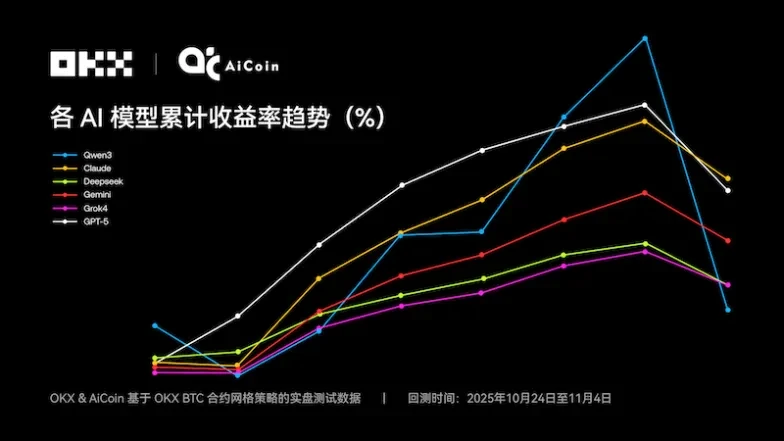
Claude Takes Championship, Truth Behind 6 Major AI Grid Strategy Showdown | OKX & Ai Coin Live Trading Review
Short-term trading champion Qwen3—is it also king in grid strategies? The first season of NOF1's "AI Trading Live Arena" finally concluded at 6 AM on November 4, 2025, whetting the appetites of the crypto, tech, and finance circles. But the ending of this "AI IQ public test" was somewhat unexpected—six models with total principal of $60,000 had only $4.3
November 6, 2025

Surviving Bulls and Bears, Stable Profit Strategy: Make Good Use of This OKX Product Combination
Like traditional financial markets, ordinary users wanting to achieve profitability in crypto face three major obstacles: shortage of cash flow, rare stable profit opportunities, and difficulty executing correct operations when facing highly volatile market conditions. Specific manifestations of these three points are: 1, The trading law of buying low and selling high is well-known, but suffering from insufficient principal to maximize returns. During market downturns, guarding a tight account can only watch certain future gains
November 3, 2025