Two Key Metrics Rise Back to Historical Highs — Will DeFi Summer Make a Return?
As the broader crypto market has stabilized and recovered recently, we have also seen encouraging performance in the DeFi market. First, there is OKTC, which launched the third phase of its mainnet on July 28. According to OK Link data, it took only 2 days for OKTC's Total Value Locked (TVL) to reach $1 billion, and it has since climbed further to $1.69 billion — representing an increase of more than 16x compared to the $99.02 million at the launch of the third phase.
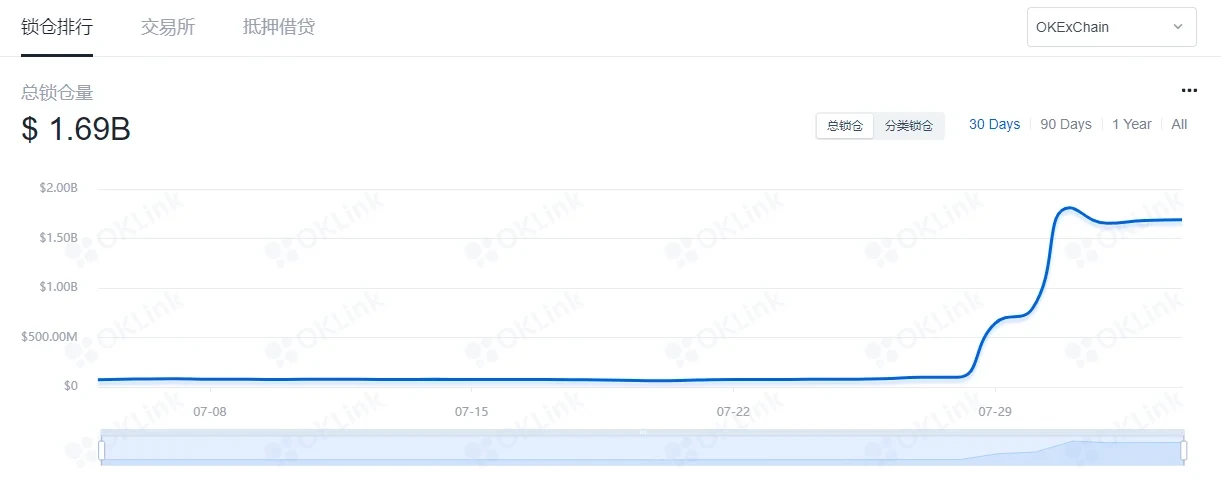
OKTC Total Value Locked (TVL) over the past month, source: OK Link
Of course, besides the rising star OKTC, when it comes to DeFi, we must also look at Ethereum. In our previous article "DeFi Summer One Year Later: 6 Key Data Points" , we reviewed DeFi Summer's one-year anniversary by examining metrics such as DeFi's total value locked and number of users, providing a comprehensive look at DeFi's development over the past year. However, over the past three months — particularly following the extreme market turbulence on May 19 — DeFi went through an inevitable two-plus month downturn. Yet since July 21, all key DeFi metrics have shown a clear upward trend. So today, we will use data as our guide to explore whether, having passed through the May–July slump, DeFi Summer can make a second explosive comeback this year and continue to lead a new market cycle.
DeFi Total Value Locked Recovers to 80% of Its All-Time High
Among the metrics used to gauge the scale of DeFi ecosystem development, Total Value Locked is one we have always focused on closely. This is because it not only directly reflects the current state and trajectory of the DeFi ecosystem, but can also reveal changes in market participants' confidence in the future of decentralized finance through the flow of funds over a given period. According to DeFiPulse data, as of 14:00 Hong Kong Time on August 3, the total value locked in the Ethereum-based DeFi ecosystem once again surpassed $70 billion, reaching $71.75 billion. On May 24, this figure had dropped to as low as $50.94 billion, and for most of the time afterward, it hovered between $51 billion and $70 billion.
This time, the DeFi ecosystem's total value locked reaching $71.75 billion represents a gain of more than 40% from the May 24 low. Compared to the all-time high of $89.57 billion set on May 12, it has recovered to approximately 80% of that peak.
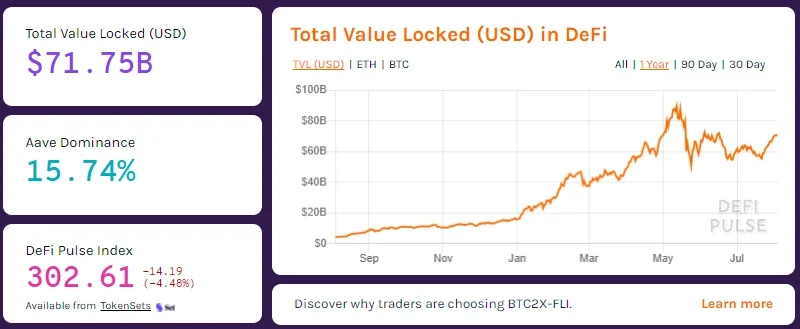
Total Value Locked in the Ethereum-based DeFi Ecosystem, source: DeFiPulse
Of course, the TVL figure above is calculated in U.S. dollar terms and is affected by fluctuations in the value of locked assets. If we shift perspective to look at the actual crypto assets locked in DeFi — specifically the ETH and BTC locked in DeFi protocols — we find that the recent recovery is even more impressive. According to DeFiPulse data, the amount of ETH locked in the DeFi ecosystem currently stands at 9.7 million ETH, which is only 12.3% below the year's high of 11.05 million ETH.
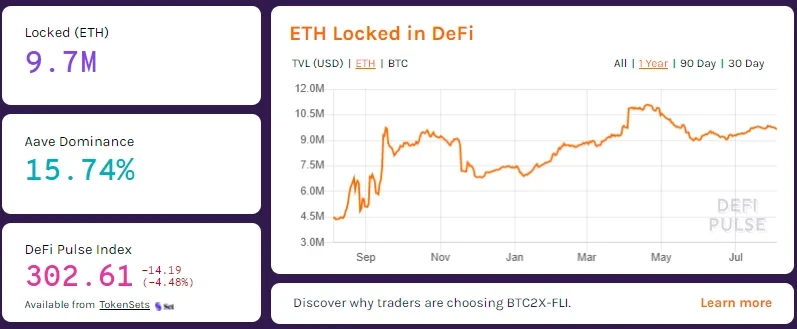
Amount of ETH Locked in the DeFi Ecosystem, source: DeFiPulse
Looking next at the amount of BTC locked in the DeFi ecosystem, it has surpassed 193,400 BTC, setting a new record high.
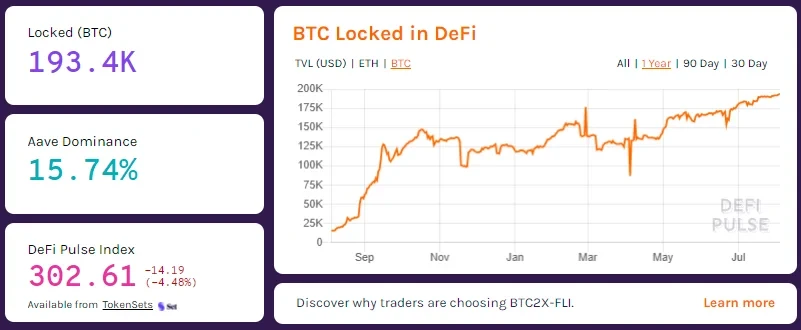
Amount of BTC Locked in the DeFi Ecosystem, source: DeFiPulse
Here, we can also make a simple comparison with the price performance of BTC and ETH over the same period. According to OKX market data, as of the time of writing, BTC is trading at $38,400, with a year-to-date high of $64,800, representing a recovery of 59.26%; ETH is trading at $2,472, with a year-to-date high of $4,371, representing a recovery of 56.55%. From the above comparison data, it is clear that despite significant short-term downward moves in the crypto market since Q2 2021, DeFi has demonstrated strong resilience — both in terms of its ability to hold up during downturns and its growth during periods of stability. Furthermore, looking at both the growth rate of TVL and the increase in the quantity of crypto assets locked in DeFi protocols, it is evident that, at least at this stage, there has been no mass exodus of funds from DeFi. On the contrary, capital has continued to flow into DeFi, which is an important source of confidence for our expectation of a second DeFi Summer.
DEX and DEX Aggregator User Base Continues to Grow
When we revisited the one-year anniversary of DeFi Summer, we also tracked changes in the DeFi user base. Between June 2020 and June 2021, the number of DeFi protocol users grew by approximately 140x in just one year. The rapid growth of DEXs contributed a significant portion of these new users. Now, let us take a closer look at how DEX user growth has evolved in recent months.
According to Glassnode data, over the past several months, the number of unique addresses across major DEXs and DEX aggregators has continued to grow. However, as the slope of the lines in the chart shows, the rate of growth in DeFi protocol users has recently begun to slow.
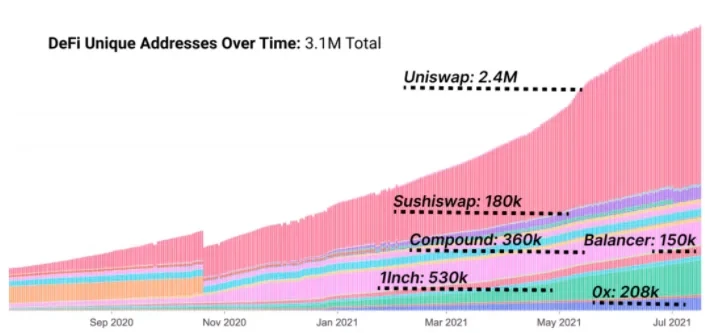
DeFi Protocol User Growth in Recent Periods, source: Glassnode
As the chart above shows, among DEXs, Uniswap still holds the top position. Of course, competitors such as SushiSwap and 1inch have also performed well in attracting new users. According to DeBank data, the combined total value locked across Uniswap V2 and V3 currently exceeds $7 billion, with more than 51,000 users participating in trading over a 24-hour period and a 24-hour trading volume of $1.1454 billion.
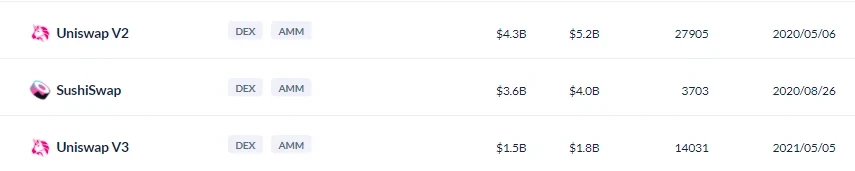
Uniswap V2 and V3 Locked Value and User Count, source: DeBank
Uniswap's strong momentum is not only reflected in its trading metrics. In fact, since launching version 3 in early May this year, Uniswap has continued to innovate without pause. In Uniswap V3, its development team introduced granular-controlled AMM aggregated liquidity, which was widely praised by liquidity providers seeking to minimize impermanent loss. More recently, according to official announcements, the Uniswap founder is collaborating with another professional team to design a new market-making model — Time-Weighted AMM (TWAMM). According to the introduction, unlike traditional AMM models that incur expensive trading costs when executing large trades on Ethereum, TWAMM uses a specialized order-splitting logic to break a single large trade into countless tiny orders and executes all of them over a fixed period through an embedded AMM. This embedded AMM's price can stay in line with the market price, ensuring execution near the time-weighted average price, while keeping all trading gas costs low. However, the development team has also stated publicly that the model is still in its early conceptual stages and is calling on more developers to participate in the project.
Looking at Uniswap's trajectory, the reason it has achieved such remarkable results in such a short time — beyond catching the right wind and benefiting from first-mover advantage — we cannot ignore that Uniswap has consistently maintained a pace of rapid iteration and continuous innovation. This is not only a core strength in the DEX space but also a valuable quality that most DeFi protocol teams should embody to keep moving forward. It also gives us greater confidence in DeFi as a great social financial experiment in human history.
"DeFi Is Conquering Wall Street"
In this section, we step away from changes within the DeFi market itself to look at the movements of Wall Street, which has a significant influence on global financial markets — this perspective may offer us a broader view.
Just two days ago, the renowned Fortune magazine published a series of cover stories on the theme of "Crypto Assets vs. Wall Street." In the report titled "Crypto Asset-Based DeFi Is Conquering Wall Street," the author described their personal experience using DeFi products, investigated and analyzed DeFi's influence on traditional financial markets, and outlined how some traditional financial institutions are responding. In this article, we will not dive into the details of Fortune's report — we simply note that as an event in itself, it serves as a very interesting signal: DeFi, as a "touchstone," has been thrown before the giants of Wall Street and is garnering increasing attention. This makes Goldman Sachs's application to the U.S. SEC on July 26 for a "Goldman Sachs Innovation DeFi and Blockchain Equity ETF" seem entirely reasonable.
In the Fortune report, the author cited the views of early crypto market investor Olaf Carlson-Wee: crypto assets will ultimately be more than just a new form of gold or a new investment asset. DeFi, in particular, is of earth-shaking importance — this is not merely about assets, but rather a comprehensive innovation that will affect all financial instruments.
Disclaimer
This article may contain product-related content that does not apply to your region. This article is intended solely to provide general information and makes no responsibility for any factual errors or omissions. This article represents the author's personal views only and does not represent the views of OKX. This article is not intended to provide any advice, including but not limited to: (i) investment advice or investment recommendations; (ii) offers or solicitations to buy, sell, or hold digital assets; or (iii) financial, accounting, legal, or tax advice. Holding digital assets (including stablecoins) involves a high degree of risk, may fluctuate significantly, and may even become worthless. You should carefully consider whether trading or holding digital assets is suitable for you based on your financial situation. For questions specific to your circumstances, please consult your legal/tax/investment professional. The information in this article (including market data and statistics, where applicable) is provided for general reference only. Although we have taken all reasonable precautions in preparing such data and charts, we assume no liability for any factual errors or omissions expressed herein. © 2025 OKX. This article may be reproduced or distributed in full or in excerpts of 100 words or less, provided that such use is for non-commercial purposes. Any reproduction or distribution of the full article must prominently state: "This article is copyrighted © 2025 OKX, used with permission." Permitted excerpts must cite the article title and include attribution, for example: "Article title, [author name (if applicable)], © 2025 OKX." Some content may have been generated or assisted by artificial intelligence (AI) tools. Derivative works and other uses of this article are not permitted.
Show More
Recommended Reading

2025 KOL Most Used OKX Products Ranking
In the cryptocurrency industry, professional players' choices are always direct and pure. In 2025, KOLs cast the most authentic votes for industry tools and ecosystem development with their year-round capital investment and time commitment. We focused on four core questions — "What was your biggest achievement this year?", "With that achievement in mind, what OKX products did you use most and love most in 2025?", "Why do you love it?", and "What does this
2026年1月5日

2026 Investment Outlook: Asset On-Chaining, Intelligence & Privacy | OKX Annual Review
The three major trends shaping crypto's future: asset transformation, subject transformation, and rule transformation. As we stand on the cusp of 2026, after four years of focused "road-building" infrastructure, the crypto industry is experiencing a profound paradigm shift. OKX Ventures defines this as the dawn of the "Kinetic Finance" era — where the core is no longer how fast a network is, but rather the liquidity and earning potential of on-chain assets.
2025年12月31日

Vote with Data: A Deep Dive into 2025's Hottest Trading Products | OKX Annual Review
Looking at price action alone, it is difficult to explain the differences in returns among CEX users in 2025. What truly determines returns also depends on account-level trading methods, not just market volatility itself. OKX's annual statement shows that mainstream coins remain the core of capital turnover and return generation, supporting trading and strategy execution; emerging coins are more often used to amplify volatility and provide阶段性 opportunities, but are not a stable, long-term source of returns. What truly and continuously generates returns is
2025年12月30日
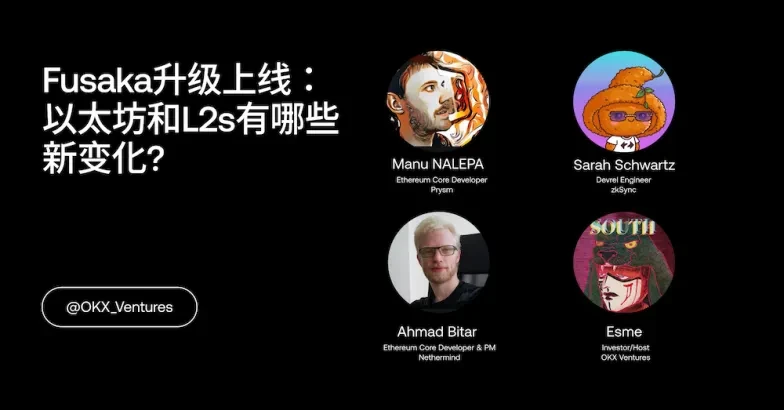
Fusaka in Practice: What Ethereum's Latest Upgrade Means for L2, Nodes, and Users
The Ethereum mainnet has completed the Fusaka fork. From a protocol perspective, this upgrade mainly covers four areas. Full text by Q&A, Show More, featuring three guests' core viewpoints and first-hand experience: Ahmad (@smartprogrammer) – Nethermind Execution Client / Ethereum Core Developer Manu (@manunalepa) – Prysm / Of
2025年12月16日
OKX Research | Why RWA Became a Key Narrative in 2025
RWA (Real World Assets) is becoming the "new favorite" of global capital. Simply put, RWA involves bringing valuable, ownership-bearing assets from the real world — such as real estate, bonds, stocks, and other traditional financial assets, as well as art, private lending, carbon credits, and other assets that are not typically easy to trade directly — onto the blockchain, transforming them into tradeable, programmable crypto assets. By doing so,
2025年11月20日
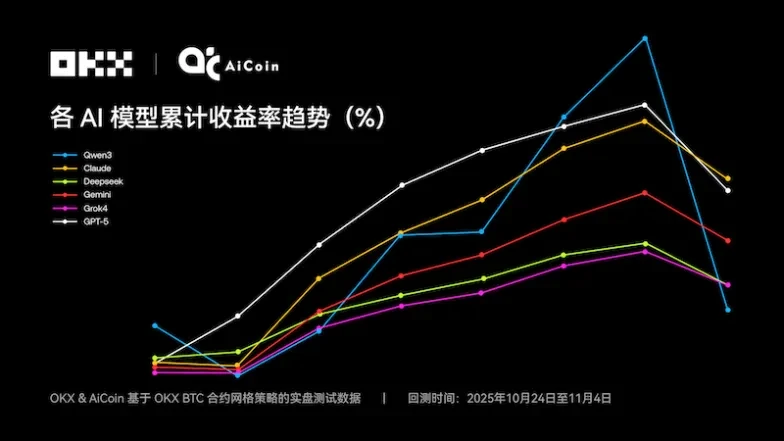
Claude Takes the Crown: 6 Major AI Grid Strategies Face Off | OKX & Ai Coin Live Test
Is the short-term trading champion ? NOF1's "AI Trading Live Arena" Season 1 finally concluded on November 4, 2025, at 6:00 AM, whetting the appetite of the crypto, tech, and financial communities. However, the outcome of this "AI IQ public test" was somewhat unexpected: out of the six models' combined $60,000 in starting capital, only $4.
2025年11月6日