Has DeFi Lost Steam? Will NFTs Take the Baton? What You See May Not Be the Full Picture
COMP +2.73%
In the classic film "Swordsman II: East is Red," there's a memorable line where Ren Woxing says to Linghu Chong, who wants to retire from the martial arts world: "Where there are people, there are grievances. Where there are grievances, there is the jianghu (martial arts world). People are the jianghu—how can you退出?"
Of course, our topic today isn't to recount martial arts tales, but using this quote to open today's discussion seems particularly apt: in emerging investment markets, wherever funds focus becomes a hotspot, and where there are hotspots, there's buzz. As long as funds don't withdraw, the buzz won't fade—so who's to say what's cold or hot? That's right, today we're discussing DeFi and NFTs.
Upon closer examination, DeFi and NFTs indeed have many aspects worth comparing. For instance, in terms of emergence timing, DeFi rose to prominence during the 2020 DeFi Summer, while NFTs, though showing early signs at the beginning of this year, truly experienced explosive growth in the third quarter. From the perspective of underlying networks, DeFi initially leveraged Ethereum's efficient smart contracts for deployment, while the vast majority of NFTs are issued following ERC-721 or ERC-1155 standards. Even in terms of development pace so far, both have basically gone through stages of launch-acceleration-concentrated explosion. However, against the backdrop of recent NFT fervor, we've noticed discussions in crypto communities questioning "Has DeFi lost steam?" and "Will NFTs replace DeFi as the new growth engine of the Ethereum ecosystem?" So today, let's examine these viewpoints through key data indicators.
Has DeFi Really Lost Steam?
From an intuitive perspective, since the mid-May significant downturn in the broader crypto market, the Total Value Locked (TVL) in DeFi protocols did indeed experience a cliff-like drop. According to OKLink statistics, between May 10 and May 23, 2021, TVL in DeFi protocols fell directly from $113.57 billion to $62.6 billion, a decline of 44.9%. Meanwhile, on May 19, influenced by ETH's price decline, DeFi lending protocols saw liquidations totaling $395 million—the largest liquidation event in DeFi history to date, which undoubtedly dealt a significant blow to DeFi. Subsequently, it maintained a two-month low period, while during the same period the NFT market was surging beneath the surface, frequently becoming the "topic king" in crypto markets, which naturally led community members to raise these questions.
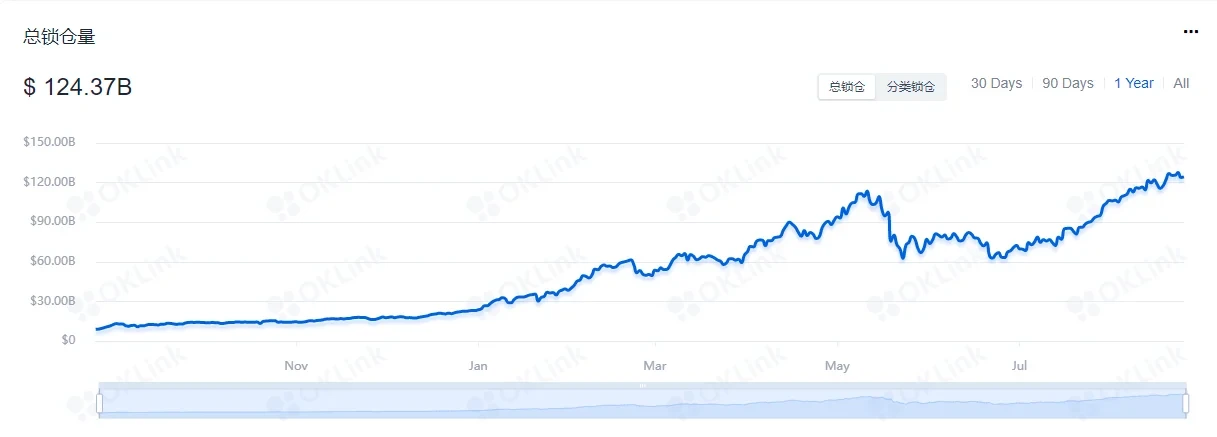
TVL changes in DeFi protocols over the past year, Source: OKLink
It should be noted here that while TVL in DeFi protocols is a frequently cited indicator in our previous articles analyzing DeFi development, strictly speaking, it cannot be called a perfect measure of DeFi protocol adoption. However, from the dimension of assessing how much importance and trust market investors place in DeFi, this indicator remains highly valuable.
So let's continue looking at the latest TVL data from OKLink above. It's not hard to see that since the end of July, this figure has successfully surpassed the previous high set in May, reaching $127.64 billion. While perhaps not matching NFTs' growth momentum in speed, in absolute terms, $127.64 billion is a formidable force that cannot be ignored in either traditional financial markets or crypto markets. The continued increase in this number undoubtedly indicates growing investor confidence in entrusting their assets to "blockchain code."
Looking more specifically, beyond the growth in TVL, many DeFi metrics since August have also shown promising upward trends. For instance, deposit and borrowing volumes in lending protocols have grown significantly as the market has stabilized, particularly with ETH price holding above $3,000. According to OKLink statistics, total deposits in lending projects have now reached $59.38 billion, also emerging from the trough to hit a new high. The "three horsemen" of the lending protocol space—Maker, Aave, and Compound—currently hold over $42 billion in total crypto asset value from investors.
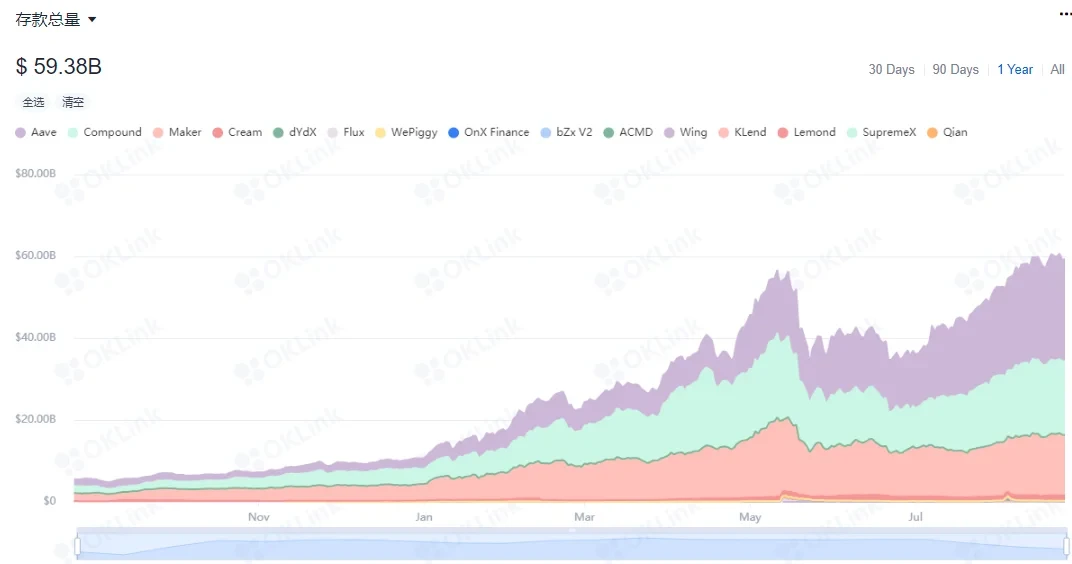
Total deposit volume changes in DeFi lending protocols, Source: OKLink
Correspondingly, total borrowing volume in DeFi lending protocols has also shown significant growth. According to OKLink, the current value of assets borrowed by market investors from DeFi lending protocols has reached $24.8 billion, representing an increase of nearly 90% compared to the cyclical low of $13.38 billion set on May 23.
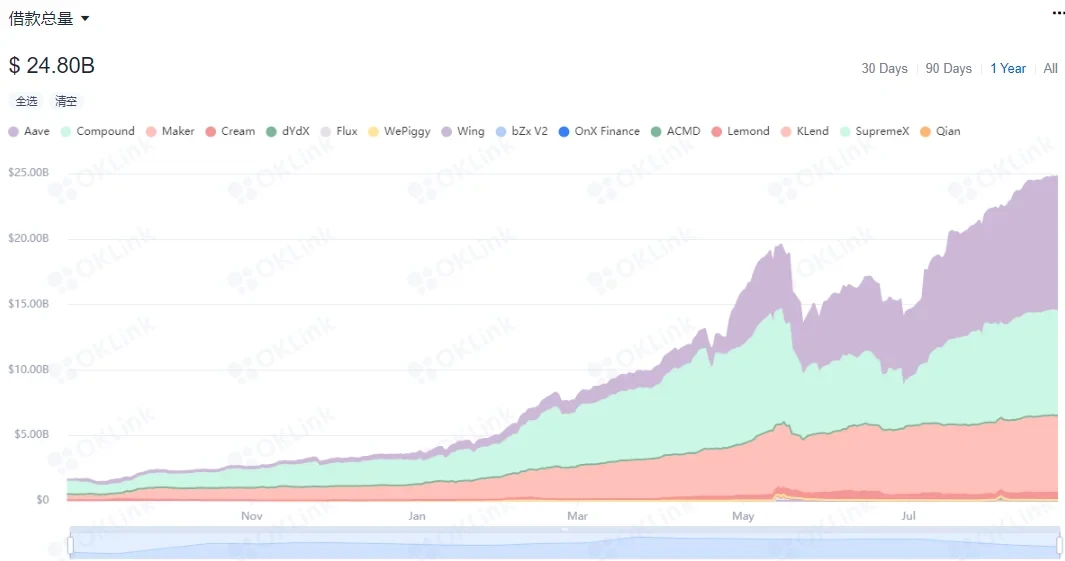
Total borrowing volume changes in DeFi lending protocols, Source: OKLink
From the synchronized increase in both total deposits and total borrowing, we can at least draw an intuitive conclusion—market investors are regaining confidence in the DeFi lending market, and risk tolerance is increasing. This is clearly a positive signal.
Meanwhile, DEX activity also appears healthier. According to statistics released by glassnode on August 18, DEX trading volume for August alone is expected to surpass the peak levels of June and July. As of the 18th, total DEX trading volume has exceeded $46 billion. DeFi researcher Luke Posey estimates that total DEX trading volume could reach $80 billion by the end of August. If this prediction materializes, it would mark the second-highest peak of the year, surpassed only by May's trading volume.
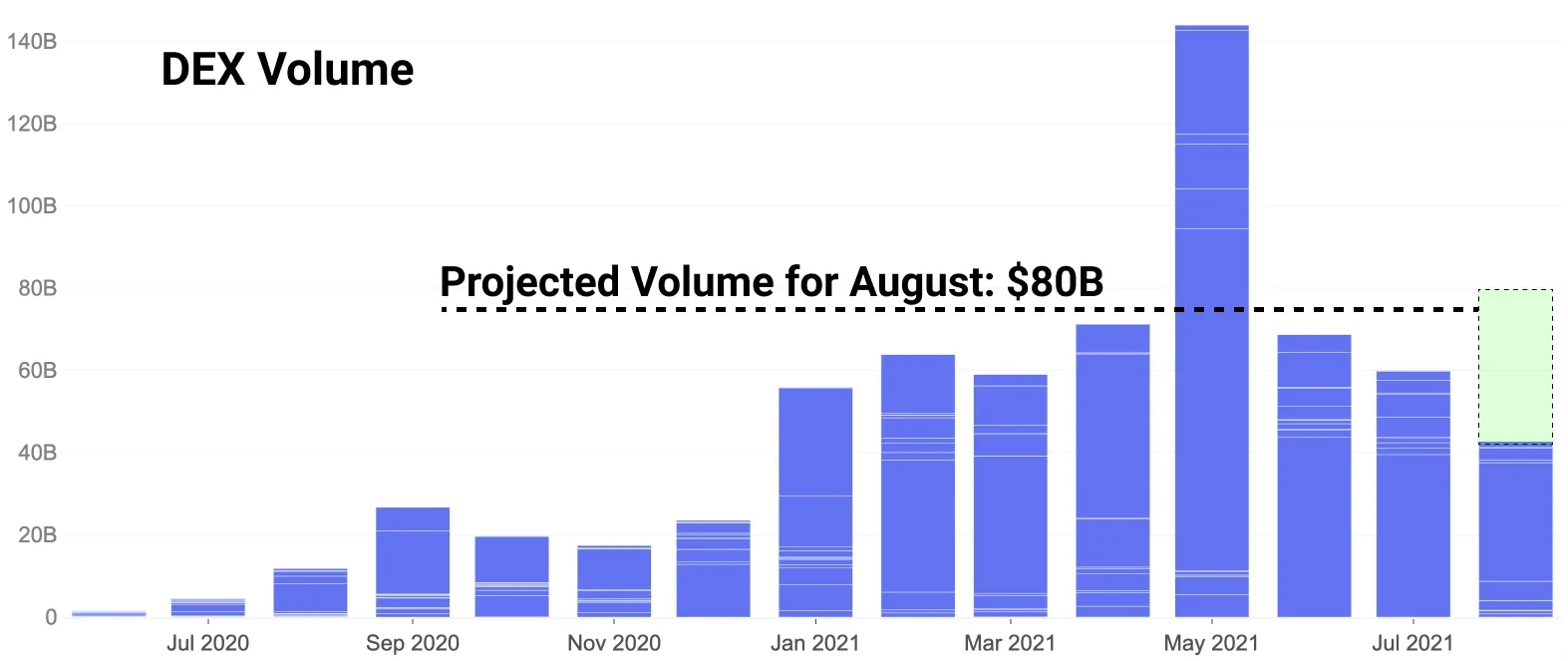
Total DEX trading volume over the past year and August 2021 forecast, Source: glassnode
Another reference indicator for increased DEX trading activity is the amount of ETH burned as base fees since EIP-1559 went live. According to qkl123 statistics, as of this writing, DEX leader Uniswap V2 and V3 have burned 6,602.1 ETH and 2,747.22 ETH respectively, totaling 9,349.32 ETH, second only to NFT field leader OpenSea.
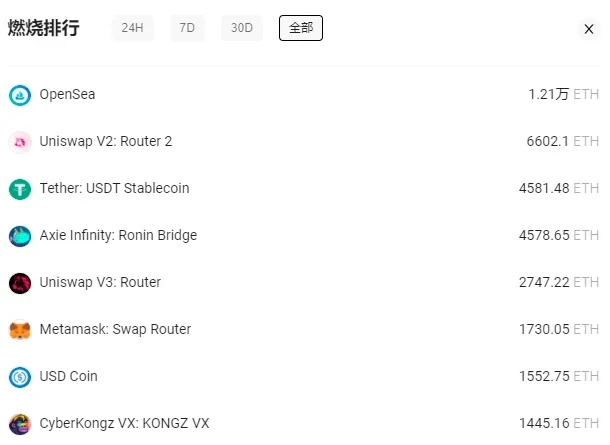
Ranking of ETH burned by on-chain smart protocols since EIP-1559 launch, Source: qkl123
Beyond spot-focused DEXs, another dark horse worth mentioning is derivatives-focused DEX dYdX. Although dYdX currently ranks only 28th in DEX rankings by defipulse, its growth in locked crypto asset value, trading volume, and trading users all show tremendous potential. In terms of locked value, dYdX rose from $160 million on July 21 to $392 million on August 25, a gain of 145%, far surpassing同期 gains of Curve (52.93%), Uniswap (32.61%), and Sushiswap (73.68%).
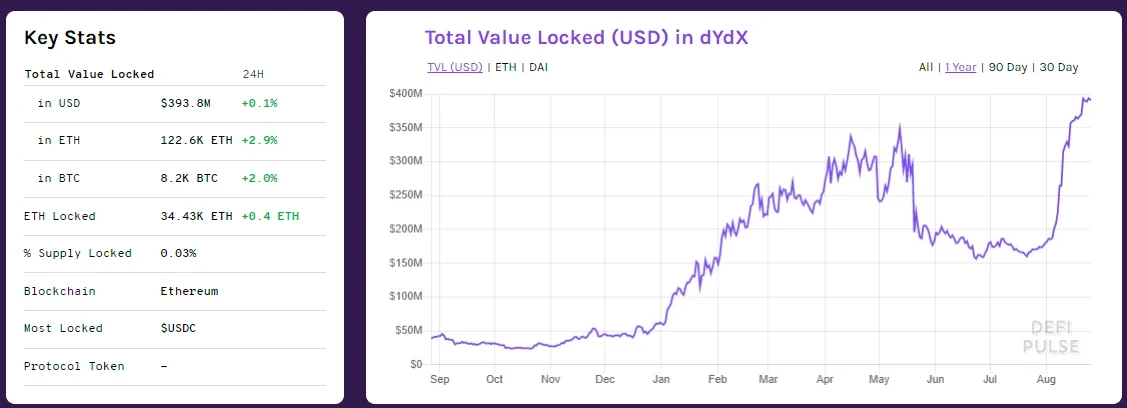
dYdX locked value changes over the past year, Source: defipulse
On August 24, dYdX founder Antonio Juliano tweeted that since announcing the platform's governance token DYDX earlier this month, dYdX platform metrics have shown significant growth, with daily trading volume exceeding $400 million for the first time, weekly revenue reaching $1.8 million, and total users reaching 73,500 (an increase of 34,000 in August).
The point of using dYdX as an example is that over the past year, our attention on the DeFi track has largely focused on lending protocols like Compound and spot DEXs like Uniswap. Beyond these, the DeFi track also includes derivatives DEXs, decentralized asset management, decentralized payments, decentralized insurance, and many other sub-sectors with unlimited potential that could become new growth engines driving DeFi's major development.
Just How Hot Are NFTs?
Blockchain project rating and data research institution Tokeninsight released an NFT industry analysis report earlier this month, in which Tokeninsight noted, "NFT and Metaverse markets rose rapidly in Q2, especially showing strong momentum in July 2021. As of July 2021, total NFT market sales reached $1 billion. July 2021 single-month sales grew 428% compared to the entire Q4 2020." This gives us a general understanding of the NFT market. Let's continue examining detailed data for a more comprehensive view.
First, let's look at NFT sales volume growth since 2021. According to nonfungible statistics, in January this year, daily NFT sales volume was around 60,000 units, while by August 18, this figure had rapidly risen to 269,900, a gain of 349.83%.
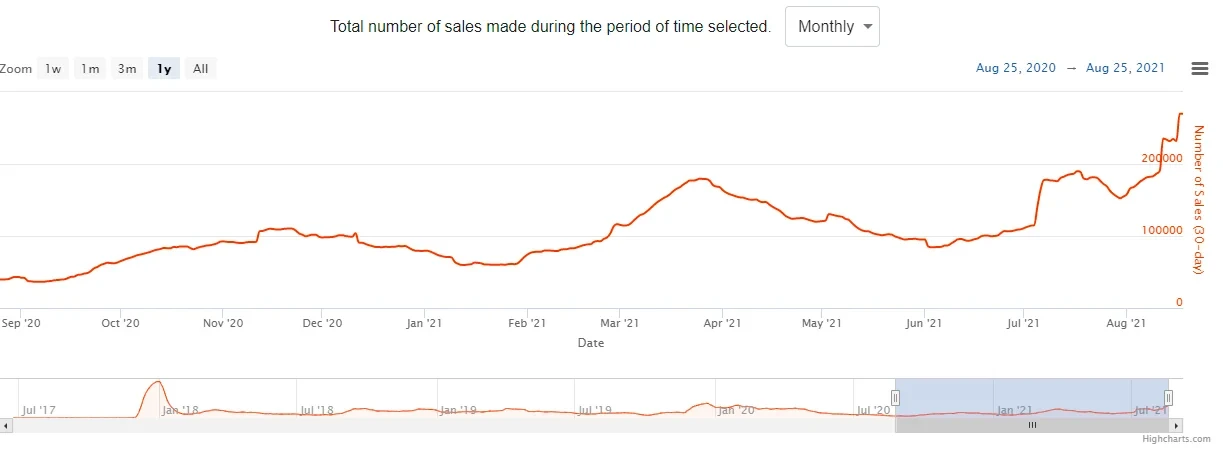
NFT sales volume growth since 2021, Source: nonfungible
Next, let's look at the trading volume increase resulting from rising NFT sales. According to nonfungible, throughout January, average daily trading volume in the NFT market hovered around $10 million, with trading sentiment relatively tepid. Upon entering August, however, trading volume showed near-linear growth, reaching $897 million on the 18th alone—an 88.7-fold increase over January's average levels. Comparing trading volume and sales figures, we can also see that beyond increased trading enthusiasm among NFT participants, unit prices of NFT items have also significantly risen during this period.
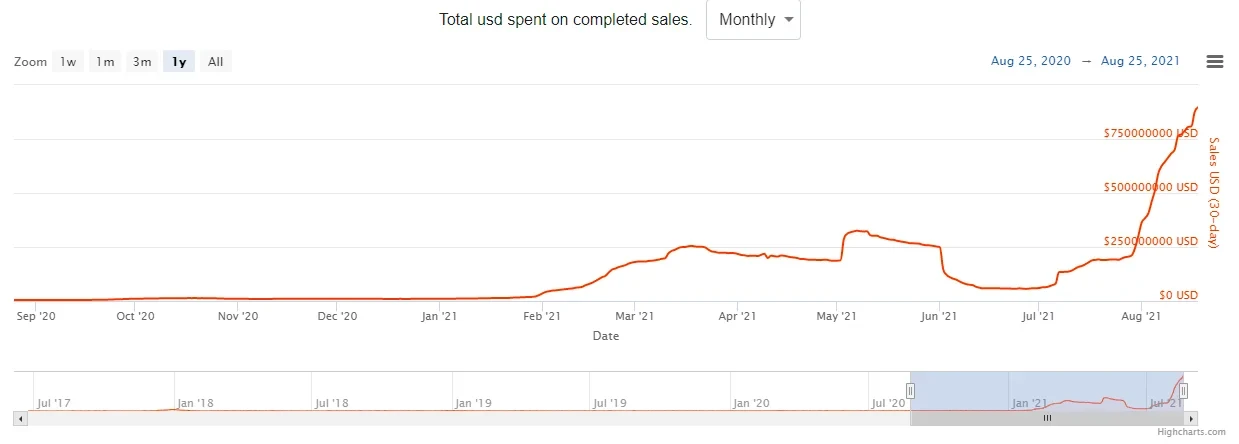
NFT market trading volume growth since 2021, Source: nonfungible
Next is the change in number of unique wallets participating in NFT trading. According to nonfungible data, in January approximately 15,000 unique wallets were active in NFTs daily, while on August 18, the number of wallets participating in trading approached 70,000, reaching 69,300.
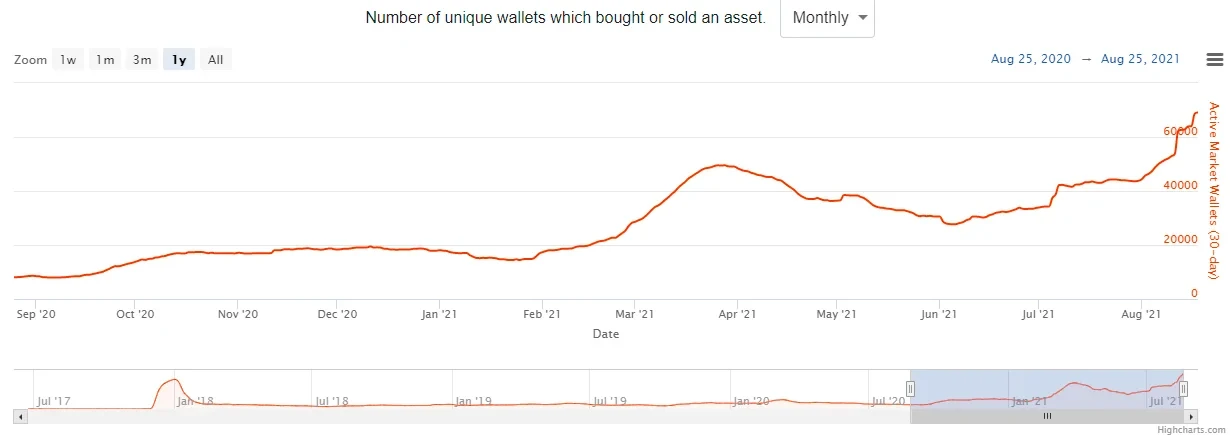
Changes in unique wallet count participating in NFT trading since 2021, Source: nonfungible
Beyond these tangible data points, the GameFi concept built upon NFTs—with Axie Infinity being the most well-known—has genuinely allowed players to experience summer's heat even after the Start of Autumn. So whether viewed from data dimensions or market sentiment we perceive, NFTs are undoubtedly hot and show no clear signs of cooling.
Conclusion
When attempting to make predictions about DeFi and NFTs that closely reflect reality, we first need to examine their development trajectories, historical opportunities leveraged, and future potential from a higher dimension, while using the simplest underlying logic for judgment. As two major tracks that have risen successively atop the Ethereum ecosystem, whether DeFi or NFTs, both have proven their value and significance through market testing. Each has created value in its respective domain, and it's foreseeable they will continue to create even greater value. Based on this assessment, over the long term, funds will continue flowing steadily into both DeFi and NFTs. Therefore, as twin flowers atop the Ethereum ecosystem, DeFi and NFTs will not be a zero-sum relationship, but rather mutually reinforcing and complementary, jointly driving the continuous advancement of the Ethereum ecosystem and even the metaverse.
Disclaimer
This article may contain content related to products not available in your region. This article is intended to provide general information only and assumes no responsibility for any factual errors or omissions herein. This article represents solely the author's personal views and does not represent the views of OKX. This article is not intended to provide any recommendations, including but not limited to: (i) investment advice or investment recommendations; (ii) offers or solicitations to buy, sell, or hold digital assets; or (iii) financial, accounting, legal, or tax advice. Holding digital assets (including stablecoins) involves high risk, may fluctuate significantly, and may even become worthless. You should carefully consider whether trading or holding digital assets is suitable for you based on your financial situation. Please consult your legal/tax/investment professional regarding questions specific to your circumstances. Information appearing in this article (including market data and statistics, if any) is for general reference only. While we have taken all reasonable care in preparing these data and charts, we assume no responsibility for any factual errors or omissions expressed herein. © 2025 OKX. This article may be reproduced or distributed in full, or excerpts of 100 words or fewer from this article may be used, provided such use is non-commercial. Any reproduction or distribution of the entire article must prominently state: "Copyright © 2025 OKX. Used with permission." Permitted excerpts must cite the article title and include attribution, for example "Article Title, [Author Name (if applicable)], © 2025 OKX". Some content may be generated or assisted by artificial intelligence (AI) tools. Derivative works or other uses of this article are not permitted.
Show More
Recommended Reading

2025 KOLs' Most-Used OKX Products: A Comprehensive Review
In the cryptocurrency industry, professional players' choices are always direct and pure. In 2025, KOLs cast their most genuine votes for industry tools and ecosystem development with a full year of capital investment and time dedication. Centered around four core questions—"What was the biggest achievement this year?", "Given those achievements, what OKX products did you use most and love most in 2025?", "Why do you like it?", and "How has this
January 5, 2026

2026 Investment Outlook: Asset Tokenization, Intelligence & Privacy | OKX Annual Review
Three major trends for crypto's future: asset transformation, entity transformation, and rule transformation. As we approach 2026, bidding farewell to four years of infrastructure-focused "road-building," the crypto industry is welcoming a profound paradigm shift. OKX Ventures defines this as the dawn of the "Kinetic Finance" era, where the core is no longer how fast the network is, but rather the flow of on-chain assets and wealth creation
December 31, 2025

Voting with Data: Insights into 2025's Popular Trading Products | OKX Annual Review
Looking only at market performance, it's hard to explain the return differences among trading users in 2025. What truly determines returns同样 depends on account-level operational methods, not merely market volatility itself. The OKX annual statement reveals that mainstream coins remain the core of capital turnover and return generation, supporting trading and strategy execution; emerging coins are more used to amplify volatility and provide phased opportunities, but are not stable, long-term sources of returns. What truly consistently contributes returns is,
December 30, 2025
Fusaka in Practice: What Ethereum's Latest Upgrade Means for L2s, Nodes, and Users
The Ethereum mainnet has completed the Fusaka fork. At the protocol level, this upgrade mainly includes four components. The full text follows Q&A Show More with core insights and frontline experience from three guests: Ahmad (@smartprogrammer) – Nethermind execution client / Ethereum core developer Manu (@manunalepa) – Prysm / Of
December 16, 2025

OKX Research | Why Did RWA Become a Key Narrative in 2025?
RWA (Real World Assets) is becoming a global capital "new favorite." Simply put, RWA means taking valuable, ownership-bearing assets from the real world—such as traditional financial assets like houses, bonds, stocks, as well as assets not easily traded directly like artwork, private lending, carbon credits—and bringing them onto blockchain to become tradeable, programmable crypto assets. This way, not
November 20, 2025
Claude Takes the Crown, Truth Behind 6 Major AI Grid Strategy Showdown | OKX & Ai Coin Live Trading Review
Short-term trading champion Qwen3—is it also a king in grid strategies? The first season of NOF1's "AI Trading Live Arena" finally concluded at 6 AM on November 4, 2025, whetting the appetites of the crypto, tech, and finance worlds. But the outcome of this "AI IQ public test" was somewhat unexpected—six models with a total principal of $60,000 were left with only $4.3
November 6, 2025