After DeFi and NFTs, Will Layer 2 Be Ethereum's Next Big Thing? (Part 2)
Preface: This Monday, the OKX Academy published "After DeFi and NFTs, Will Layer 2 Be Ethereum's Next Big Thing? (Part 1)". In the previous article, we briefly introduced Ethereum's EIP-1559 upgrade, hashrate hitting new highs, and the recent developments in Layer 2. This article is the second part of the series, focusing on analysis of Arbitrum's TVL, Layer 2's relative advantages over Layer 1, and other aspects. If there are any errors or omissions, or if readers would like to discuss additional topics, feel free to join the OKX official community for exchange and feedback.
NFT Summer followed DeFi Summer, igniting a new wave of热潮. Taking Open Sea, the leading NFT trading platform, as an example, its total trading volume in August alone reached $3.4 billion, surpassing the combined historical trading volume of all previous periods — a clear testament to surging market activity and the NFT frenzy.
On the other hand, much like DeFi Summer, the booming NFT market also caused Ethereum congestion and excessively high Gas fees. Although EIP-1559 has been successfully implemented, its primary effect has been to accelerate Ethereum's token burning and even deflationary pressure — which benefits token price — but it seems to have little impact on reducing Gas fees.
OK Link data shows that Ethereum's recent daily average Gas fee peak occurred on September 8th, at 0.017 ETH/transaction. Based on OKX's closing price of $3,499 on that day, the daily average Gas fee on September 8th was approximately $60. The peak during the previous DeFi Summer occurred on September 2nd, 2020, at 0.034 ETH/transaction. Based on OKX's closing price of $440 on that day, the daily average Gas fee at the peak was approximately $15.
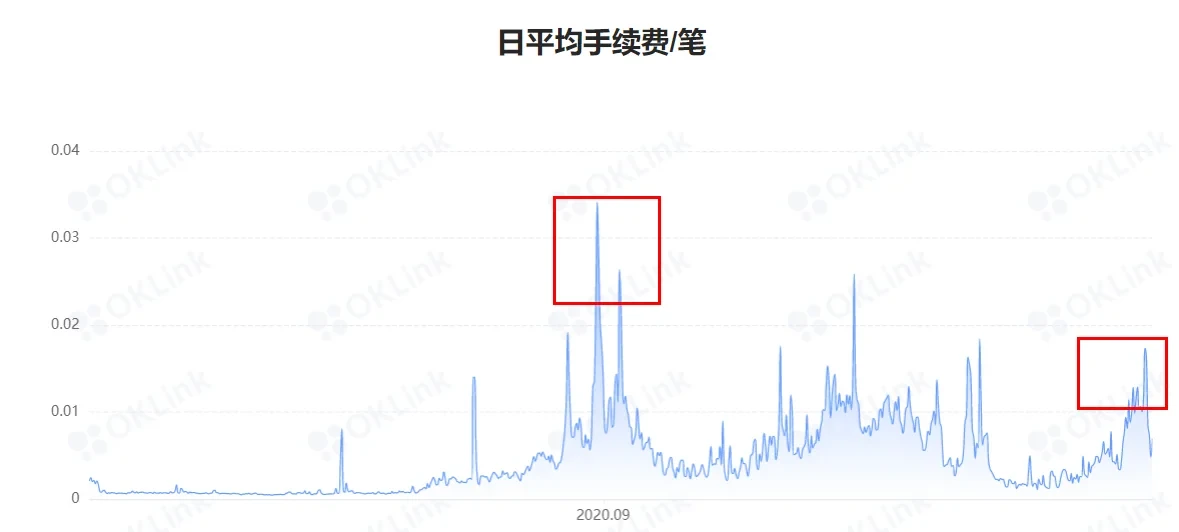
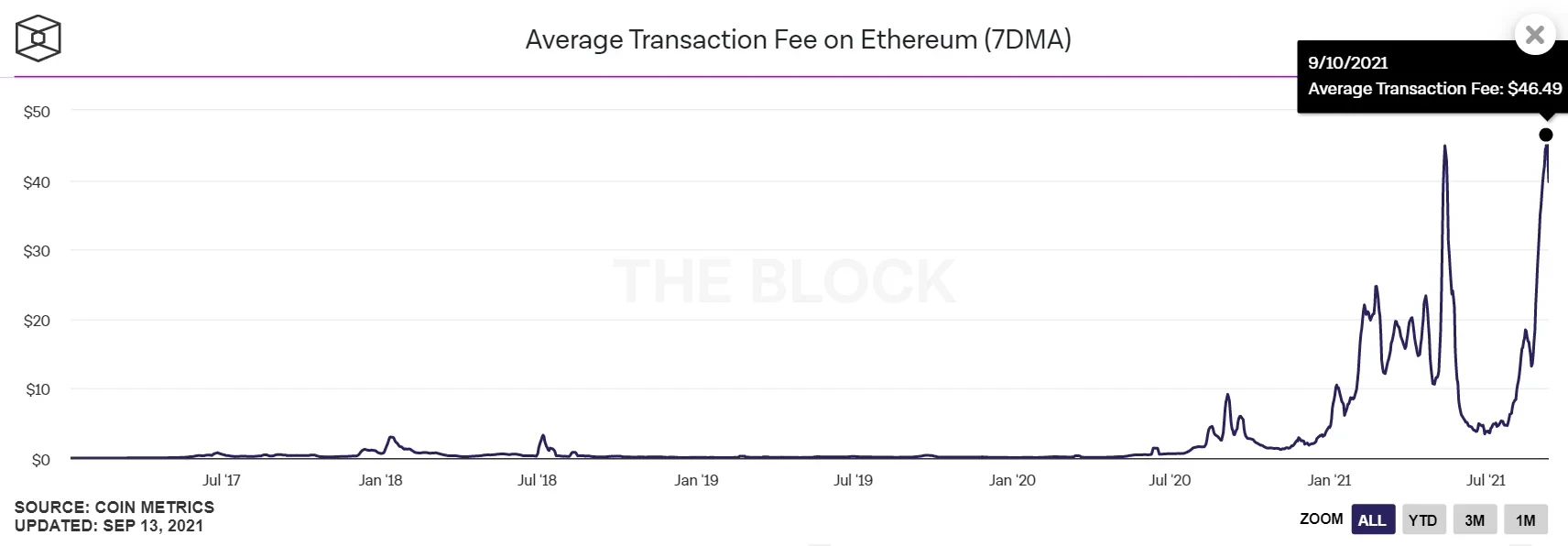
The Block's charts using USD as the unit are even more intuitive, showing that since NFT Summer, user costs for on-chain interactions have risen dramatically. On the evening when dYdX lifted the transfer restrictions on its governance token DYDX — a recent market热点 — Ethereum's Gas fees surged to over $150 at their peak, a cost that put off most users.
Given this, Ethereum competitor chains gained momentum. Tokens of public chains like Solana, Fantom, and Near all delivered strong performance over the past 2-3 months. However, recently, as NFTs have cooled down and Layer 2 has advanced, market attention appears to be shifting back to Ethereum…
Arbitrum TVL Surpasses $2.3 Billion, Layer 2 Begins to Show Its Mettle
Opening L2Beat, it is easy to see that Layer 2 has made significant progress recently. Over the past 7 days, Layer 2's total TVL grew from $803 million to $3.192 billion, a surge of 298%. Among all Layer 2 projects, the star project Arbitrum leads with a total TVL of $2.3 billion and a 7-day TVL growth rate of 2,561%.
The decentralized derivatives platform dYdX, which recently saw a surge in热度 due to its governance token launch and airdrop campaign, ranks second with a total TVL of $344 million. dYdX employs ZK Rollup scaling technology developed based on StarkWare. Meanwhile, Optimism, which like Arbitrum uses Optimistic Rollup technology, ranks third with a total TVL of $209 million.
At this point, it is worth briefly reviewing the two major Layer 2 scaling solutions that are currently hot topics. In an article we published in late March this year titled "Layer 2 Scaling Showdown: Who Can Solve Ethereum's Burning Problem?", there was a passage explaining what Rollup is: Rollup packages a large amount of various transaction data into a single transaction published on-chain. To ensure data consistency and fund security during the process, different solutions were developed. Currently, ZK Rollup and Optimistic Rollup are hailed as the two giants of Rollup. ZK Rollup mainly introduces zero-knowledge proofs to verify data authenticity to the main chain — an validity proof. Optimistic Rollup abandons the zero-knowledge proof mechanism and instead adopts Plasma's slashing mechanism — a fraud proof type.
The biggest advantage of ZK Rollup is speed and security. When Layer 1 interacts with Layer 2, due to the zero-knowledge proof mechanism, Layer 1 can easily trust data from ZK Rollup, enabling rapid transaction completion. However, its disadvantage is that it struggles to support general-purpose smart contracts. ZK Rollup developers need to independently develop smart contract modules, making it highly challenging and labor-intensive. Nevertheless, as ZK Rollup technology advances, its long-term potential is stronger. Optimistic Rollup draws from Plasma and tends to assume nodes will not misbehave, resulting in higher trust costs. It takes at least a week to withdraw from Layer 2 back to Layer 1. However, due to its consideration for compatibility — allowing fully general-purpose smart contracts to run on Layer 2 — Optimistic Rollup has a lower barrier to entry and is easier for developers to get started with, making it more suitable for solving Ethereum's pressing issues.
Among the two Rollup research directions, four teams have garnered significant attention: Matter Labs (ZK Sync) and StarkWare (StarkNet & StarkEx) focusing on ZK Rollup, and Optimism and Offchain Labs (Arbitrum) focusing on Optimistic Rollup.
Recently, the reason Layer 2's TVL on Ethereum has achieved explosive growth is mainly attributed to the two major Optimistic Rollup-based scaling solutions — Optimism and Arbitrum — officially opening their networks for public testing. On September 1st, it was announced that the Ethereum scaling network Arbitrum declared that its mainnet beta version, Arbitrum One, was fully launched. Although this is an important milestone, given that Arbitrum One is still in the testing phase, the team stated they will closely monitor the launch and maintain the ability to upgrade rapidly. If necessary — such as when abnormal activity or potential security incidents are detected on the network — the system will be paused. It is evident that Arbitrum currently operates in a somewhat centralized manner.
Although Optimism's Ethereum-based scaling solution had a soft launch on January 16th, for a long period of time, due to various technical debugging, its network was not fully open to the public, nor did it support arbitrary contract deployment. However, as Uniswap V3 was officially deployed to the Optimism mainnet on July 9th, the market began to see Optimism's development pace accelerate. On August 20th, it was reported that Optimism plans to open whitelist qualifications to more projects. Any qualifying project may submit an application, and projects that receive whitelist status can deploy on the Optimism network. Regarding the full public launch, while the previously stated target of "March this year" has already been delayed by 5 months, the Optimism team believes the project still does not meet the conditions for fully lifting the whitelist. They plan to conduct a major upgrade within the next 3 months.
Before Arbitrum launched, StarkWare's ZK Rollup technology was considered the leader in Layer 2. Currently, StarkWare has three main products: StarkNet, StarkEx, and Cairo. According to its official website, Cairo is a Turing-complete high-level language and framework used to generate STARK proofs for general computation. DApp developers can use Cairo to define any business logic. StarkNet is a decentralized, permissionless, and censorship-resistant ZK Rollup based on STARK technology, operating as an L2 network on Ethereum. It supports general-purpose computation on Ethereum and is written in the Turing-complete Cairo language. StarkNet aims to achieve scalability without compromising Ethereum's composability and security. StarkEx is an L2 scaling engine, functioning as one of StarkNet's use cases, capable of handling complex trading logic (spot, derivatives, NFT) and payments. Well-known projects in the market, such as dYdX, DeversiFi, Immutable X, and Sorare, all use StarkWare scaling.
Another hot ZK Rollup project, ZK Sync, announced the latest progress of ZK Sync 2.0 on August 31st. Over the past 6 months, Matter Labs has tested execution nodes, ZK-EVM, Solidity, and Zinc compilers. Current items being finalized include Web3+API, Ethers+SDK, and L1-to-L2 communication. The testnet will gradually open in 3 phases: Phase 1 will release the first version of a set of protocols in a few weeks; Phase 2 will be open to those willing to create content; and Phase 3 will be open to everyone.
Leapfrog Development May Become a Formidable Rival to Ethereum Competitor Chains — How Much Cheaper Is L2 Than L1?
Although Layer 2 did not, as we expected, follow closely on the heels of the DeFi boom, after NFT Summer, we did see encouraging performance from Layer 2.
Taking Arbitrum as an example, Arbiscan data shows Arbitrum's unique address growth curve is steep — in just one week, it rose from 14,958 to 99,485, a 565% increase. Daily transaction count peaked at 267,600,
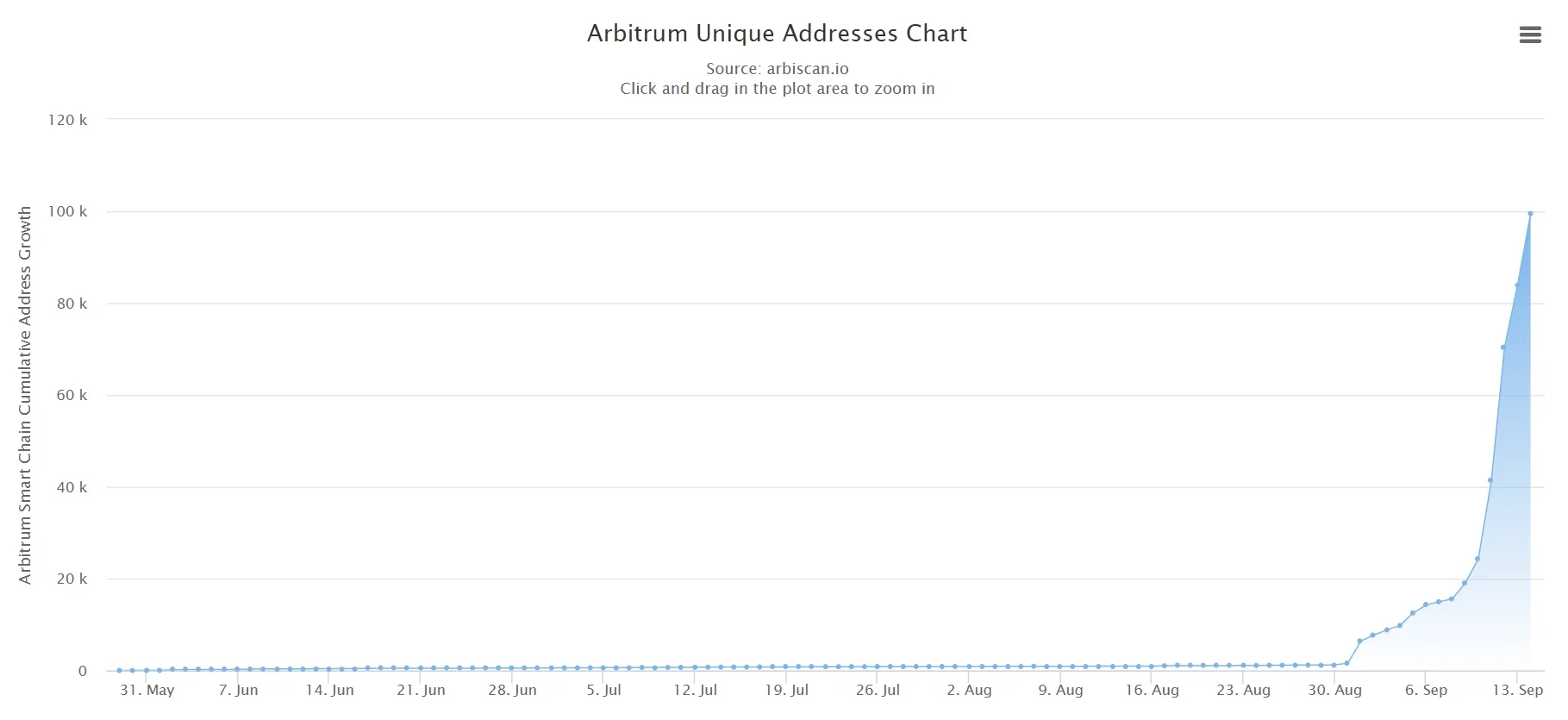
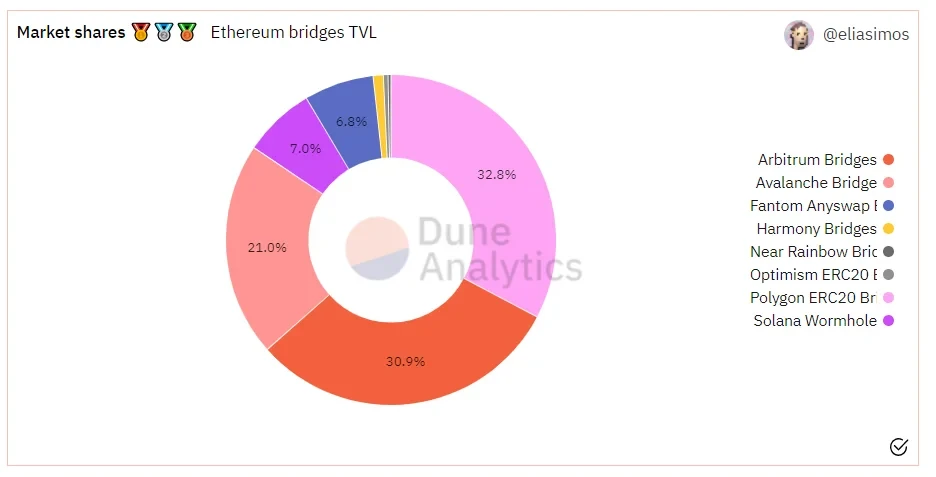
Currently, Dune Analytics data shows Arbitrum accounts for 30.9% of the total assets locked in Ethereum bridges, narrowing the gap with Polygon's 32.8%. Projects such as SushiSwap, Uniswap V3, Dodo, Balancer, Curve, MetaMask, and Chainlink have all deployed on Arbitrum. It is reported that Arbitrum will open permissionless token bridging to all projects on October 22nd. This functionality applies to basic ERC20 token features and transferability properties on both L1 and L2, and also allows projects or individuals to deploy features such as governance and snapshots on ERC20 tokens. Before October 22nd, this functionality is only available to whitelisted project tokens — projects may contact Arbitrum for early deployment. As seen on DeFiLlama, Arbitrum's total TVL has already surpassed that of Fantom, Near, and other public chains.
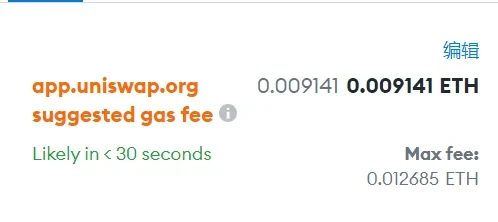
We briefly tested the transaction and transfer functionality on both Arbitrum and ZK Sync. Starting with Arbitrum: first, we logged into Uniswap on Ethereum L1 mainnet and made an ETH-to-USDT swap. At that point, the Gas fee was $31.13.
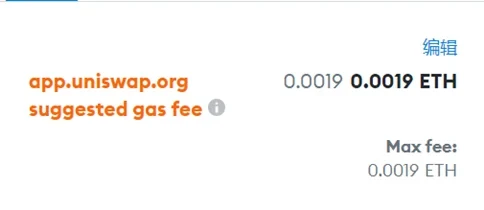
We then switched to the Arbitrum network and initiated another ETH-to-USDT swap on Uniswap. At this point, the on-chain Gas fee was 0.0019 ETH, which at the current price is approximately $6.50. Compared to the mainnet, Gas fees decreased by nearly 85%.
We then tried ZK Sync another way. Opening Gitcoin, we selected a donation project and entered the desired donation amount. Selecting "Standard Checkout" — paying via Ethereum L1 — the Gas fee was $25.57.
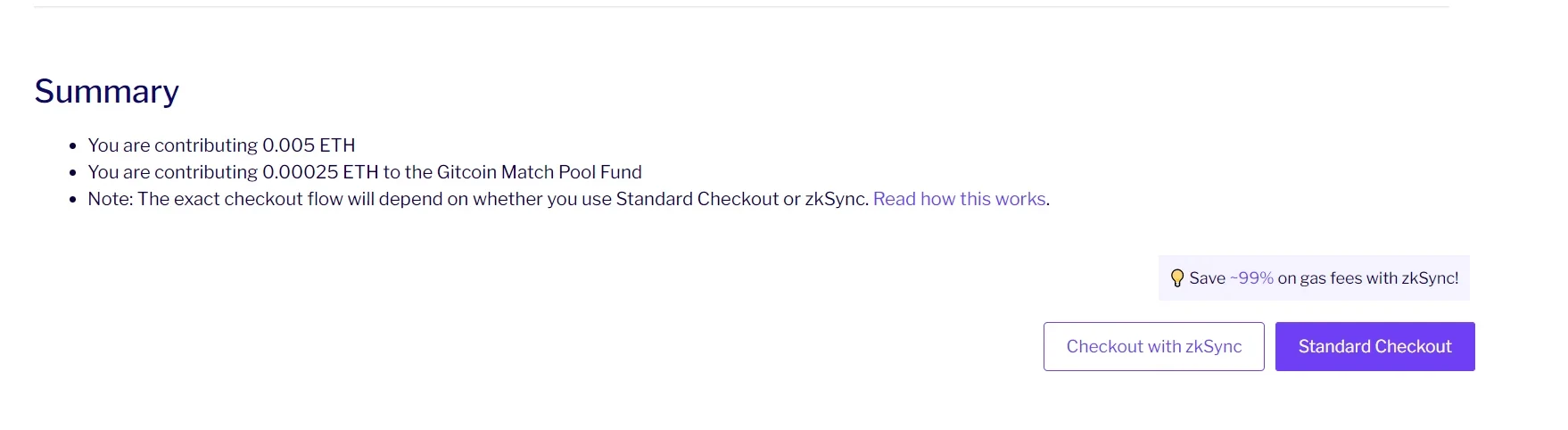
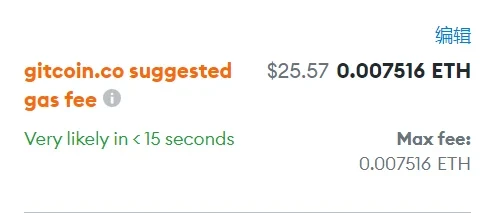
If switching to "Checkout with ZK Sync," the Gas fee was $0.54. Comparing the two, donating using ZK Sync is approximately 98% cheaper.

Considering that currently, the star Layer 2 projects still limit network scaling capacity, there will be even more room for improvement in the future. For example, on September 13th, Optimism announced it had doubled the mainnet throughput limit, enabling up to 200,000 transactions per day. It should be noted that the exponential growth in unique addresses for Layer 2 projects like ZK Sync, Optimism, and Arbitrum recently may also be attributed to users making symbolic interactions and betting on potential future airdrops from the project teams. In reality, Optimistic Rollup's current exit mechanism takes 7 days, which is not user-friendly for capital efficiency, especially for large capital volumes — the playability remains relatively low.
Currently, Ethereum faces high Gas fees and scalability issues, making people realize that Ethereum's current performance and architecture struggle to accommodate the diversity of internet applications. If adopting a unified platform where different applications compete for on-chain resources, it would still be possible for a small number of applications to cause network paralysis under extreme conditions. Additionally, from the perspective of industry evolution, it is unlikely that multiple chains will share the same user base. For example, the Ronin sidechain built by Axie Infinity and the Flow public chain focused on NFTs — there will certainly be a trend toward specialization. This also explains the current exceptionally dynamic landscape: on one hand, Ethereum competitor chains are innovating and competing fiercely for attention; on the other hand, major Layer 2 projects are launching and capturing market focus, intensifying the competition. What can be foreseen is that this invisible war will not end in the short term…
Disclaimer
This article may contain product-related content not applicable to your region. This article is only intended to provide general information and does not responsible for any factual errors or omissions. This article represents only the author's personal views and does not represent OKX's views. This article is not intended to provide any advice, including but not limited to: (i) investment advice or investment recommendations; (ii) offers or solicitations to buy, sell, or hold digital assets; or (iii) financial, accounting, legal, or tax advice. Holdings of digital assets (including stablecoins) involve high risk and may fluctuate significantly, or even become worthless. You should carefully consider whether trading or holding digital assets is appropriate for you based on your financial situation. For questions specific to your circumstances, please consult your legal/tax/investment professional. The information in this article (including market data and statistics, where applicable) is provided for general reference purposes only. Although we have taken all reasonable precautions in preparing this data and these charts, we assume no responsibility for any factual errors or omissions expressed herein. © 2025 OKX. This article may be reproduced or distributed in its entirety, or excerpts of 100 words or less may be used, provided that such use is non-commercial. Any reproduction or distribution of the full article must prominently state: "This article is copyrighted © 2025 OKX, used with permission." Permitted excerpts must cite the article title and include attribution, for example, "Article title, [author name (if applicable)], © 2025 OKX." Some content may have been generated or assisted by artificial intelligence (AI) tools. Derivative works and other uses of this article are not permitted.
Show More
Recommended Reading

2025 KOL Most Used OKX Products Roundup
In the cryptocurrency industry, professional players' choices are always direct and pure. In 2025, KOLs cast the most authentic votes for industry tools and ecosystem development with a full year of capital investment and time dedication. We focused on four core questions — "What was your biggest achievement this year?", "With that achievement in mind, what OKX products did you use most and love most in 2025?", "Why do you like it?", and "What
January 5, 2026

2026 Investment Outlook: Assets On-chain, Intelligence & Privacy | OKX Year in Review
The three major trends of Crypto's future: asset transformation, subject transformation, and rule transformation. As we are about to enter 2026, bidding farewell to four years of focusing on "building roads" for infrastructure, the crypto industry is welcoming a profound paradigm shift. OKX Ventures defines this as the dawn of the "Kinetic Finance" era, whose core is no longer how fast the network is, but the flow and earning of on-chain assets
December 31, 2025

Votes with Data: A Deep Dive into the Most Popular Trading Products of 2025 | OKX Year in Review
Looking at price movements alone, it is difficult to explain the returns differences among trading users in 2025. What truly determines returns also depends on account-level operation methods, not just market volatility itself. OKX's annual report shows that mainstream coins remain the core of capital turnover and returns carrying, supporting trading and strategy execution; emerging coins are more used to amplify volatility and provide phased opportunities, but are not a stable, long-term source of returns. What truly continuously contributes to returns is
December 30, 2025
Fusaka in Practice: What Ethereum's Latest Upgrade Means for L2, Nodes, and Users
Ethereum mainnet has completed the Fusaka fork. At the protocol level, this upgrade mainly includes four components. Full text follows Q&A format. Show More three guests' core viewpoints and frontline experience: Ahmad (@smartprogrammer) – Nethermind Execution Client / Ethereum Core Developer Manu (@manunalepa) – Prysm / Of
December 16, 2025
OKX Research | Why Did RWA Become a Key Narrative in 2025?
RWA (Real World Assets) is becoming the "new favorite" of global capital. Simply put, RWA is the process of bringing valuable, ownership-bearing things from the real world — such as houses, bonds, stocks, and other traditional financial assets, and even art, private lending, and carbon credits that are not typically easy to trade directly — onto the blockchain, transforming them into tradable, programmable crypto assets. In this way, n
November 20, 2025
Claude Takes the Crown — 6 Major AI Grid Strategies Face Off | OKX & Ai Coin Live Test
The short-term trading champion — is it also the king of grid strategies? The first season of NOF1's "AI Trading Live Arena" finally concluded on November 4, 2025, at 6 AM, whetting the appetite of the crypto, tech, and finance circles. But the outcome of this "AI intelligence public test" was somewhat unexpected. The six models' combined $60,000 in starting capital was worth only $43,000 at the close.
November 6, 2025