Looks Rare Trading Volume Surpasses OpenSea, NFT Market Battle Begins
Recently, the emerging NFT platform Looks Rare has been gaining momentum rapidly. After launching its trading rewards program, its trading volume quickly surpassed OpenSea, and the LOOKS token price also hit a new high. In just two weeks, Looks Rare claimed the "top spot" in the NFT market, making it the center of attention. So, what is the background of Looks Rare? Can OpenSea continue to be threatened? How will the NFT market competitive landscape evolve?
Why Did Looks Rare Rise to the Top?
On January 23, according to Dappradar data, Looks Rare's trading volume in the past 7 days reached $1 billion, surpassing OpenSea's $726 million. Last week, Looks Rare's seven-day trading volume reached $3.6 billion, with a 24-hour trading high of $700 million—5 times that of OpenSea during the same period. As Looks Rare's trading volume surged, the LOOKS token price also broke through $7.1 on January 21, hitting an all-time high.
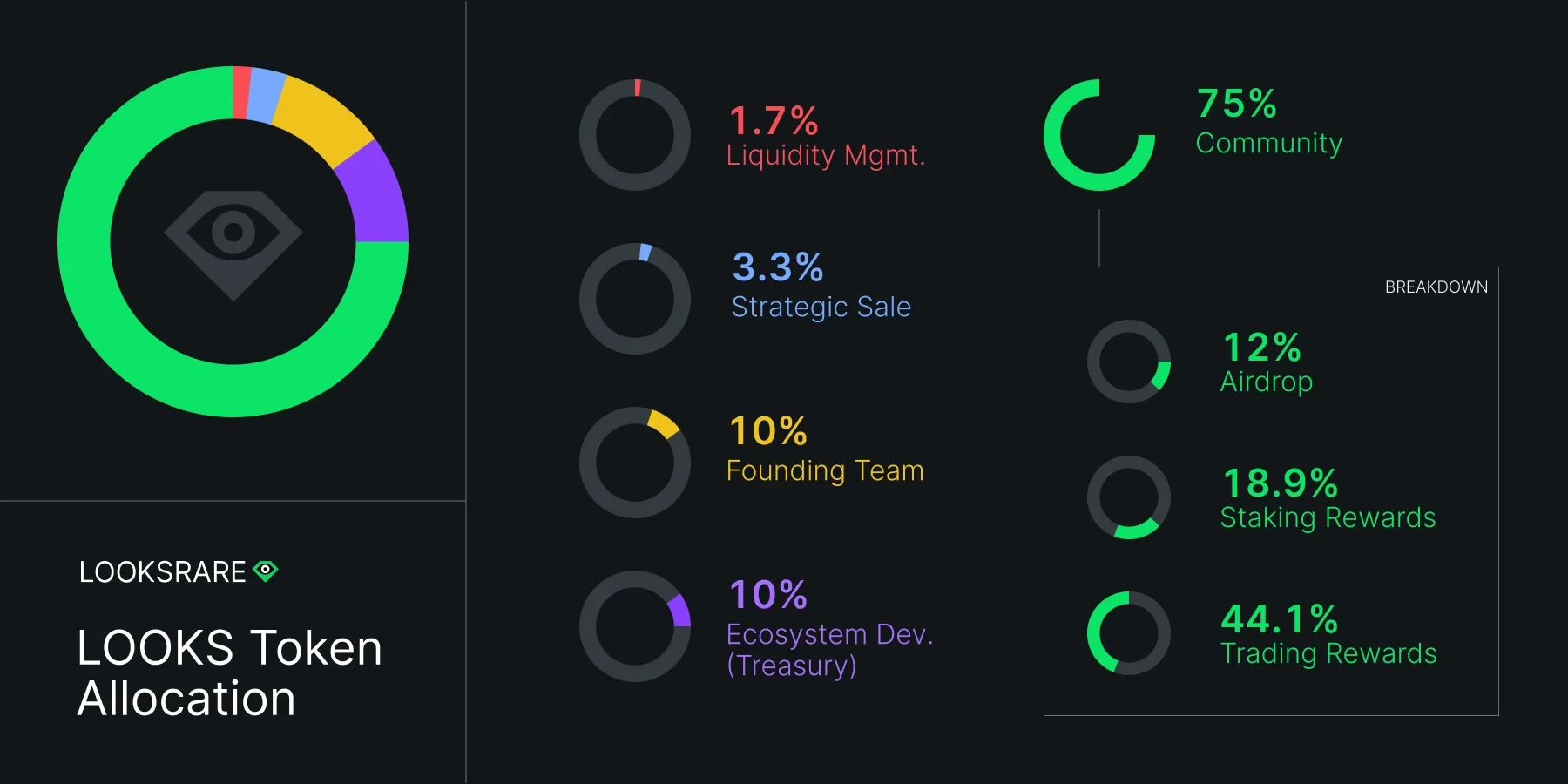
LOOKS is the governance token of the Looks Rare platform, with three-quarters of the total supply owned by the community. Of this, 63% is allocated to incentivize token stakers and platform traders, while the remaining 12% is for retroactive airdrop rewards. The token distribution method reflects the platform's community-centric approach. According to the official website, Looks Rare is a new community-driven NFT trading marketplace launched by an anonymous team on Ethereum in January 2022. On January 10, 2022, it announced the official launch of the LOOKS token and airdropped it to OpenSea users. Users who traded 3 ETH or more on OpenSea between June 16, 2021 and December 16, 2021, and listed at least one NFT on Looks Rare, could receive the LOOKS token airdrop without needing to make a single trade.
So, why was Looks Rare able to quickly surpass OpenSea, which has always held the top market position?
This is mainly due to its trading incentive mechanisms and innovative features. According to the official website, the rewards Looks Rare designed are mainly divided into two types: trading rewards and staking rewards. Trading fees (WETH) are 100% earned by LOOKS token holders, and users can earn LOOKS and WETH tokens by trading NFTs on its platform and staking LOOKS tokens. Currently, the official website shows that the APR for staking LOOKS tokens is approximately 303%, and the APR for WETH is approximately 267%. In addition, to improve the liquidity of the LOOKS token, Looks Rare also provides LOOKS token rewards to users who hold LOOKS-ETH Uni V2 LP tokens. The initial liquidity plan will last 500,000 blocks (approximately 77 days), with the reward rate for LP stakers at 10 LOOKS per block.
On the innovation side, Looks Rare has designed several new features compared to most existing NFT trading platforms, mainly including: one-click bidding, mixed payment, and instant royalties. Users on the Looks Rare platform can easily use the one-click bidding feature, and all open orders can be cancelled with one click, which is simpler and more convenient compared to the experience of placing sell orders or batch bidding and waiting for transactions. Mixed payment refers to supporting both ETH and WETH payments simultaneously, while the OpenSea platform uses ETH for payments and WETH for bidding. Looks Rare's mixed payment offers a better user experience and eliminates the gas fees required for token conversion. Instant royalties, compared to OpenSea's bi-weekly distribution of royalty income to creators, means that every single trade on Looks Rare immediately distributes royalty income to creators, which may incentivize more creators to publish their work.
Can It Challenge OpenSea's Position?
Looks Rare's rapid rise has posed a challenge to OpenSea and injected new momentum into the booming NFT market. As for whether it can truly disrupt OpenSea and establish itself, it may still face many challenges, such as whether its incentive mechanisms and platform liquidity solutions are sustainable.
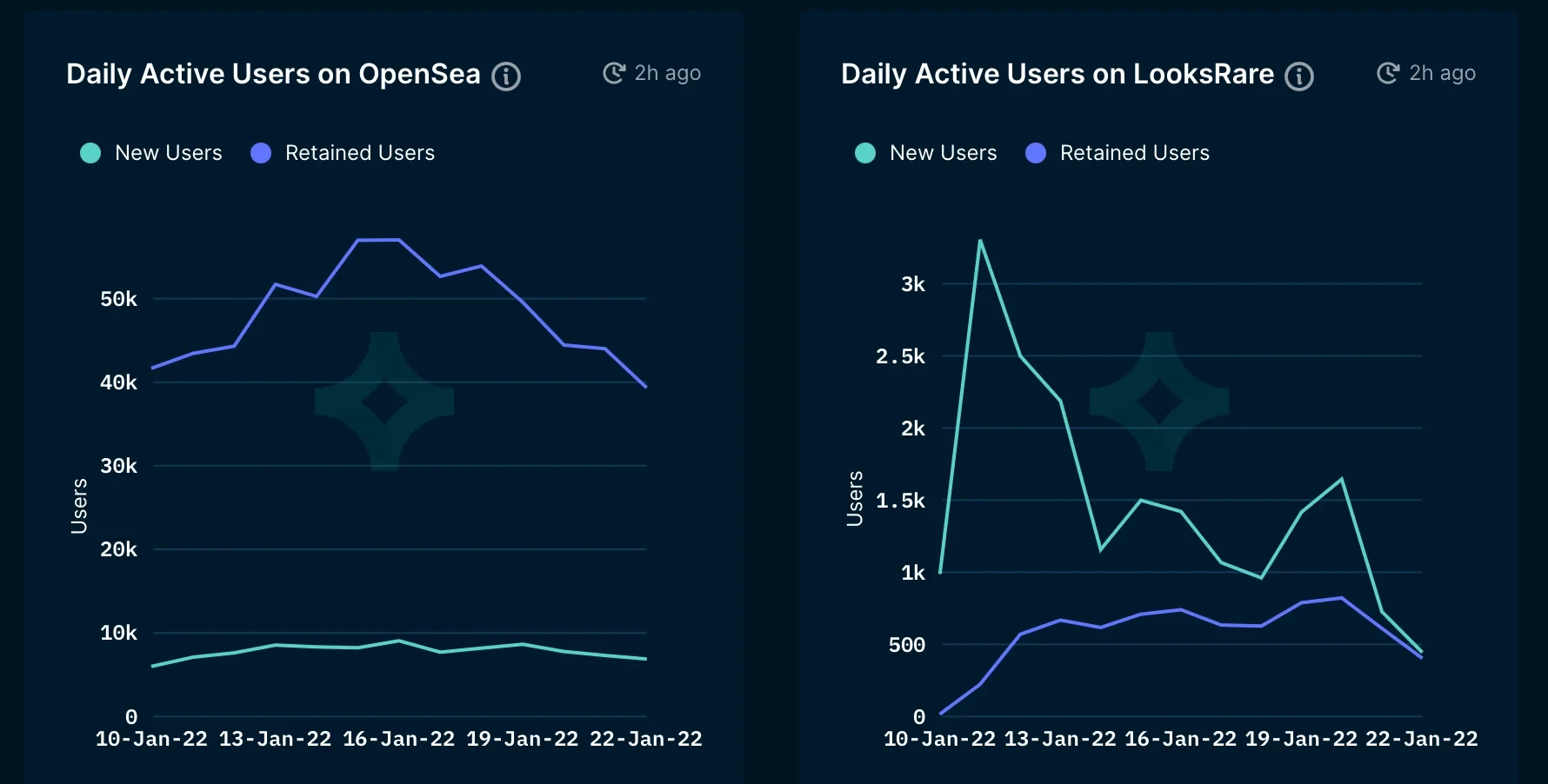
Currently, Looks Rare's performance has been unstable, and there is still a considerable gap between Looks Rare and OpenSea in terms of active users and trading volume. The latest data shows that Looks Rare had 737 users in the past 24 hours, a 32% decrease from the previous day, with a very obvious downward trend in new users; OpenSea had 44,200 users, with active users mainly being retained users, and daily active users decreased by 8.59% from the previous day.
Looks Rare's daily trading volume fluctuates sharply between 0 and 130,000 ETH, while OpenSea's is mainly concentrated between 500 and 5,000 ETH, with relatively smaller fluctuations. OpenSea's daily trade count is 20 to 100 times that of Looks Rare.
From the perspective of "smart money" holders and their movements, Looks Rare clearly cannot surpass the OpenSea platform in the short term. Currently, smart money NFT market activities are mainly concentrated on the OpenSea platform, basically at 80-90% or above. NFT whale user activity on OpenSea also accounts for more than 90% of the entire market. Looking at the daily active "smart money" user count, Looks Rare's minting users have decreased significantly. Although OpenSea's daily active user count also shows a downward trend, the trend is relatively flat, and its holders and traders are still about 15 times that of Looks Rare.
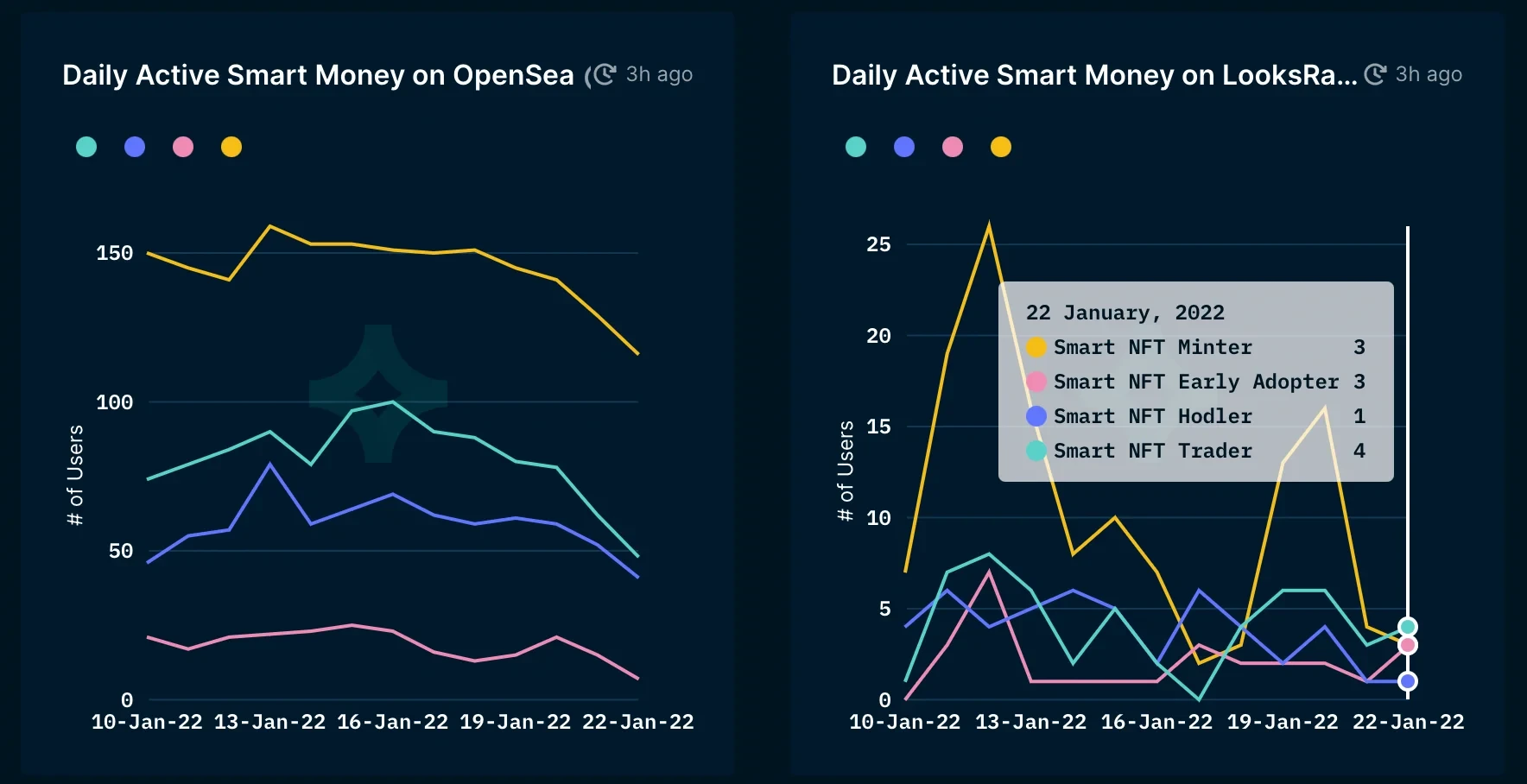
Therefore, based on data from all the above dimensions, although Looks Rare briefly surged to the top in trading volume, its active users and trading figures have been extremely unstable, which means its user base and stickiness are not solid. Even if Looks Rare surpasses OpenSea in certain user experiences and innovative features, and although OpenSea also faces some criticism and dissatisfaction, its dominant position is not so easily challenged. What measures will Looks Rare take to continue capturing the NFT market? We look forward to seeing what unfolds.
Tech Giants Join the NFT Platform Battle
It is worth noting that the NFT market is not just being coveted by new players like Looks Rare. Although cryptocurrency asset prices have been sluggish, the NFT market is still growing rapidly. According to NFTGO data, the current total market value of NFT is $12.422 billion, with over 16 million holders. The latest data shows that the total NFT on-chain sales have exceeded $25 billion. The top five blockchains by current sales volume are Ethereum, Ronin, Solana, FLOW, and WAX. Analysts at investment bank Jefferies predict that the NFT market value will exceed $35 billion in 2022 and $80 billion in 2025.
As NFT continues to gain mainstream attention and the market continues to grow, many international well-known brands and companies, including LV, have joined the NFT ranks and are competing for this high ground. This trend has been accelerating since the second half of last year. In addition to emerging platforms like Looks Rare continuing to emerge, mainstream exchanges have long ago entered the NFT sector, such as the NFT marketplace in OKX Meta X. Recently, many globally leading tech giants have been accelerating their entry into the NFT market.
First, Meta, which announced its metaverse transition last year, plans to launch an NFT marketplace for users to buy and sell NFTs, and will also launch new features for users to mint NFTs. At the same time, Meta also intends to support users in displaying NFTs on their Facebook and Instagram profile pages.
In this NFT market battle, Meta is not the only company wanting to launch an NFT marketplace. Recently, the well-known social networking giant LINE announced that it will launch a one-stop NFT platform called DOSI to users in 180 countries worldwide in the first quarter of this year, providing a series of services for creating and trading NFTs. It is reported that the name "DOSI" comes from the Korean word for "city." At that time, the DOSI platform will provide three main services: DOSI Store, DOSI Wallet, and DOSI Support. These products can provide support including NFT creation and marketing. Creators can list their work on DOSI, and can use the platform's NFT wallet and pay with cryptocurrency assets (such as ETH, BTC) or credit cards to trade.
Twitter's cryptocurrency team, established last year, is currently recruiting senior product managers, focusing on NFT, DAO, Web3 and other areas, and designing specific cryptocurrency products and features. Previously, the team has already launched NFT avatar verification services for subscribers. Therefore, what can be predicted is that as long as the NFT market continues to grow, the trend of large companies entering the market battle will continue. This market battle may have just begun. Among these, the NFT marketplaces launched by trading platforms have provided users with convenient ways to participate and services. Relying on their ecosystem, technology, and existing active user advantages, they have gained a certain first-mover advantage in the NFT market. So, what challenges will the latecomers face? How will they join in and inject new vitality into the NFT market? This test paper is left for the many competitors entering the NFT platform battle.
Disclaimer
This article may contain product-related content that does not apply to your region. This article is only committed to providing general information and is not responsible for any factual errors or omissions. This article represents only the author's personal views and does not represent OKX's views. This article is not intended to provide any advice, including but not limited to: (i) investment advice or investment recommendations; (ii) offers or solicitations to buy, sell, or hold digital assets; or (iii) financial, accounting, legal, or tax advice. Holding digital assets (including stablecoins) involves high risk and may fluctuate significantly or even become worthless. You should carefully consider whether trading or holding digital assets is suitable for you based on your financial situation. For questions regarding your specific circumstances, please consult your legal/tax/investment professionals. The information contained in this article (including market data and statistical information, if any) is for general reference purposes only. Although we have taken all reasonable precautions in preparing such data and charts, we do not accept any responsibility for any factual errors or omissions expressed herein. © 2025 OKX. This article may be reproduced or distributed in full, or excerpts of 100 words or less may be used, provided that such use is non-commercial. Any reproduction or distribution of the full article must prominently state: "This article is copyrighted © 2025 OKX, used with permission." Permitted excerpts must cite the article name and include the source, for example, "Article name, [author name (if applicable)], © 2025 OKX". Some content may be generated or assisted by artificial intelligence (AI) tools. Derivative works and other uses of this article are not permitted.
Show More
Recommended Reading

2025 KOL Most Frequently Used OKX Products List
In the cryptocurrency industry, professional players' choices are always direct and pure. In 2025, KOLs used their Funds and time throughout the year to cast the most authentic votes for industry tools and ecosystem development. We focused on four core questions—"What was your biggest achievement this year?", "Given your achievements, what OKX products do you use most frequently and love the most in 2025?", "Why do you like it?", "This product
2026年1月5日

2026 Investment Outlook: Assets Go On-Chain, Intelligence & Privacy | OKX Annual Review
The three major trends in crypto's future: asset transformation, subject transformation, and rule transformation. At the point of stepping into 2026, bidding farewell to four years of focusing on "building roads" for infrastructure, the crypto industry is welcoming a profound paradigm shift. OKX Ventures defines this as the beginning of the era of "Kinetic Finance," whose core is no longer about how fast the network is, but the flow and earning of on-chain assets.
2025年12月31日

Voting with Data: A Deep Dive into the 2025 Popular Trading Products | OKX Annual Review
If you only look at price trends, it's hard to explain the returns differences among exchange users in 2025. What truly determines returns also depends on account-level operation methods, not just market volatility itself. OKX's annual report shows that mainstream coins remain the core of capital turnover and returns bearing, supporting trading and strategy execution; emerging coins are more used to amplify volatility and provide phased opportunities, but are not a stable, long-term source of returns. What truly continuously contributes to returns is
2025年12月30日
Fusaka in Practice: What Ethereum's Latest Upgrade Means for L2, Nodes, and Users
The Ethereum mainnet has completed the Fusaka fork. From a protocol perspective, this upgrade mainly includes four components. The full text follows a Q&A with three guests sharing their core viewpoints and frontline experience: Ahmad (@smartprogrammer) – Nethermind Execution Client / Ethereum Core Developer Manu (@manunalepa) – Prysm / Of
2025年12月16日
OKX Research | Why Did RWA Become a Key Narrative in 2025?
RWA (Real World Assets) is becoming the "new favorite" of global capital. Simply put, RWA involves taking valuable, ownership-bearing assets from the real world—such as traditional financial assets like houses, bonds, stocks, and even artworks, private lending, and carbon credits that are not typically easy to trade directly—and moving them onto the blockchain, transforming them into tradeable, programmable cryptocurrency assets. This way, n
2025年11月20日
Claude Takes the Crown, 6 Major AI Grid Strategies Face Off | OKX & Ai Coin Live Test
Short-term trading champion , is it also the king of grid strategies? The first season of NOF1's "AI Trading Live Arena" finally concluded on November 4, 2025 at 6 AM, whetting the appetite of the crypto, tech, and financial circles. But the outcome of this "AI IQ open test" was somewhat unexpected. Of the six models' total $60,000 principal, at closing, only $4.3
2025年11月6日
```