NFT Frenzy Propels Ethereum Higher — What Does DeFi Bring to NFTs?
According to OKX market data, in mid-May, affected by Bitcoin's decline, Ethereum hit an all-time high of $4,372 before its overall trend weakened. Within just 10 days, Ethereum fell to as low as $1,865, representing a maximum decline of 57%. After two months of consolidation, Ethereum successfully broke through the $2,800 resistance level after forming a standard "W" bottom, and surged above $3,800 — a new high for Ethereum since May 16th.
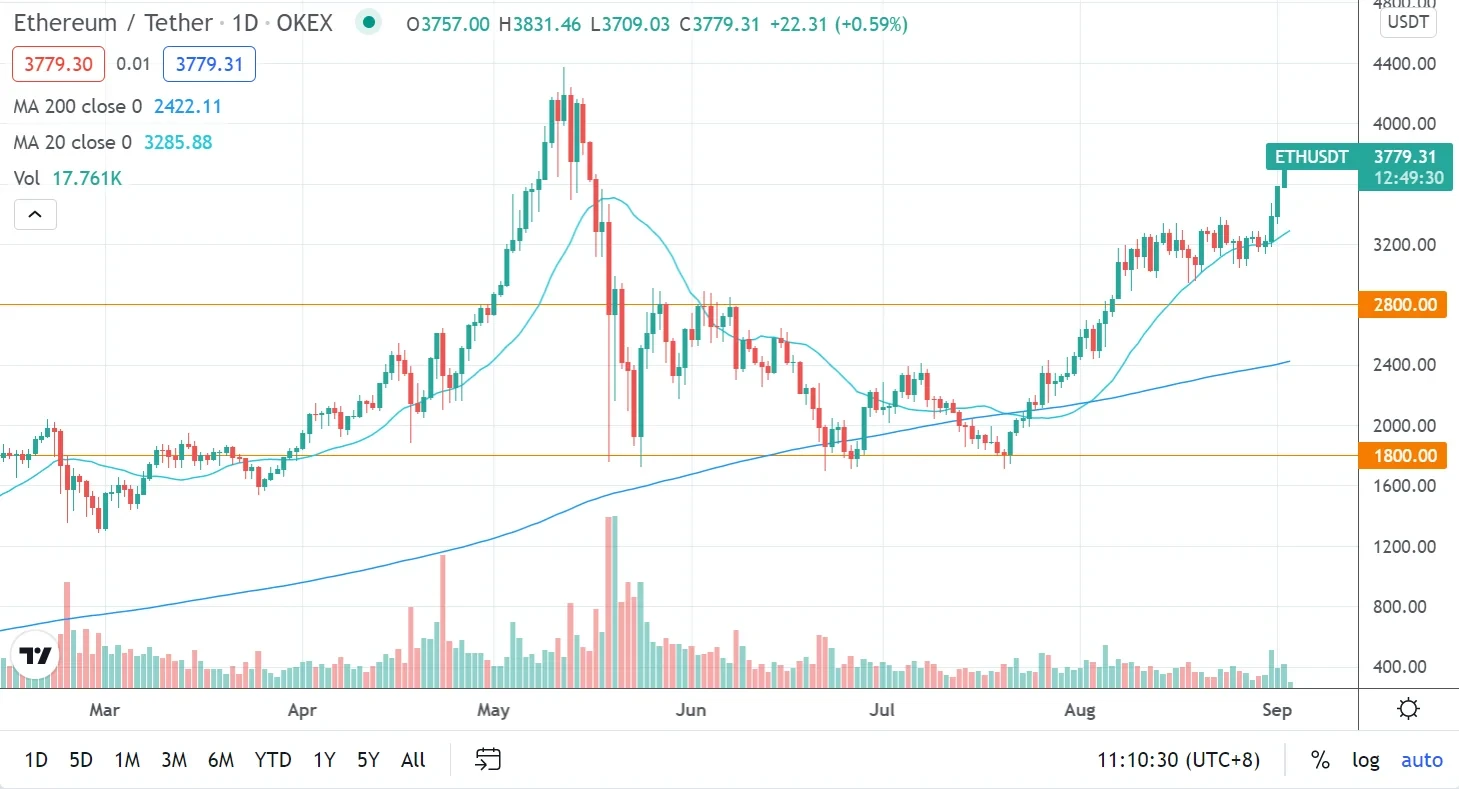
Calculating from Ethereum's opening price of $1,805 on July 21st, to its September 2nd closing price of $3,757, Ethereum surged 108% in just 43 days.
The prevailing market view holds that this round of Ethereum's price increase is primarily attributable to the NFT frenzy driven by GameFi, and since the implementation of EIP-1559, Ethereum's burn volume has continued to rise. On August 31st, the burn volume even exceeded 12,000 ETH, with the gap between new issuance and burn volume narrowing to just 782 — the psychological expectation of "deflation" has strongly fueled Ethereum's rally. Additionally, The Block data shows that Ethereum miner revenue surged 83% to $1.98 billion in August, with trading fees reaching $690 million, up 243% from the previous month.
Of course, the increase in burn volume and rising miner fee revenue ultimately stem from higher on-chain activity on Ethereum. According to qkl123 data, over the past month, NFT trading platform OpenSea ranked first on the EIP-1559 burn leaderboard by burning 27,800 Ethereum, followed by Ethereum on-chain transfers — underscoring the intensity of the NFT fervor.
Recently, OpenSea's trading volume has repeatedly hit new highs, CryptoPunks floor prices continue to刷新认知 (defy expectations), and Loot has emerged to capture market attention — inevitably evoking memories of last year's DeFi Summer. As two phenomenon-level ecosystems that both erupted on Ethereum, what is the relationship between them, and where will they go from here?
The Evolution of DeFi Summer and NFT Summer
On June 16, 2020, decentralized lending protocol Compound launched its governance token COMP, and the "lend-to-mine" model quickly gained traction. Within one month, Compound's total value locked (TVL) surged from $175 million to $576 million, a 229% increase. The introduction of lend-to-mine provided a breakthrough for the DeFi sector, which had been dormant for two years, and reignited the market sentiment that had been gradually recovering since the "3·12" crash.
As a turning point in DeFi development, the series of activities centered around yield farming greatly unlocked the liquidity of crypto assets and fully activated the crypto world. DeFi subsequently experienced explosive growth.
Looking at the two most closely watched metrics in DeFi — TVL and total market cap — before June of last year, DeFi's total TVL was merely $880 million. Following the launch of liquidity mining, DeFi's total TVL quickly climbed to $7.613 billion within three months, an almost 8-fold increase. Driven by liquidity mining, various DeFi governance tokens soared, with DeFi's total market cap growing from $3.72 billion in early June to $20.521 billion, a 452% gain.
At the same time, Bitcoin pegged tokens on the Ethereum chain also surged dramatically, growing from 5,191 Bitcoin pegged tokens to 55,465 in just three months, a nearly 10-fold increase. During this period, numerous DeFi projects covering lending, decentralized exchanges, derivatives, synthetic assets, insurance, and more emerged rapidly, quickly attracting capital with their high annual yields and returns.
As DeFi flourished, since on-chain activities required Ethereum as gas fees, Ethereum's price naturally climbed alongside — rising from $234 in early June to $434 by the end of August, an 85% increase. Since the essence of DeFi is still trading-focused, and in pursuit of lucrative returns from so-called "first mines," investors would often drive up Gas fees. While DeFi powered the Ethereum ecosystem, it also caused network congestion.
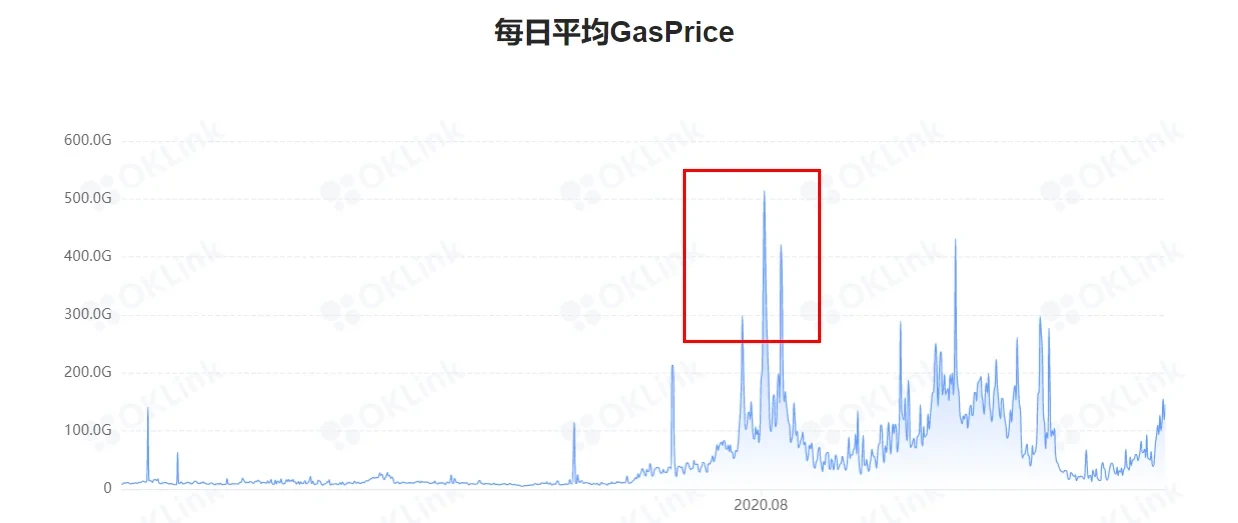
According to OK Link data, before the DeFi boom, Ethereum's average daily gas price was between 5–10 Gwei. However, after the launch of liquidity mining on June 16th, the daily average price climbed steadily, reaching a staggering 514.54 Gwei on September 2nd — a 50–100 fold increase. Gas fees of $20–30 became commonplace, and for users with smaller fund positions, mining returns couldn't even cover the gas fees. Cobo co-founder Fish at the time bluntly stated on Weibo that a fund size of approximately $50,000 was needed just to barely offset the high gas fees.
Although DeFi showcased a decentralized finance innovation experiment at an unprecedented speed, the reality that new valuable projects couldn't be rolled out every day was inherently unsustainable. Moreover, as hot money in the market witnessed the wealth-generation phenomenon in DeFi, they rushed in frantically, creating numerous dressed-up replicas of similar projects. DeFi's later stage also saw a "gap period," and after DeFi's total market cap hit a high of $17.74 billion on September 1st last year, it fell 54% within one month. DeFi then entered a three-month consolidation period, only regaining ground above its previous high on January 6, 2021, which gradually quelled market doubts about DeFi.
NFT — ever since the first DeFi downturn, there were rumors that it would take over from DeFi and lead the next crypto wave. However, at that time, the community was relatively niche, primarily remaining in the collectibles and art spaces. So despite the passionate advocacy of NFT believers, the market didn't seem receptive. It wasn't until 2021, when top auction houses first listed NFT artworks and sold them for a staggering $69 million, that NFTs successfully broke into the mainstream. Combined with the participation of the well-known NBA league, NBA Top Shot sparked investors' interest in NFT trading cards, the impressive performance of the NFT blockchain Flow, and the subsequent wave of sports-related events driving fan tokens like CHZ and JUV — NFTs allowed early adopters to taste success and gradually attracted market attention. But it was at best a small-scale rally, still unable to create the fervor that DeFi once did. It wasn't until Axie Infinity drove blockchain gaming to prominence in mid-June, with its "Play-to-Earn" model breaking through, and the in-game creatures Axies perfectly combining blockchain gaming with NFTs, that the subsequent NFT waves — including Avatar (profile picture) trends — were ignited.
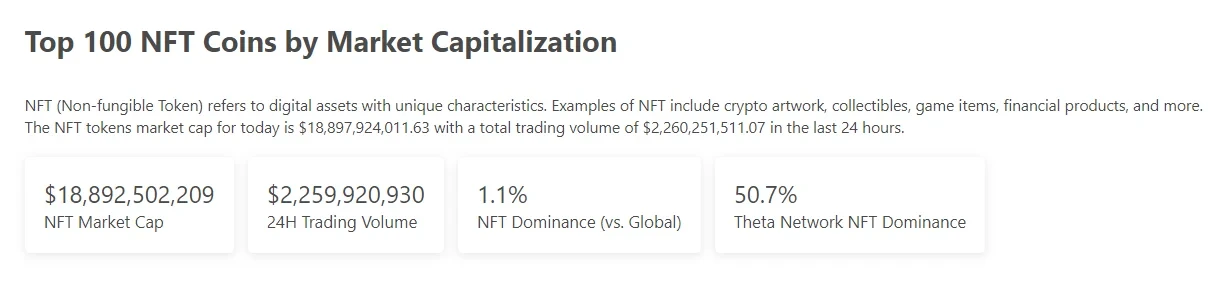
In our article "NFT Sales Plunge 80%, Do Top Events Secretly Power the Sports Sector?", we noted that on June 17th, the total NFT market cap stood at $18.893 billion. By September 2nd, the total NFT market cap reached $29.784 billion, a 58% increase in just under three months.

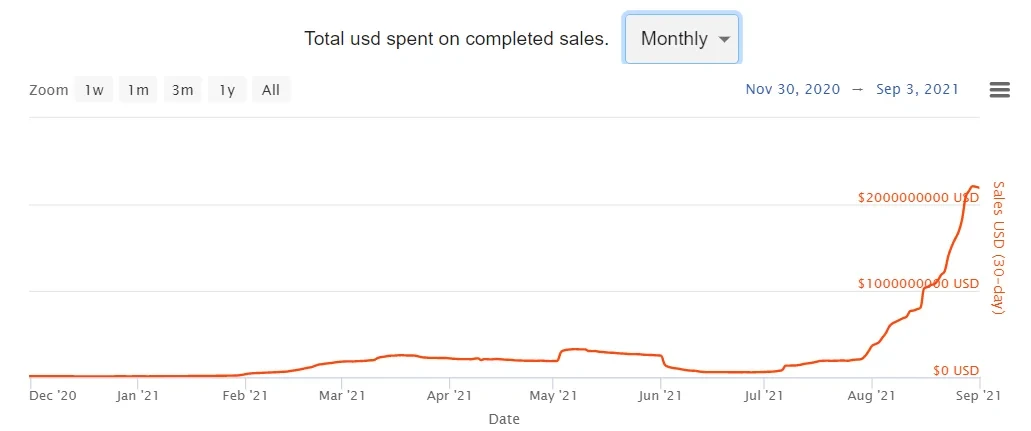
According to Nonfungible data, monthly NFT trading volume climbed from $252 million at the end of May to $2.203 billion by the end of August, a 774% increase.
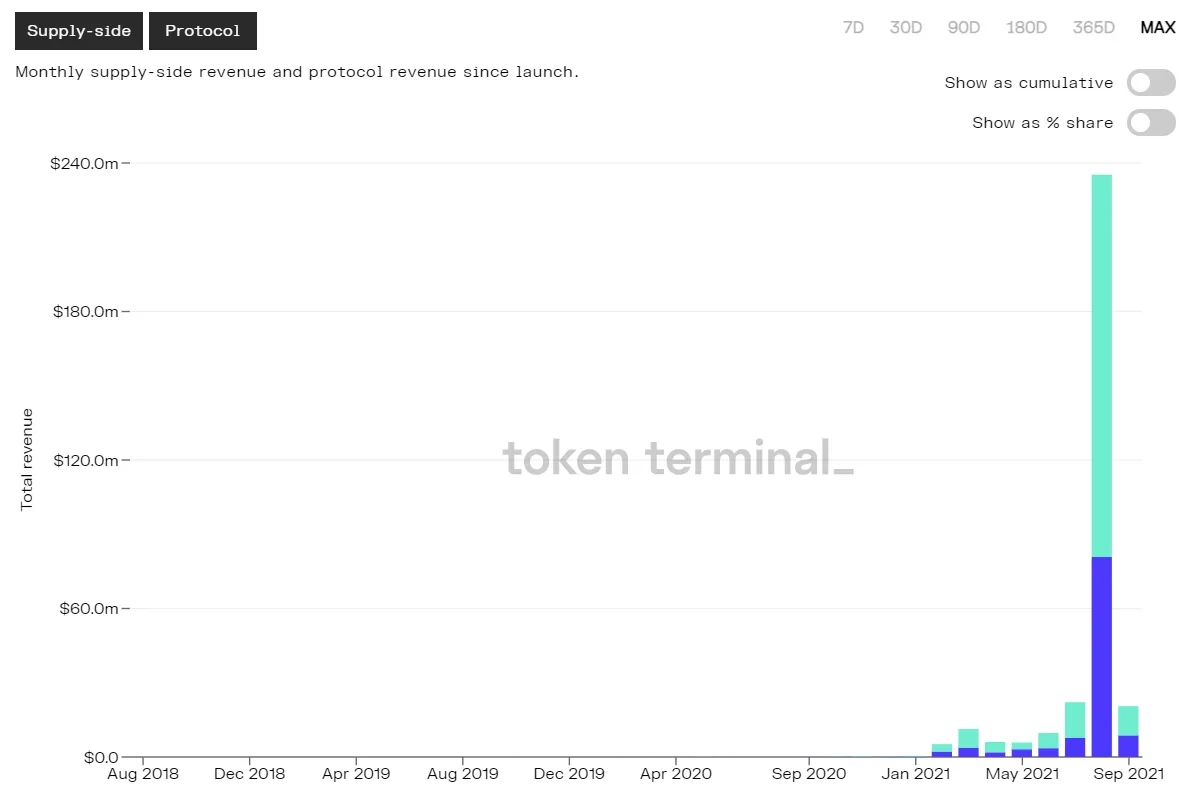
The dominant NFT trading platform OpenSea's total revenue hit new records, with August revenue reaching $235 million — far exceeding the combined total of all other months on record.
By late July, when Avatar profile pictures gained traction, CryptoPunks' floor price climbed steadily and previously broke through 120 ETH. Not long ago, NBA star Curry also spent $180,000 to purchase a digital profile picture — a BAYC ape. More recently, Loot, which doesn't even have images and is just a string of text, saw its floor price surge to a staggering 18.88 Ethereum. The market believes there are three reasons behind this phenomenon: First, pricey NFT collectibles have become a status symbol, and as the world increasingly digitizes, more people believe NFTs will play an indispensable role in the metaverse. Second, NFT profile pictures represent that internet natives have grown into a dominant force, and they more strongly support NFTs' exchange demands and trading value. Finally, market sentiment catalyzed the frenzy, with the massive influx of capital also spawning FOMO (fear of missing out) emotions.
During this NFT boom, Ethereum's price rose from its June 22nd low of $1,700 to a recent high of $3,843, a 126% increase — mirroring the earlier DeFi-driven Ethereum rally.
Of course, just like DeFi, the NFT market's development has also encountered a bottleneck. Axie Infinity's popularity has declined, while some valuable blockchain gaming projects like Illuvium won't launch until Q3. Certainly, the rapidly launching NFT profile pictures have shown a similar trend —热闹 (buzzing) at launch, then ending up in a mess (一地鸡毛) shortly after. LEBTC Mining Pool founder Jiang Zhuoer predicted that profile picture NFTs would crash within 20 days, with the defining event being the emergence of Loot (text NFTs). Jiang Zhuoer believes that profile picture NFTs, lacking retail investors, will deplete far faster than typical projects. With limited entry funds but an unlimited supply of profile pictures, this situation has worsened.
DeFi Summer Fuels NFT Summer
Why do we group this year's NFT Summer with last year's DeFi Summer in this article? Because we believe that, at least in areas such as user education, investment philosophy upgrades, and trading habit cultivation, DeFi Summer objectively laid a solid foundation for NFT Summer. Additionally, we note that although NFTs and DeFi each ignited crypto investors' trading fervor in the summers of this year and last year respectively, a closer look reveals several differences. Let's dive deeper.
First, before DeFi's massive breakout, the investment options available to crypto market investors were extremely limited. Specifically, for the vast majority of ordinary investors, CEXs were their only option. On CEXs, whether spot trading or derivatives trading, it was essentially a binary buy-sell trading model, with investors seeking returns by finding low-buy-high-sell opportunities. After being baptized by DeFi Summer, collateralized lending protocols and the liquidity mining model popular on DEXs were rapidly accepted and embraced by crypto investors. Notably, during this process, operations such as using self-custody wallets like MetaMask to interact directly with smart contracts also became increasingly familiar to more users. This removed operational barriers to basic on-chain interactions for this year's NFT rise and cultivated the first batch of potential seed users.
According to Dapp Radar's investment portfolio tracking tool, 85% of DeFi users have also interacted with NFTs, a 10% increase compared to May, supporting the view that NFTs have grown increasingly popular over the past two months. After analyzing more than 13,000 wallets, the conclusion is that the overlap between NFTs and existing DeFi users is growing.
Additionally, taking a bird's-eye view of DeFi's year-long development, one can observe that at the outset of DeFi Summer, skeptical voices among investors outweighed supportive ones. This skepticism stems from a本能的 (instinctive) self-protection behavior when facing unfamiliar new things, especially in investment-related domains. Only as the security and viability of numerous DeFi smart contracts were gradually validated by the market, and as the allure of high returns from liquidity mining attracted attention, did DeFi ultimately gain acceptance and participation from most investors. From this dimension, what DeFi brought to the crypto market goes far beyond application-layer changes like DEXs, decentralized collateralized lending, or liquidity mining. The more profound impact was the shock to the crypto market and every investor's investment philosophy — proving that in a trustless code world, finance can still operate in an orderly manner. The deeper-level impact is that in the rapidly evolving crypto market, maintaining an open mindset and embracing change is essential for keeping pace with this market. The impact of these shocks is not only profound but注定 (destined) to continue fermenting. Judging by NFT's development since 2021, a large group of investors has already profited from it.
Now let's discuss the differences we've observed compared to last year's DeFi Summer. The most obvious point is the different impact each had on Ethereum on-chain trading fee volatility. Although more than a year has passed, the soaring Ethereum on-chain fees caused by last year's DeFi boom still leave a vivid impression. According to OK Link statistics, the Ethereum fee levels inflated during the 2020 DeFi Summer remain the all-time record to this day.
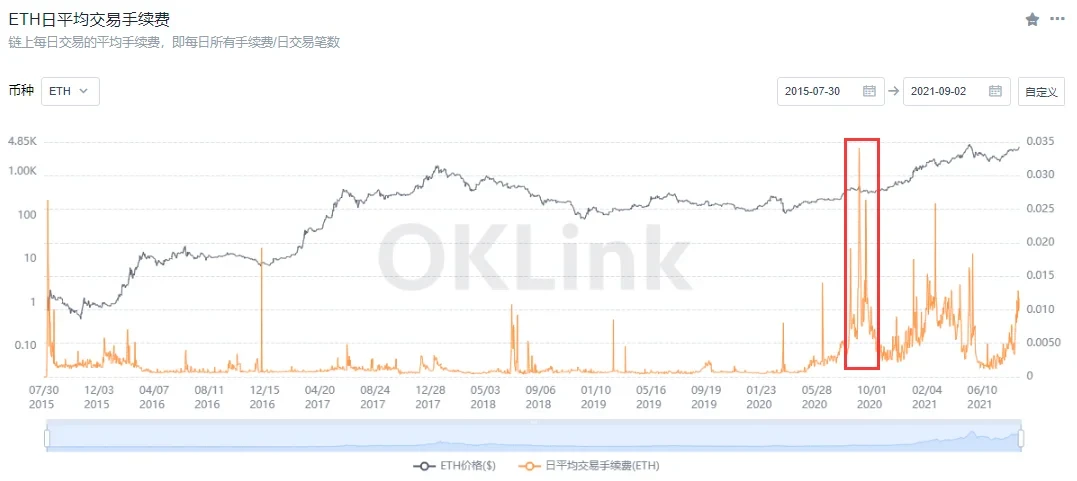
Meanwhile, this year's NFT Summer, despite heated market sentiment, did not experience the large-scale, prolonged congestion seen last year, nor did trading fees spike sharply. The primary reason lies in the fundamentally different application scenarios that DeFi and NFTs侧重 (emphasize). DeFi can largely be viewed as a mapping and transformation of traditional financial markets within the blockchain world. Its core is still finance, and finance's starting point and endpoint must be trading — and trading is inherently high-frequency and around-the-clock, with extremely high demands for speed and efficiency. When all these factors叠加 (compound), a surge in Ethereum on-chain trading fees was inevitable. The NFT sector, on the other hand, actually emphasizes collection and social attributes more — whether GameFi, the sports market, or the art market. This inherently means the trading assets in the NFT sector are difficult to make high-frequency, implying its liquidity is far inferior to the DeFi sector. Even if there are short-term fee spikes, they are usually concentrated within extremely brief windows of intense抢购 (frantic purchasing) for high-profile projects, after which things quickly return to normal.
From Ethereum's ecosystem development, we've glimpsed the身影 (figure) of the metaverse. The metaverse is no castle in the air — it will create an even more cutting-edge digital economy, encompassing finance, social interaction, gaming, and more. The emergence of DeFi and NFTs protects asset rights and circulation in the metaverse, opening up a broader imagination for all of us.
Additionally, OKX NFT platform launched on September 2nd, where users can freely create and trade NFTs. As a one-stop NFT trading platform, OKX NFT will collaborate with artists, creators, celebrities, and more to premiere various quality NFTs, with the first batch of works opening on September 6th.
Disclaimer
This article may contain product information not applicable to your region. This article is intended to provide general information only and does not accept responsibility for any factual errors or omissions. This article represents the author's personal views only and does not represent the views of OKX. This article is not intended to provide any advice, including but not limited to: (i) investment advice or investment recommendations; (ii) offers or solicitations to buy, sell, or hold digital assets; or (iii) financial, accounting, legal, or tax advice. Holdings of digital assets (including stablecoins) involve high risk and may fluctuate significantly, or even become worthless. You should carefully consider whether trading or holding digital assets is suitable for you based on your financial situation. For questions specific to your circumstances, please consult your legal/tax/investment professional. The information in this article (including market data and statistics, if any) is provided for general reference purposes only. Although we have taken all reasonable precautions in preparing this data and these charts, we do not accept any responsibility for any factual errors or omissions expressed herein. © 2025 OKX. This article may be reproduced or distributed in its entirety or may use excerpts of 100 words or less from this article, provided that such use is non-commercial. Any reproduction or distribution of the full article must prominently state: "This article is copyrighted © 2025 OKX, used with permission." Permitted excerpts must cite the article title and include attribution, e.g., "Article Title, [Author Name (if applicable)], © 2025 OKX." Some content may be generated or assisted by artificial intelligence (AI) tools. Derivative works and other uses of this article are not permitted.
Show More
Recommended Reading

2025 KOL Most Used OKX Products Ranking
In the cryptocurrency industry, professional traders' choices are always direct and pure. In 2025, KOLs cast the most authentic votes for industry tools and ecosystem development with their year-long capital investment and time dedication. We centered around four core questions — "What was your biggest achievement this year?", "Given your achievements, what OKX products did you use most and love most in 2025?", "Why do you love it?", "This product...
January 5, 2026

2026 Investment Outlook: Assets Go On-Chain, Intelligence & Privacy | OKX Annual Report
Three major trends shaping crypto's future: asset transformation, entity transformation, and rule transformation. As we stand on the verge of 2026, bidding farewell to four years of focusing on "road-building" infrastructure, the crypto industry is embracing a profound paradigm shift. OKX Ventures defines this as the dawn of the "Kinetic Finance" era, where the core is no longer how fast the network is, but the flow and earning of on-chain assets.
December 31, 2025

Vote with Data — A Deep Dive into 2025 Popular Trading Products | OKX Annual Report
Looking only at price action, it's hard to explain the returns gap between exchange users in 2025. What truly drives returns also depends on account-level operation methods, not just market volatility itself. OKX Annual Statement shows that mainstream coins remain the core for capital周转 (turnover) and returns, supporting trading and strategy execution; emerging coins are more used to amplify volatility and provide staged opportunities, but are not stable, long-term sources of returns. What truly generates...
December 30, 2025
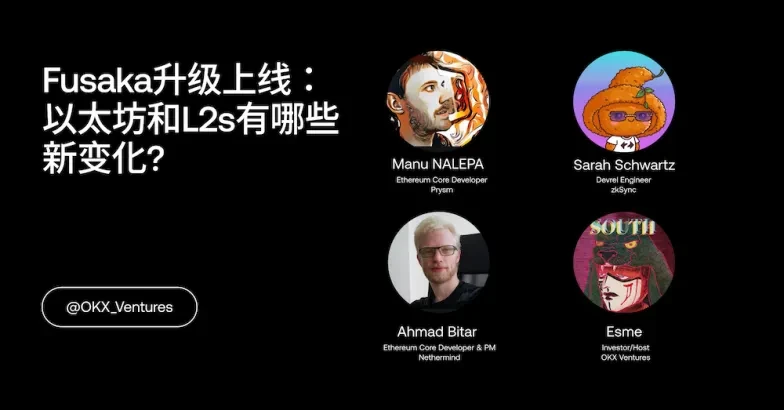
Fusaka in Practice: What Ethereum's Latest Upgrade Means for L2, Nodes, and Users
The Ethereum mainnet has completed the Fusaka fork. From a protocol perspective, this upgrade primarily covers four areas. Full text按 (follows) Q&A三位嘉宾 (three guests) of Show More's core viewpoints and frontline experience: Ahmad (@smartprogrammer) – Nethermind Execution Client / Ethereum Core Developer Manu (@manunalepa) – Prysm / Of
December 16, 2025

OKX Research | Why Did RWA Become a Key Narrative in 2025?
RWA (Real World Assets) is becoming the "new favorite" of global capital. Simply put, RWA is the process of bringing valuable, ownership-bearing things from the real world — such as houses, bonds, stocks, and other traditional financial assets, or even art, private lending, carbon credits, and other assets that are usually difficult to trade directly — onto the blockchain, transforming them into tradeable, programmable crypto assets. This way...
November 20, 2025
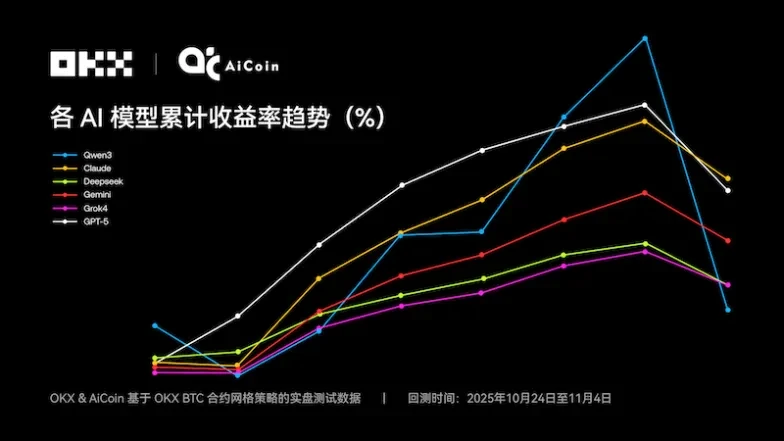
Claude Takes the Crown — 6 Major AI Grid Strategies Face Off | OKX & Ai Coin Live Test
Short-term trading champion , is it also the king of grid strategies? NOF1's "AI Trading Live Arena" first season finally concluded on November 4, 2025 at 6 AM, whetting the appetite of the crypto, tech, and finance circles. But the outcome of this "AI intelligence public test" was somewhat出乎意料 (unexpected). Of the six models' combined $60,000 principal, only $4.3...
November 6, 2025