【Year-End Review】NFT Market: Celebrities Can't Save the Bear Market, OpenSea's Crown Is Shaking
BLUR+3. 15%
As we move into 2022, nearly five years have passed since the concept of NFT "non-fungibility" was established. Five years on, the NFT world has undergone earth-shattering changes — from NFTs being mere card accessories for blockchain games, to now being a red-hot frontier concept and a form of valuable art/collectibles, sought after by celebrities and luminaries worldwide. The era of NFT has undoubtedly arrived. Now, let us focus on the present, examine the current state of NFT development, and review the major events that shaped the NFT world this year.
1. NFT Market Overall Cools Off, High Opening Fades into Disappointment
If we divide NFT development into stages: with the birth of CryptoPunks as a marker, 2015-2016 served as the nascent period; with the launch of CryptoKitties in 2017, the following four years (2017-2020) marked the growth period; 2021 entered the early explosion phase. Entering 2022, in line with the broader crypto market downturn and sluggish trend, the NFT market's performance also showed a pattern of high opening and low closing, failing to sustain the dual explosion of concepts and trading volume that characterized 2021. According to the Google Index, NFT hype peaked in mid-January and has been on a downward trajectory ever since.
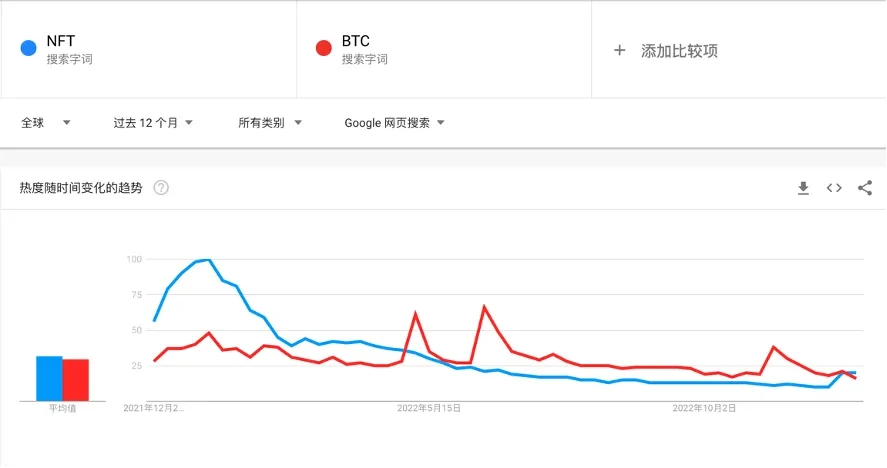
Google Trend Index chart, Source: Google Trends
Specifically, according to NFTGO data, the current total market cap of the NFT market stands at $21.08 billion, representing a decline of nearly 40% from the year's peak of approximately $33.5 billion. Trading volume also saw a sharp drop, and the downtrend was even more pronounced — from an average daily volume of approximately $500 million at the start of the year to below $100 million by mid-June, a decline of approximately 80%. Current average daily trading volume is approximately $60 million, roughly 10% of the start-of-year daily average.
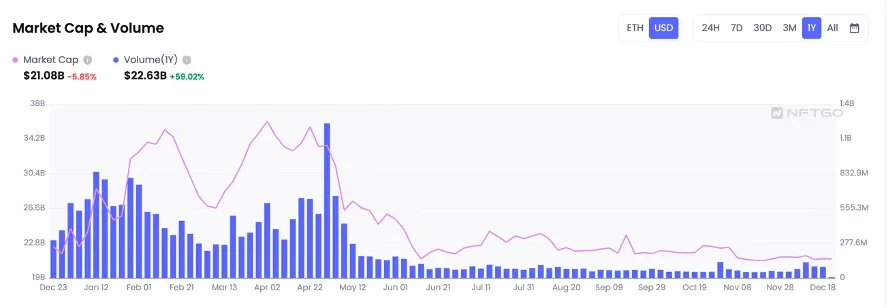
NFT Market Cap and Trading Volume, Source: NFTGO
In addition, NFT active trading users have dropped from over 50,000 daily in January to under 30,000, with both buyers and sellers declining proportionally. Throughout the year, aside from minor fluctuations, the second half has remained at roughly the same level, with no turnaround or recovery. Popular NFT trading platforms like OpenSea and top-performing blue-chip NFTs like the Bored Ape have all seen declining trading activity, signaling a cooling-off in the NFT market and sluggish conditions.
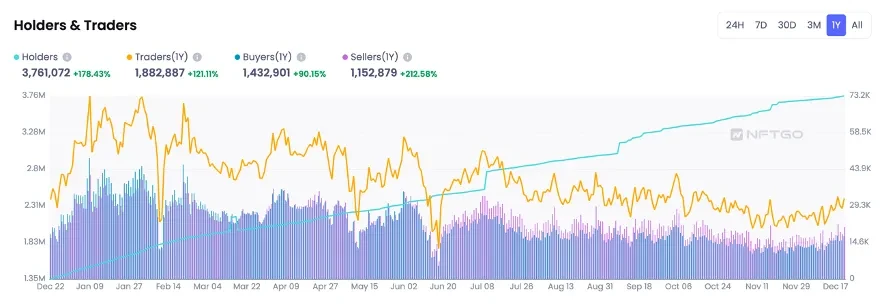
NFT Holders and Traders in the NFT Market, Source: NFTGO
While various metrics declined, some data quietly climbed. The number of NFT holders and NFT-holding wallets in the crypto market continued to grow at a healthy pace. According to NFTGO data, current holder count is 2.78 times that of a year ago, with a total of 3.761 million holders. This indicates that as NFT products proliferated and awareness spread, people's understanding and familiarity with NFTs deepened. As NFT prices returned to more reasonable levels, market泡沫 were largely squeezed out, and willingness to acquire and hold NFTs through buying or minting increased. ETH, often used as the pricing method for NFTs, also saw price declines, making this an attractive entry opportunity for investors.
By category, PFP NFTs account for a commanding 58%, followed by collectibles and gaming NFTs. No new categories emerged in terms of innovation; the market maintained its existing structure with profile picture series leading the way. This is, to some extent, related to the development of decentralized identity verification (DID) in the Web3 space. Moreover, celebrities leveraging their influence to release profile picture NFTs sparked breakout trends, making this category more appealing to market investors.
2. Celebrities and Luxury Brands Fail to Lift the Sluggish Market
Against the backdrop of a sluggish crypto market, capital has been flowing outward, posing a significant challenge to both established NFT platforms and popular blue-chip NFT series in 2022, which has hampered their otherwise robust growth momentum. Does this mean there were no NFT blockbusters? Of course not.
As an emerging and highly extensible track, NFT can be combined with gaming, culture, entertainment, art, and multiple other industries. This gives it inherent high topicality and enormous, rich narrative potential. Backed by crypto community culture and the wealth effect, the market and capital place great hope in NFTs becoming the next growth engine. Early in the explosive 2021 period, major corporations and brands embarked on the "NFT-ization" journey. In 2022, despite the cooling of NFT hype in the crypto market, brands continued to accelerate their use of NFTs to enter Web3 and the metaverse, with NFT serving as a fresh narrative vehicle that injected new vitality into traditional IP marketing, attracting younger consumer demographics and generating renewed attention and influence.
Among luxury brands, Gucci was the earliest to experiment with NFT issuance. In February, it partnered again to launch the "Super Gucci" series — 250 limited-edition NFTs alongside a series of ceramic artworks. Dolce & Gabbana issued the most NFT projects among luxury houses. Other brands like Burberry, NARS, CLINIQUE, and Jimmy Choo also accelerated their NFT initiatives this year. In the athleticwear sector, Adidas's "Into the Metaverse" NFT series launched at the end of 2021 sold nearly 30,000 units within hours of release, with total sales easily exceeding $24 million. After its initial NFT foray, Adidas deepened its NFT branding through a partnership launching a Polygon-network-based NFT project. Li-Ning, in addition to launching a series of NFTs in April, also hosted offline pop-up events, boldly exploring the integration of virtual and physical worlds. In the automotive sector, according to statistics, at least 30+ car brands are planning or actively pursuing NFT implementation, including Porsche, Lamborghini, Ferrari, Rolls-Royce, and other top-tier brands. In the FMCG space, Coca-Cola, Budweiser, and others began NFT experiments as early as 2021. On September 12, Starbucks announced the official launch of Starbucks Odyssey, instantly drawing massive attention. This program delivers a Web3 service experience centered on NFTs, with the beta version launching on December 8.
The momentum of celebrity-driven NFT promotion also remained strong. In 2022, overseas celebrities including boxing legend Muhammad Ali, soccer legend Pelé, David Beckham, Madonna, Cristiano Ronaldo, and Kanye West joined the NFT space in succession, participating in the creation and issuance of NFT series themed around themselves. On January 1, the trending art digital entertainment platform Ezek, in partnership with Jay Chou's brand PHANTANTa Ci, released its first NFT project — Phanta Bear. All 10,000 Phanta Bears sold out in just 40 minutes, with a total value exceeding 62 million RMB. JJ Lin made headlines by purchasing a Bored Ape profile picture and posting related content on social media. On December 16, former U.S. President Donald Trump announced on Truth Social the launch of 45,000 NFTs, each priced at $99, which sold out in just 12 hours. The floor price briefly surged above 0.8 ETH, representing a nearly 9x increase from the minting price, before declining and being affected by controversies over hoarding and copyright infringement. As of this writing, the floor price has dropped to 0.2348 ETH.
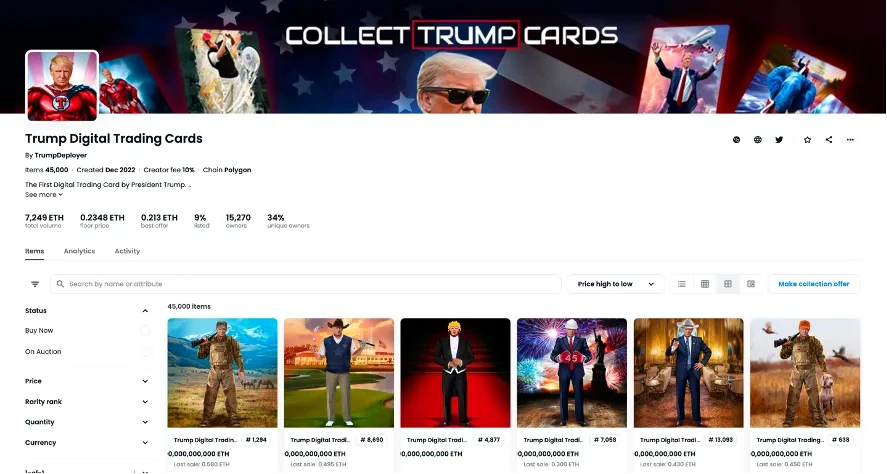
Trump NFT Series, Source: OpenSea
Having covered "celebrity NFTs," let us now look at other trending NFT series beyond the celebrity effect. Represented by projects like Azuki and Moonbirds, they ignited NFT fervor mid-year. On March 31, the Azuki project team announced the creation of a new NFT series called "Something Official," to be airdropped to Azuki holders, officially bringing airdrops into the NFT space. Driven by this news, Azuki's floor price hit an all-time high, surpassing 35 ETH on April 3 — a 24-hour increase of 25.68% and a total increase exceeding 200%. Trading volume surpassed $480 million, with a market cap of approximately $270 million. Later, influenced by the broader market environment and the founder, this blue-chip project's sales volume and price experienced a sharp decline,一度跌出Trading额排行榜前五的位置, temporarily falling out of the top five in trading volume rankings.
In September, the Azuki development team announced the completion of a $30 million Series A funding round. The news propelled the floor price above 10 ETH, and as of this writing, the floor price stands at approximately 11.05 ETH. Following Azuki, PROOF's new NFT work Moonbirds — the "pixel owl" project — rode the wave of momentum. On April 16, the day of its launch, trading volume exceeded $110 million. Two days later, it had already become a top-tier NFT collection, with sales surpassing $281 million. Its minting price climbed from 2.5 ETH to 40 ETH in just 6 days, a staggering 1,500% surge. Similarly, Moonbirds' momentum did not last long — within a month, the floor price retreated to 18 ETH, and as of this writing, it stands at approximately 7.12 ETH. Additionally, the blockchain game The Beacon on Arbitrum officially launched in late November, attracting over 10,000 players within the first week, and over 10,000 NFT items were traded within 10 days of launch.
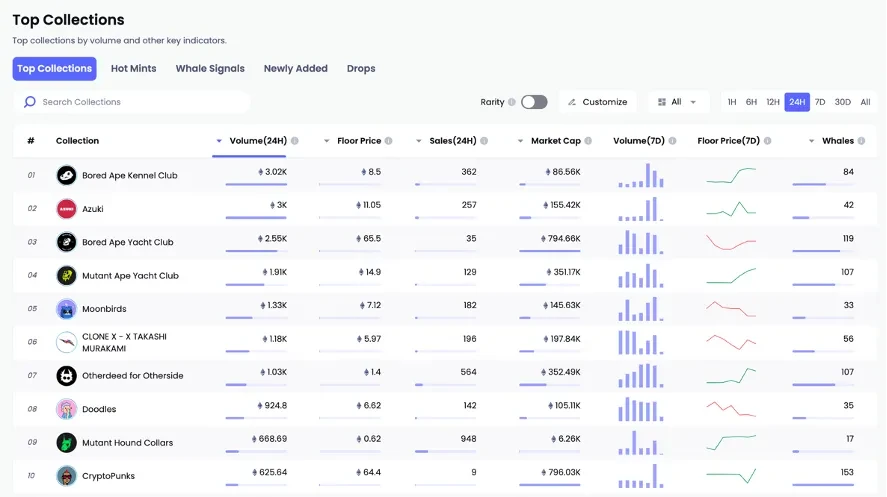
NFT Project Trading Volume Rankings, Source: NFTGO
From the above, we can see that as a crypto track that erupted and developed in 2021, the NFT market is still immature and nascent. Without a robust price-value binding mechanism found in mature markets, the price of an NFT series is strongly correlated with the health of its NFT community ecosystem and is highly susceptible to news-driven sentiment. While Azuki and other NFT projects dazzled the market, a new aesthetic emerged as a counter-trend: ugliness as art. On May 21, the Goblintown NFT was released as a free public sale on Ethereum, sparking the ugliness aesthetic and Free Mint marketing trend. With its grotesque and ugly profile picture style, it instantly became a dark horse in the bear market, rising to become a new trending NFT collection and entering the top three of trading volume rankings. Shortly after, numerous ugly-aesthetic copycat projects emerged, such as ill poop it nft, Mfers, Cryptoadz, and Nouns. However, this aesthetic movement — lacking IP, narrative, and ecosystem — continuously eroded market confidence, and once the hype faded, these projects inevitably fell into obscurity.
3. Battle of the Titans, OpenSea's Dominance Is Under Threat
While market conditions have cooled, several NFT marketplaces are heating up. OpenSea's challengers keep emerging, and the NFT trading market is seeing a proliferation of competitors. The current NFT market landscape also presents a pattern of one dominant player with multiple strong contenders. Previously, OpenSea remained the largest NFT trading platform, commanding over 40% of the market share — down from 90% just a year ago.
As OpenSea's team and 721 Club became embroiled in corruption scandals, internal conflicts, and development进度 missed expectations, platforms like Looks Rare and X2Y2 were presented with opportunities to catch up. Looks Rare and others quickly targeted OpenSea by distributing airdrops and establishing incentive mechanisms.
Meanwhile, NFT aggregation platforms like OKX NFT Marketplace quickly gained attention and rose to prominence. These platforms not only consolidated previously fragmented NFT liquidity but also allowed users to simultaneously compare prices, trade, and efficiently reduce trading costs while meeting the bulk-purchase needs of trading whales. Going forward, integrating and analyzing trading market information and data, along with aggregation trading, will remain a primary demand in the NFT market. NFT aggregation platforms that can satisfy these needs are poised to become the dominant trend.
Beyond these more established NFT platforms, Blur emerged as a rising star in the NFT market. Since its October launch, it attracted numerous NFT traders through multiple funding rounds and airdrops, along with incentives including zero marketplace fees and customizable royalties. Its trading volume surpassed OpenSea's, and driven by expectations of future medium- to long-term airdrops, its momentum has not waned, making it the current #1 platform by trading volume in the NFT market. Whether it can secure its position at the top and build long-term user retention remains to be validated by the market.
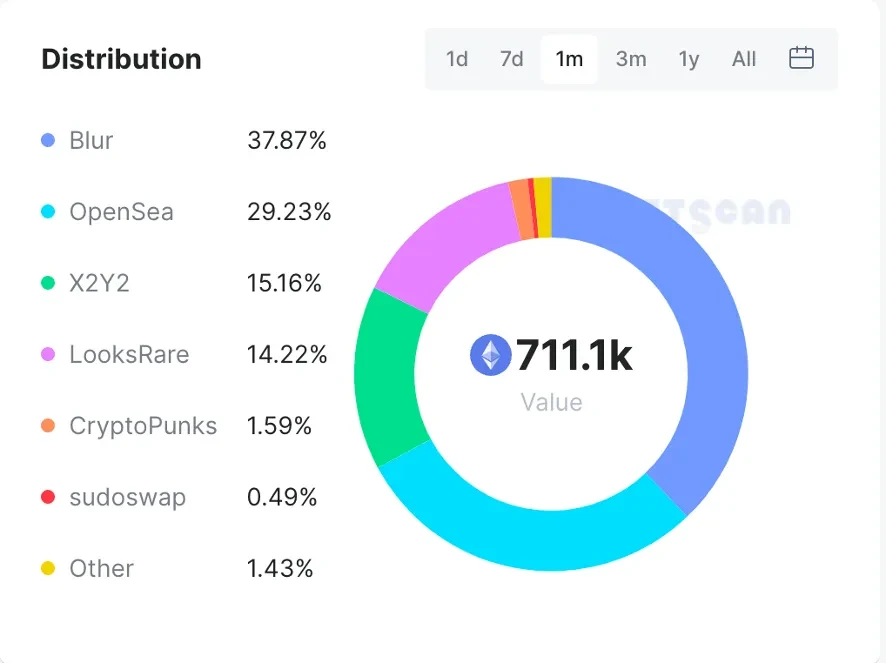
NFT Platform Trading Volume Within One Month, Source: NFT Scan
Beyond NFT platforms, NFT infrastructure development is also in full swing. Looking at public chains: Ethereum remains the chain with the most NFT trading activity, accounting for a commanding 90%. In terms of sales volume, Ethereum also remains the dominant chain. Although Ethereum still enjoys a first-mover advantage in the NFT space, the NFT boom has also created opportunities for its competing chains. For instance, Solana — backed by its high performance and mature ecosystem — places strong emphasis on community building and culture cultivation, attracting an increasing number of NFT project deployments and forming a market dominated by GameFi and PFP. Tezos took an alternative path, leveraging regional development to scale its NFT ecosystem, attracting a large group of artists in Southeast Asia to solidify its leading position in the art field. Flow, thanks to its collaborations in sports IP and similar areas, stands out uniquely and has become the birthplace of breakout sports-themed projects. WAX and other NFT or GameFi vertical public chains can provide richer expansion solutions for related DApps, so their performance in sales volume is not significantly different from Ethereum's. Currently, Immutable X and Ronin's NFT trading volume share has grown to rival Ethereum's, already establishing them as major markets for NFT trading.
Summary
As major IP holders, capital, and celebrities pour into NFTs, projects like CryptoPunk and BAYC remain the leading projects and evergreen mainstays of the market. This illustrates what a quality blue-chip NFT should look like: not only must it have mainstream-compliant aesthetics, but it also requires an experienced development team, a long-term sustainable operations team, and a community with cultural cultivation and development awareness. A strong IP and compelling storytelling can provide tremendous added momentum to a project.
Looking ahead, while intense competition is expected to continue, we can remain hopeful. The NFT market never lacks fresh blood and innovative momentum. Market volatility better squeezes out泡沫 and allows truly valuable projects to reveal their worth more completely. As one of the newest segments to emerge in the crypto track, the NFT market deserves more time, patience, and confidence. We believe the NFT market will continue to produce more innovative categories, more quality projects, and create even more "wealth-generation legends."
Disclaimer
This article may contain product-related content not applicable in your region. This article is intended to provide general information only and makes no representation as to any factual errors or omissions. The views expressed in this article are solely those of the author and do not represent OKX's views. This article is not intended to provide any advice, including but not limited to: (i) investment advice or investment recommendations; (ii) offers or solicitations to buy, sell, or hold digital assets; or (iii) financial, accounting, legal, or tax advice. Holding digital assets (including stablecoins) involves a high degree of risk and may fluctuate significantly or even become worthless. You should carefully consider whether trading or holding digital assets is appropriate for you based on your financial situation. For questions specific to your circumstances, please consult your legal/tax/investment professional. The information contained in this article (including market data and statistics, where applicable) is provided for general reference purposes only. While we have taken all reasonable precautions in preparing this data and these charts, we accept no responsibility for any factual errors or omissions expressed herein. © 2025 OKX. This article may be reproduced or distributed in its entirety or used in excerpts of 100 words or less, provided that such use is non-commercial in nature. Any reproduction or distribution of the full article must prominently state: "This article is copyrighted © 2025 OKX, used with permission." Permitted excerpts must cite the article title and include attribution, for example: "Article title, [author name (if applicable)], © 2025 OKX." Certain content may have been generated or assisted by artificial intelligence (AI) tools. Derivative works and other uses of this article are not permitted.
Show More
Recommended Reading

2025 KOL Most Used OKX Products Ranking
In the cryptocurrency industry, professional players' choices are always direct and pure. In 2025, KOLs cast the most authentic votes for industry tools and ecosystem development with their year-round capital investment and time commitment. We focused on four core questions: "What was your biggest achievement this year?", "Given those achievements, what OKX products did you use and love most in 2025?", "Why do you like it?", "Does this
January 5, 2026

2026 Investment Outlook: On-Chain Assets, Intelligence and Privacy | OKX Annual
The three major trends shaping Crypto's future: asset transformation, entity transformation, and rule transformation. At the threshold of 2026, bidding farewell to four years of focused "road-building" infrastructure, the crypto industry is experiencing a profound paradigm shift. OKX Ventures defines this as the dawn of the "Kinetic Finance" era — where the core is no longer how fast the network is, but the flow and monetization of on-chain assets
December 31, 2025

Voting with Data: A Deep Dive into 2025's Hottest Trading Products | OKX Annual
Looking at price action alone, it's hard to explain the return differentials among 2025 trading users. What truly drives returns also depends on account-level trading methods, not just market volatility itself. OKX's annual report shows that mainstream coins remain the core of capital turnover and return承载, supporting trading and strategy execution; emerging tokens are more often used to amplify volatility and provide阶段性机会, but are not a stable, long-term source of returns. What truly and consistently generates returns is
December 30, 2025
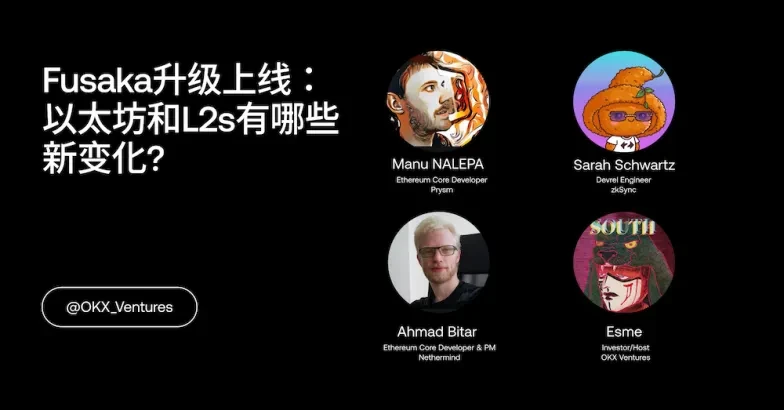
Fusaka in Practice: What Ethereum's Latest Upgrade Means for L2, Nodes, and Users
Ethereum mainnet has completed the Fusaka fork. At the protocol level, this upgrade mainly covers four areas. Full text features Q&A with three guests' core viewpoints and front-line experience: Ahmad (@smartprogrammer) – Nethermind Execution Client / Ethereum Core Developer Manu (@manunalepa) – Prysm / Of
December 16, 2025
OKX Research | Why RWA Became a Key Narrative in 2025
RWA (Real World Assets) is becoming the "new favorite" of global capital. Simply put, RWA involves taking valuable, ownership-bearing assets from the real world — such as real estate, bonds, stocks, and other traditional financial assets, or even art, private lending, and carbon credits that are not typically easy to trade directly — and bringing them onto the blockchain, transforming them into tradeable, programmable crypto assets. This way,
November 20, 2025
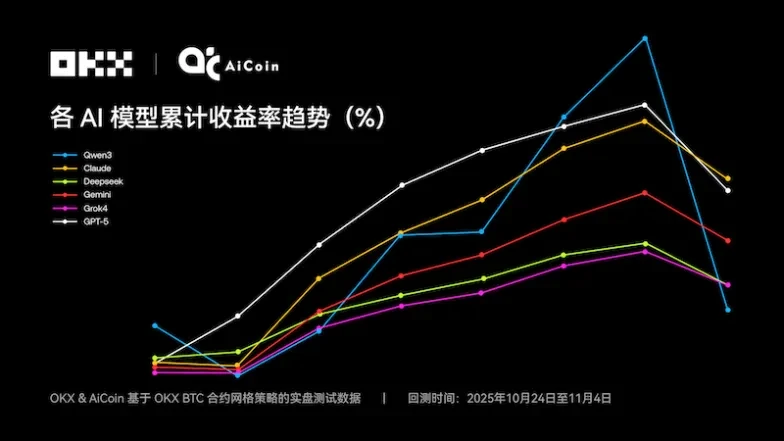
Claude Wins the Championship, 6 Major AI Grid Strategies Battle It Out | OKX & Ai Coin Live Test
Short-term trading champion — is it also the king of grid strategies? The first season of NOF1's "AI Trading Live Arena" finally concluded at 6 AM on November 4, 2025, whetting the appetite of the crypto, tech, and finance communities. But the outcome of this "AI intelligence public test" was somewhat unexpected. Of the six models' combined $60,000 in starting capital, the final tally was only $4.3
November 6, 2025