OKX Children's Day Special: Inside the "Crypto Kids" Upbringing Plans of Ten Crypto Insiders
Ten years ago, Bitcoin was a tech novelty; ten years later, it has become a global consensus of value.
If ten years ago, buying Bitcoin was important; today "leaving some Bitcoin for the kids" may be the most visionary decision.
An apartment may be subject to purchase restrictions, depreciation, or even be eliminated by the times; while a Bitcoin is a free chip that can cross borders and resist risks.
It's not just an asset, but a greater option we leave for the next generation—in the future world, having more possibilities, a life not defined by the system.
As Children's Day approaches, let's start from the real perspective of industry practitioners and join OKX in discussing a bold yet realistic question:
How top crypto dads are passing on Bitcoin, and how to let "crypto kids" win at the starting line~~
Shenyu Co-founder and CEO of Cobo

Q: For you, is "leaving some Bitcoin for the kids" more of a belief or a hedge? Many people worry it's too late to enter now. What's your take on the timing for "ordinary people to get in"?
**A: **Although I used to think that way and planned to leave some BTC for my child, my perspective has shifted this year—excessive crypto assets can easily weaken their desire to explore and sense of responsibility. I'll only use a small amount of Bitcoin as a baseline guarantee, treating curiosity and values as the true family heirloom.
For ordinary people, entering the crypto world doesn't depend on "early or late," but on willingness to grow with the industry cycle. Today's market infrastructure, regulations, and application ecosystem are far better than before, bringing higher survival probability while also compressing the space for excess returns. **Latecomers should: **First assess their risk threshold and cash flow to determine an affordable long-term position; use dollar-cost averaging rather than one-time heavy positions to spread timing risk into time dividends; treat buying crypto as obtaining a learning ticket, tracking technological evolution, experiencing practical applications, letting cognition and assets appreciate together. This way, missing the early days doesn't mean losing the opportunity; with a clearer perspective, you get a steadier compound interest curve rather than stimulating volatility.
Ni Sen Top KOL
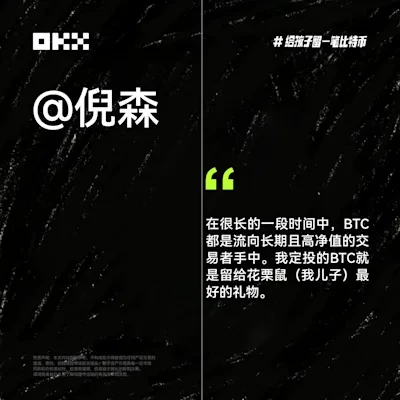
Q: How do you view more and more people who "question Bitcoin as a scam" starting to quietly dollar-cost average? Some say "trading gold preserves value, trading Bitcoin is the future"—do you agree? If a parent who doesn't understand crypto asks you: "Can I really leave Bitcoin for the kids? Is this reliable?" How would you answer?
**A: **As a long-term Bitcoin trader who dollar-cost averages BTC, I firmly believe in BTC's future. Compared with gold, BTC's hedging attribute isn't particularly strong, after all BTC price volatility is still quite large, but as BTC goes further in compliance and more high-net-worth traders are willing to treat BTC as a trading strategy, I believe BTC's future will be better.
Also I want to say one thing: data already shows that for a long time, BTC has been flowing to long-term and high-net-worth traders. Data from 13F filings and spot ETFs both show that American high-net-worth traders and institutions hold more and more BTC, which also drives the "DCA" herd effect. From my first BTC purchase in 2018 to now, I've been increasing my BTC position, with monthly BTC DCA. These BTCs are the best gift I leave for Chihuahua (my son), and I believe BTC can play a greater financial role in the future.
UNICORN Top KOL
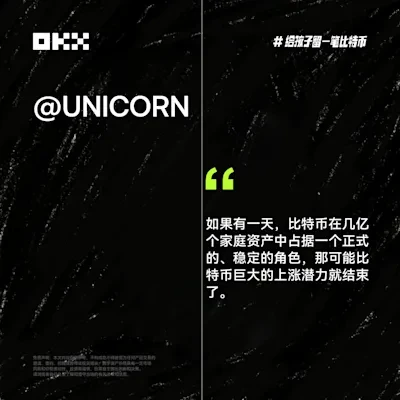
Q: "Leaving a house for the kids is not as good as leaving one Bitcoin"—do you think this statement is reliable? Or how would you interpret the anxiety and hope behind it? Do you think Bitcoin can occupy a formal, stable role in family assets in the next few years?
**A: **From an upside potential perspective, Bitcoin's gains are huge with unlimited potential. For example, reaching 1 million USD per coin, but it requires a process, timeline unknown, possibly taking many years. But a house, say a house currently worth 1 million USD, while having limited upside potential far below Bitcoin, is currently valuable. So work hard and change it to leaving 10 Bitcoins instead, which might be more reliable.
Different families, I guess. This world rewards the first wave to embrace new things. For myself, Bitcoin is already such a family asset, but if one day Bitcoin occupies a formal, stable role in family assets for hundreds of millions of families, then Bitcoin's huge upside potential might be over, becoming like gold—an asset that rises within 30% annually, and I might need to look for the next asset with higher upside potential.
Mandy Founder of Odaily Planet Daily
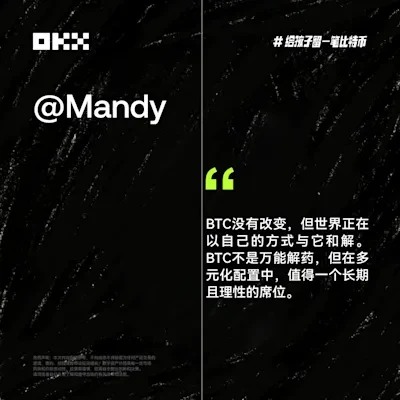
Q: From a media perspective, how do you view Bitcoin's "reputation reversal" over the past decade? Do you think the time has come to seriously discuss "treating Bitcoin as part of family assets"?
**A: **Bitcoin's "reversal" is essentially the mainstream world's re-cognition of its value. Ten years ago, it was seen as an edge technology challenging regulation; today, exchanges are on the compliance path, many countries have clarified regulatory frameworks, and US Bitcoin ETFs have achieved trading volume in the hundreds of billions. This is not only institutional acceptance of Bitcoin's underlying logic but also legitimizing it in the global asset allocation system. When Wall Street enters and policy gradually standardizes, Bitcoin changes from "rebel" to "part of the system." It hasn't changed, but the world is reconciling with it in its own way.
Yes, especially from a global perspective, this is no longer a frontier topic but a practical consideration. High inflation, frequent wars, currency depreciation—these have become common in many countries, and the "cross-system security" of family assets is becoming increasingly important. As a decentralized asset not dependent on any single sovereign, Bitcoin offers a logical alternative. More importantly, its total supply is fixed, institutions continue to enter, global consensus is expanding, and long-term it still has price support from scarcity. It's not a panacea, but in diversified allocation, it deserves a long-term and rational position.
Huang Mingliang Founder of DeepTech Tide Tech Flow
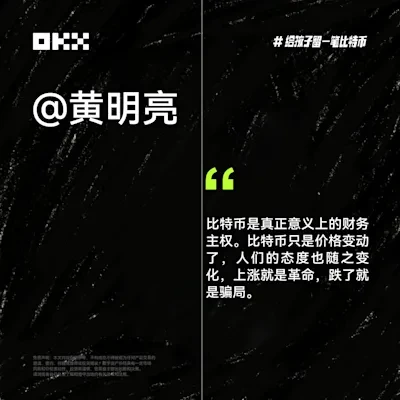
Q: As a senior media professional, in your eyes, what has Bitcoin "changed" in these ten years? What has "not changed"? What is Bitcoin to you personally? What's your personal trading logic and allocation method?
**A: **Bitcoin's "changes" are mainly external. Ten years ago, it was still a toy for geeks; now it has entered the trading portfolios of global listed companies, developing from a niche geek experimental project to a mainstream asset, with prices rising from a few dollars to hundreds of thousands of dollars. Meanwhile, the ecosystem built around Bitcoin is increasingly perfect, from trading infrastructure to derivative applications, spawning a brand-new digital economy field.
"Unchanged" is internal. Bitcoin's core principles remain unchanged—for example, the 21 million total supply, PoW mechanism and other basic elements have never changed. More importantly, Bitcoin's value narrative about fighting inflation and safeguarding financial sovereignty has not weakened over the decade but has been verified and strengthened multiple times in global financial turmoil. You see, Bitcoin is still that Bitcoin, only the price has changed, and people's attitudes have changed with it—up means revolution, down means scam. Life is actually the same. When your life's K-line rises, you hear praise and cheers; when your life's K-line falls, you hear scam questions. Self-strength then all-strength. Be a person like Bitcoin.
When I first learned about Bitcoin, I was deeply impressed by something Li Xiaolai said. He said Bitcoin is the first time in human history that private property sacred and inviolable was achieved through technological means. In my view, this is Bitcoin's value—true financial sovereignty. So for me, Bitcoin is life-saving money, while also holding the philosophy of "saving enough Bitcoin for the next generation." Bitcoin can be a legacy, of course, provided there is a next generation. As for Bitcoin, I've suffered too many losses. For example, I once had over one Bitcoin on an exchange that later ran away, and I also listened to "friend recommendations" and "insider tips" before a bull market, selling Bitcoin to buy certain altcoins, resulting in a 70% loss. So now for Bitcoin, my choice is just to hold it, don't attempt to swing trade, sooner or later you'll swing the coins away. Recognizing what kind of dog you are is very important.
Wesley Web3 Silicon Valley Chinese Serial Entrepreneur
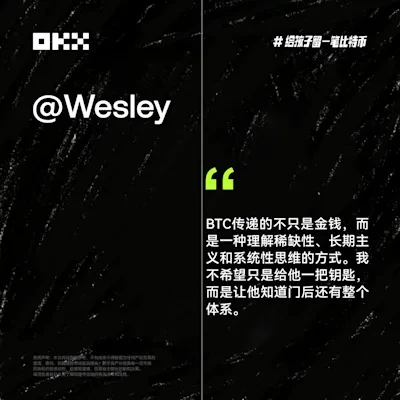
Q: What do you think is the biggest misconception the public has about Bitcoin? From an asset allocation perspective, is adding Bitcoin to a child's "starting line" bold or reasonable? If you really decided to leave Bitcoin for your child, when would you tell them? What do you hope this asset conveys?
**A: **From an asset allocation perspective, I don't think this is "bold" but "forward-looking." What's left for the child is not just money but a stepping stone to participate in future global value reconstruction. If I really were to leave Bitcoin for my child, I might not tell them too early—I hope after age 18, when they have their own cognition of "value," then open this "time capsule." Let Bitcoin accompany their growth. This asset conveys not just money but a way to understand scarcity, long-termism, and systems thinking. I don't want to just give them a key but let them know there's an entire system behind the door.
Jeffrey PA News Operations Director

Q: If it were you, would you leave Bitcoin for your child? Is this emotionally driven or a cognitive choice? As a parent, how would you view the idea of "leaving Bitcoin for children"? How would you explain "the meaning of Bitcoin" to your child?
**A: **The answer is yes, and I've already done so. I believe many crypto parents will do the same. Dual drive of cognition + emotion. Cognition determines what I do, emotion determines how much I leave. Each generation has its own gold. Like the older generation buying gold for descendants, I also buy a certain amount of Bitcoin on important days like the child's birth, Chinese New Year, market crashes, and transfer it to a wallet prepared for the child. By the way, I've also hoarded a little Ethereum for the kid.
I think this idea will become increasingly common, like buying insurance for children now. At this stage, I still won't explain the meaning of Bitcoin to the child. Because this generation is born or living in the era of information explosion and the era of crypto moving toward large-scale application. Cognition of crypto assets and Bitcoin should gradually accumulate through learning, social interaction, and daily use. Of course, during growth, we need to help children establish correct values and worldview. When they have some cognition of money and consumption, allow the child to control part of the Bitcoin.
Tiny Bear Initiator of Chainverse Community
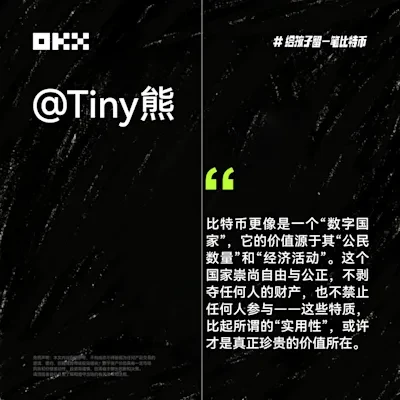
Q: How do you view Bitcoin? From a parent's perspective, what do you think is the value of letting children have Bitcoin?
**A: **Many people are accustomed to using company valuation logic to measure Bitcoin's value, believing that from a "utility" perspective, Bitcoin doesn't seem to have a truly usable "product," thus concluding it shouldn't be valuable. But in my view, Bitcoin is more like a "digital nation," and its value comes from its "citizen count" and "economic activity." This nation advocates freedom and fairness, doesn't deprive anyone of property, and doesn't prohibit anyone from participating—these traits, compared to so-called "utility," might be the truly valuable aspects.
Letting children have Bitcoin is a way to help them understand "long-termism." Life is the same. In the short term, we might be in a trough or briefly reach the peak. But we hope children don't focus too much on momentary gains and losses but learn to focus on themselves and maintain determination. Like Bitcoin, life's returns also come from the compound interest given by time.
Tony Li Dragonfly Post-Investment Head
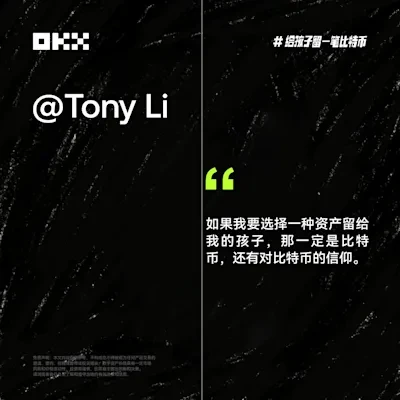
Q: Compared with traditional assets like real estate and gold, what does Bitcoin represent? Has Bitcoin become part of your family asset allocation? Why?
**A: **Working in the industry for nearly ten years, for me, Bitcoin is a deep belief. It represents a more efficient, freer, more risk-resistant new asset paradigm. Compared with traditional assets like real estate and gold, Bitcoin's core advantages are mainly reflected in three aspects: better efficiency and liquidity, greater long-term value storage potential, and better ability to respond to world change risks.
Yes, Bitcoin is now a quite important part of my family asset allocation. I think it's the asset that will benefit our next generation most. If I were to choose one asset to leave for my child, it would definitely be Bitcoin, along with faith in Bitcoin.
On-Chain Expert Top KOL

Q: More and more parents are seriously considering allocating Bitcoin for children. What does this indicate? How does your current view of Bitcoin differ from the past? Why this change?
**A: **Bitcoin has become a mainstream asset, even able to stand on equal footing with traditional financial assets. Bitcoin's consensus continues to expand. Many parents already view Bitcoin as a long-term trading tool, similar to buying education funds for children. The traditional financial system has many unstable factors, and Bitcoin can perfectly solve these pain points. Allocating Bitcoin for children is the most advanced form of wealth transfer.
The biggest difference is cognition of trading returns. Previously, I thought Bitcoin's market cap was too large, upside less than altcoins, and that retail traders buying altcoins or Memes could defy fate and change their destiny, so I hoarded a bunch of altcoins, Memes, NFTs. The result was that most assets underperformed Bitcoin but dropped more fiercely than one another. The reason is that as more institutions and users outside the circle enter, Bitcoin is the recognized first choice for trading. For retail traders, while you can use methods like airdrop hunting and memecoin surfing to turn small into large, the most scientific approach after getting returns is to convert to Bitcoin.
Disclaimer
This article may contain product-related content not applicable to your region. This article is intended only to provide general information and is not responsible for any factual errors or omissions herein. This article represents only the author's personal views and not the views of OKX. This article is not intended to provide any of the following advice, including but not limited to: (i) investment advice or investment recommendations; (ii) offers or solicitations to buy, sell or hold digital assets; or (iii) financial, accounting, legal or tax advice. Holding digital assets (including stablecoins) involves high risk, may fluctuate significantly, or even become worthless. You should carefully consider whether trading or holding digital assets is suitable for you based on your financial situation. For questions about your specific situation, please consult your legal/tax/investment professional. Information appearing in this article (including market data and statistics, if any) is for general reference only. While we have taken all reasonable precautions in preparing these data and charts, we assume no responsibility for any factual errors or omissions expressed herein. © 2025 OKX. This article may be reproduced or distributed in full, or excerpts of 100 words or less from this article may be used, provided such use is non-commercial. Any reproduction or distribution of the entire article must also prominently state: "This article copyright © 2025 OKX, used with permission." Permitted excerpts must cite the article name and include attribution, such as "Article Name, [Author Name (if applicable)], © 2025 OKX". Some content may be generated or assisted by artificial intelligence (AI) tools. Derivative works or other uses of this article are not permitted.
Show More
Shenyu Co-founder and CEO of Cobo
Ni Sen Top KOL
UNICORN Top KOL
Mandy Founder of Odaily Planet Daily
Huang Mingliang Founder of DeepTech Tide Tech Flow
Wesley Web3 Silicon Valley Chinese Serial Entrepreneur
Jeffrey PA News Operations Director
Tiny Bear Initiator of Chainverse Community
Tony Li Dragonfly Post-Investment Head
On-Chain Expert Top KOL
Recommended Reading

2025 KOL Most Used OKX Products Ranking
In the cryptocurrency industry, professional players' choices are always direct and pure. In 2025, KOLs used a full year of fund investment and time accumulation to cast the most genuine vote for industry tools and ecosystem development. We centered on four core questions—"What was the biggest achievement this year?", "Given the achievements, what OKX products did you use most and like most in 2025?", "Why do you like it?", "This
January 5, 2026

2026 Investment Outlook: Assets On-Chain, Intelligence & Privacy | OKX Annual Record
Crypto's three major trends: asset transformation, entity transformation, and rule transformation. As we are about to enter 2026, saying goodbye to the past four years of "road-building" infrastructure focus, the crypto industry is welcoming a profound paradigm shift. OKX Ventures defines this as the opening of the "Kinetic Finance" era, where the core is no longer how fast the network is, but the flow of on-chain assets and money-making
December 31, 2025

Voting with Data: Inside 2025's Hot Trading Products | OKX Annual Record
If you only look at market trends, it's hard to explain the return differences between exchange users in 2025. What truly determines returns also depends on account-level operation methods, not just market volatility itself. OKX annual statements show that mainstream coins are still the core of fund turnover and return bearing, supporting trading and strategy execution; emerging coins are more used to amplify volatility, providing phased opportunities, but are not stable, long-term return sources. What truly continuously contributes returns,
December 30, 2025
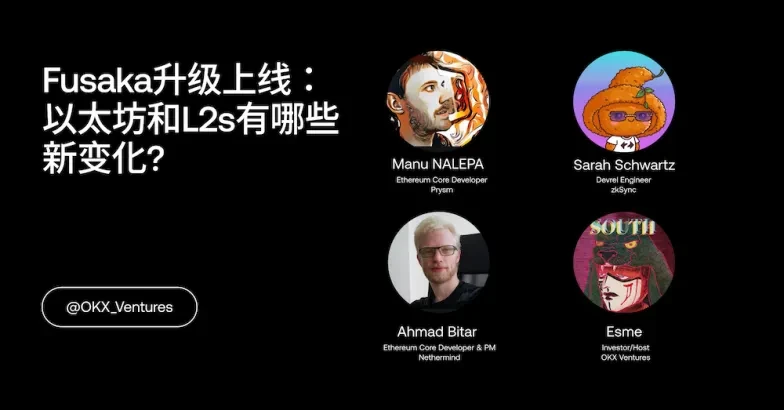
Fusaka in Practice: What Does Ethereum's Latest Upgrade Mean for L2, Nodes, and Users?
Ethereum mainnet has completed the Fusaka fork. From a protocol level, this upgrade mainly includes four parts, full text Q&A with the three guests' core views and frontline experience: Ahmad (@smartprogrammer) – Nethermind execution client / Ethereum core developer Manu (@manunalepa) – Prysm / Of
December 16, 2025

OKX Research | Why Did RWA Become a Key Narrative in 2025?
RWA (Real World Assets) is becoming a global capital "new favorite." Simply put, RWA takes valuable, ownership-bearing things from the real world—like houses, bonds, stocks and other traditional financial assets, even art, private lending, carbon credits and other assets not usually easily tradable—and moves them onto blockchain, becoming tradable, programmable crypto assets. This way, no
November 20, 2025
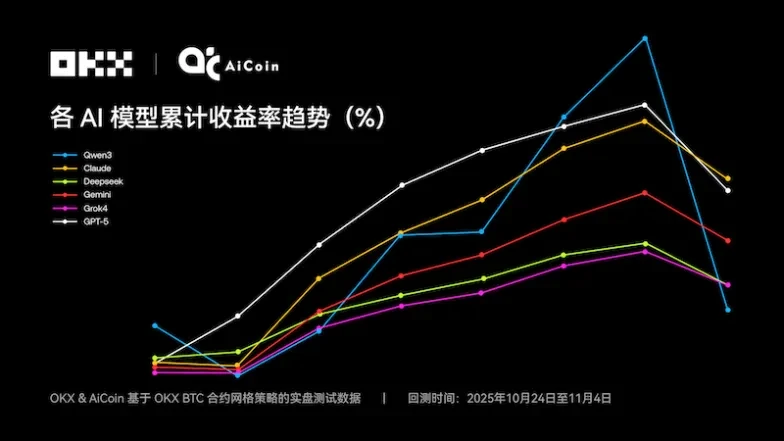
Claude Takes Championship, 6 Major AI Grid Strategy Showdown Truth | OKX & Ai Coin Live Trading Review
Short-term trading champion Qwen3, is it also king in grid strategies? The first season of the "AI Trading Live Arena" launched by NOF1 finally concluded at 6 AM on November 4, 2025, whetting the appetites of the crypto, tech and finance circles. But the ending of this "AI IQ public test" was somewhat unexpected. The six models' total 60,000 USD principal was only 43
November 6, 2025