OKX Research | Why RWA Became a Key Narrative in 2025?

RWA (Real World Assets) is becoming the "new favorite" of global capital.
Simply put, RWA involves bringing valuable, ownership-backed assets from the real world—such as traditional financial assets like houses, bonds, and stocks, as well as assets that are typically difficult to trade directly like artwork, private lending, and carbon credits—onto the blockchain, transforming them into tradable, programmable crypto assets. This way, regardless of your location, you can trade these assets on-chain around the clock at low cost.
OKX Research believes that RWA is not a short-lived crypto trend, but an important bridge for the convergence of Web3 and the multi-trillion dollar traditional financial market. From asset securitization in the 1970s to today's RWA transformation, the core has always been enhancing asset liquidity, reducing trading costs, and expanding the user base. This report aims to provide an in-depth analysis of the RWA sector landscape and explore these future possibilities.
I. RWA Market Overview: Development History, Scale, and Institutional Drivers
Take the rental scenario as an example: RWA is reconstructing the traditional model—no intermediary needed, no "deposit three, pay three" requirement, mobile-based "rent for one month" can enable automatic deduction for check-in; at check-out, "one-click settlement" returns deposits instantly; temporary relocation allows on-chain transfer of remaining lease term, with full transparency and immutability. Landlords achieve complete on-chain property rights confirmation through RWA, rent is automatically distributed via smart contracts, and they can even securitize "future lease terms" or "rental yield rights" in advance. RWA transforms real estate into flexibly circulating crypto assets, enhancing efficiency.
RWA is the inevitable result of making traditional financial assets machine-readable on-chain. It's not creating new assets, but building a brand new, efficient operating environment for existing assets.
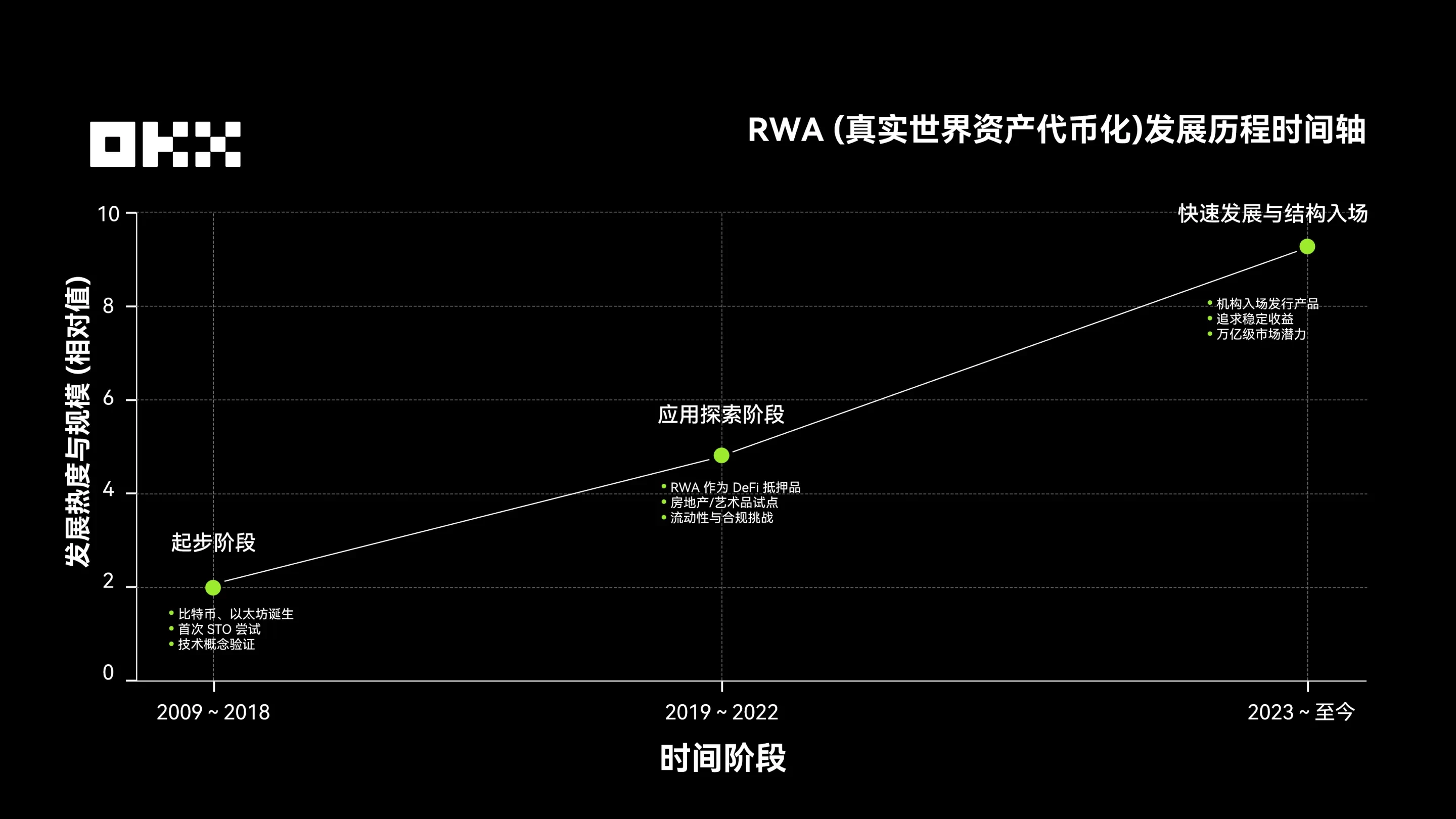
RWA's development has roughly gone through three stages: 2009-2018 was the startup phase, with Bitcoin and Ethereum being born successively, launching early exploration of asset tokenization and STO; 2019-2022 entered the application exploration phase, with RWA being introduced into DeFi as collateral, and assets like real estate and artwork beginning on-chain pilots, though still facing liquidity and compliance challenges; since 2023, as investors pursue stable returns and institutions actively issue tokenized products, the RWA market has entered a rapid development phase, with scale continuing to expand, moving toward a trillion-dollar new financial market.
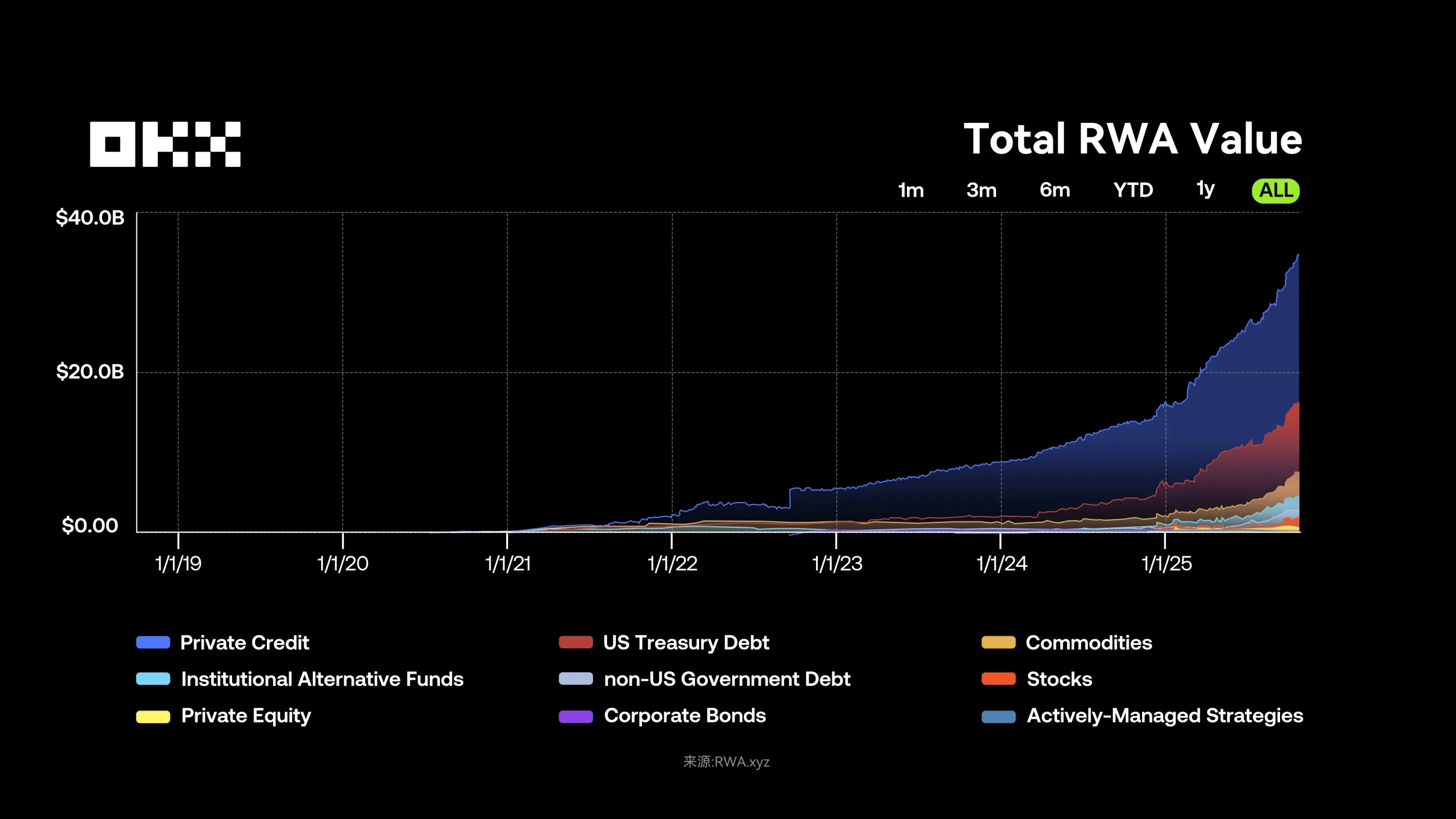
Especially from a macro perspective, RWA first improves payment and collateral efficiency, then expands to credit, and ultimately supports AI wallet trading, potentially reshaping capital markets over the next five to ten years. The RWA market scale has shown exponential growth since $50 million in 2019, with particularly significant growth in 2024-2025. As of November 3, 2025, total on-chain RWA (excluding stablecoins) reached $35 billion, growing over 150% year-over-year; total stablecoin market cap exceeded $295 billion, with over 199 million holders, reflecting that the tokenization narrative is moving from concept to large-scale application.
According to DeFi Llama data, global RWA total value locked (TVL) reached $18.117 billion, continuing the growth trend. (Note: Total on-chain RWA statistics refer to the total value of all related tokens issued on-chain; while TVL specifically refers to the value of RWA deposited in DeFi protocols as collateral or yield-bearing assets. A significant portion of RWA (such as BlackRock's BUIDL) is held directly by users in wallets and not deposited into DeFi protocols, so TVL will be far less than total issuance.)
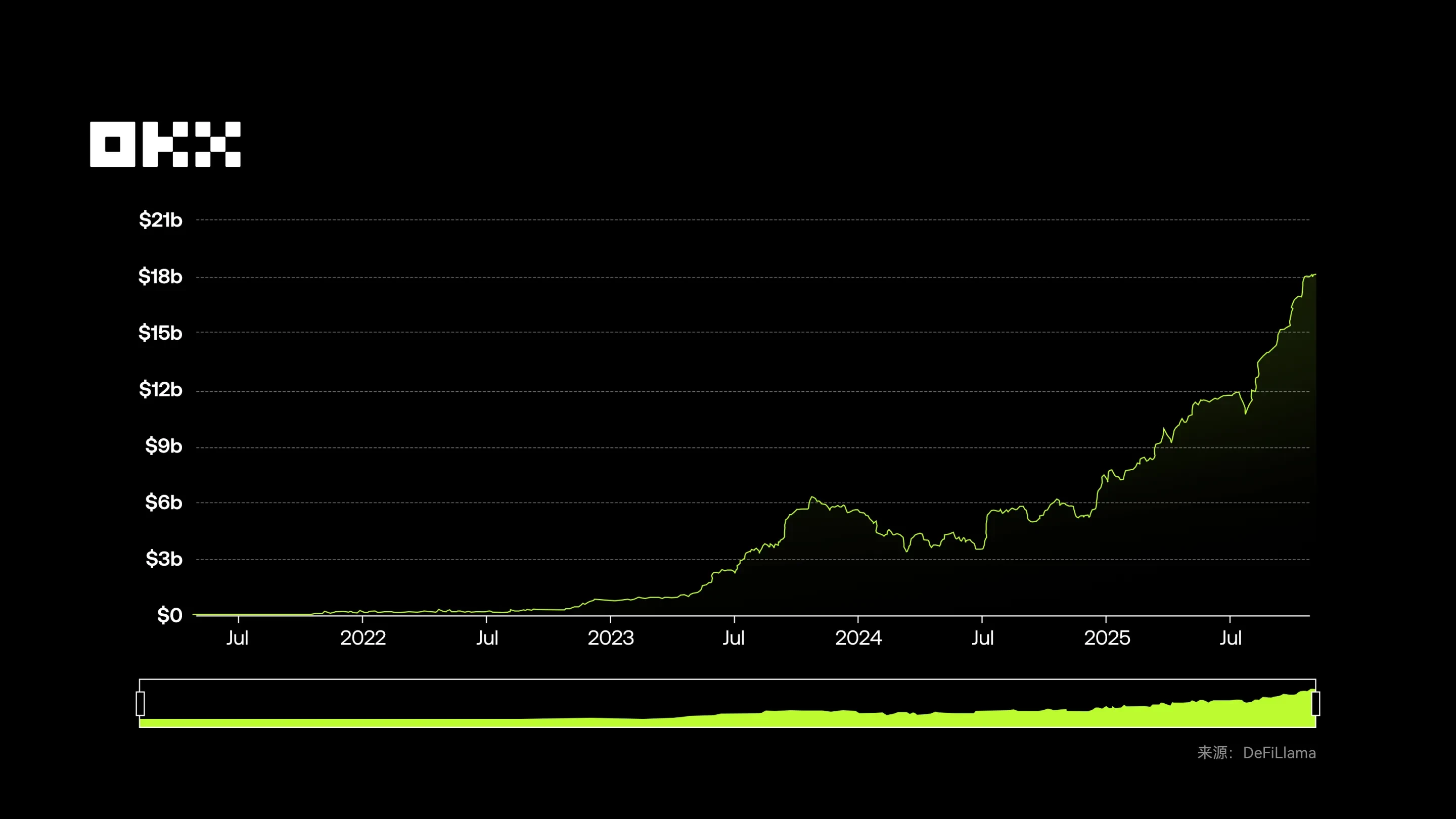
This growth stems from the resonance of institutional entry, regulatory clarity, and technological maturity: uncertain global interest rate environments have made tokenized U.S. Treasury bonds (~4% yield) the preferred low-risk asset for DeFi users and institutions; regulatory frameworks like the EU's MiCA provide legal blueprints; asset management giants like BlackRock and Franklin Templeton issuing products have validated RWA's compliance and feasibility. Meanwhile, DeFi protocols have introduced RWA as collateral and yield benchmarks to avoid volatility, with Maker DAO and others accepting RWA collateral to unlock stablecoin liquidity, creating on-chain and off-chain capital resonance.
II. RWA Sector Perspective: User Profiles, Structure, and Six Major Asset Categories
According to RWA.xyz data, as of November 3, 2025, RWA asset holders exceeded 520,000. Institutional investors dominate the market (~50-60%), participating through platforms like BlackRock BUIDL and JP Morgan TCN; accredited/high-net-worth individuals account for 10-20%, primarily through platforms like Ondo and Paxos; retail investor participation remains low but is gradually entering through new models like fractional ownership.
While the current RWA market appears prosperous, institutional capital mainly chases a few safe assets like U.S. Treasuries and top-tier private credit—already a red ocean. Real growth lies in whether illiquid long-tail assets (such as SME invoices, carbon credits, consumer credit) can be scaled on-chain, but there's a fundamental conflict between DeFi's composability and traditional finance's risk isolation. Without supporting disclosure and constraint tools, RWA will forever remain just an on-chain mirror of traditional finance, not a more efficient capital market.
On-chain RWA asset structure shows market preferences: private credit and U.S. Treasuries are core assets, with the former occupying half the market due to high yields, and the latter being the "entry-level" product for institutional capital; commodities and institutional alternative funds are approximately $3 billion and $2 billion respectively. Non-U.S. government bonds ($1 billion), public equity ($690 million), and private equity ($580 million) constitute long-tail assets with greater growth potential. Long-term, asset tokenization space far exceeds current scale. BCG estimates that by 2030, global asset tokenization business opportunities could expand to $16.1 trillion, about 10% of global GDP.
It's worth noting that not all assets are suitable for tokenization. Real growth points often come from assets with stable cash flows rather than flashy returns, such as short-term Treasuries, HELOCs, and consumer credit—these assets are predictable with sufficient cash flow, making them ideal for on-chain packaging. Poorly liquid assets (like some real estate), even when tokenized, can't escape liquidity dilemmas.
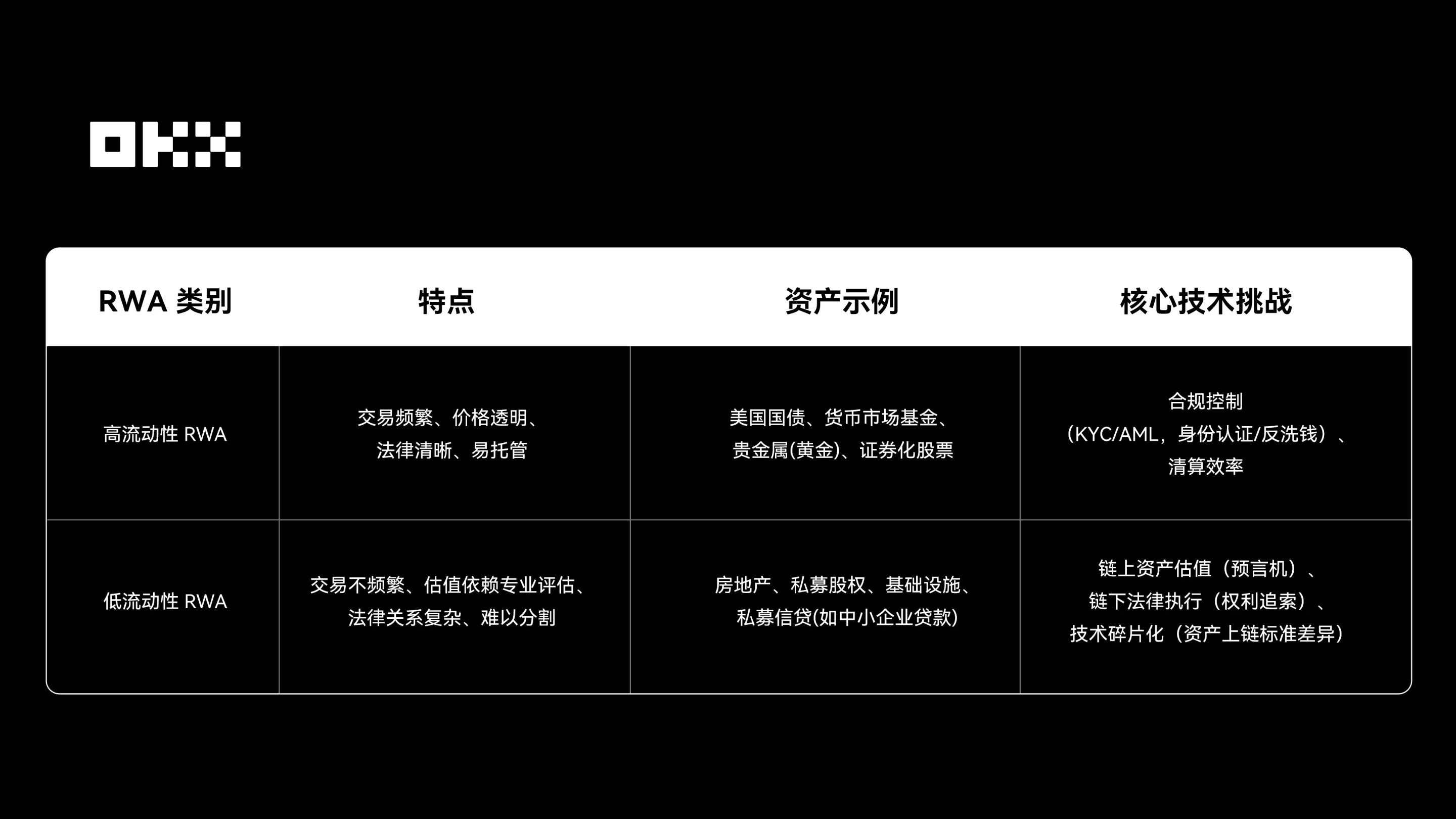
A common but misleading understanding is: "Tokenization creates liquidity." Reality is, tokenization cannot generate liquidity; it can only expose and amplify assets' inherent liquidity characteristics. For highly liquid assets (like U.S. Treasuries, blue-chip stocks), tokenization can optimize and expand, making liquidity 24/7, global, and programmable—a value-add. For low-liquidity assets (like single-property real estate, specific private equity), tokenization only changes ownership registration form, unable to solve fundamental problems: information asymmetry, difficult valuation, complex legal transfers, insufficient market depth. An on-chain property NFT without buyers still has zero liquidity.
The core logic is that liquidity comes from strong market maker networks, clear price discovery mechanisms, and market confidence—not the token standard itself. Blockchain solves settlement and custody efficiency, not asset attractiveness. The lesson for the market—successful RWA projects (like tokenized U.S. Treasuries) don't create new assets, but provide better pipelines for assets with high demand and low trading efficiency. Additionally, current slow-growing RWA areas (like real estate) face problems not in technology, but in assets' non-standard and low-frequency trading nature. Tokenization's main value lies in transparency and process automation, with liquidity improvement being secondary.
RWA scale differences across public chains are significant. Besides Digital Asset's private, permissioned blockchain Canton, etc., RWA assets remain mainly concentrated on the Ethereum network. Additionally, networks like Polygon, Solana, and Arbitrum have different-scale deployments.
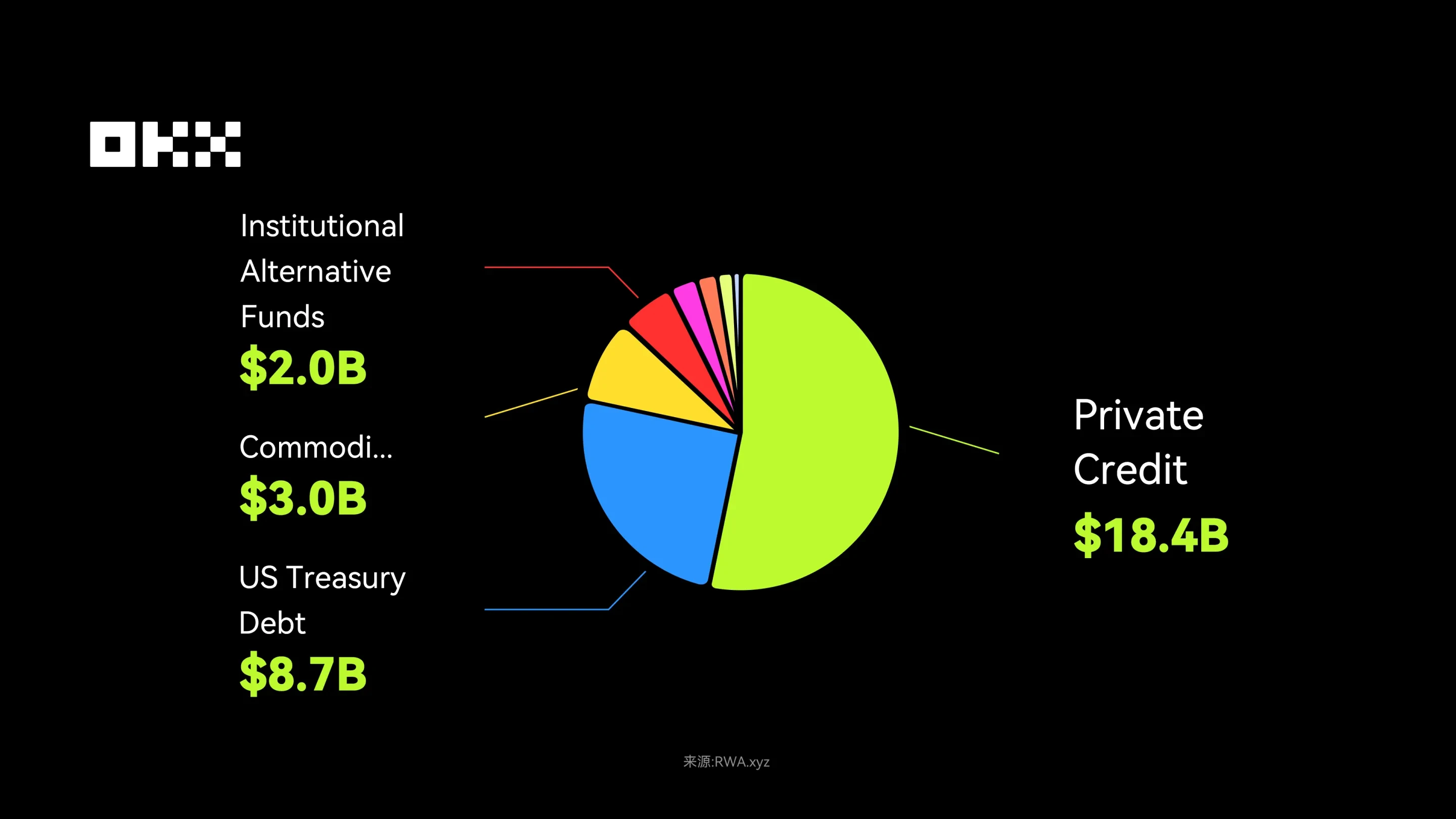
If analyzing from yield-bearing assets or investment potential perspective, core focus remains on categories like private credit, U.S. Treasuries, and commodities—though smaller in scale, these are the true "yield-driven" RWA. Therefore, understanding the RWA market requires distinguishing between total market cap dominance and yield-bearing asset dominance perspectives.
(I) Private Credit: High-Yield RWA Core Asset
Private credit in traditional finance scales to $1.6 trillion, making it the largest asset category among non-stablecoin RWA. By using blockchain smart contracts to package non-publicly traded debt instruments like corporate loans, invoice financing, and real estate mortgages into tradable tokens.
Private credit growth comes from high yields and relative stability, providing DeFi users with 5%-15% annualized returns with volatility independent of crypto markets. Tokenization fractionalizes illiquid assets, attracting global crypto capital and improving liquidity while empowering traditional lenders. Additionally, it doesn't redefine credit but provides a more efficient receipt mechanism. Once these assets are on-chain, they can be inserted into lending markets like other crypto assets, used as collateral, or packaged into asset-backed securities.
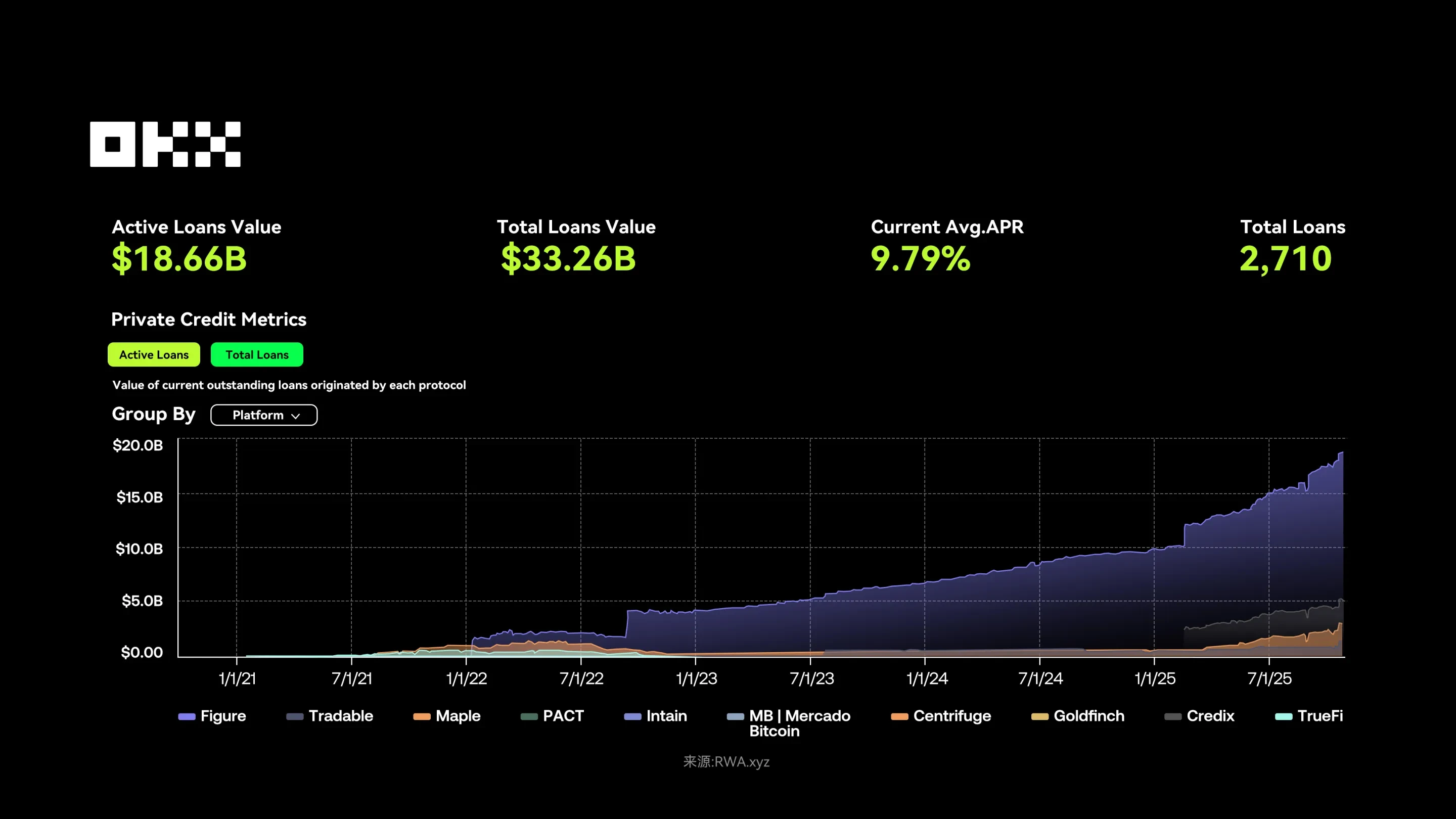
As of November 7, 2025, active loans in RWA private credit totaled approximately $18.66 billion, with average annualized interest rate of 9.79%, and total loan count of 2,710. Figure platform occupies about 92% market share with total loans reaching $17.2 billion; Centrifuge, through multi-chain architecture interoperability with DeFi protocols, grew TVL from $350 million to over $1.3 billion, with historical annualized returns of 8%-15%.
On-chain private credit prosperity replicates the traditional credit cycle: starting with high-quality credit, then expanding to lower-quality collateral. Some yield-bearing stablecoin blowups may signal entering the "junk bond" phase—these products essentially lend user funds to opaque on-chain/off-chain hedge funds, with huge counterparty risk behind high returns. The Stream Finance incident shows that the modular lending market's real threat is liquidity freeze: even when protocols are solvent, asset crashes triggering bank runs can drain the entire shared liquidity layer, causing temporary user paralysis—not just technical risk, but reputation and trust collapse.
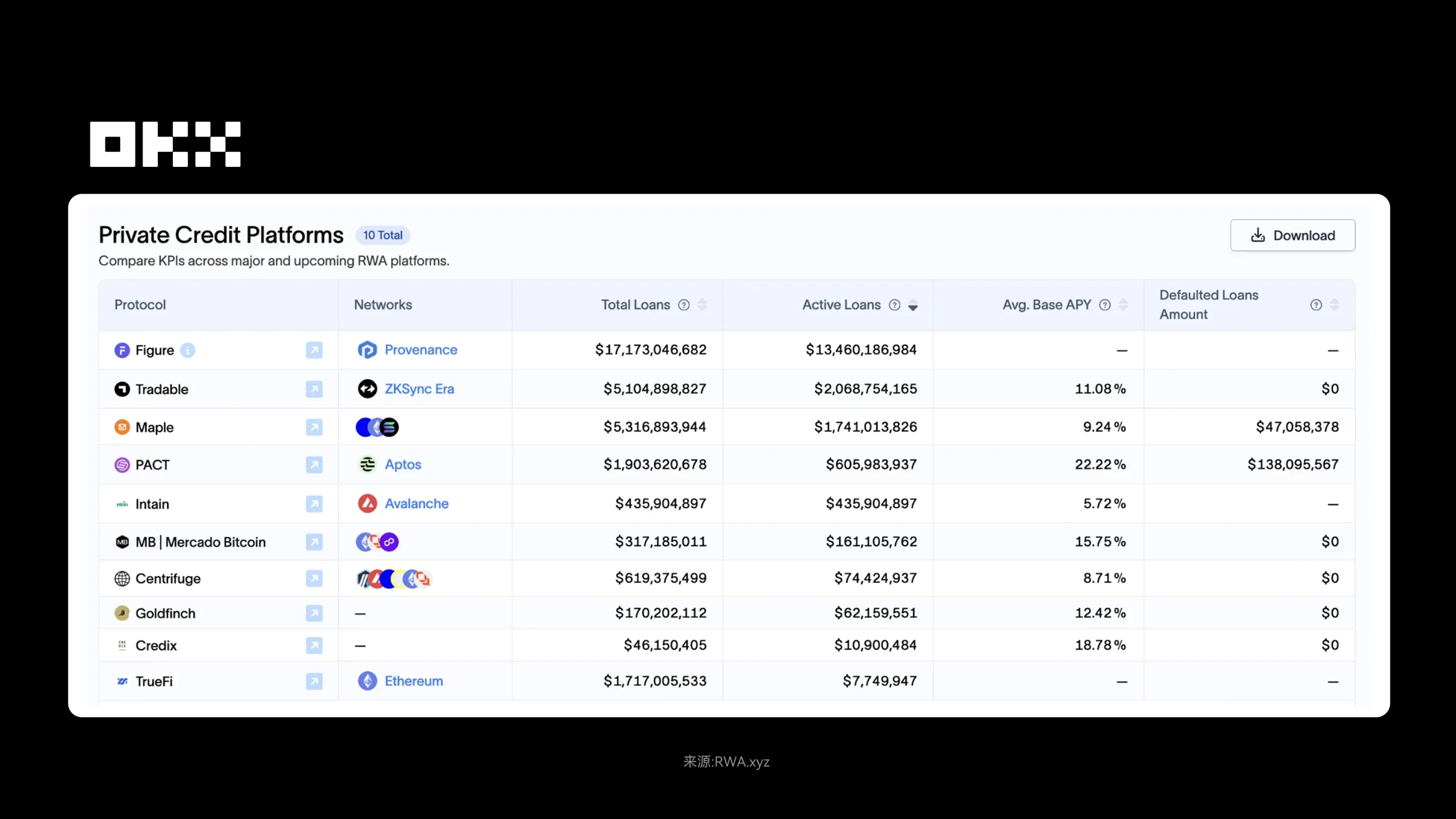
Figure takes a high-compliance U.S. approach. It solves traditional lending pain points of multiple intermediaries, slow approvals, and poor asset liquidity. The platform uses its self-developed Provenance blockchain to tokenize the entire Home Equity Line of Credit (HELOC) process, enabling rapid on-chain asset settlement and custody. In other words, from application to funding, borrowers experience ultra-fast speeds—5 minutes for pre-approval, 5 days to funding. This high-efficiency model not only meets borrower needs but also makes institutional investors more willing to participate. With over $16 billion in home equity loans and over 50% active market share, Figure nearly dominates the HELOC market, successfully listing on NASDAQ in September 2025.
Centrifuge's approach is completely different, leaning toward DeFi infrastructure with focus on multi-chain interoperability. It solves the problem of traditionally illiquid assets (like corporate invoices, receivables) being difficult to bring on-chain. Core product Tinlake can split assets into different risk tiers (Senior/Junior) tokens, while providing DeFi users approximately 8%-15% annualized returns. Centrifuge's biggest advantage is its deep integration with DeFi ecology—for example, Aave and Maker DAO can directly use its assets as collateral. Through this method, the platform's TVL has exceeded $1 billion, providing an efficient, on-chain financing channel for SMEs and asset providers.
(II) U.S. Treasuries: Institutional Capital's "Entry-Level" RWA
As of the end of October 2025, total U.S. Treasury debt exceeded $38 trillion. Treasury tokenization actually originated in the 2020-2022 DeFi bear market, when market returns were generally low and users started seeking more stable, decent-return assets. U.S. Treasuries met this need perfectly: government-guaranteed, nearly zero-risk, 4%-5% annualized returns, significantly higher than bank deposits (1%-2%) and some DeFi lending products. But problems were obvious—poor liquidity (trading through brokers or securities accounts), high barriers (KYC required), geographic restrictions (non-U.S. users struggle to invest directly). By 2023, Federal Reserve rate hikes pushed Treasury yields above 5%, combined with the stablecoin market explosion, Treasury tokenization demand rapidly increased.
Early projects like Ondo Finance's OUSG (2023) and Franklin Templeton's FOBXX were representative. By 2024, BlackRock officially joined, driving market scale from $85 million in 2020 to $4-5 billion in Q1 2025, with the overall market exceeding $8 billion. In terms of yields, BlackRock's BUIDL yields 4%-5% annually, Ondo's USDY even exceeds 5%, and can participate as collateral in DeFi "sustainable yield farming," further amplifying returns.
Technically, Treasury tokenization uses ERC-20/ERC-721 for on-chain ownership transfer; BUIDL and USDY are essentially programmable wrappers for extremely conservative debt instruments. They don't redefine Treasuries but provide an on-chain interface. Once these assets are on-chain, they can be used as DeFi collateral, participate in yield farming, or even circulate across chains. This "Wrap as a Service" model is key to RWA moving from pilots to scale. Regulatory support from the EU's MiCA and U.S. SEC approval accelerates implementation.
From a stability perspective, U.S. Treasuries have nearly zero default (AAA rating), resisting both inflation and market volatility; on-chain tokenization also improves transparency and security through smart contracts and audits. Even better, liquidity and accessibility are significantly improved—24-hour trading, $1 minimum participation, global user access; can be used as collateral to borrow USDC in DeFi. As institutions continue joining, KYC support improves, and products diversify (short-term and long-term Treasuries), tokenized Treasuries become increasingly compliant and universal.
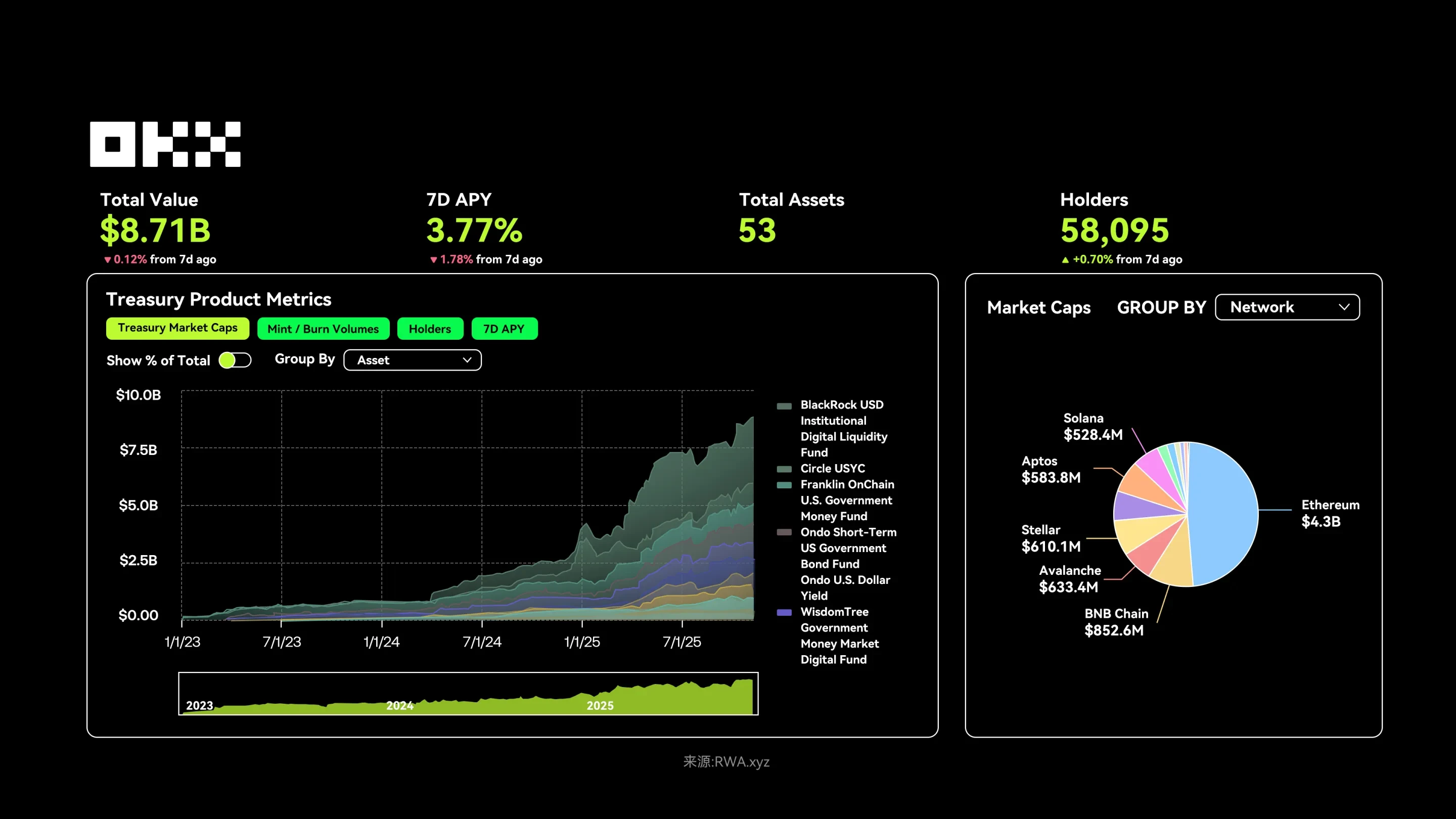
As of November 7, 2025, total value locked in tokenized U.S. Treasury market is approximately $8.7 billion, with over 58,000 holders, and 7-day average annualized yield rate (APY) of 3.77%, slightly down from earlier periods, reflecting changing interest rate environments. From on-chain distribution, Ethereum accounts for over $4.3 billion, with a clear multi-chain trend, as Van Eck's VBILL fund expands to multiple ecosystems.
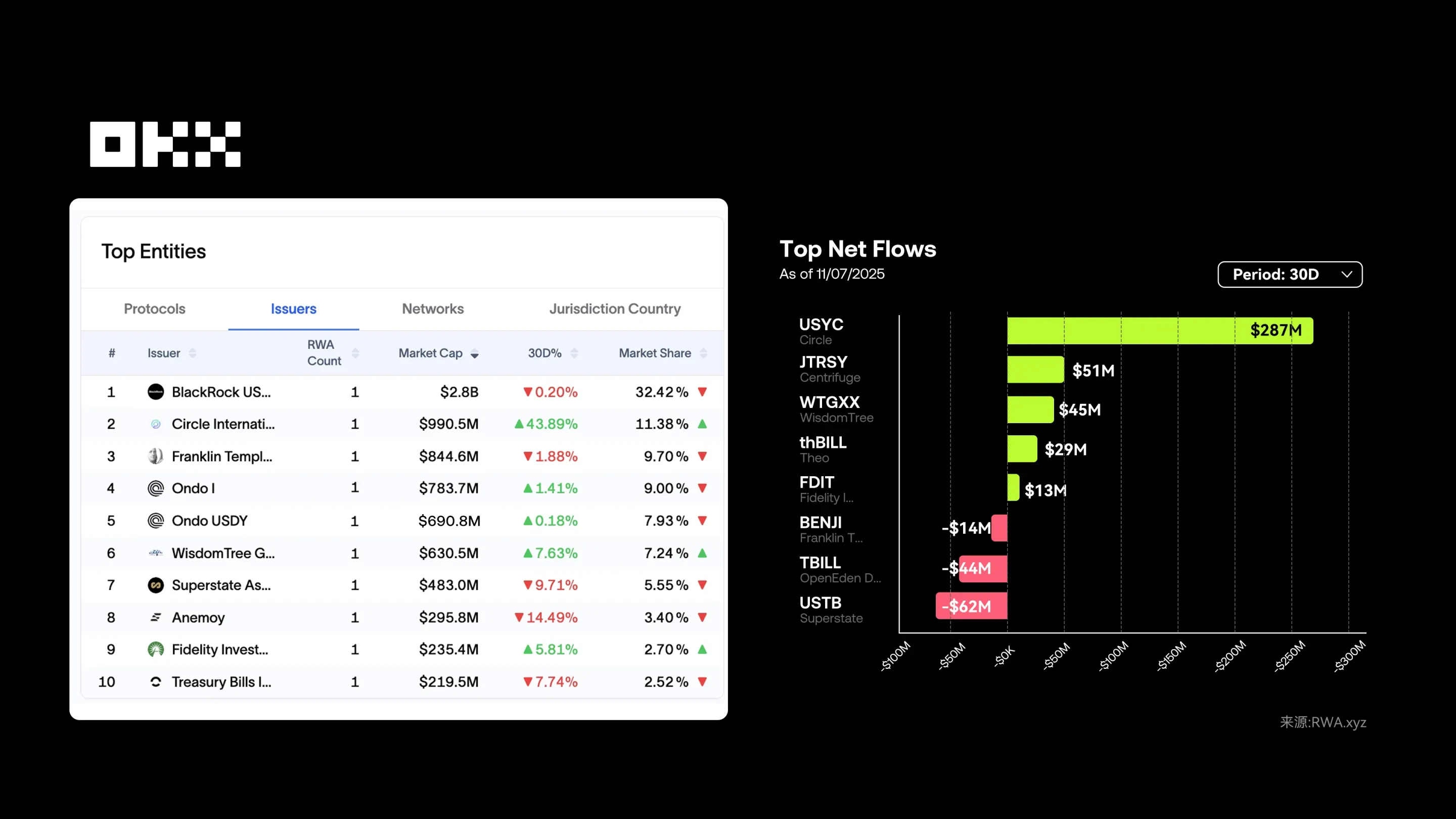
RWA U.S. Treasury tokenization market is currently dominated by institutions like BlackRock BUIDL, Circle USYC, and Ondo Finance. In 2025, with interest rates returning to normal levels and stablecoin regulation becoming clearer, this sector heated up rapidly. The core goal is straightforward: bringing U.S. Treasuries onto blockchain, allowing users to earn stable, readily available returns. Meanwhile, these products strictly distinguish between U.S. accredited investors and global non-U.S. investors, with barriers ranging from retail (like USDY/USYC) to high-net-worth (like OUSG/BUIDL), allowing users to reasonably diversify investments based on geography, risk tolerance, returns, and fees.
BlackRock BUIDL is the leader in institutional-grade Treasury tokenization. It solves problems of high traditional investment barriers and poor liquidity. With BlackRock's brand endorsement and Securitize's compliance path, BUIDL has a market cap of approximately $2.8 billion, about one-third of the market. Barriers are high (minimum $5 million), only for U.S. accredited institutions. Returns are based on SOFR rate (simply put, the average overnight lending rate collateralized by U.S. Treasuries) minus management fees, approximately 3.85% annualized, with on-chain transparent audits, making it the highest compliance benchmark for traditional finance and Web3 convergence.
Circle USYC mainly serves non-U.S. users and accredited institutions, solving their inconvenience in buying Treasuries, currently scaling approximately $990 million. It's deeply integrated with USDC, supported by Bermuda regulation, with 7-day annualized yield rate of approximately 3.53% APY, returns automatically updated daily through net asset value, no manual claiming required. The fund charges no management fee, only a 10% performance fee, relatively medium-high. USYC supports T+0 instant redemption, multi-chain circulation, moderate barriers ($100,000 and KYC/AML verification), and accelerates global expansion through partnerships with traditional institutions like DBS Bank.
Ondo Finance takes a mass-market approach, covering different user groups through OUSG and USDY products, solving high KYC barriers and insufficient liquidity in Treasury investment. OUSG (approximately $783 million) targets U.S. accredited institutions, investing in short-term Treasury ETFs, requiring strict verification (net assets ≥$5 million, minimum investment $100,000 USDC); USDY (approximately $690 million, over 16,000 holders) targets global non-U.S. investors, no strict verification required, depositing USDC earns returns, greatly simplifying retail participation. Advantages include low management fees (0.15%), multi-chain token compatibility (Ethereum, Solana), usability as DeFi collateral, turning Treasury yields (approximately 3.7% APY) into "liquid money." Strategically, Ondo is building full-stack RWA infrastructure through acquisitions like Strangelove, providing asset issuance, secondary markets, custody, and compliance tools, preparing for institutional-grade RWA solutions.
The success of tokenized Treasuries lies not in disrupting Treasuries themselves, but as a compliant, low-risk "Trojan horse" bringing institutional capital and trust on-chain. BUIDL and USDY are essentially programmable wrappers for conservative debt instruments, making ancient financial products portable, composable, and always online. This is RWA's first phase true PMF (Product-Market Fit): serving machines rather than humans, providing risk-free yield curves for on-chain finance, and paving the way for more complex RWA financial engineering. The next phase, whoever builds killer applications for on-chain money market funds based on this will capture tremendous value.
(III) Commodities: Gold Tokenization Leads Growth
Commodities in the RWA sector refer to tokenizing traditional goods like oil, gold, silver, and agricultural products through blockchain, giving them digital ownership and enabling on-chain trading.
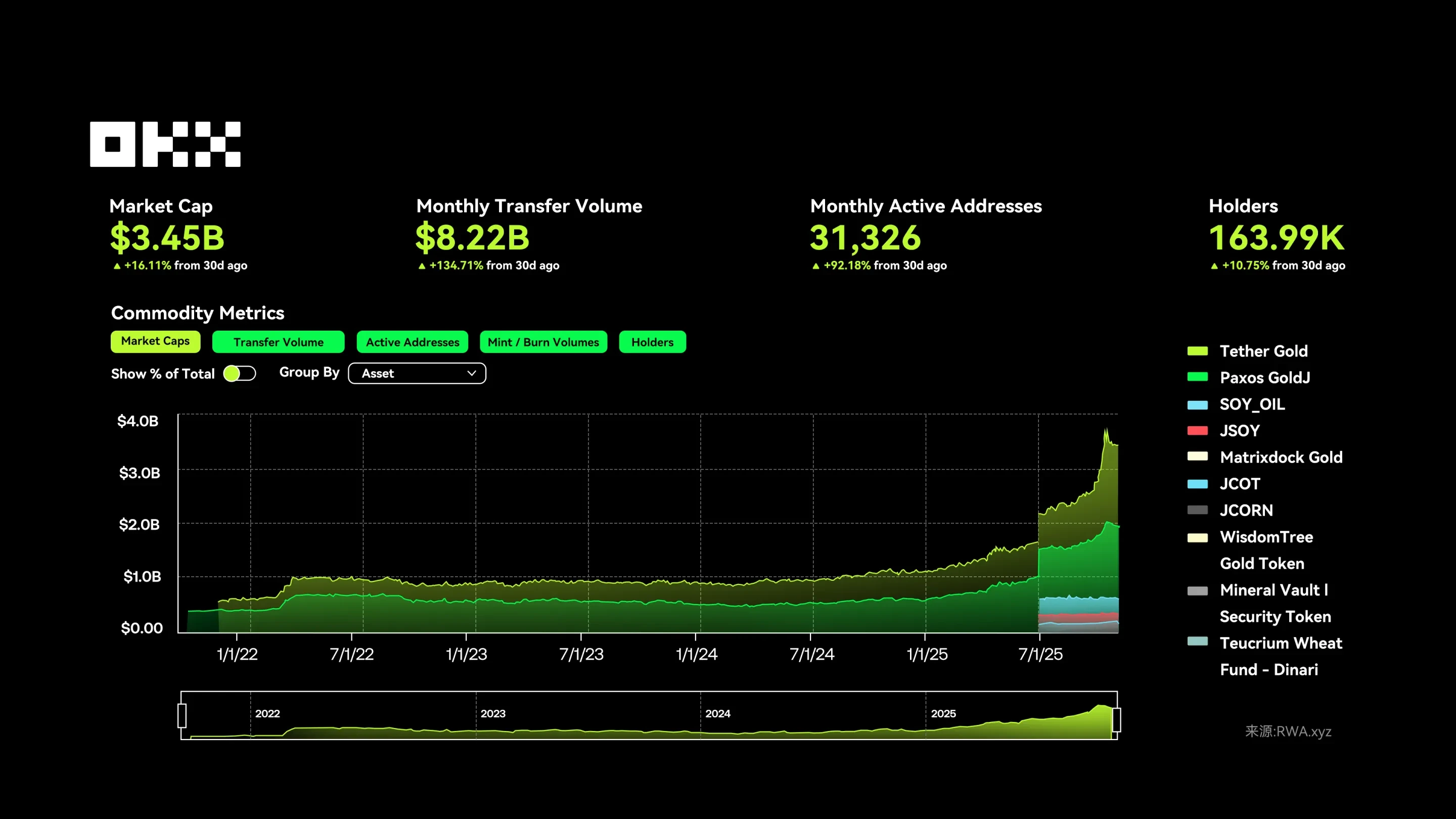
As of November 10, commodity tokens in the RWA sector show significant growth momentum, with total scale growing from less than $10 in early stages to approximately $3.5 billion, monthly trading volume reaching $8.22 billion, monthly active addresses of 31,326, and 164,000 holders. Gold tokens particularly stand out, with commodity tokenized assets like oil and soybeans showing accelerated upward trends, and overall market activity and scale rapidly expanding.
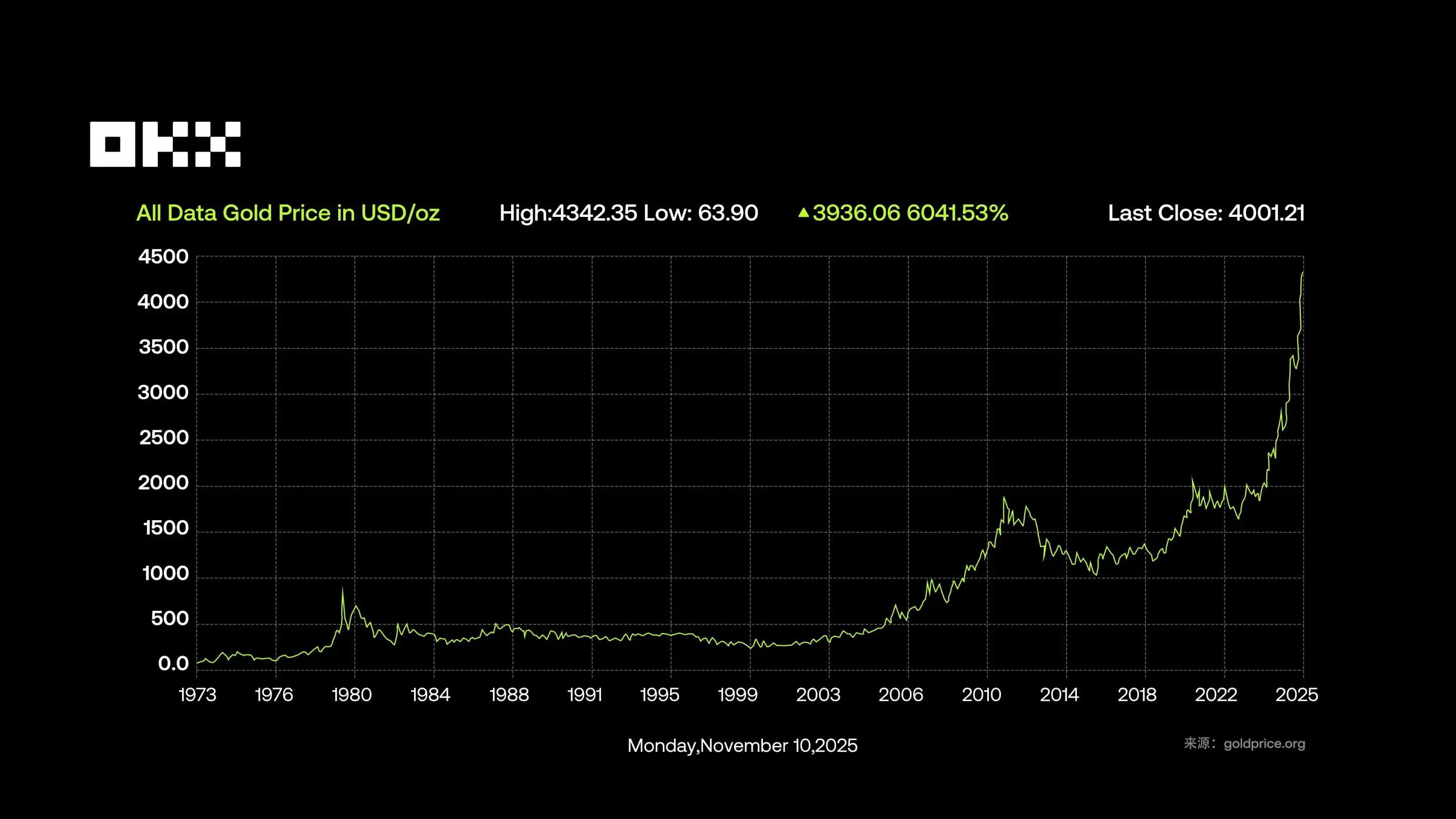
As of November 10, 2025, gold spot price has risen to approximately $4,075 per ounce, accumulating 55.3% gains year-to-date, reaching historical highs. Price increases are mainly driven by geopolitical tensions, inflation expectations, and sustained central bank purchases—in the first three quarters of 2025, global central banks net purchased over 600 tons of gold. From a market scale perspective, total global gold stock is approximately 216,000-282,000 tons (including mining, central bank reserves, and jewelry), with total value of approximately $27 trillion at current prices. Global annual demand is approximately 4,500-5,000 tons, with Q2 2025 demand reaching 1,249 tons (valued at approximately $132 billion, up 45% year-over-year), with full-year demand expected to exceed 5,000 tons.
RWA commodity asset structure is relatively concentrated, with gold tokens becoming the preferred choice for users allocating to RWA commodities due to traditional safe-haven attributes and mature on-chain issuance mechanisms. This growth reflects both increased market demand for on-chain commodity assets and gold's pioneering breakthrough as a "digital-native" physical asset in the RWA sector. Tether Gold and Paxos Gold are core assets in RWA commodities, with market caps far exceeding other commodities (like oil, agricultural tokens). Especially after July 2025, gold RWA token market cap showed explosive growth, becoming the main driver pulling the entire sector's scale expansion.
Tokenized gold market is currently dominated by products like Tether Gold (XAUT) and Paxos Gold (PAXG). Although both maintain 1:1 pegging to physical gold, they differ significantly in strategic focus and user service. The former suits users seeking trading convenience and yield opportunities, while the latter is more suitable for holders prioritizing safety and long-term allocation.
Tether Gold (XAUT) is the largest tokenized gold by volume, issued by Tether, with each token corresponding to one ounce of physical gold stored in professional vaults. As of November 2025, market cap is approximately $2.1 billion, accounting for 56.8% of the market, making it the absolute leader. XAUT can be bought and sold on exchanges like OKX, supports small holdings, and can be redeemed for physical gold for 0.1%-0.5% fees, with some DeFi protocols supporting collateralization or yield generation. Technically, it runs on multi-chain networks including Ethereum, Solana, and Algorand. According to Tether's published data, gold reserves exceed 7.7 tons. However, due to centralized custody and Tether's past transparency controversies, users should note custody and audit risks.
Paxos Gold (PAXG) focuses on compliance, targeting institutions and conservative users, issued by Paxos Trust Company regulated by the New York Department of Financial Services, with each token corresponding to one ounce of physical gold in London vaults. Advantages include compliance and traceability, with users able to query on-chain the corresponding bar number and storage information. As of November 2025, market cap is approximately $1.12 billion, 30.3% market share, with over 41,000 holder addresses. PAXG supports purchases from 0.01 ounces, can be traded on OKX or Paxos official website, and redeemed for physical bars, unallocated gold, or fiat. Settlement completes same day, total cost 19-40bps, no custody fees, audited by KPMG, with monthly reserve reports, leading industry transparency.
(IV) Public Stocks: Tech Stocks and ETF Tokenization as Mainstream
Stocks in the RWA sector refer to crypto assets created by tokenizing traditional public company stocks through blockchain technology. Each token represents partial ownership of company stock, with holders enjoying rights like dividends and voting. Through tokenization, stocks can achieve 24/7 trading, high liquidity, and cross-border settlement on blockchain while maintaining compliance and transparency.
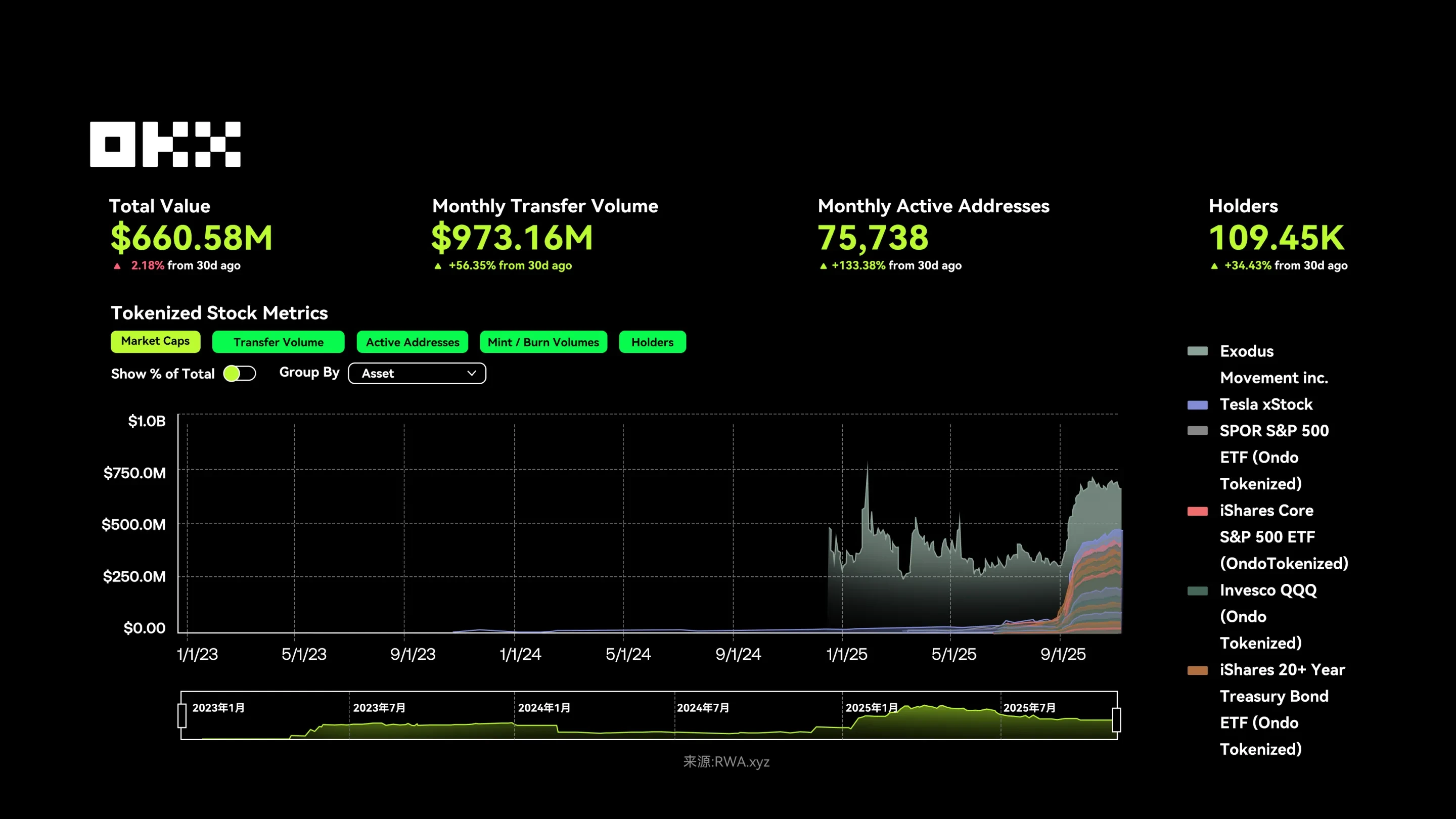
As of November 10, 2025, total value locked in public stocks is approximately $661 million, monthly trading volume reaching $973 million (+56.35% quarter-over-quarter), active addresses 75,738 (+133.38% QoQ), total holders exceeding 109,000 (+34.43% QoQ), showing overall sustained recovery in user participation and trading enthusiasm, with the market entering a new growth cycle.
Tokenized stocks face the "triple interrogation" of structure, liquidity, and regulation. Mainstream models rely on SPV wrappers, criticized for users not getting complete shareholder rights, but supporters argue this is the necessary path from 0 to 1. The most fatal pain point is liquidity: market makers unwilling to hold naked positions on weekends, wide spreads, low depth, Musk's late-night tweet-style black swans can instantly crash on-chain prices, spot markets pull back Monday, retail investors always getting liquidated; DeFi lending liquidating at these prices could trigger cascading liquidations. Real opportunity may not lie in the next Robinhood, but in the "water sellers" providing infrastructure.
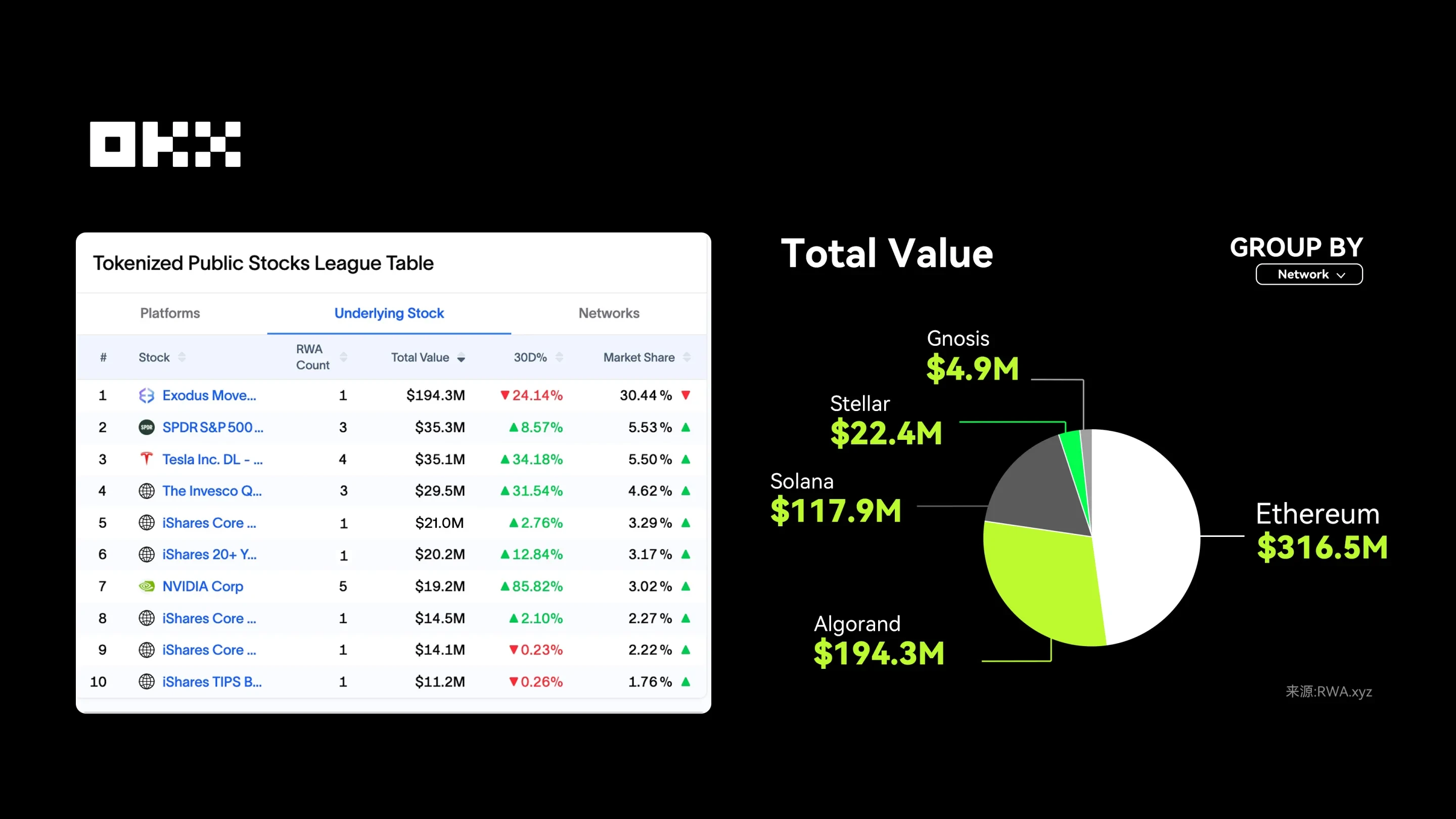
From asset structure perspective, current tokenized stocks remain focused on tech stocks and ETF products, with market highly concentrated in a few head projects. For example, Exodus Movement Inc. (EXOD) steadily ranks first with $194 million total value. On October 20, 2025, Exodus announced expanding common stock tokens to Solana through Superstate's issuance platform (previously mainly running on Algorand), becoming a representative case of "native on-chain stocks," showing compliant equity tokenization moving from concept to implementation.
Tech leaders' popularity extends on-chain. Tesla x Stock (TSLAx) issued by Backed Finance on Solana, with total value approximately $29.44 million, over 17,000 holders, showing tech stocks remain hot in crypto markets. Additionally, two tokenized ETFs—SPDR S&P 500 ETF (SPYon) and iShares Core S&P 500 ETF (IVVon)—have combined market cap exceeding $45 million, issued by Ondo Finance, further strengthening ETF tokenization's strategic position in providing broad market exposure.
From issuance perspective, growth in this sector is dominated by a few platforms. They generally adopt 1:1 physical asset backing, achieving asset mapping and return distribution through on-chain infrastructure. Ondo Finance ($ONDO) ranks first with approximately 47.8% market share ($316 million), focusing on ETF tokenization (SPYon, IVVon, QQQon, etc.), running on self-developed Ondo Chain and Nexus framework, currently the core driver of tokenized ETFs.
Securitize, although currently only issuing one asset (EXOD), occupies nearly 30% market share with $194 million total value. As a SEC-regulated compliant platform, Securitize focuses on institutional-grade equity tokenization, having processed over $10 billion in assets by 2025. Additionally, Backed Finance (Backed Fi) has approximately 18.6% market share ($123 million), focusing on tech stock tokenization (TSLAx, NVDAx, etc.), ensuring precise price synchronization through Chainlink oracles, and actively deploying in Solana multi-chain ecosystem. WisdomTree, representing traditional finance giants, with WisdomTree 500 Digital Fund (SPXUX) holding approximately 3.4% market share, focuses on ETF digital fund issuance, accelerating compliance implementation through traditional finance (TradFi) experience.
Overall, the top four platforms control over 90% market share. With mainstream exchanges like Robinhood and Kraken gradually opening tokenized stock trading in mid-2025, plus maturing cross-chain settlement and regulatory mutual recognition mechanisms, tokenized stocks are moving from niche experiments to mainstream asset categories. However, centralized custody and fragmented regulation remain potential risks requiring continued attention in this sector.
Although tokenized public stocks bring convenience, they don't solve fundamental pain points, as traditional broker experiences are already good enough. The next growth wave will more likely come from a core contradiction: providing efficiency premiums for traditionally inefficient assets.
The main growth battlefield will shift from transparent, efficient public markets (public stocks, Treasuries) to private markets (private credit, private equity). These markets' real pain points are difficult exits, vague valuations, slow settlements—selling private fund shares can take months, relying on email and manual matching. Tokenization through on-chain settlement and fractional ownership can reduce months to minutes, unlocking liquidity for non-standard assets. Real PMF (Product-Market Fit) lies in private credit and pre-IPO equity (like SpaceX) tokenization, not only lowering investment barriers but solving industry-level problems of capital lockup and price discovery.
(V) Real Estate: Fractional Ownership Reduces Investment Barriers
RWA real estate sector refers to tokenizing traditional real estate assets through blockchain, enabling ownership or yield shares to be traded and managed on-chain. Market growth mainly benefits from fractional ownership, allowing global users to invest in high-value properties with barriers as low as $50 (like Lofty AI), enjoying rental returns and high efficiency from instant settlement.
Although private credit and U.S. Treasuries occupy the majority share, real estate tokenization remains in rapid growth stage with tremendous long-term potential. However, real estate tokenization's structural challenges won't automatically disappear from "going on-chain": pricing lacks transparent benchmarks, property title transfers are complex, cash flow costs remain high. Even with property tokens or NFTs, property rights still depend on off-chain contracts and registration systems, which is why RWA remains concentrated in standardized assets like Treasuries while real estate stays in pilot phase.
Ready to Start Trading?
Register on OKX with invite code OKK329 and enjoy 20% trading fee discount
Register Now →Invite Code: OKK329