
【Year-End Review】After the PoS Merge, What Does the Future Hold for Ethereum as It Enters the Deflationary Era?
As 2022 draws to a close, when discussing the major events in the crypto space throughout the year, the Ethereum PoS merge simply cannot be overlooked. This is a pivotal event for the entire industry, and it represents a crucial and milestone moment in the overall Ethereum 2.0 upgrade trajectory. Beyond the merge, what new developments and changes has the Ethereum ecosystem experienced in 2022? Let's take a look back.
Impacted by Rate Hikes, ETH Price Drops Over 60-70%
Since macroeconomic conditions have a global impact on the entire investment market, and the Federal Reserve is one of the world's major central banks, its monetary policy has always been a key focus in financial markets. Any changes in monetary policy affect investors' nerves. When the Fed's FOMC meetings are scheduled, when and how many times rates will be raised, and by how much—all this information profoundly influences investor sentiment and risk appetite.
As early as January 11, 2022, Fed Chairman Jerome Powell stated at a nomination hearing before the U.S. Senate Banking Committee that inflationary pressure might persist through mid-2022. If high inflation in the U.S. lasts longer than expected, the Fed might raise rates more times and begin reducing its balance sheet earlier and faster to combat persistent high inflation.
As expectations for Fed tightening grew stronger and rate hike frequency and magnitude became more aggressive, enormous volatility and impact were brought to the macroeconomic environment and financial markets. Unfortunately, such market reactions also appeared in the crypto market. Within just half a month into 2022, ETH price experienced sharp rises and falls. After reaching a high of $3,900.01 on January 4th, it dropped to around $2,933 on January 10th—a maximum decline of nearly 25%.
In the following months, ETH price entered a downward trend, with the overall decline peaking in May and continuing through June, when the spot price fell to around $881. During this round of decline, the ETH/BTC exchange rate also dropped from 0.072 to 0.054, indicating that Ethereum's decline exceeded that of Bitcoin. Entering the second half of 2022, the crypto market remained shrouded in a sentiment of gradual decline, with overall market prices oscillating, falling, and then oscillating again. ETH price also lingered in the $1,200–$1,800 range for a long time—a price range that was also at the level of the early 2021 bull market. From the all-time high of the 2021 bull market, this price level represented a loss of over 60%.
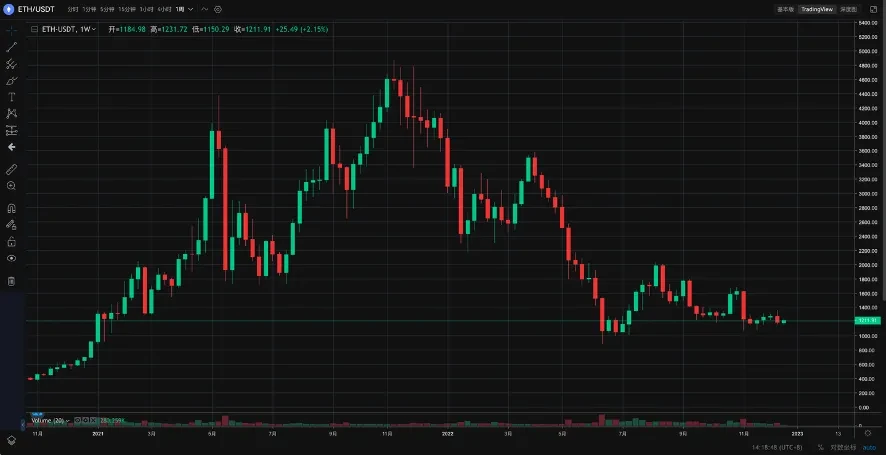
ETH/USDT Price Weekly Chart, Source: OKXOKX
At present, whether the overall crypto market in 2023 will see a reversal remains unpredictable. But what is undeniable is that for Ethereum and other mainstream crypto assets alike, price movements are inevitably influenced by changes in the macroeconomic environment and Fed policy. Investors still need to closely monitor relevant information and manage risk effectively.
Market Sentiment Cools, On-Chain Activity Contracts Across the Board
Beyond the decline in token prices, various on-chain activities on Ethereum have also contracted.
First, let's look at trading volume and gas fees—the most intuitive indicators of on-chain activity. According to Etherscan data, after removing outliers, the average daily on-chain trading volume on Ethereum in 2022 dropped from 1.173 million at the beginning of the year to 1.039 million at year-end—a decline of over 10%. The sharp spikes in trading volume in July and December were closely related to significant market panic or FOMO sentiment at the time. On the gas fee front, after declining mid-year, the average daily gas fee by year-end exceeded the level at the start of the year, which is related to the increase in smart contract deployments and indicates that more projects are being built on the Ethereum network.
Next, let's look at active addresses. According to Etherscan data, after removing outliers, the average daily active addresses on Ethereum dropped from 518,000 at the beginning of the year to 453,000 at yearend—a decline of over 12%, showing a slight overall downward trend. In addition, the growth in total addresses also slowed noticeably compared to previous years. This also reflects the extent of the decline in on-chain activity.
Now let's examine the overall network revenue situation. According to Token Terminal data, Ethereum's average daily network revenue exceeded $25 million at the beginning of the year, but dropped to below $4 million in the second half of 2022—a decline of over 84%. This significant drop can still be attributed to the weak macroeconomic environment and the general market weakness that led to reduced on-chain activity.
Finally, let's look at the number of Dapps and DeFi TVL. According to Dapp Radar data, as of writing, Ethereum hosts a total of 3,598 Dapps, accounting for 27.8% of all Dapps across all public chains, covering gaming, DeFi, and many other sub-categories. According to DeFi Llama data, the total value locked (TVL) on Ethereum stands at $23.39 billion, accounting for 59.24% of all public chain TVL. This figure was approximately 64% in early March, when Ethereum's TVL was around $90 billion—a quarter-on-quarter decline of 74%. This shows that Ethereum's TVL declined faster than other public chains during this period.
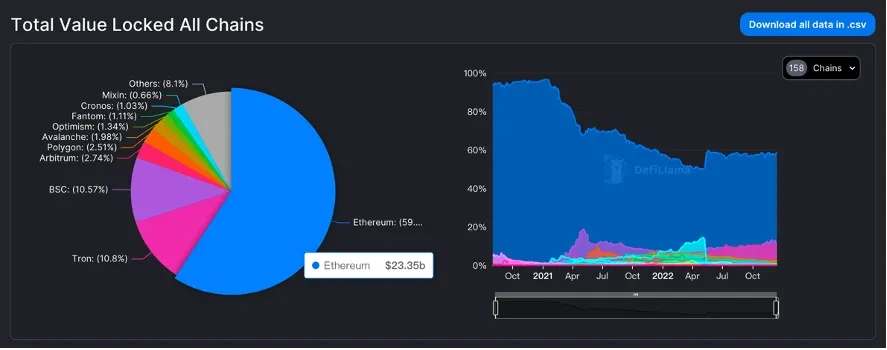
TVL Share Across the Network, Source: DeFi Llama
Ethereum's Issuance Plummets, Shifting from Inflationary to Deflationary
In 2022, the Ethereum network and ecosystem welcomed the final post-development phase of the 2.0 upgrade—Serenity. The primary mission of this phase was to completely transition from "PoW" to "PoS," thereby reducing electricity costs in the mining process and minimizing energy waste. That is why the Ethereum merge upgrade was a matter of paramount importance to the entire industry.
The Ethereum Foundation announced that the Ethereum merge plan would be split into two upgrades: The first upgrade was the Bellatrix upgrade on the Ethereum consensus layer, completed on September 6, 2022 (HKT). The second upgrade was the Paris upgrade on the Ethereum execution layer, which completed when the Ethereum Proof of Work chain reached the Terminal Total Difficulty (TTD) value of 58,750,000,000,000,000,000,000, completed on September 15, 2022 (HKT).
After the upgrade was completed, by eliminating dependence on cryptocurrency miners and significantly reducing energy costs, the way the world's second-largest blockchain network operates was fundamentally changed. Furthermore, as demand for PoW miners decreased, Ethereum's annual ETH issuance was reduced from 4.3% to 0.43%—a reduction of over 90%. Thus, the Ethereum merge directly pushed ETH into a deflationary state. This was another major deepening of ETH's deflationary trajectory following EIP-1559. After the merge, the ETH inflation rate plummeted from 4% to near-deflation. As of December 21st, the net issuance was only 2,212 ETH.
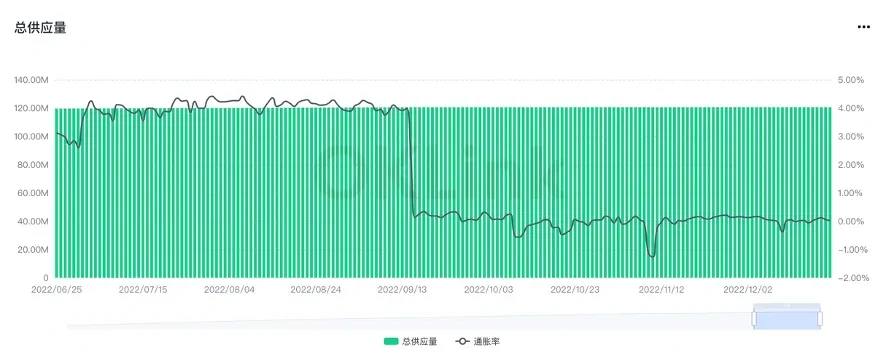
ETH Total Supply and Inflation Rate, Source: OKLink
Following the PoS merge, the next significant upgrade for the Ethereum network will be "Shanghai." The Shanghai upgrade using "Shandong" as the testnet is expected to take place in March 2023. This will be the first upgrade for Ethereum since the September 2022 merge. Shanghai is expected to address issues concerning network efficiency and scalability, among others. Among the widely anticipated EIPs are EIP-3540, EIP-4895, and EIP-5654, which may bring effective adjustments and optimizations in areas such as EVM changes, staking rewards, and reduced gas fees.
Looking back at the past and throughout 2022, Ethereum's development has been relatively slow, and expectations for upgrades have often been overly optimistic. Future significant upgrade and optimization events are also highly likely to face delays or postponements. The sharding plan aimed at improving overall network usability may also require considerable time to materialize. Nevertheless, given that the Ethereum network hosts numerous ecosystem projects, even a minor misstep could cause irreparable damage and affect public chain reputation and user confidence. Therefore, being cautious about network development and upgrades is not necessarily a bad thing—after all, the prerequisite for upgrade optimization is ensuring network stability.
Layer 2, Though Affected by the Market Environment, Sees Exciting Developments Across Sub-Sectors
Ethereum's network congestion hardly needs repeating—the 2.0 upgrade was, to a large extent, designed to solve the problem of network congestion. While waiting for the upgrade to complete, scaling has been the solution to improving Ethereum's performance and addressing congestion, which is why it has attracted so much attention. Ethereum Layer 2 scaling is a method born from this need—the main operating method is to build new chains alongside the main chain to achieve scaling. Among the many Ethereum L2 solutions, Arbitrum, Optimism, zkSync, and StarkNet stand out particularly.
As a segment of the crypto market, Layer 2 development is inevitably influenced by the overall market environment. According to L2BEAT data, the total value locked (TVL) on Ethereum L2 has currently pulled back to $4.24 billion, with a 7-day decline of 5.53%. Among them, Arbitrum has the highest TVL at approximately $2.30 billion, accounting for 54.2% of the total Layer 2 TVL. Next is Optimism, with a TVL of approximately $1.14 billion, accounting for 26.9%. dYdX ranks third, with a TVL of approximately $391 million, accounting for 9.2%.
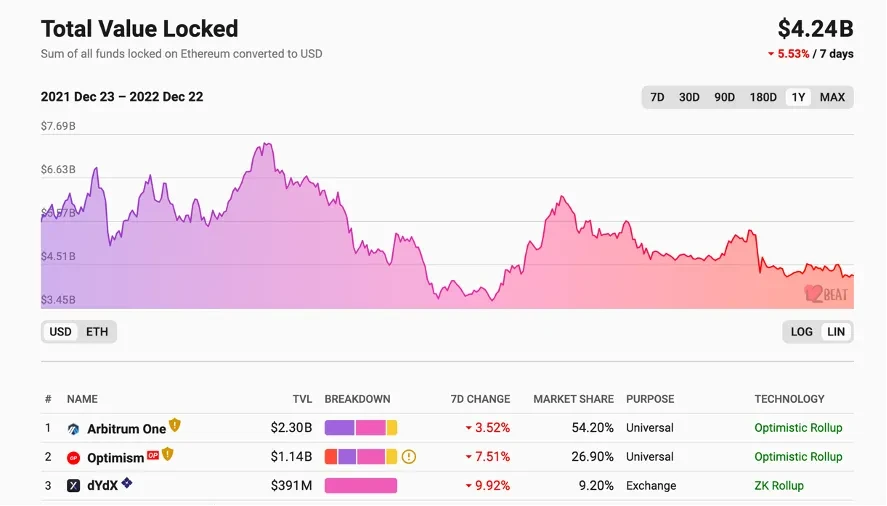
Total Value Locked on Ethereum L2, Source: L2BEAT
Although market sentiment has cooled, in 2022 there was still no shortage of standout projects in areas such as DeFi, NFT, and DAO. Moreover, since the Ethereum merge did not significantly improve network speed, Layer 2 networks continue to play a vital role, hosting DeFi and Dapp applications across multiple sub-sectors, such as Synthetix and SushiSwap. For example, The Beacon—a blockchain game that went viral in the crypto community at the end of 2022—attracted over 18,000 players within its first week of launch, and over 17,000 founder characters were sold. The game was issued on the Arbitrum chain by Treasure DAO.
Additionally, the establishment of bridges between various Layer 2 networks and the Ethereum mainnet has further addressed issues such as limited liquidity and low awareness. Based on their current advantages in areas such as transaction fees and speed, it is believed that Layer 2 will host more projects and have stronger liquidity before Ethereum 2.0 launches.
In the future, when Ethereum 2.0 launches and network performance improves significantly, running on top of various shards alongside Layer 2 will further enhance Ethereum's performance. Layer 2 and Ethereum 2.0 complementing and mutually benefiting each other will become the prevailing trend. As new gaming and NFT projects emerge, more and more Ethereum L2 solutions will continue to appear. It is believed that as the Ethereum ecosystem continues to grow, Ethereum L2 and other high-performance public chains will continue to flourish across the board.
Conclusion
Nothing in this world develops overnight. Ethereum's transition to the PoS mechanism is not the end of Ethereum's upgrade journey. The grand Ethereum 2.0 upgrade still requires many small-scale phase additions and corrections. The successful completion of Ethereum's PoS merge this year has undoubtedly strengthened market confidence.
Meanwhile, as Ethereum's highly competitive rival chain Terra-Luna—a $100 billion empire—collapsed, and Solana was impacted by the bankruptcies of FTX and Alameda Research, mired in performance degradation and outage crises.
In this context, can Ethereum continue to consolidate its absolute dominance, and how will the public chain landscape change? As we enter 2023, what innovations will emerge in the Ethereum ecosystem and Layer 2, what surprises will Ethereum's upgrades bring, how will Ethereum kick off a new era for public chains, and how will the overall crypto market environment develop—while the outcomes of all these questions remain unknown, time will provide the answers. We wait with anticipation.
Disclaimer
This article may contain product-related content not applicable in your region. This article is only intended to provide general information and makes no representation as to any factual errors or omissions. The views expressed herein are solely those of the author and do not represent the views of OKX. This article is not intended to provide any advice, including but not limited to: (i) investment advice or investment recommendations; (ii) offers or solicitations to buy, sell, or hold digital assets; or (iii) financial, accounting, legal, or tax advice. Holdings in digital assets (including stablecoins) involve a high degree of risk and may fluctuate dramatically, or even become worthless. You should carefully consider whether trading or holding digital assets is suitable for you given your financial situation. For questions regarding your specific circumstances, please consult your legal/tax/investment professional. Information appearing in this article (including market data and statistical information, if any) is provided for general reference purposes only. Although we have taken all reasonable precautions in preparing such data and charts, we make no representations and accept no responsibility for any factual errors or omissions expressed herein. © 2025 OKX. This article may be reproduced or distributed in its entirety, or excerpts of 100 words or fewer may be used, provided that such use is non-commercial in nature. Any reproduction or distribution of the full article must prominently state: "This article is copyrighted © 2025 OKX, used with permission." Permitted excerpts must cite the article title and include the source, for example: "Article title, [author name (if applicable)], © 2025 OKX." Some content may have been generated or assisted by artificial intelligence (AI) tools. Derivative works and other uses of this article are not permitted.
Show More
Recommended Reading

2025 KOL Most Used OKX Products Review
In the cryptocurrency industry, professional players' choices are always direct and pure. In 2025, KOLs cast the most authentic votes for industry tools and ecosystem development with their capital investment and time dedication throughout the year. We focused on four core questions—"What was your biggest achievement this year?", "Given those achievements, what OKX products did you use most frequently and love the most in 2025?", "Why do you like it?", and "Does this
January 5, 2026

2026 Investment Outlook: On-Chain Assets, Intelligence & Privacy | OKX Annual Review
The three major trends shaping the future of crypto: asset transformation, subject transformation, and rule transformation. As we are about to enter 2026, bidding farewell to four years of focusing on "building roads" for infrastructure, the crypto industry is ushering in a profound paradigm shift. OKX Ventures defines this as the dawn of the "Kinetic Finance" era, whose core is no longer how fast the network is, but the flow and monetization of on-chain assets
December 31, 2025

Voting with Data: A Deep Dive into 2025's Hot Trading Products | OKX Annual Review
Looking only at price movements, it's hard to explain the return differences between OKX Trading users in 2025. What truly determines returns equally depends on account-level operational methods, not just market volatility itself. The OKX annual report shows that mainstream coins remain the core of capital turnover and return generation, supporting trading and strategy execution; emerging coins are more used to amplify volatility and provide stage-based opportunities, but they are not a stable, long-term source of returns. What truly and consistently contributes to returns is
December 30, 2025
Fusaka In Practice: What Does Ethereum's Latest Upgrade Mean for L2, Nodes, and Users?
Ethereum mainnet has completed the Fusaka fork. From a protocol perspective, this upgrade mainly covers four areas, the full text按Q&A Show MoreCore viewpoints and first-hand experience from three guests: Ahmad (@smartprogrammer) – Nethermind Execution Client / Ethereum Core Dev Manu (@manunalepa) – Prysm / Of
December 16, 2025

OKX Research | Why Did RWA Become a Key Narrative in 2025?
RWA (Real World Assets) is becoming the "new favorite" of global capital. Simply put, RWA is about taking valuable, ownership-bearing things from the real world—such as houses, bonds, stocks, and other traditional financial assets, or even art, private lending, and carbon credits that are not usually easy to trade directly—and bringing them onto the blockchain, making them tradeable, programmable crypto assets. This way, n
November 20, 2025
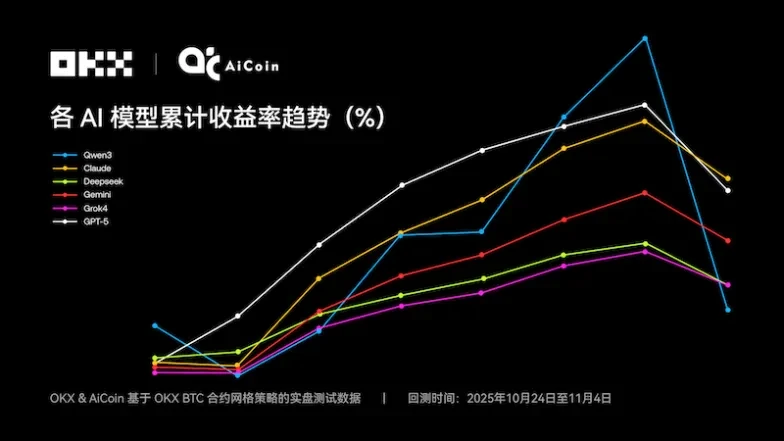
Claude Takes the Crown, 6 Major AI Grid Strategies Face Off | OKX & Ai Coin Live Test
Can the short-term trading champion Qwen3 also be the king of grid strategies? The first season of NOF1's "AI Trading Live Arena" finally concluded at 6 AM on November 4, 2025, whetting the appetites of the crypto, tech, and finance circles. But the result of this "AI intelligence public test" turned out to be somewhat unexpected. The combined $60,000 in starting capital from all six models, at the conclusion, had shrunk to just $4.3
November 6, 2025