Polkadot Parachains vs. Ethereum 2.0: Which Is More Worth Anticipating?
In the recently passed October, the cryptocurrency market experienced successive "celebrations." BTC, ETH, DOT, and many other mainstream coins successively hit record highs, and the dogcoin series also surged again and again, driving market sentiment to new heights. On November 4, ETH reached a new high of $4,668, and DOT hit a historical high of $54.543. Against this backdrop, Polkadot is also officially kicking off the curtain on parachain slot auctions.
As everyone knows, the blockchain "impossible trinity" problem has always accompanied and plagued the development of various public chains. As a star project with the grand vision of Web3.0, Polkadot, besides mainly focusing on cross-chain, is also committed to solving blockchain scalability and decentralization issues, while Ethereum has also spent significant energy and cost on the ETH 2.0 upgrade to solve Ethereum network expansion and a series of other issues.
Due to the founders' identities and project backgrounds, people usually mention Polkadot and Ethereum in the same breath, and even viewpoints like "Polkadot will surpass Ethereum" have emerged one after another. As both major projects steadily progress, who can better carry the vision of future public chain development? Who is more worth anticipating?
1**, Polkadot and Ethereum's respective progress**
First, let's look at the current main progress and status of Polkadot and Ethereum.
In 2016, the first version of the Polkadot whitepaper was released, marking the debut of the Polkadot project. In 2017, the Web3 Foundation was established and DOT conducted its first sale. Since then, Polkadot quietly developed for two or three years, with almost no trace in the market. Until August 2019, Polkadot launched the canary network Kusama to test Polkadot's governance, Staking, sharding, and other functions in a real economic environment, and Polkadot began to gradually attract market attention. In May 2020, Polkadot launched the first mainnet candidate chain, marking the beginning of its phased launch process. By this point, Polkadot also entered the competitive track with Ethereum and many other public chains.
After more than a year of testing, Kusama's functions have been basically perfected, and the test operating environment is stable. Polkadot's core function development and ecosystem applications have also made significant progress. In the past year or so, the Polkadot network has transitioned to the NPoS (Nominated Proof of Stake) mechanism, enabled governance and DOT transfer functions, released Substrate 2.0, and core functions such as XCMP cross-chain message passing and parachains are also successively coming online.
In addition, due to Polkadot's heterogeneous structure, parachain slot auctions have become a much-watched industry event in the past two years. As of the end of October, Kusama slot auctions have entered normalization and successfully opened the 13th slot auction. Already, 11 projects including Acala and Bifrost have become Kusama's parachains. As of now, the total amount of KSM locked in Kusama parachain slots and crowdloans reaches approximately 2.53 million KSM, accounting for 21.8% of total issuance. Polkadot has also announced that slot auctions will begin on November 11, and many projects are already preparing for the Polkadot auctions. It is worth noting that the OKX platform has launched an early bird auction activity where users can quickly participate in slot bidding with zero fees and enjoy rewards from the OKX platform and project teams.
Meanwhile, the public chain leader Ethereum has experienced 7 years of ups and downs since its development in 2014, witnessing the ICO boom, DeFi Summer, NFT craze, and more. Currently, Ethereum is in the "Serenity" phase of its roadmap, committed to completing the ETH 2.0 upgrade.
Since the launch of the Beacon Chain in December 2020, Ethereum has officially begun transitioning to Proof of Stake (PoS). This new PoS system is part of the Ethereum 2.0 overall network upgrade and is currently running smoothly. As of November 3, there are over 250,000 active validators on the Beacon Chain, with a total of 8.04 million ETH deposited into Ethereum 2.0, and the network participation rate has remained above 96% in the past month.

Source: beaconscan
This August, Ethereum successfully completed the significant London upgrade, improving the trading fee market. As of now, over 744,000 ETH have been burned. On the other hand, Ethereum-based Layer 2 solutions such as Rollups have also developed very rapidly. On November 3, according to L2BEAT data, the total TVL on Ethereum Layer 2 reached $4.94 billion, hitting a record high. Among them, the scaling solution Arbitrum has the highest TVL, accounting for 59.21%. The progress of Layer 2 technology has become the key to solving Ethereum problems before the launch of shard chains. In the future, Ethereum will have Layer 1 focusing on decentralization and Layer 2 handling scaling and innovation, working together with a two-pronged approach to improve the Ethereum network experience.
So as both processes progress smoothly, in the upcoming public chain competition, who will come out ahead: Polkadot's parachains or Ethereum 2.0?
2, Polkadot VS Ethereum 2.0
We need to first understand the similarities and differences between Polkadot and Ethereum 2.0.
In terms of project background, both Polkadot and Ethereum have technically strong teams and technical backgrounds, so we won't go into detail here. One is the world's advanced smart contract platform, and the other is a platform for future multi-chain interoperability. Both platforms are designed for developers to build decentralized applications and are pursuing scaling strategies based on parallel execution to solve blockchain network performance and scalability issues. Specifically in structure, each execution thread is called a shard in Ethereum 2.0, and a parachain or parathread in Polkadot.
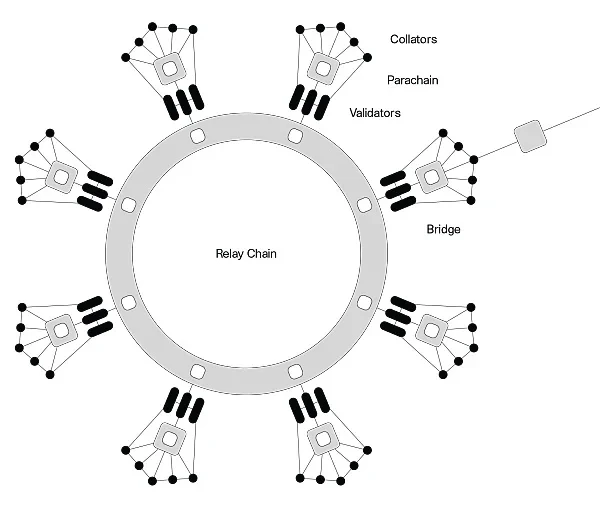
Polkadot is a scalable heterogeneous multi-chain blockchain. To achieve the cross-chain vision, it designed a "Relay Chain + Parachain" dual-layer structure. Through this structure, Polkadot can transmit data to all blockchains, achieving the circulation of assets and data between various chains. Polkadot's parachains are equivalent to shard chains, responsible for processing various transactions, and then interconnecting through the Relay Chain.
Ethereum 2.0 is a hard fork upgrade planned by Ethereum during the complete transition to the Serenity phase. It will mainly improve performance through three technical means: sharding, Proof of Stake (PoS) consensus mechanism, and new EVM, among which sharding technology is relatively key. Ethereum 2.0 splits the Ethereum network into multiple shards (supporting up to 1024 shards), thereby increasing Ethereum's execution capability by a corresponding multiple. As the data layer, each shard is a sub-network, equivalent to Polkadot's parachains. The Beacon Chain, as the coordination layer, is responsible for handling Ethereum 2.0's consensus and communication between various sub-shards in the system, which is equivalent to the Relay Chain in the Polkadot network.
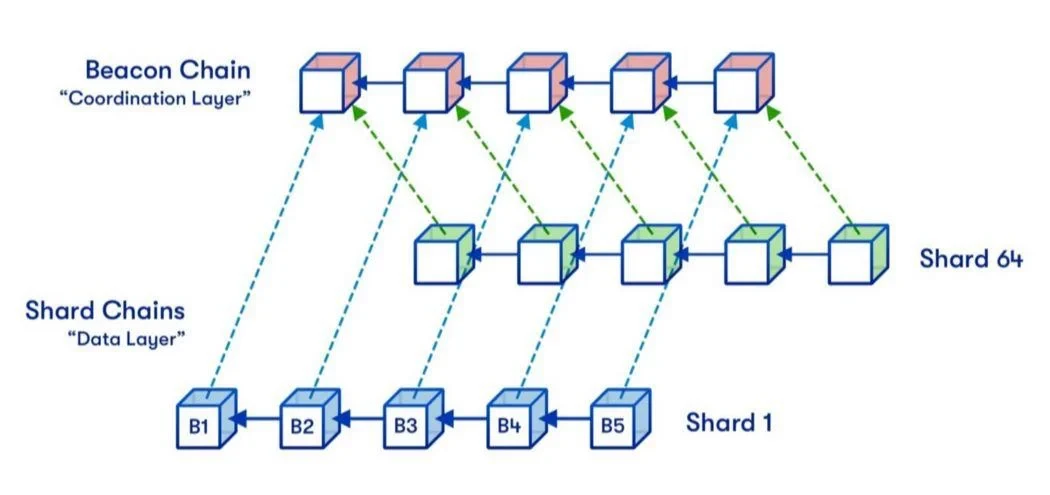
Eth 2.0 sharding diagram
It can be seen that Polkadot and Ethereum 2.0 have some similarities in overall architecture, but there are many differences at the detail level. From the structural diagrams of both above, we can see that Polkadot is a framework for interconnection between different systems (parachains), while Ethereum 2.0 is a framework for interconnection within the same system (each shard). Ethereum 2.0 focuses more on itself, building a powerful underlying system to support more dApp ecosystems, while Polkadot focuses on connecting other chains to create a multi-chain interoperability system.
In addition, another major difference lies in their design goals and consensus mechanisms. Polkadot's goal is to achieve cross-chain, horizontal expansion through parachains, helping people build and integrate blockchains, thereby solving performance throughput issues. Ethereum 2.0's design is basically aimed at its performance and throughput issues. In terms of consensus mechanism, Ethereum 2.0 uses the PoS mechanism, while Polkadot uses the NPoS mechanism. The following is a summary of key differences between Polkadot and Ethereum previously compiled by Polkaworld for readers' reference:
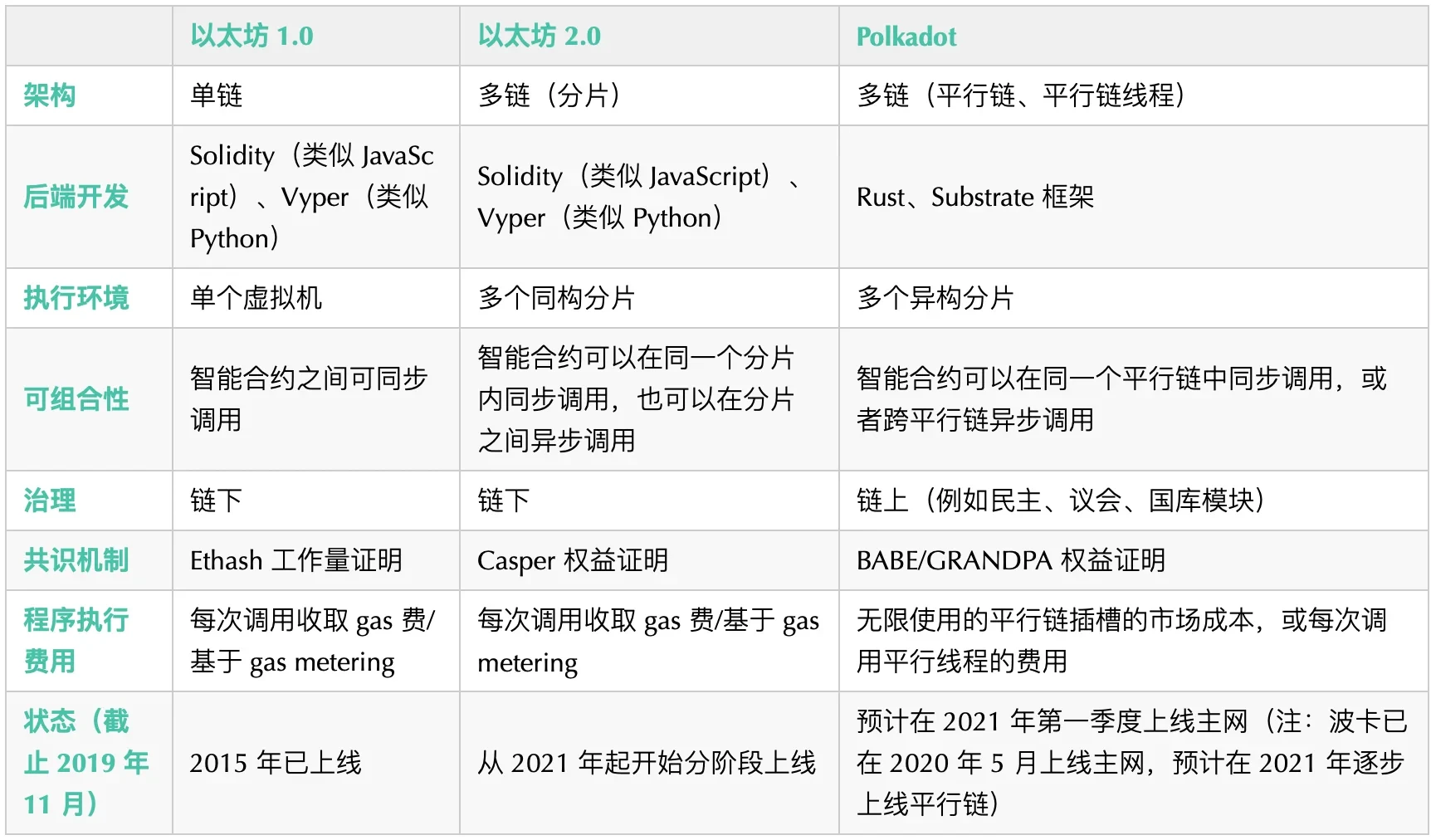
Source: Polkaworld
Since Polkadot's inception, many investors bullish on Polkadot believe that Polkadot has the grand vision based on Web3.0, and with the connection of parachains and cross-chain bridges, surpassing Ethereum 2.0 in the future is just around the corner.
3, Can Polkadot surpass Ethereum?
So, returning to the question we want to explore: Can Polkadot really surpass Ethereum in the future?
Undoubtedly, as public chain systems, both have their unique advantages and do indeed have a competitive relationship. Ethereum's biggest advantage lies in its mature and massive ecosystem and developer community, and it has already secured the throne of public chain leader. As the largest smart contract platform in the current blockchain field, Ethereum has significant network effects. The DeFi, NFT, and GameFi crazes we're familiar with were all launched on top of Ethereum. Against this backdrop, ETH as the underlying token has also captured enormous economic value. Therefore, from the current network infrastructure perspective, Ethereum inevitably has the upper hand.
But on the other hand, the scalability challenges and high gas costs facing Ethereum have become shackles to its development, while also providing opportunities for other public chains to overtake. Therefore, more and more new quality projects choose to build on Polkadot, pursuing higher trading throughput and higher decentralization attributes. Substrate-based parachains can not only design their own chains but also have their own economic models, and can enjoy these four characteristics (advantages): uninteruptible, upgradability, no restrictions, and no transaction fees. Here we must also mention the centralization difference in on-chain governance between Polkadot and Ethereum. Polkadot can react quickly and upgrade rapidly. Any new technology or proposal can be added to the Polkadot chain, and all are executed by community voting. But on Ethereum, although proposals can also be publicly created and submitted, the final decision is handed to the core development team for review and voting.
According to Polkaproject data, there are currently hundreds of applications and protocols in the Polkadot ecosystem, covering cryptocurrency wallets, validators, forums, browsers, and various Substrate-based projects such as privacy, bridges, DeFi, smart contracts, and more. Therefore, Polkadot's current "threat" to Ethereum mainly comes from competing for quality projects in the ecosystem, including at the infrastructure level. Even Ethereum core developer Afri Schoedon said early this year that Polkadot's development process is faster than Ethereum's, even stating that Polkadot brings what Ethereum's Serenity phase (final stage of hard fork upgrade) can bring. Thus, Polkadot's advantages cannot be underestimated.
Polkadot's biggest advantage lies in the development tool Substrate. Substrate is a development framework for creating Polkadot-compatible blockchains, supporting developers in rapidly developing a blockchain in a short time, greatly reducing the cost, time, and effort required to create blockchains.
In addition, its "Relay Chain + Parachain" dual-layer structure can provide powerful network security and very strong scalability. Not only can various blockchains run on Polkadot, but in the future it can also connect with Bitcoin and Ethereum. After achieving cross-chain interoperability with these mainstream blockchains, this will be a huge advantage for Polkadot. From a technical perspective, Polkadot has a leading advantage. Once the parachain system operates smoothly, it will open up a brand new cross-chain era for us.
In summary, although Polkadot and Ethereum are competitors, their ultimate visions are different, so there's no need to get caught up in whether Polkadot will surpass Ethereum. The arrival of Polkadot parachains and Ethereum 2.0 will both bring better experiences and upgrades to blockchain. In the short term, Polkadot surpassing Ethereum may still be some distance away, and it's expected that both will continue to exist in a state of multi-chain coexistence, long-term competition and symbiosis.
Disclaimer
This article may contain content related to products that are not applicable in your region. This article is intended only to provide general information and does not assume responsibility for any factual errors or omissions contained therein. This article represents only the author's personal views and does not represent the views of OKX. This article is not intended to provide any advice, including but not limited to: (i) investment advice or investment recommendations; (ii) offers or solicitations to buy, sell or hold digital assets; or (iii) financial, accounting, legal or tax advice. Holding digital assets (including stablecoins) involves high risk, may fluctuate significantly, and may even become worthless. You should carefully consider whether trading or holding digital assets is suitable for you based on your financial situation. For questions about your specific situation, please consult your legal/tax/investment professional. The information appearing in this article (including market data and statistics, if any) is for general reference only. Although we have taken all reasonable precautions in preparing these data and charts, we assume no responsibility for any factual errors or omissions expressed herein. © 2025 OKX. This article may be reproduced or distributed in its entirety, or excerpts of 100 words or less from this article may be used, provided that such use is non-commercial. Any reproduction or distribution of the entire article must also prominently state: "Copyright © 2025 OKX. Used with permission." Permitted excerpts must cite the article name and include attribution, for example "Article Name, [Author Name (if applicable)], © 2025 OKX". Some content may be generated or assisted by artificial intelligence (AI) tools. Derivative works or other uses of this article are not permitted.
Show More
Recommended Reading
OKX Pay: Opening a New Era of Next-Generation Cryptocurrency Payments
The choice of tens of millions of users. Register OKX and enjoy ultimate trading experience and diverse wealth management products. A letter from OKX CEO Star: Today, we are officially releasing the first version of OKX Pay to over 100 million global users. As the industry's first payment application to truly achieve non-custodial and compliance integration, OKX Pay will be embedded in the OKX App, currently open to some markets, and expected to fully
March 22, 2026

New Chapter: Building Next-Generation Financial Infrastructure Together
OKX's partnership with Intercontinental Exchange (ICE) is an important moment for OKX and equally significant for the evolution of the entire digital assets market. ICE establishes and operates the world's most important financial infrastructure, including the New York Stock Exchange and global derivatives and clearing platforms. This ICE strategic investment in OKX and joining our board reflects both parties' shared belief—digital assets technology will be in financial markets
March 10, 2026
Tribute to Another Year of Forging Ahead
As OKX's CEO and also a builder who remains true to our original vision, I am proud to look back on the extraordinary growth and progress OKX has achieved this year. Despite many challenges, 2024 was still a year filled with focus, innovation, and resilience. We not only expanded and optimized our products but also made important progress in launching transparent and compliant localized businesses, while further strengthening our global management team. Notably, after experiencing
January 29, 2026

2025: Steady Progress Towards Financial Freedom Together
—— Year-end letter from OKX Founder and CEO Star to global users "Financial freedom" is often misunderstood. It doesn't mean no rules, but rather having the right to choose even when rules exist—and when the system is truly tested, it remains reliable and effective. This is exactly what we have been focused on throughout 2025. First, I want to extend sincere gratitude to our global clients, partners, and regulatory bodies
January 16, 2026

OKX Has Officially Launched in Germany and Poland
Author: Erald Ghoos, CEO of OKX Europe Today is significant for OKX—and for cryptocurrency users across Europe. We have officially launched fully compliant centralized cryptocurrency trading platforms in Germany and Poland! For us, this is not just a geographic expansion, but a commitment to building the cryptocurrency future the right way: secure, transparent, and meeting local needs. If you are in Germany
October 21, 2025
Partnership Upgrade! OKX Partners with Standard Chartered to Expand European Market
On October 15, OKX Europe CEO Erald Ghoos stated that OKX is expanding its strategic partnership with Standard Chartered to the European Economic Area (EEA). Earlier this year, OKX first partnered with Standard Chartered in the UAE to launch the collateral mirroring program—a
October 15, 2025