
OKX Blockchain 60 Lectures | Episode 27: What Is Sharding Technology?
Hello everyone, I'm Xiao K. Today we're going to talk about: "What Is Sharding Technology"?
Simply put, sharding technology, like the sidechains, Lightning Network, and SegWit technologies we mentioned earlier, is a technology born to solve the efficiency and scalability problems of blockchain. The difference is that it wasn't originally designed to solve Bitcoin's congestion issues, but rather Ethereum's efficiency problems.
Ethereum is a smart contract platform built on blockchain, much like the Android OS on our phones. Developers can create various decentralized apps (dApps) on it, but due to blockchain's efficiency limitations, these dApps struggle to compete with the centralized apps we use daily. To solve this problem, someone proposed whether the sharding technology from traditional internet databases could be introduced into blockchain — and thus blockchain sharding was born.
Sharding technology gets its name from the principle of "divide and conquer." It originated from traditional centralized databases and is used to improve database processing efficiency. A shard is a horizontal partition of a database, with each shard stored on a separate server, distributing the load and greatly enhancing efficiency. Here's how it works in blockchain:

We need to understand that blockchain is also a database, but it has a chain structure. This chain must handle all the system's functions, and every transaction must be processed through all nodes before being confirmed. Under this approach, processing efficiency naturally can't keep up.
Sharding technology offers a solution by dividing this chain into individual regions — each region is called a shard. Each shard handles a dedicated function, and nodes are distributed across shards to process their respective workloads. This way, when processing transactions, they are distributed across shards for simultaneous handling, much like different departments working together. Each node only processes a small portion of the network's transactions, which greatly improves the chain's processing efficiency.
However, this raises a new problem: network security and decentralization are compromised. For example, originally, if I wanted to act maliciously in your network, due to the consensus mechanism, I would need to take control of most nodes across the entire network. But now, since sharding distributes nodes into smaller regions, I only need to control the majority of nodes in one small region.
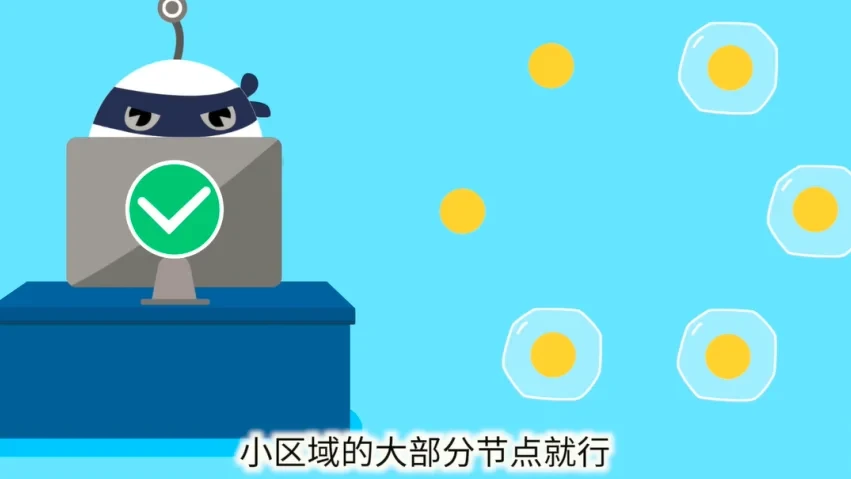
Therefore, another crucial mechanism in sharding technology is random distribution. It has a dedicated component responsible for generating random numbers and assigning nodes to other shards, randomly distributing nodes. This way, anyone trying to act maliciously would have a hard time knowing which nodes are in a particular region, greatly increasing the cost of malicious behavior. This allows sharding technology to solve efficiency and scalability issues while maintaining security and decentralization.
Overall, while sharding is currently one of the mainstream technologies used to address blockchain efficiency and scalability problems, because the technology originated from traditional internet databases, this solution cannot be directly applied to a decentralized blockchain. As a result, the sharding concept has been proposed for years but still hasn't been implemented.
However, thanks to its characteristics, once implemented, this technology could extremely likely accelerate the large-scale adoption of blockchain technology. So there have always been high expectations for it. Hopefully, as this technology matures, the blockchain world will also give rise to world-class super apps like Facebook and WeChat.
Special thanks to Ms. Xu Kun for her assistance and guidance on this episode.
Sina Weibo: @Xu Kun Alysa
The "OKX Blockchain 60 Lectures" is a blockchain educational animation series jointly produced by OKX and Sina Technology, designed for users with zero knowledge of blockchain. Through articles, educational animations, and other formats, it covers five major sections and 60 key points to vividly explain blockchain concepts from the perspectives of concepts, technology, and applications.
Disclaimer
This article may contain product-related content not applicable to your region. This article is committed to providing general information only and does not accept responsibility for any factual errors or omissions. This article represents the author's personal views only and does not represent the views of OKX. This article is not intended to provide any advice, including but not limited to: (i) investment advice or investment recommendations; (ii) offers or solicitations to buy, sell, or hold digital assets; or (iii) financial, accounting, legal, or tax advice. Holdings in digital assets (including stablecoins) involve a high degree of risk and may fluctuate significantly, or even become worthless. You should carefully consider whether trading or holding digital assets is appropriate for you based on your financial situation. For questions specific to your circumstances, please consult your legal/tax/investment professional. The information in this article (including market data and statistics, if any) is provided for general reference purposes only. Although we have taken all reasonable precautions in preparing this data and these charts, we accept no responsibility for any factual errors or omissions expressed herein. © 2025 OKX. This article may be reproduced or distributed in its entirety, or used in excerpts of 100 words or less, provided that such use is non-commercial in nature. Any reproduction or distribution of the full article must prominently state: "This article is copyrighted © 2025 OKX, used with permission." Permitted excerpts must cite the article title and include attribution, e.g., "Article Title, [Author Name (if applicable)], © 2025 OKX". Some content may have been generated or assisted by artificial intelligence (AI) tools. Derivative works and other uses of this article are not permitted.
Show More
Recommended Reading

OKX Blockchain 60 Lectures | Episode 43: The Rise of the Mining Industry (Part 2) — The Rise of Bitmain
Hello everyone, I'm Xiao K. Today we're going to talk about: "The Rise of the Mining Industry (Part 2) — The Rise of Bitmain". In the previous lesson, we discussed two people who opened the doors to mining industry capitalization and commercialization: one was Nanogui Zhang (Zhang Nan'geng), and the other was烤猫 (Jiang Xinyu). Although they jointly ushered in the golden age of the mining industry, the one who truly pushed the mining business to its peak was someone else — and that person's name is Wu Jihan.
2025年9月18日

OKX Blockchain 60 Lectures | Episode 2: Why Is Blockchain Called Blockchain?
The "OKX Blockchain 60 Lectures" is a blockchain educational animation series jointly produced by OKX and Sina Technology, designed for users with zero knowledge of blockchain. Through articles, educational animations, and other formats, it covers five major sections and 60 key points to vividly explain blockchain concepts from the perspectives of concepts, technology, and applications. The content of this episode was guided by Meng Yan, Deputy Dean of the Digital Assets Research Institute. In 2008, a global financial crisis erupted. On October 31st, "
2025年9月18日

OKX Blockchain 60 Lectures | Episode 16: What Is PoW Consensus Mechanism?
The "OKX Blockchain 60 Lectures" is a blockchain educational animation series jointly produced by OKX and Sina Technology, designed for users with zero knowledge of blockchain. Through articles, educational animations, and other formats, it covers five major sections and 60 key points to vividly explain blockchain concepts from the perspectives of concepts, technology, and applications. The content of this episode was guided by Huang Fangyu, Co-founder of Wanyou Computing Power. Hello everyone, I'm Xiao K. Today we're going to talk about:
2025年9月18日

OKX Blockchain 60 Lectures | Episode 51: 2019, Giants Enter the Arena — Facebook's Cryptocurrency Dream
Previously, we discussed how in 2018, as blockchain was hyped to an过度繁荣, a fervent wave of de-bubbling began, and the entire industry entered a winter. However, danger and opportunity coexist — this periodic downturn in the industry also happened to provide the best timing for international giants to enter the market. In February 2019, JPMorgan Chase, the Wall Street financial giant, officially sounded the horn for international giants to enter the blockchain space, followed by Goldman Sachs, UBS, Citigroup, Microsoft, and other giants.
2025年9月18日

OKX Blockchain 60 Lectures | Episode 7: What Does a Fork in the Blockchain Mean?
The "OKX Blockchain 60 Lectures" is a blockchain educational animation series jointly produced by OKX and Sina Technology, designed for users with zero knowledge of blockchain. Through articles, educational animations, and other formats, it covers five major sections and 60 key points to vividly explain blockchain concepts from the perspectives of concepts, technology, and applications. The content of this episode was guided by Boolean Economist (Bulfei Mo). A fork in the blockchain can be said to be a unique phenomenon in blockchain networks.
2025年9月18日

OKX Blockchain 60 Lectures | Episode 25: What Is the Lightning Network?
Hello everyone, I'm Xiao K. Today we're going to talk about: "What Is the Lightning Network"? The Lightning Network is a technology first proposed in 2015 by Joseph Poon and Thaddeus Dryja in a whitepaper to solve Bitcoin transaction congestion. This technology arose from a problem left over from Bitcoin's early days. Because when Bitcoin was originally designed, a
2025年9月18日