OKX Blockchain 60 Lectures | Episode 3: Characteristics of Blockchain - Decentralization
"OKX Blockchain 60 Lectures" is a blockchain education series jointly produced by OKX and Sina Tech. Targeted at users with zero blockchain background, it uses articles, animated videos, and other formats to provide an accessible introduction to blockchain concepts across five major sections and 60 knowledge points—from concepts to technology to applications. The content of this episode was guided by Dr. Liu Changyong, Ph.D. in Economics from Peking University.
From the PC internet to the mobile internet, from e-commerce to cloud computing, Alibaba at 20 years old can be said to have keen technical instincts, having not missed a single era-defining trend. This time, Alibaba has set its sights on blockchain. Jack Ma once said that for Alibaba, blockchain is not a gold mine, but a solution—and that Alibaba must have blockchain, because without it, people could die.
Of course, this statement may be somewhat exaggerated, but it is by no means empty talk. After all, history reminds us that Nokia did nothing wrong, yet it still lost. Currently, Alibaba is far from the only one bullish on blockchain: Tencent's blockchain invoices have already been piloted in Shenzhen, blockchain gaming projects are already live, JD.com's blockchain logistics, Baidu's public chain, and Huawei's blockchain plus cloud computing are all well underway. This naturally leads one to wonder—why are so many tech giants bullish on blockchain?
So today, Xiao K Jun will start from its characteristics: What advantages does blockchain have, and what makes it worthy of the青睐 of tech giants?
We all know that big data is a trend, and for tech giants, whoever can better manage data in the future will have the advantage. Blockchain acts as a database that can help solve this problem for them. What makes blockchain unique compared to internet databases is its decentralization—a feature that represents the single most important characteristic of blockchain. So, what exactly is centralization?
Let's use an example. The apps we use for everyday shopping are essentially centralized platforms. Whether you select a product or make payment, for both buyer and seller, there is an unavoidable role: the company that created the software. It can obtain all user data generated during the entire process, and can even determine whether a seller's store performs well (for example, through search rankings)—its power is immense, making it the central figure in the entire process. This is what centralization looks like.
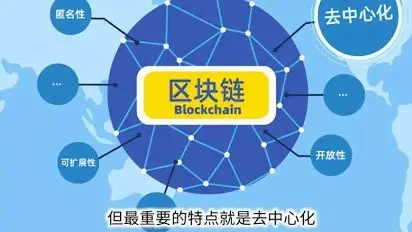
Decentralization, on the other hand, removes this central authority and distributes the power that previously belonged to the centralized entity. Users can freely engage in peer-to-peer trading with each other. For instance, data generated from user shopping can now be managed by users themselves, and centralized companies can only retrieve it—they have no right to view it at will. Similarly, whether a merchant succeeds or fails is entirely determined by users, and centralized companies cannot manipulate search rankings or influence merchant sales. This is what decentralization looks like.
The benefits of decentralization manifest in two aspects. First, it reduces network security risks. For example, in the traditional internet, all data is stored in a single central node—if a hacker targets and attacks that central node, the entire network can be destroyed. With decentralization, the network is maintained by multiple nodes, each with equal authority, so even if one node fails, it will not cause major disruption. Second, it disperses the power of centralized companies, preventing data monopolies and safeguarding user information privacy. In a sense, decentralization could be described as the communistization of the internet world.

The reason blockchain is favored by tech giants is also a reflection of the broader trend. As data becomes increasingly important and more people come to recognize its value, the distribution of data rights is ultimately inevitable (just think about the data monopoly companies in sci-fi movies—we certainly wouldn't want such a reality to come true). Therefore, whoever can best balance data processing efficiency with user information security will be best positioned for the future.
Special thanks to mentor Liu Changyong for his assistance and support in the creation of this episode.
Disclaimer
This article may contain product-related content that does not apply to your region. This article is committed to providing general information only and does not accept responsibility for any factual errors or omissions herein. This article represents the author's personal views only and does not represent the views of OKX. This article does not intend to provide any advice, including but not limited to: (i) investment advice or investment recommendations; (ii) offers or solicitations to purchase, sell, or hold digital assets; or (iii) financial, accounting, legal, or tax advice. Holding digital assets (including stablecoins) involves a high degree of risk and may be subject to significant price fluctuations, and may even become worthless. You should carefully consider whether trading or holding digital assets is appropriate for you based on your financial situation. For questions specific to your circumstances, please consult your legal/tax/investment professional. The information contained in this article (including market data and statistics, if any) is provided for general reference purposes only. Although we have taken all reasonable precautions in preparing such data and charts, we do not accept any responsibility for any factual errors or omissions expressed herein. © 2025 OKX. This article may be reproduced or distributed in its entirety, or excerpts of 100 words or less may be used, provided that such use is for non-commercial purposes only. Any reproduction or distribution of the full article must prominently state: "This article is copyrighted © 2025 OKX, used with permission." Permitted excerpts must cite the article title and include attribution, for example "Article Title, [Author Name (if applicable)], © 2025 OKX". Some content may have been generated or assisted by artificial intelligence (AI) tools. Derivative works and other uses of this article are not permitted.
Show More
Recommended Reading
OKX Blockchain 60 Lectures | Episode 43: The Rise of the Mining Sector (Part 2) — The Rise of Bitmain
Hello everyone, this is Xiao K Jun. Today we are going to cover: "The Rise of the Mining Sector (Part 2) — The Rise of Bitmain." In the last lesson, we discussed that two figures were responsible for opening the door to mining sector capitalization and commercialization: one was "Pumpkin Zhang"—Zhang Nangeng, and the other was "Fried Cat"—Jiang Xinyu. Although together they kicked off the golden age of the mining sector, the person who truly elevated the mining industry to its peak was someone else—Wu Jihan.
September 18, 2025

OKX Blockchain 60 Lectures | Episode 2: Why Is Blockchain Called Blockchain?
"OKX Blockchain 60 Lectures" is a blockchain education series jointly produced by OKX and Sina Tech. Targeted at users with zero blockchain background, it uses articles, animated videos, and other formats to provide an accessible introduction to blockchain concepts across five major sections and 60 knowledge points—from concepts to technology to applications. The content of this episode was guided by Meng Yan, Deputy Dean of the Digital Assets Research Institute. In 2008, a global financial crisis erupted. On October 31st, "
September 18, 2025

OKX Blockchain 60 Lectures | Episode 16: What Is the PoW Consensus Mechanism?
"OKX Blockchain 60 Lectures" is a blockchain education series jointly produced by OKX and Sina Tech. Targeted at users with zero blockchain background, it uses articles, animated videos, and other formats to provide an accessible introduction to blockchain concepts across five major sections and 60 knowledge points—from concepts to technology to applications. The content of this episode was guided by Huang Fangyu, Co-founder of Wanyou Computing Power. Hello everyone, this is Xiao K Jun. Today we are going to cover:
September 18, 2025

OKX Blockchain 60 Lectures | Episode 51: 2019, Tech Giants Enter the Arena — Facebook's Cryptocurrency Dream
Previously, we discussed how in 2018, as blockchain was being overly hyped, it underwent a dramatic de-bubble process and the entire industry entered a winter. However, crisis and opportunity coexist. This cyclical pullback happened to give international tech giants the best window to enter the market. In February 2019, Wall Street financial giant JPMorgan Chase sounded the clarion call for international giants entering the blockchain space. Since then, industry leaders such as Goldman Sachs, UBS, Citibank, and Microsoft have
September 18, 2025
OKX Blockchain 60 Lectures | Episode 7: What Does a Fork in the Blockchain Mean?
"OKX Blockchain 60 Lectures" is a blockchain education series jointly produced by OKX and Sina Tech. Targeted at users with zero blockchain background, it uses articles, animated videos, and other formats to provide an accessible introduction to blockchain concepts across five major sections and 60 knowledge points—from concepts to technology to applications. The content of this episode was guided by Austrian School economist Bu Feimo. A blockchain fork can be said to be a unique phe
September 18, 2025

OKX Blockchain 60 Lectures | Episode 25: What Is the Lightning Network?
Hello everyone, this is Xiao K Jun. Today we are going to cover: "What Is the Lightning Network"? The Lightning Network was first introduced in 2015 by Joseph Poon and Thaddeus Dryja in a white paper, as a technology designed to solve Bitcoin trading congestion. This technology originated from a problem left over from Bitcoin's early days. Because when Bitcoin was first designed, a
September 18, 2025