
OKX Blockchain 60 Lectures | Episode 31: What Is cryptocurrency Halving?
Hello everyone, this is Xiao K. Today we're going to talk about: "What is cryptocurrency halving?"
In simple terms, halving is actually a special mechanism in cryptocurrency. As we all know, Bitcoin was born during the 2008 financial crisis, and the root cause of that crisis was world-wide inflation caused by the expansion of the U.S. dollar. Against this backdrop, when Nakamoto was designing the economic model, naturally he wouldn't consider infinite-expansion currency models like those of the dollar or yen. So Bitcoin adopted a deflationary economic model with a fixed total supply from the start.
However, this created a new problem: how should Bitcoin be distributed into the market? To solve this, Nakamoto stipulated in Bitcoin's underlying consensus mechanism that all Bitcoin could only be initially obtained through mining. Each time a block is produced, miners receive a certain amount of Bitcoin as a reward. Furthermore, to prevent miners from mining too quickly and exhausting all Bitcoin in a short period, Nakamoto added a new mechanism — and this is Bitcoin's halving.
The specifics of Bitcoin halving are as follows:
In Bitcoin's blockchain network, starting from the first genesis block, a new block is produced on average every 10 minutes, and each block brings 50 Bitcoin into circulation.
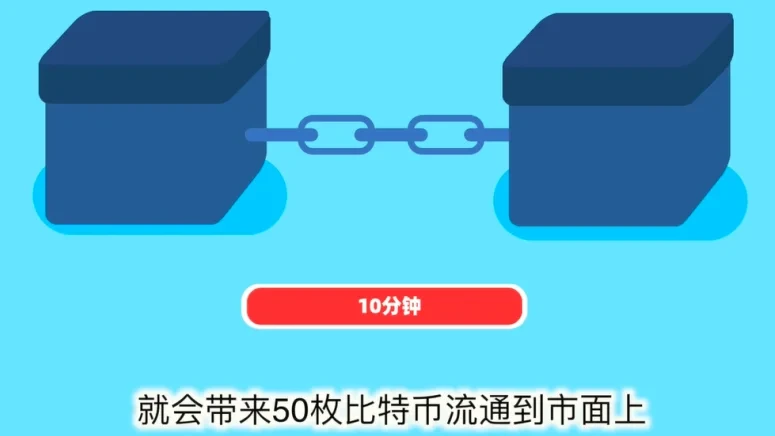
However, to ensure Bitcoin wouldn't flood the market all at once, Nakamoto also stipulated that for every 210,000 blocks produced — roughly every four years — the Bitcoin reward for each new block would be cut in half.
In other words, starting from block 210,001, each new block would bring only 25 Bitcoin into circulation. By block 420,001, it would drop to 12.5 Bitcoin, and so on. After 33 halving events, the reward per block would approach zero from 0.0021 Bitcoin.

Based on the data range supported by computer language, the calculated limit is 20,999,999.9769 BTC, approximately 21 million. Therefore, Bitcoin's total supply cap is 21 million coins.
The Bitcoin halving mechanism has played a crucial role in Bitcoin's success. The reason is that it allowed Bitcoin to effectively balance deflation and inflation in its early days. As we all know, if an item is completely deflationary, its liquidity will inevitably deteriorate over time. Conversely, if it experiences constant inflation, the item's value will decline.
Halving helped Bitcoin control the rate at which it entered the market in its early days — neither expanding too rapidly (which would devalue Bitcoin) nor becoming too deflationary (which would reduce its liquidity). This is why Bitcoin's "payment" value could shine in its early stages.
Additionally, this mechanism helped Bitcoin's blockchain network grow and strengthen. Early on, because Bitcoin's price was low, the reward amounts were higher, incentivizing more people to learn about and participate in the project. Later, as Bitcoin's price rose, mining rewards decreased, but transaction fees gradually increased, maintaining the size and stability of the network's hashrate.
So later, as Bitcoin's mechanism was validated by the market, many others adopted this approach. As a result, most cryptocurrencies on the market today have their own halving events.

In summary, when most people talk about halving today, they're not just referring to the halving mechanism itself — they're also referring to the market fluctuations that follow it. While speculation is human nature, I still hope everyone will stay grounded and never forget their original intent.
Disclaimer
This article may contain product-related content not applicable to your region. This article is provided for general informational purposes only and makes no representation as to any factual errors or omissions. The views expressed herein are solely those of the author and do not represent the views of OKX. This article is not intended to provide, and should not be relied upon as, legal, tax, investment, financial, or other advice, including but not limited to: (i) investment advice or investment recommendations; (ii) offers or solicitations to buy, sell, or hold digital assets; or (iii) financial, accounting, legal, or tax advice. Holding digital assets (including stablecoins) involves a high degree of risk and the value of such assets may fluctuate dramatically or even become worthless. You should carefully consider whether trading or holding digital assets is appropriate for you in light of your financial situation. Please consult your legal/tax/investment professionals regarding questions specific to your circumstances. Information provided in this article (including market data and statistics, if any) is for general reference only. While reasonable care has been taken in preparing such data and charts, we make no representation and accept no responsibility for any factual errors or omissions expressed herein. © 2025 OKX. This article may be reproduced or distributed in its entirety or in excerpts of 100 words or fewer, provided such use is non-commercial in nature. Any reproduction or distribution of the entire article must include the following attribution: "This article is copyrighted © 2025 OKX, used with permission." Permitted excerpts must cite the article name and include attribution, e.g., "Article name, [author name (if applicable)], © 2025 OKX." Some content may have been generated or assisted by artificial intelligence (AI) tools. Derivative works and other uses of this article are not permitted.
Show More
Recommended Reading

OKX Blockchain 60 Lectures | Episode 43: The Rise of the Mining Circle (Part 2) — The Rise of Bitmain
Hello everyone, this is Xiao K. Today we're going to talk about: "The Rise of the Mining Circle (Part 2) — The Rise of Bitmain." In the last lesson, we talked about two people who opened the door to capitalization and commercialization of the mining industry. One was "Pumpkin Zhang" — Zhang Nan-geng, and the other was "烤猫" (Fried Cat) — Jiang Xinyu. Although they jointly launched the golden age of the mining circle, it was someone else who truly brought the mining industry to its peak — and his name is Wu Jihan.
September 18, 2025

OKX Blockchain 60 Lectures | Episode 2: Why Is Blockchain Called Blockchain?
"OKX Blockchain 60 Lectures" is a blockchain education animation series co-produced by OKX and Sina Technology. Aimed at users with zero blockchain knowledge, it uses articles and animated videos to vividly explain blockchain concepts through five major sections and 60 knowledge points, covering concepts, technology, and applications. The content for this episode was guided by Meng Yan, Deputy Dean of the Digital Assets Research Institute. In 2008, a global financial crisis erupted. On October 31st, "
September 18, 2025

OKX Blockchain 60 Lectures | Episode 16: What Is the PoW Consensus Mechanism?
"OKX Blockchain 60 Lectures" is a blockchain education animation series co-produced by OKX and Sina Technology. Aimed at users with zero blockchain knowledge, it uses articles and animated videos to vividly explain blockchain concepts through five major sections and 60 knowledge points, covering concepts, technology, and applications. The content for this episode was guided by Huang Fangyu, Co-founder of Wanyou Computing Power. Hello everyone, this is Xiao K. Today we're going to talk about:
September 18, 2025

OKX Blockchain 60 Lectures | Episode 51: 2019, Giants Enter the Scene — Facebook's cryptocurrency Dream
Previously, we discussed how 2018 saw blockchain's over-hyped prosperity give way to a dramatic de-bubble process, plunging the entire industry into a winter. But crisis and opportunity coexist — this cyclical downturn恰好 provided international giants with the perfect window to enter the market. In February 2019, Wall Street financial beast JPMorgan Chase sounded the horn for international giants entering the blockchain space, followed by Goldman Sachs, UBS, Citigroup, Microsoft, and other industry titans.
September 18, 2025

OKX Blockchain 60 Lectures | Episode 7: What Does a Blockchain Fork Mean?
"OKX Blockchain 60 Lectures" is a blockchain education animation series co-produced by OKX and Sina Technology. Aimed at users with zero blockchain knowledge, it uses articles and animated videos to vividly explain blockchain concepts through five major sections and 60 knowledge points, covering concepts, technology, and applications. The content for this episode was guided by Ludwig von Mises economist Boolean Fee Ink. A blockchain fork can be described as a unique phenomenon in blockchain networks —
September 18, 2025

OKX Blockchain 60 Lectures | Episode 25: What Is the Lightning Network?
Hello everyone, this is Xiao K. Today we're going to talk about: "What Is the Lightning Network?" The Lightning Network refers to a technology first proposed in a whitepaper by Joseph Poon and Thaddeus Dryja in 2015 to solve Bitcoin trading congestion. This technology originated from a problem left over from Bitcoin's early design. Because when Bitcoin was originally designed, a
September 18, 2025