
OKX Blockchain 60 Lectures | Episode 56: What is Blockchain + Cross-border Payment
Hello everyone, I'm Xiao K. Today we're going to talk about: "What is Blockchain + Cross-border Payment"?
The so-called "blockchain + cross-border payment" refers to applying blockchain technology to the cross-border payment field. Blockchain + cross-border payment is a disruptive application scenario, and it may even reconstruct the existing international financial network. Why do we say this? The reason is that blockchain technology can bypass the existing SWIFT system and completely solve the fund settlement issues in cross-border transfers.
Let us explain this in detail below.
Regarding traditional cross-border transfer methods, typically we need to go to a bank counter, fill out relevant wire transfer forms, and then wait at least one to two weeks for the money to be transferred. For large trade wire transfers, this cycle takes even longer. The reason it takes so long is that our funds, during the transfer process, need to go through an institution called "SWIFT." "SWIFT" stands for Society for Worldwide Interbank Financial Telecommunication and mainly provides settlement services for banks around the world.
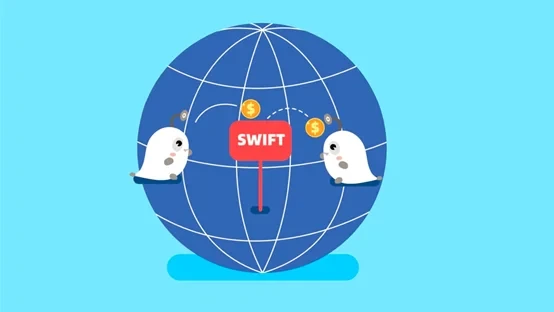
When Bank A wants to transfer money to Bank C, during SWIFT processing, it does not directly complete the transfer from A to C. Instead, it first matches interbank accounts using SWIFT's user lending relationships, account associations, and other connections, then matches an optimal path and transfers the money layer by layer. The entire path goes from Bank A to Bank B, then to Bank C.
When the transfer amount is relatively large, the funds may need to be split into many smaller transfers, each completed through different paths, with each portion of funds also requiring a new path match and going through the A-B-C process. Additionally, at each step of the funds journey, every bank involved needs to be settled once again through SWIFT's centralized system, which results in traditional cross-border transfers having drawbacks such as complicated processes and long cycles.

When blockchain technology is applied in the cross-border payment field, it is completely different. It essentially reconstructs a new decentralized transfer network, bypassing the SWIFT network, and based on the nature of blockchain networks, the data is transparent, verifiable, and tamper-proof.
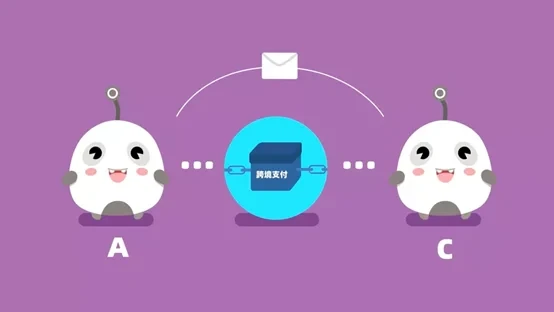
Furthermore, when blockchain handles cross-border payments, the fundamental difference from the traditional SWIFT network is that SWIFT is essentially the transfer of cash, while blockchain is essentially the transfer of information. When using blockchain for cross-border transfers, the funds go directly from A to C, and even the slowest public chain on blockchain can complete transfers within one hour, with no long trading delays. Therefore, applying blockchain to cross-border payments is truly groundbreaking.
Currently, blockchain + cross-border payment is a huge market of 25 to 30 trillion USD. Major domestic and international financial giants such as Ant Group and JPMorgan have already launched related products. It is believed that as cross-border payments combine with blockchain technology in the future, the next financial blue ocean will emerge, building a brand-new financial era.
Special thanks to Professor Chang Yong for his assistance and guidance on this episode.
– END –
Disclaimer
This article may contain product-related content that is not applicable to your region. This article is committed to providing general information only and does not accept responsibility for any factual errors or omissions. This article represents the author's personal views only and does not represent the views of OKX. This article is not intended to provide any advice, including but not limited to: (i) investment advice or investment recommendations; (ii) offers or solicitations to purchase, sell, or hold digital assets; or (iii) financial, accounting, legal, or tax advice. Holding digital assets (including stablecoins) involves high risk and may fluctuate significantly, or even become worthless. You should carefully consider whether trading or holding digital assets is suitable for you based on your financial situation. For questions about your specific circumstances, please consult your legal/tax/investment professional. The information in this article (including market data and statistical information, if any) is for general reference only. Although we have taken all reasonable precautions in preparing such data and charts, we do not accept any responsibility for any factual errors or omissions expressed herein. © 2025 OKX. This article may be reproduced or distributed in its entirety, or excerpts of 100 words or less may be used, provided that such use is non-commercial. Any reproduction or distribution of the full article must also prominently state: "This article is copyrighted © 2025 OKX, used with permission." Permitted excerpts must cite the article name and include the source, for example "Article name, [author name (if applicable)], © 2025 OKX." Some content may have been generated or assisted by artificial intelligence (AI) tools. Derivative works and other uses of this article are not permitted.
Show More
Recommended Reading

OKX Blockchain 60 Lectures | Episode 43: The Rise of the Mining Circle (Part 2) — The Rise of Bitmain
Hello everyone, I'm Xiao K. Today we're going to talk about: "The Rise of the Mining Circle (Part 2) — The Rise of Bitmain." In the previous lesson, we discussed that there are two people who opened the door to capitalization and commercialization of the mining circle. One is "Pumpkin Zhang" — Zhang Nangeng, and the other is "Fried Cat" — Jiang Xinyu. Although they jointly inaugurated the golden era of the mining circle, it was someone else who truly pushed the mining industry to its peak, and this person's name is Wu Jihan.
2025年9月18日

OKX Blockchain 60 Lectures | Episode 2: Why is Blockchain Called Blockchain?
"OKX Blockchain 60 Lectures" is a blockchain science animation video jointly produced by OKX and Sina Technology, aimed at users with zero knowledge of blockchain. Through series of articles, science animations, and other forms, it popularizes blockchain concepts vividly from the perspectives of concepts, technology, and applications through 5 major sections and 60 knowledge points. The content of this episode was guided by Meng Yan, Deputy Dean of the Digital Assets Research Institute. In 2008, a global financial crisis erupted. On October 31st, "
2025年9月18日

OKX Blockchain 60 Lectures | Episode 16: What is PoW Consensus Mechanism
"OKX Blockchain 60 Lectures" is a blockchain science animation video jointly produced by OKX and Sina Technology, aimed at users with zero knowledge of blockchain. Through series of articles, science animations, and other forms, it popularizes blockchain concepts vividly from the perspectives of concepts, technology, and applications through 5 major sections and 60 knowledge points. The content of this episode was guided by Huang Fangyu, Co-founder of Wanyou Computing Power. Hello everyone, I'm Xiao K. Today we're going to talk about:
2025年9月18日

OKX Blockchain 60 Lectures | Episode 51: 2019, Giants Enter the Market, Facebook's Cryptocurrency Dream
Previously, we discussed that in 2018, as blockchain was hyped to be overly prosperous, it began a vigorous de-bubble process, and the entire industry entered a winter. However, danger and opportunity coexist. This cyclical retreat of the industry also happened to give international giants the best timing to enter the market. In February 2019, Wall Street financial beast JPMorgan Chase completely sounded the horn for international giants to enter the blockchain field. Subsequently, giants such as Goldman Sachs, UBS, Citigroup, and Microsoft
2025年9月18日

OKX Blockchain 60 Lectures | Episode 7: What Does a Fork in the Blockchain Mean?
"OKX Blockchain 60 Lectures" is a blockchain science animation video jointly produced by OKX and Sina Technology, aimed at users with zero knowledge of blockchain. Through series of articles, science animations, and other forms, it popularizes blockchain concepts vividly from the perspectives of concepts, technology, and applications through 5 major sections and 60 knowledge points. The content of this episode was guided by Bulan Feimo, an Austrian School economist. A fork in the blockchain can be said to be a unique phe
2025年9月18日

OKX Blockchain 60 Lectures | Episode 25: What is Lightning Network?
Hello everyone, I'm Xiao K. Today we're going to talk about: "What is Lightning Network"? The Lightning Network is a technology first proposed in 2015 by Joseph Poon and Thaddeus Dryja in a whitepaper to solve Bitcoin transaction congestion. This technology originated from a problem left over from Bitcoin's early days. Because when Bitcoin was initially designed, a
2025年9月18日