OKX Blockchain 60 Lessons | Episode 59: What is Blockchain + Finance?
Hello everyone, I'm Xiao K. Today we're going to talk about: "What is Blockchain + Finance"?
The financial sector is arguably the most important application scenario for blockchain — bar none. Why is that? Because blockchain can solve the trust problem in finance.
This trust manifests in two aspects. One is the trust issue regarding data. For example, when we hand funds over to a financial institution to manage, the institution's processing is actually opaque — like a black box. We only know the final result, how much profit was made, but have no way to truly understand where the institution allocated the funds.

The other aspect is the trust issue between people. As we all know, not everyone has access to the convenience of financial services — there are barriers to financial participation. Just as you wouldn't lend money to someone who lacks the ability to repay, banks won't lend to someone with a history of default. This is a credit trust issue between people.
Nakamoto addressed these problems in the whitepaper right from the birth of blockchain. The essence of blockchain is an immutable, decentralized database. Information recorded on-chain is not collected or compiled by a single organization or institution — there is no manager or centralized management concept. Trading parties can directly engage in Trading, which reduces excessive trading costs, management costs, and the risks associated with centralized management in the social credit system. The trust mechanism it establishes is more robust and more reliable than the credit management mechanisms under centralized management.
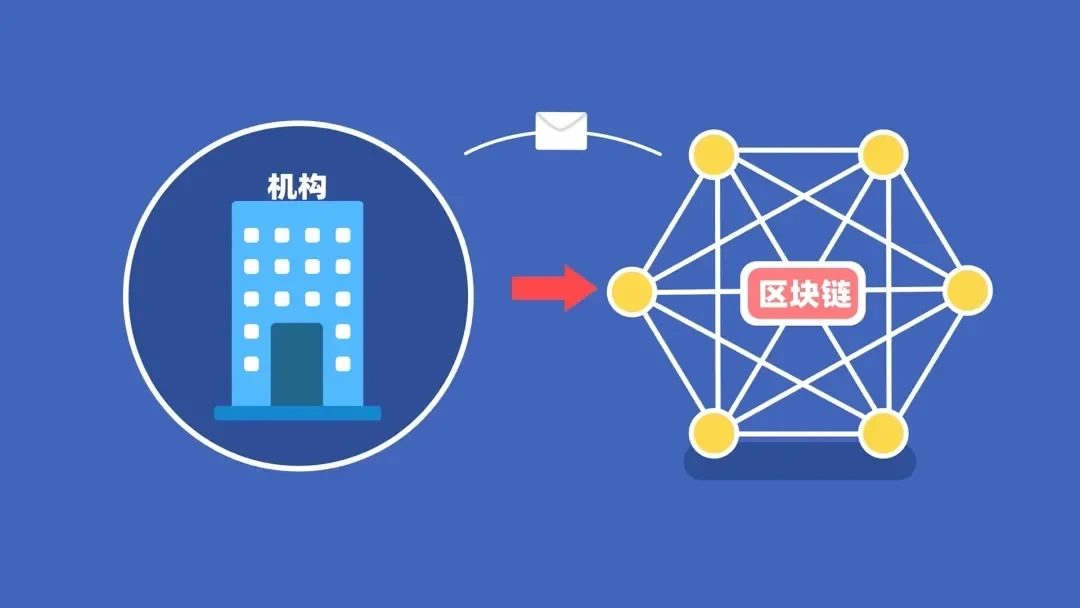
When financial institutions use blockchain technology to record data on a distributed ledger, the data is encrypted through a hashing algorithm and becomes tamper-proof. Every participant in the blockchain can access all on-chain information in real time — data is transparent and traceable on-chain. Whenever we want to track the destination of each fund, we can trace it clearly through the blockchain. This effectively solves the information asymmetry problem in the social credit system, also known as the black box problem of financial institutions.
Additionally, blockchain can decentralize existing financial models through the form of smart contracts. For example, the familiar banking lending process can eliminate the bank entirely — smart contracts programmed with code can take over the bank's role of receiving and releasing funds. The entire process has no participation barriers, and lending profits are returned to users, essentially transferring the profits that would have gone to banks to all participants. This truly achieves decentralization and barrier-free access.

Currently, Blockchain + Finance has become a trend. More than 50 banks worldwide have bet on blockchain technology, including the Industrial and Commercial Bank of China and China Construction Bank that we are familiar with. Moreover, decentralized finance (DeFi) is also thriving, growing from an initial scale of just over one billion dollars to a trillion-dollar scale. It is believed that in the future, Blockchain + Finance will open a brand-new market and truly achieve the blockchain revolution.
Special thanks to Liu Changyong for his assistance and guidance on this episode.
– END –
Disclaimer
This article may contain product-related content that does not apply to your region. This article is committed to providing general information only and does not accept responsibility for any factual errors or omissions. This article represents the author's personal views only and does not represent OKX's views. This article is not intended to provide any advice, including but not limited to: (i) investment advice or investment recommendations; (ii) offers or solicitations to buy, sell, or hold digital assets; or (iii) financial, accounting, legal, or tax advice. Holding digital assets (including stablecoins) involves a high level of risk and may be subject to significant volatility, or may even become worthless. You should carefully consider whether trading or holding digital assets is suitable for you based on your financial situation. For questions specific to your circumstances, please consult your legal/tax/investment professional. The information in this article (including market data and statistical information, if any) is provided for general reference purposes only. Although we have taken all reasonable precautions in preparing such data and charts, we do not accept any responsibility for factual errors or omissions expressed herein. © 2025 OKX. This article may be reproduced or distributed in its entirety, or excerpts of 100 words or less may be used, provided that such use is non-commercial in nature. Any reproduction or distribution of the full article must prominently state: "This article is copyrighted © 2025 OKX, used with permission." Permitted excerpts must cite the article title and include attribution, e.g., "Article Title, [Author Name (if applicable)], © 2025 OKX". Some content may be generated or assisted by artificial intelligence (AI) tools. Derivative works and other uses of this article are not permitted.
Show More
Recommended Reading
OKX Blockchain 60 Lessons | Episode 43: The Rise of the Mining Circle (Part 2) — The Rise of Bitmain
Hello everyone, I'm Xiao K. Today we're going to talk about: "The Rise of the Mining Circle (Part 2) — The Rise of Bitmain." In the last lesson, we talked about two people who opened the door to the commercialization of the mining circle — one was "Pumpkin Zhang" (Zhang Nanmeng) and the other was "烤猫" (Jiang Xinyu). Although they jointly ushered in the golden age of the mining circle, it was someone else who truly took the mining industry to its peak — and that person's name is Wu Jihan.
2025年9月18日

OKX Blockchain 60 Lessons | Episode 2: Why Is Blockchain Called Blockchain?
"OKX Blockchain 60 Lessons" is a blockchain educational animation series jointly produced by OKX and Sina Technology, designed for users with zero knowledge of blockchain. Through articles, educational animations, and other formats, it covers blockchain concepts from the perspectives of concepts, technology, and applications, using 5 major sections and 60 knowledge points to vividly and clearly explain blockchain concepts. The content of this episode was guided by Meng Yan, Deputy Dean of the Digital Assets Research Institute. In 2008, a global financial crisis erupted. On October 31st, "
2025年9月18日

OKX Blockchain 60 Lessons | Episode 16: What Is the PoW Consensus Mechanism?
"OKX Blockchain 60 Lessons" is a blockchain educational animation series jointly produced by OKX and Sina Technology, designed for users with zero knowledge of blockchain. Through articles, educational animations, and other formats, it covers blockchain concepts from the perspectives of concepts, technology, and applications, using 5 major sections and 60 knowledge points to vividly and clearly explain blockchain concepts. The content of this episode was guided by Huang Fangyu, Co-founder of Wanyou Computing Power. Hello everyone, I'm Xiao K. Today we're going to talk about:
2025年9月18日

OKX Blockchain 60 Lessons | Episode 51: 2019, Giants Enter the Scene — Facebook's Cryptocurrency Dream
Previously, we discussed how in 2018, as blockchain was hyped to excessive prosperity, a grand de-bubbling process began and the entire industry entered a winter. However, opportunities coexist with dangers. This cyclical downturn in the industry coincidentally provided the optimal timing for international giants to enter the market. In February 2019, JPMorgan Chase, a Wall Street financial giant, officially sounded the horn for international giants to enter the blockchain field, followed by Goldman Sachs, UBS, Citigroup, Microsoft, and other giants.
2025年9月18日
OKX Blockchain 60 Lessons | Episode 7: What Does a Fork in the Blockchain Mean?
"OKX Blockchain 60 Lessons" is a blockchain educational animation series jointly produced by OKX and Sina Technology, designed for users with zero knowledge of blockchain. Through articles, educational animations, and other formats, it covers blockchain concepts from the perspectives of concepts, technology, and applications, using 5 major sections and 60 knowledge points to vividly and clearly explain blockchain concepts. The content of this episode was guided by Boolean费墨 (Burkhardt), an Austrian School economist. A fork in the blockchain can be described as a unique pheno
2025年9月18日

OKX Blockchain 60 Lessons | Episode 25: What Is the Lightning Network?
Hello everyone, I'm Xiao K. Today we're going to talk about: "What Is the Lightning Network"? The Lightning Network is a technology first proposed in 2015 by Joseph Poon and Thaddeus Dryja in a whitepaper, designed to solve Bitcoin trading congestion. This technology originated from a problem left over from Bitcoin's early design. Because when Bitcoin was first created, one
2025年9月18日