
OKX Blockchain 60 Lectures | Episode 8: Classification of Blockchain
"OKX Blockchain 60 Lectures" is a blockchain educational animation video co-produced by OKX & Sina Tech, targeting users with zero knowledge of blockchain. Through series articles, educational animations, and other forms, it explains blockchain concepts vividly from the perspectives of concepts, technology, and applications, covering 5 major sections and 60 knowledge points. This episode's content was completed under the guidance of Dong Zhao, founder of D Fund.
We all know that blockchain was originally the underlying application model of Bitcoin. However, later on, people discovered that this technology indeed has unique features. Without any company leading it, the Bitcoin system has been operating autonomously from 2009 to the present and has never been breached. Consequently, everyone separated blockchain, improved it, and applied it to other fields such as finance, logistics, and more.
Blockchain itself is a large distributed database that ensures the overall system's security and decentralization by having more people keep records. The more people keeping records, the stronger the decentralization and the higher the security, but the slower the system's processing efficiency, and vice versa.
Because blockchain is applied in different fields, some fields require more security, while others focus more on efficiency. This has led to the emergence of various improved versions of blockchain on the market. Based on the degree of openness to nodes, blockchain is currently mainly divided into three types: public chains, private chains, and consortium chains.
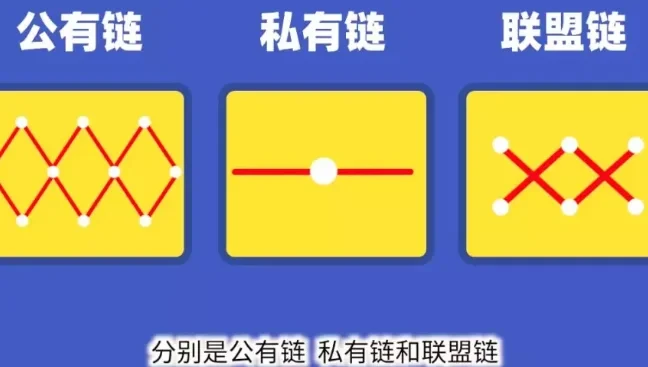
A public chain, also known as a public blockchain, refers to a consensus blockchain where anyone in the world can read, send transactions, and transactions can receive effective confirmation. It is fully open to the entire network, and users can join or leave the network at any time without authorization.
It's somewhat like a public ledger where everyone keeps records together. It's open to anyone, and everyone can freely join or leave the blockchain network, obtain complete data from the ledger, and participate in the blockchain's data maintenance and computational competition. Data is recorded jointly by everyone, fair and transparent, and cannot be tampered with. It has the strongest decentralization nature.

A private chain is the opposite of a public chain. It is a completely private blockchain, referring to a blockchain where write permissions are entirely in the hands of one organization. All nodes participating in this blockchain are strictly controlled and only open to individuals who meet specific conditions. It's somewhat like a private ledger belonging to an individual or company, open only to internal use by the individual or enterprise.
In certain application scenarios, developers do not want anyone to be able to participate in this system. Therefore, they established a private blockchain that is not publicly accessible, where only permitted nodes can participate and view all data. Private chains have a limited number of nodes and are easy to control, so they have the highest processing efficiency but the weakest decentralization. They can be used to solve data management and auditing issues for financial institutions, governments, and large enterprises.

A consortium chain falls between the two, being a consortium blockchain, referring to a blockchain jointly managed by several organizations or institutions. Each organization or institution controls one or more nodes, jointly records transaction data, and only these organizations and institutions can read and write data in the consortium chain and send transactions.
It's somewhat like a consortium formed by multiple companies, using a common ledger for their internal use. Data is jointly maintained by members within the consortium and is open only to internal members of the organization. Its degree of decentralization is moderate; it can be described as multi-center. In terms of efficiency, it is stronger than public chains but weaker than private chains.

In summary, different types of blockchain serve different purposes. Public chains are more inclined toward public infrastructure, while private chains and consortium chains are more inclined toward applications for enterprises or organizations. Each has its unique strengths, and the future will certainly be an era of parallel multi-chain operation and a hundred schools of thought contending.
Thanks to Teacher Dong Zhao for his help and guidance with this episode's content.
Disclaimer
This article may contain product-related content that is not applicable to your region. This article is intended to provide general information only and does not assume responsibility for any factual errors or omissions contained therein. This article represents only the author's personal views and does not represent the views of OKX. This article is not intended to provide any advice, including but not limited to: (i) investment advice or investment recommendations; (ii) offers or solicitations to buy, sell, or hold digital assets; or (iii) financial, accounting, legal, or tax advice. Holding digital assets (including stablecoins) involves high risk, may fluctuate significantly, and may even become worthless. You should carefully consider whether trading or holding digital assets is suitable for you based on your financial situation. For questions regarding your specific situation, please consult your legal/tax/investment professional. The information appearing in this article (including market data and statistics, if any) is for general reference only. Although we have taken all reasonable precautions in preparing these data and charts, we assume no responsibility for any factual errors or omissions expressed herein. © 2025 OKX. This article may be reproduced or distributed in full, or excerpts of 100 words or less from this article may be used, provided that such use is non-commercial. Any reproduction or distribution of the entire article must also prominently state: "© 2025 OKX, used with permission." Permitted excerpts must cite the article name and include attribution, such as "Article Name, [Author Name (if applicable)], © 2025 OKX". Some content may be generated or assisted by artificial intelligence (AI) tools. Derivative works or other uses of this article are not permitted.
Show More
Recommended Reading

OKX Blockchain 60 Lectures | Episode 43: The Rise of the Mining Circle (Part 2) — The Rise of Bitmain
Hello everyone, I'm Xiao K. Today we're going to talk about: "The Rise of the Mining Circle (Part 2) — The Rise of Bitmain." In the last class, we talked about two people who opened the door to mining capital and commercialization: one was Pumpkin Zhang—Zhang Nangeng, and the other was Roasted Cat—Jiang Xinyu. Although they jointly started the golden era of the mining circle, the person who truly pushed the mining industry to its peak was someone else, and this person's name is Wu Jihan.
September 18, 2025

OKX Blockchain 60 Lectures | Episode 2: Why Is Blockchain Called Blockchain?
"OKX Blockchain 60 Lectures" is a blockchain educational animation video co-produced by OKX & Sina Tech, targeting users with zero knowledge of blockchain. Through series articles, educational animations, and other forms, it explains blockchain concepts vividly from the perspectives of concepts, technology, and applications, covering 5 major sections and 60 knowledge points. This episode's content was completed under the guidance of Teacher Meng Yan, Vice Dean of the Digital Assets Research Institute. In 2008, a global financial crisis broke out. On October 31, "
September 18, 2025

OKX Blockchain 60 Lectures | Episode 16: What Is the PoW Consensus Mechanism
"OKX Blockchain 60 Lectures" is a blockchain educational animation video co-produced by OKX & Sina Tech, targeting users with zero knowledge of blockchain. Through series articles, educational animations, and other forms, it explains blockchain concepts vividly from the perspectives of concepts, technology, and applications, covering 5 major sections and 60 knowledge points. This episode's content was completed under the guidance of Mentor Huang Fangyu, co-founder of Wan You Computing Power. Hello everyone, I'm Xiao K. Today we're going to talk about:
September 18, 2025

OKX Blockchain 60 Lectures | Episode 51: 2019, Giants Enter, Facebook's Cryptocurrency Dream
Previously we talked about how in 2018, as blockchain was hyped into excessive prosperity, it began a vigorous de-foaming process, and the entire industry entered a harsh winter. However, crisis and opportunity coexist. This cyclical downturn in the industry happened to provide the best timing for international giants to enter. In February 2019, Wall Street financial beast JPMorgan Chase thoroughly sounded the clarion call for international giants entering the blockchain field. Thereafter, Goldman Sachs, UBS, Citigroup, Microsoft, and other giants
September 18, 2025

OKX Blockchain 60 Lectures | Episode 7: What Does a Fork in Blockchain Mean?
"OKX Blockchain 60 Lectures" is a blockchain educational animation video co-produced by OKX & Sina Tech, targeting users with zero knowledge of blockchain. Through series articles, educational animations, and other forms, it explains blockchain concepts vividly from the perspectives of concepts, technology, and applications, covering 5 major sections and 60 knowledge points. This episode's content was completed under the guidance of Mentor Buer Feimo, an Austrian School economist. The so-called blockchain fork can be said to be unique to blockchain networks, one
September 18, 2025

OKX Blockchain 60 Lectures | Episode 25: What Is the Lightning Network?
Hello everyone, I'm Xiao K. Today we're going to talk about: "What Is the Lightning Network"? The so-called Lightning Network was first proposed in a white paper in 2015 by Joseph Poon and Thaddeus Dryja as a technology to solve Bitcoin transaction congestion. The origin of this technology stems from a problem left over from Bitcoin's early days. Because when Bitcoin was first designed, one
September 18, 2025