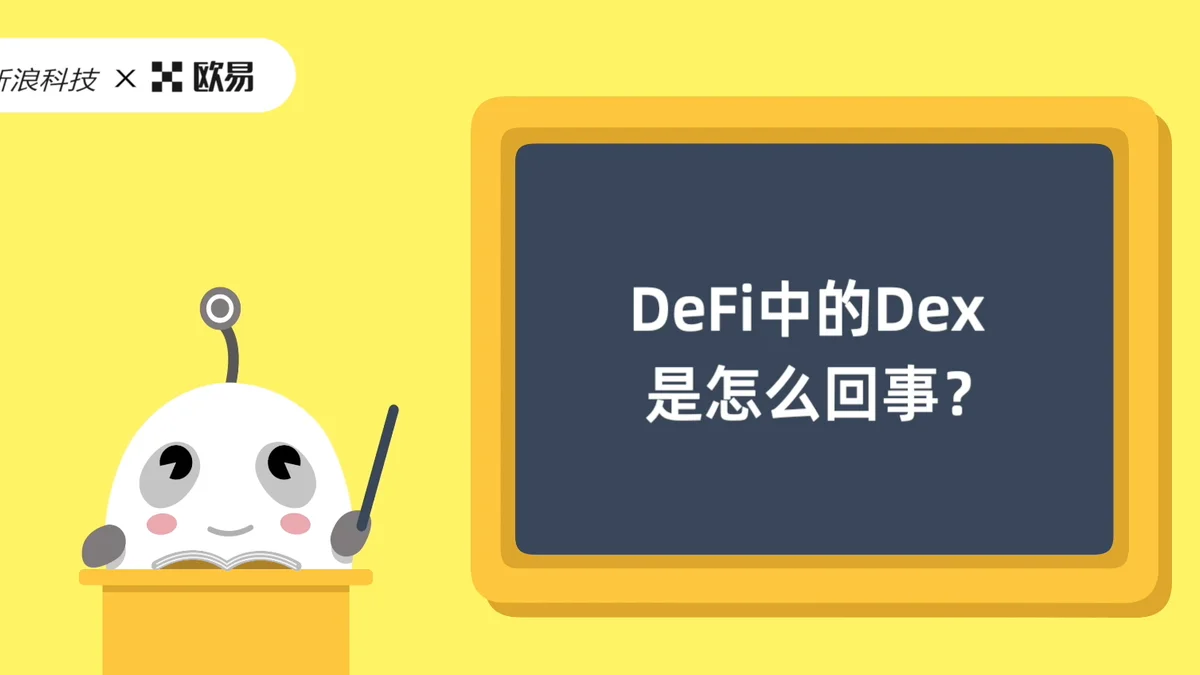
OKX Blockchain 60 Lectures | DeFi Episode 4: How Do DEXs Work in DeFi?
Hello everyone, this is Xiao K. Today we will be discussing: "How Do DEXs Work in DeFi"?
Hello everyone, this is Xiao K. Today we will be discussing: "How Do DEXs Work in DeFi"?
In the previous lesson, we covered aggregators, which are an alternative to funds in the DeFi world. In this lesson, we will share another important area of DeFi — DEX. DEX stands for Decentralized Exchange, which refers to a decentralized trading venue.
In the previous lesson, we covered aggregators, which are an alternative to funds in the DeFi world. In this lesson, we will share another important area of DeFi — DEX. DEX stands for Decentralized Exchange, which refers to a decentralized trading venue.
As we all know, in traditional finance, if you want to buy stocks of companies like Alibaba or Tencent, you need to go to a securities exchange in the United States. Similarly, if you want to purchase digital assets like Bitcoin or Ethereum, you need to go to a cryptocurrency exchange. DEX is essentially the counterpart of cryptocurrency exchanges within the DeFi ecosystem. By using smart contracts and on-chain trading to eliminate the need for third-party institutions, DEXs perform the function of order matching, thereby ensuring fairness and transparency in trading.
As we all know, in traditional finance, if you want to buy stocks of companies like Alibaba or Tencent, you need to go to a securities exchange in the United States. Similarly, if you want to purchase digital assets like Bitcoin or Ethereum, you need to go to a cryptocurrency exchange. DEX is essentially the counterpart of cryptocurrency exchanges within the DeFi ecosystem. By using smart contracts and on-chain trading to eliminate the need for third-party institutions, DEXs perform the function of order matching, thereby ensuring fairness and transparency in trading.
Below, we will specifically discuss the differences between traditional cryptocurrency exchanges and DEXs:
Below, we will specifically discuss the differences between traditional cryptocurrency exchanges and DEXs:
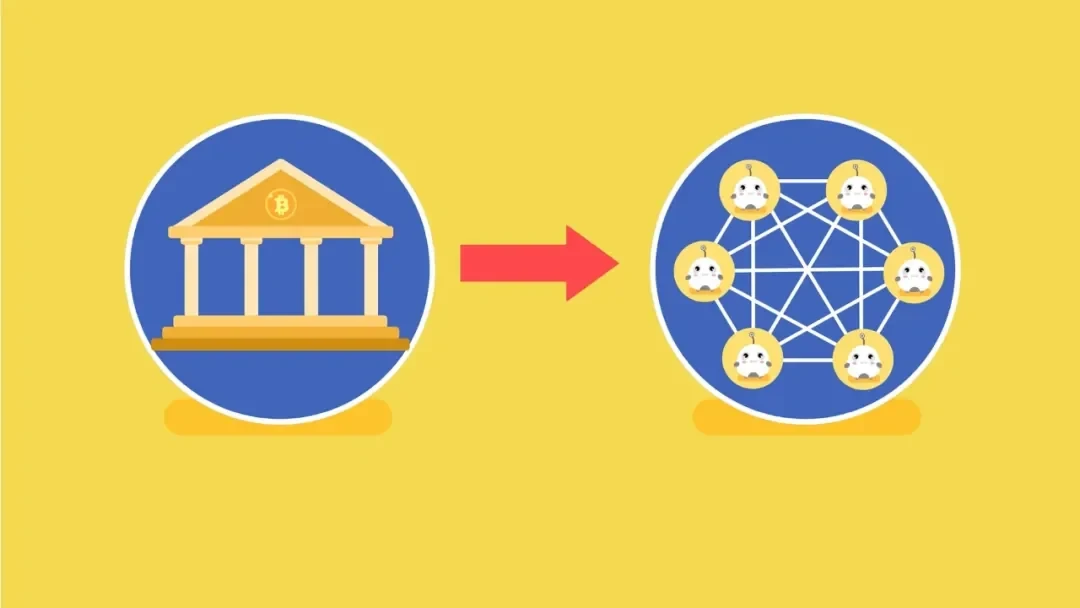
In traditional cryptocurrency markets, when users trade with each other, they place various buy and sell orders. The exchange provides a dedicated platform operated by a third-party team, matching buy and sell orders through the platform to help users complete their trades. Throughout this entire process, users' assets are held in the exchange and managed by the exchange on their behalf.
In traditional cryptocurrency markets, when users trade with each other, they place various buy and sell orders. The exchange provides a dedicated platform operated by a third-party team, matching buy and sell orders through the platform to help users complete their trades. Throughout this entire process, users' assets are held in the exchange and managed by the exchange on their behalf.
However, over time, this gave rise to a new problem — people felt that exchanges were like a black box, with opaque data and no way to verify whether they actually held sufficient reserve funds. As a result, someone proposed using pre-programmed smart contracts to replace the original third-party trading platform and perform the order-matching function. This is how decentralized exchanges came into existence.
However, over time, this gave rise to a new problem — people felt that exchanges were like a black box, with opaque data and no way to verify whether they actually held sufficient reserve funds. As a result, someone proposed using pre-programmed smart contracts to replace the original third-party trading platform and perform the order-matching function. This is how decentralized exchanges came into existence.
However, traditional exchanges, in order to ensure stable and smooth trading, will specifically seek professional market-making teams to ensure order depth for buyers and sellers. But decentralized exchanges, due to the absence of third-party market makers, result in large price spreads between user trades. For example, something with a market price of 100 yuan, due to insufficient order depth and no one selling at the 100 price level, must have the price raised to 200 yuan before a transaction can be executed. This causes users to lose money before they even trade.

To solve this problem, decentralized exchanges developed a special mechanism — the liquidity pool. This pool functions as a reserve fund for decentralized exchanges, where users first deposit their funds, and all subsequent trades are conducted through this pool for digital asset swaps. The pool provides order book depth, thereby ensuring trading stability.
Additionally, the funds in this pool can be provided by anyone without restrictions and can be withdrawn at any time. Decentralized exchanges also reward liquidity providers by returning a certain percentage of trading fees to them, encouraging everyone to contribute liquidity. Therefore, compared to traditional centralized exchanges, decentralized exchanges are essentially powered by everyone "making the market" together, collectively maintaining trading stability and depth.
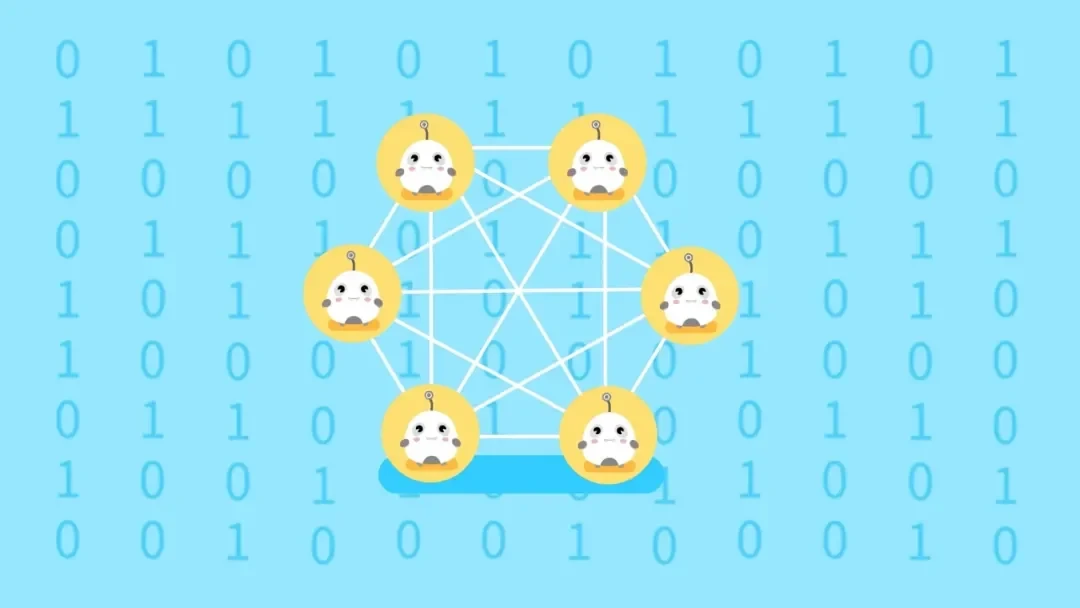
Overall, both centralized and decentralized exchanges have their own respective advantages. Decentralized exchanges offer greater data transparency and fairer rules, while centralized exchanges provide faster efficiency and a better user experience. It is believed that for a long time to come, the two will complement each other, and through competition and cooperation, deliver a better financial investment experience for everyone.
Special thanks to Shentu Qingchun for his assistance and guidance on this episode.
Weibo: @申屠青春
– END –
Disclaimer
This article may contain product-related content that is not applicable to your region. This article is intended to provide general information only and does not assume responsibility for any factual errors or omissions therein. This article represents only the author's personal views and does not represent the views of OKX. This article is not intended to provide any of the following advice, including but not limited to: (i) investment advice or investment recommendations; (ii) offers or solicitations to buy, sell, or hold digital assets; or (iii) financial, accounting, legal, or tax advice. Holding digital assets (including stablecoins) involves high risk, may fluctuate significantly, and may even become worthless. You should carefully consider whether trading or holding digital assets is suitable for you based on your financial situation. For questions regarding your specific situation,
Please consult your legal/tax/investment professional. Information appearing in this article (including market data and statistics, if any) is for general reference purposes only. While we have taken all reasonable precautions in preparing these data and charts, we accept no responsibility for any factual errors or omissions expressed herein. © 2025 OKX. This article may be reproduced or distributed in full, or excerpts of 100 words or less may be used, provided that such use is non-commercial in nature. Any reproduction or distribution of the full article must also prominently state: "This article is copyrighted © 2025 OKX, used with permission." Permitted excerpts must cite the article title and include the source, for example "Article title, [author name (if applicable)], © 2025 OKX". Some content may be generated or assisted by artificial intelligence (AI) tools. Derivative works and other uses of this article are not permitted.
Crypto Fried Cat — Jiang Xinyu. Although together they kicked off the golden era of the mining circle, the person who truly propelled the mining industry to its peak was someone else — and that person's name is Wu Jihan.
September 18, 2025

OKX Blockchain 60 Lessons | Episode 2: Why Is Blockchain Called Blockchain?
"OKX Blockchain 60 Lessons" is a blockchain educational animation series jointly produced by OKX and Sina Tech. Designed for users with zero knowledge of blockchain, through articles, educational animations and other formats, it covers blockchain concepts from the perspectives of concepts, technology, and applications through 5 major sections and 60 key points, vividly explaining blockchain concepts. The content of this episode was guided by Meng Yan, Deputy Dean of the Digital Assets Research Institute. In 2008, a global financial crisis erupted. On October 31st,
September 18, 2025

OKX Blockchain 60 Lessons | Episode 16: What Is the PoW Consensus Mechanism?
"OKX Blockchain 60 Lessons" is a blockchain educational animation series jointly produced by OKX and Sina Tech. Designed for users with zero knowledge of blockchain, through articles, educational animations and other formats, it covers blockchain concepts from the perspectives of concepts, technology, and applications through 5 major sections and 60 key points, vividly explaining blockchain concepts. The content of this episode was guided by Huang Fangyu, Co-founder of Wanyou Computing Power. Hello everyone, this is Xiao K. Today we will discuss: What is the PoW consensus mechanism?
September 18, 2025

OKX Blockchain 60 Lessons | Episode 51: 2019 — Giants Enter the Arena, Facebook's Cryptocurrency Dream
Previously, we discussed how in 2018, as blockchain was being hyped beyond sustainable levels, the market underwent a dramatic de-bubble process, and the entire industry entered a winter. However, danger coexists with opportunity — this cyclical downturn in the industry also
```htmlprovided international giants with the perfect timing to enter the market. In February 2019, Wall Street financial giant JPMorgan Chase officially sounded the horn for international giants to enter the blockchain space. Subsequently, giants such as Goldman Sachs, UBS, Citigroup, Microsoft, and others
September 18, 2025

OKX Blockchain 60 Lessons | Episode 7: What Does a Fork in the Blockchain Mean?
"OKX Blockchain 60 Lessons" is a blockchain educational animation series jointly produced by OKX and Sina Tech. Designed for users with zero knowledge of blockchain, through articles, educational animations and other formats, it covers blockchain concepts from the perspectives of concepts, technology, and applications through 5 major sections and 60 key points, vividly explaining blockchain concepts. The content of this episode was guided by Boolean Feimo, an Austrian School economist. A blockchain fork can be described as a unique phe
September 18, 2025

OKX Blockchain 60 Lessons | Episode 25: What is the Lightning Network?
Hello everyone, this is Xiao K. Today's topic is: "What is the Lightning Network"? The Lightning Network is a technology first proposed in 2015 by Joseph Poon and Thaddeus Dryja in a whitepaper, designed to solve Bitcoin trading congestion. This technology originated from a problem left over from Bitcoin's early days. Because when Bitcoin was first designed, a
September 18, 2025
```